The usual Nuke Schills have written messages of hope and lies, to the Japanese people to explain the health impacts of the Fukushima accident.
“Only an open information policy on the level of the effects, the media and the science community will create the trust needed to heal… and prevent negative socio-economic effects from unwarranted anxiety and fear.”
Thus radiation gradually departs and life in the affected areas of Japan will return to normality.”
“Even people near the damaged power plant received such low doses of radiation that no discernible health effect could be expected.”
“It is important to understand that the risk to health from radiation from Fukushima is negligible, and that undue concern over any possible health effects could be much worse than the radiation itself”
Also citing UNSCEAR, Thomas explained “the worst health effects from Chernobyl came from the fear of what radiation might do, rather than the effects radiation actually caused.”
“Even people near the damaged power plant received such low doses of radiation that no discernible health effect could be expected.”

Image source ; http://psychgames.weebly.com/deception-in-relationships.html
03 September 2013
http://www.world-nuclear-news.org/RS_Fear_and_Fukushima_0309131.html
The letters were published on the website of prime minister Shinzo Abe and his cabinet and explain what is known about the effects of radiation on the human body. As individual comments to the government’s ‘Nuclear Disaster Expert Group’ submitted between late July and the end of August, they collectively underline that the potential effects of radiation exposure are minimal compared to the observable effects of stress and stigmatisation on Fukushima residents.
“It is important to understand that the risk to health from radiation from Fukushima is negligible, and that undue concern over any possible health effects could be much worse than the radiation itself”
Gerry Thomas
Imperial College, London
Werner Burkart, a professor of radiation biology Munich’s Ludwig Maximilians University began his letter, “Nearly two and a half years since the earthquake and tsunami event of March 2011, it is time to reflect on the suffering but also on the resilience of the affected and Japan as a whole, and to develop visions for a future without fears and restrictions.”
Abel Gonzalez of Argentina has served for many years on the UN Scientific Committee on the Effects of Atomic Radiation (UNSCEAR). He explained its conclusion that, “No discernible increased incidence of radiation-related health effects are expected among exposed members of the public and their descendants.” The American representative of UNSCEAR, Fred Mettler, noted that fear of effects on future generations were unfounded: “You should be assured that many scientific studies have shown that this does not appear to happen in humans.”
Fukushima nuclear leaks 18 times worse than we were told – Truthloader
Published on 3 Sep 2013
In March 2011 the Fukushima Daiichi nuclear power plant was struck by a devastating earthquake and tsunami. Three reactors went into meltdown and a maximum, level 7 nuclear disaster was declared, putting it on a par with Chernobyl. Since then the Tokyo Electric Power Company (Tepco) has been managing the crisis but has been accused of making a series of mistakes and attempting to cover up just how bad the disaster really is.
Recent admissions about large and potentially disastrous leaks have shed light on how dire the situation really is at Fukushima. Truthloader decided to have a look at some of the alleged cock-ups and cover-ups Tepco have made along the way.
Subscribe to our channel: http://bit.ly/TRUsub
Fukushima: Radiation Measurements So High they had to be Redacted: Plume-Gate
Published on 3 Sep 2013
When information is of a proprietary nature (design secrets, trade secrets, ingredients to a recipe like the Colonel’s fried chicken) or if it would reveal military secrets (position of naval ships, strength of forces etc.) it can be redacted from Freedom of Information documents.
Wrong way: Subversion of the Freedom of Information Act in the form of redacting information that is incriminating (of a criminal nature) and NOT trade secrets or military secrets.
Something Wicked This Way Comes: The story of Plume-Gate, the world’s largest, provable cover-up: http://hatrickpenryunbound.com/?p=3683
Something Wicked This Way Comes: The story of Plume-Gate, the world’s largest, provable cover-up: http://hatrickpenryunbound.com/?p=3683
original upload here: http://youtu.be/fSXs0fnn1YI
Plume-Gate NRC FOIA March 14th, 2011: ‘prolonged station blackout’, ‘worst case scenario’ by HatrickPenry
http://youtu.be/lMEOr7g0h0s
Props and cred go to the one and only SHAZZAM!!!
Every good quarterback has an even better coach.
The only blog dedicated to Plume-Gate and the NRC FOIA documents: http://plumegate.wordpress.com/
Chernobyl/Fukushima bird study: http://tinyurl.com/padeanh
Uncovering Plume-Gate: http://plumegate.wordpress.com/
HatrickPenryUnbound: http://hatrickpenryunbound.com/
HatrickPenry original upload here: http://youtu.be/PXAQKLcyJI4
~~~~~~~~~~
Here’s my playlist on Plume-Gate titled: Plume-Gate PROOF Cover-up of Fukushima via the NRC Documents (25+ HOURS of Uploads!)
Ocean dumps of leaking water at Fukushima ‘unavoidable’ says Japanese nuclear regulator

Image source ; http://www.globalresearch.ca/fukushima-pacific-ocean-will-not-dilute-dumped-radioactive-water/31200
http://www.bellona.org/articles/articles_2013/fukushima_dumps_unavoidable
Japan’s nuclear regulator Monday announced that highly radioactively contaminated water from the tsunami-stricken Fukushima Daiichi nuclear plant must eventually be released into the Pacific Ocean, saying that the plant cannot store huge amounts of coolant water at the site indefinitely, Japanese media have reported.
“I’m afraid that it is unavoidable to dump or release the water into the sea” after it is purified to levels recognized as safe under international standards, Shunichi
Tanaka, chairman of the newly-constituted Nuclear Regulatory Agency (NRA) told a news conference, as quoted by Agence France Presse.
Tepco has long struggled to deal with the massive amounts of water used to cool reactors that went into meltdown after being struck by an earthquake and tsunami on March 11, 2011.
Neighboring countries and local fishermen have expressed concern at the mooted release from the plant, where contaminated water was already believed to have escaped into sea.
“The situation at Fukushima is changing everyday,” Tanaka said, according to AFP. “Fukushima Daiichi has various risks. The accident has yet to be settled down.”
“It’s time to call in international oversight,” said Nils Bøhmer, Bellona’s general director and nuclear physicist, who, with other Bellona staff, has visited Fukushima.
“They need international help because irradiated water is now leaking and more will soon be dumped into the Pacific Ocean and the environment is by far not the best solution –this is an international issue,” he said.
Original radiation measurements 18 times too low
Fukushima No. 4 fuel pool “is perhaps the greatest threat humanity has ever faced” -CEO
http://enenews.com/global-threat-fukushima-4-fuel-pool-greatest-threat-humanity-faced-ceo
Published: September 3rd, 2013 at 9:58 am ET
By ENENews
David Webb, Chief Executive Officer of Origin Investments AB (Sweden): I think we should keep in mind that TEPCO declared plants 1, 2 and 3 to be in cold shut-down. And of course we now know that was not the case. Other people were pointing out that the cores had melted down through the facility. We now know that is the case. […]
[…] the most dangerous thing is the cooling pool of Unit 4. Now it is terribly dangerous because the entire hot core of reactor 4 had been removed and put in this cooling pool shortly before the tsunami. […]
The entire area is weakened and there is a great risk of an aftershock. Now this pool contains something on the order of 400 kg of hot plutonium. So, the thing that people should be aware of is that TEPCO is going to begin attempting to remove these rods […]
The media coverage of the situation has been almost non-existent. The public must become engaged and the governments must become engaged because this is a global threat. […]
This is perhaps the greatest threat humanity has ever faced. […] the measures that the Japanese government is discussing at this point are not sufficient, I believe. Other governments must become engaged in this.
Spread of high radiation at Fukushima nuclear plant
High radiation spreads at ruined Fukushima plant, Japan vows aid SMH, September 3, 2013 – Tokyo: High radiation levels are spreading at the ruined Fukushima nuclear plant, its operator said on Monday, and the Japanese government prepared to offer more funding and oversight to try to contain the crisis. Japanese authorities were seeking to address criticism that Tokyo Electric Power Co has bungled the response to the world’s worst nuclear accident since Chernobyl.
Japanese officials fear the Fukushima crisis could threaten Tokyo’s bid to host the 2020 Olympics
“Tokyo Electric has been playing a game of whack-a-mole with problems at the site,” Trade and Economy Minister Toshimitsu Motegi said in a televised interview.
Prime Minister Shinzo Abe vowed to “step forward and implement all necessary policies” to deal with the flood of radioactive waste building up at Fukushima since the March 2011 reactor meltdown at Fukushima……….
Olympic Bid At Stake
Japan’s nuclear industry, which once provided a third of its energy, has ground nearly to a halt since the earthquake, causing reactor meltdowns. Restarting Japan’s idled reactors, and reducing its reliance on foreign energy supplies, is a central element of Abe’s economic growth plans.
Japanese officials also fear that international attention to the Fukushima crisis could threaten Tokyo’s bid to host the 2020 Olympics, a decision set to be made by the International Olympic Committee on Saturday in Buenos Aires.
Yasuhisa Shiozaki, deputy policy chief of the ruling Liberal Democratic Party and head of its project team on nuclear regulation, called for the creation of a “decommissioning agency” that could resemble Britain’s National Decommissioning Authority, a public body charged with managing the dismantling of the nation’s atomic power and research stations. http://www.smh.com.au/world/high-radiation-spreads-at-ruined-fukushima-plant-japan-vows-aid-20130903-2t1jf.html#ixzz2dssfzv3V
Out of control: Fukushima will finish off the nuclear industry
Professor Busby believes the situation is clearly out of control and that no one can go anywhere near it. “Nobody can go in to measure where these leaks are or do anything about them, because anybody who is to approach that sort of area would be dead quite quickly. They would be seriously harmed”
 What happens next is anyone’s guess,
This will have a domino impact on all nuclear reactors in my opinion. The cost of keeping those still operating will have to go up, and as the cost of decommissioning them becomes clearly extraordinary, often more than double the cost of building them, and sometimes, like Sellafield, orders of magnitude more, and in a climate of disappearing liquidity……… nobody will be able to afford to build any nukes. There simply won’t be the funds, as all the money that could have been used disappears down the blackhole of decommissionings.
The last nail in the Nuclear Coffin….http://damnthematrix.wordpress.com/2013/09/02/the-last-nail-in-the-nuclear-coffin/ 2 Sept 13, Things have been looking grim at Fukushima. First, they realised that for some time they had been using a radiation meter that could not read beyond 100 milli Sieverts and believed that this was the actual radiation level there…. only to find out with another instrument that levels were in fact much higher, and that hundreds of tonnes of highly radioactive water were leaking into the Pacific Ocean daily for…. well no one knows.
Then it was decided (as I recently reported) that fuel rods lying perilously in a damaged above ground leaking pool that keeps those rods from melting down and causing an actual out of control nuclear reactor (read explosion + mushroom cloud…) were going to be moved, by hand… because? Well the cranes that normally do this have been destroyed by the earthquake, presumably ably assisted by the tsunami.
At the time I commented “what could go wrong?”……..
Well…. things have actually taken a turn for the worse, even before the attempt to move the rods. Continue reading
Cape Downwinders demand shutdown of Pilgrim Nuclear Power Plant
 AUDIO: Protesters Use Cape Traffic To Protest Pilgrim Nuclear Power Plant http://boston.cbslocal.com/2013/09/02/protesters-use-cape-traffic-to-protest-pilgrim-nuclear-power-plant/ September 2, 2013 SAGAMORE (CBS/AP) – An anti-nuclear group took advantage of the Labor Day traffic jam leaving the Cape to spread their message.
Dozens of protesters who call themselves the Cape Downwinders waved to visitors at the base of the Sagamore Bridge Monday and demanded the Pilgrim Nuclear Power Plant in Plymouth be shut down.
The group says Cape residents and tourists could be trapped if a serious accident ever occurred at Pilgrim because there is no evacuation plan. They also claim the nuclear plant is not safe. “Basically, it’s anotherFukushima waiting to happen,” one protester told WBZ NewsRadio 1030, …. Gov. Deval Patrick said recently that it wasn’t clear to him whether the state needed Pilgrim.
The recent announcement that the Vermont Yankee nuclear power plant would close at the end of 2014 has focused renewed attention on Pilgrim.
Both are owned by Entergy Corp.
‘A Dangerous Delusion’ – book shows up Western errors about Iran’s nuclear ambitions
 BOOKS: ‘Delusion’ Challenges U.S. Claims About Nuclear Iran Global Issues, by Peter Jenkins September 02, 2013 Inter Press Service LONDON, Sep 02 – A Dangerous Delusion is the work of one of Britain’s most brilliant political commentators, Peter Oborne, and an Irish physicist, David Morrison, who has written powerfully about the misleading of British public and parliamentary opinion in the run-up to the 2003 Iraq War.
This book will infuriate neoconservatives, Likudniks and members of the Saudi royal family but enlighten all who struggle with what to think about the claim that Iran’s nuclear programme threatens the survival of Israel, the security of Arab states in the Persian Gulf, and global peace.
Writing with verve and concision as well as with the indignation that has been a feature of good criticism since the days of Juvenal, the authors spare the reader potentially tedious detail so that the book can be devoured in a matter of hours. Their purpose, stated early in the work, is to argue that U.S. and European confrontation with Iran over its nuclear activities is unnecessary and irrational. Insofar as some concern about Iranian intentions has been and is justified, that concern can be allayed by measures that Iran has been ready to volunteer since 2005 and by more intrusive international monitoring. Continue reading
Pacific Ocean – a handy drain for Fukushma’s radioactive trash
Use sea as nuclear sink, says Tokyo http://www.theaustralian.com.au/news/world/use-sea-as-nuclear-sink-says-tokyo/story-fnb1brze-1226709319491 BY:RICK WALLACE, TOKYO CORRESPONDENT September 03, 2013 THE head of Japan’s nuclear watchdog has flagged dumping contaminated water from the Fukushima Daiichi nuclear power plant into the Pacific Ocean amid mounting woes over storage and seepage of radioactive water.
But Nuclear Regulation Authority chairman Shunichi Tanaka said any water released would be treated to an extent that the level of contaminants was well below international limits.
“If (the situation) becomes more severe, and some water falls below regulatory limits, it might have to be discharged into the ocean,” he said yesterday in a speech to the Foreign Correspondents’ Club of Japan in Tokyo.
“I know this (previously) created a great stir in some circles. However, I will absolutely not support the dumping of water where the level of contamination is above the limits.”
Mr Tanaka said properly functioning nuclear plants dumped contaminated water into the ocean as part of normal operations, provided it met the limits.
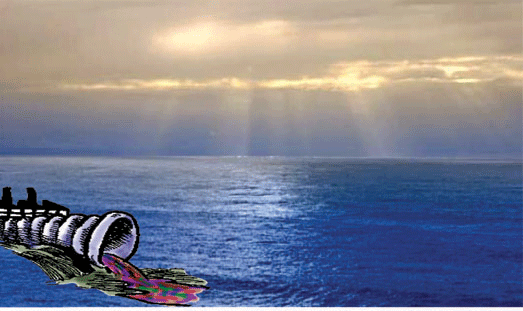
But any discharge of water – irrespective of the level of decontamination carried out – is likely to spark outrage from environmentalists, fishing operators and neighbouring countries. Continue reading
Call for volunteers to assist radiation Baby Tooth Survey
 Volunteers Needed: Baby Tooth Survey to Assess the Effect of Nuclear Fallout From Above-Ground Nuclear Testing http://blog.eogn.com/eastmans_online_genealogy/2013/09/volunteers-needed-baby-tooth-survey-to-assess-the-effect-of-nuclear-fallout-from-above-ground-nuclea.html
A group of genealogy volunteers is needed for a project of unique historical and medical significance. You can help! In the 1960’s thousands of school-age children sent their baby teeth to the Baby Tooth Survey to assess the effect of the nuclear fallout from above-ground nuclear testing. Over the 12-year life of the program, 320,000 teeth were collected. Examination of the teeth revealed higher than normal levels of Strontium 90 (Sr-90), leading to the Partial Test Ban Treaty of August 5, 1963.
- Volunteers in or near Ocean City, New Jersey, can help by scanning the information cards.
- Interested volunteers anywhere else in the world can help by transcribing the scanned images created by the Ocean City volunteers.
You can learn more in the graphic below as well as at http://goo.gl/mveltE. Information about the Radiation and Public Health Project Follow-up may be found at http://www.radiation.org.
Some anxiety over Japan’s Olympic Games bid, as Fukushima crisis contnues
 Tokyo hopes concerns over nuclear leaks won’t hurt image as safe choice to host 2020 Olympics National Post, Jim Armstrong, Associated Press | 13/09/02 TOKYO — Heading into the final days of the contest to host the 2020 Olympics, Tokyo is hoping concern over leaks of highly radioactive water at the crippled Fukushima nuclear power plant won’t damage its image as the safest choice among the bids.
With anti-government demonstrations plaguing Istanbul’s bid and a recession and high unemployment hanging over Madrid’s candidacy, Tokyo is pushing its bid as the safe choice in uncertain times.
The IOC will select the 2020 host on Sept. 7 in Buenos Aires, Argentina. A 300-ton leak of radioactive water was discovered at the Fukushima plant on Aug. 19, the fifth and worst leak since the plant had triple meltdowns after the massive earthquake and tsunami in 2011.
Fukushima is 250 kilometres (155 miles) north of Tokyo and bid officials say the leak won’t affect the city’s plans to host the Olympics, but the incident is an untimely reminder of Tokyo’s vulnerability to natural disasters…..
Tokyo has an existing $4.5 billion fund for Olympic construction and enjoys the support of the national government…… http://sports.nationalpost.com/2013/09/02/tokyo-hopes-concerns-over-nuclear-leaks-wont-hurt-image-as-safe-choice-to-host-2020-olympics/
Gulf Cooperation Council showcases solar energy development
UAE And Saudi Arabia Evolving Into Solar Powerhouses http://www.energymatters.com.au/index.php?main_page=news_article&article_id=3920 3 Sept 13 The United Arab Emirates and Saudi Arabia are leading the way among Gulf Cooperation Council (GCC) states in the deployment of solar power.
Combined, GCC countries have approximately 84 GW of solar farm projects in the pipeline due for completion by 2017; representing investment value of US$155 billion.
“Over the years, solar power has been acknowledged as the most promising source of renewable energy and GCC governments have demonstrated their keenness to shift from traditional energy sources to these low-cost and abundant alternatives,” said Derek Burston, Director of the UK-based Bowmedia, the organisers of Gulf Sol 2013.
“Direct radiation in many Middle Eastern countries exceeds 6 kWh per square metre per day, making for excellent solar potential. In addition, recent decreases in the costs of solar technologies coupled with rising electricity demand in these growing nations, if coupled with the right policies, could make the region a hub for solar expansion”.
Saudi Arabia aims to double its installed electricity capacity; a goal that will be achieved in part by the construction of 54 GW of renewable energy power stations by 2032, 41 GW of which will be solar.
The largest operating solar panel based power generation facility in the GCC region currently is Enviromena’s 10 MW PV plant in Masdar City, Abu Dhabi, UAE. Abu Dhabi has set a goal of generating 7% of its electricity from renewable sources by 2020.
The Gulf Sol 2013 summit will run from September 3 to 5 and aside from showcasing the latest in solar technology, the event will include sessions discussing the feasibility of solar power projects in remote areas, opportunities in the GCC for international companies and regulatory and policy frameworks for implementation of solar projects.
The Gulf Cooperation Council consists of six Middle Eastern countries – Saudi Arabia, Kuwait, the United Arab Emirates, Qatar, Bahrain, and Oman. The alliance was formed in part to strengthen relations among its member countries.
Disaster for uranium industry as uranium glut grows
Japan’s nuclear energy intentions are the swing factor at present. … if Japan does not start turning back on more reactors, Japanese uranium stockpiles will continue to hit the market to pay for increased fossil fuel imports. Nor is it helping at present that the US is also talking about turning off reactors.
Meanwhile, traders and speculators stuck with material and producers suffering cash flow problems are ever more desperate to offload material.
No rush to buy uranium, 9 News Finance by FN Arena 2 Sept 13, The spot market for uranium was never of much interest until the big surge took prices up well over US$100/lb in 2006. In that era, legacy contract obligations at much lower prices impacted on the earnings potential of the large and long-established players, such as Energy Resources of Australia in Australian terms, while new kids on the block, such as Paladin Energy relished the opportunity to secure contracts at more spot-aligned pricing.
Fast forward to the post-Fukushima era of 2013 and the tables have turned. Those noughties contract obligations have largely run off and the uranium price is wallowing in the depths. Continue reading
India, Japan, negotiating purchase of nuclear reactors

 India, Japan to restart nuclear talks today NEW DELHI, DHNS: Sep 3, 2013 India will continue to stonewall pressure from Japan to convert its unilateral moratorium on nuclear tests into a bilateral commitment, even as the two countries are set to restart negotiations on a proposed agreement for cooperation in civilian use of atomic energy on Tuesday.
Over two years after the accident at its Fukushima Daiichi nuclear plant prompted Japan to pause talks with India for a bilateral civil nuclear cooperation agreement, the process is now set to resume. The negotiations, however, are likely to be tough, as New Delhi will resist Tokyo’s pressure to add a clause to the agreement providing for termination of bilateral cooperation in the event of a nuclear test conducted by India.
Sources told Deccan Herald that India would also insist on protecting its right to reprocess the fuel spent on nuclear reactors to be procured under the agreement with Japan.
Two officials of the Ministry of External Affairs—Joint Secretary (East Asia) Gautam Bambawale and Joint Secretary (Disarmament) Bala Venkatesh Varma—are in Tokyo to restart the talks……. http://www.deccanherald.com/content/354971/india-japan-restart-nuclear-talks.html
1 This Month



Tell the Ukrainian Government to Drop Prosecution of Peace Activist Yurii Sheliazhenko

Petition to revoke the licensing of the Near Surface Nuclear Disposal Facility (NSDF) at Chalk River. https://www.ourcommons.ca/petitions/en/Petition/Details?Petition=e-7247


of the week – STOP SMALL MODULAR REACTORS IN CANADA
To see nuclear-related stories in greater depth and intensity – go to https://nuclearinformation.wordpress.com
-
Archives
- March 2026 (222)
- February 2026 (268)
- January 2026 (308)
- December 2025 (358)
- November 2025 (359)
- October 2025 (376)
- September 2025 (258)
- August 2025 (319)
- July 2025 (230)
- June 2025 (348)
- May 2025 (261)
- April 2025 (305)
-
Categories
- 1
- 1 NUCLEAR ISSUES
- business and costs
- climate change
- culture and arts
- ENERGY
- environment
- health
- history
- indigenous issues
- Legal
- marketing of nuclear
- media
- opposition to nuclear
- PERSONAL STORIES
- politics
- politics international
- Religion and ethics
- safety
- secrets,lies and civil liberties
- spinbuster
- technology
- Uranium
- wastes
- weapons and war
- Women
- 2 WORLD
- ACTION
- AFRICA
- Atrocities
- AUSTRALIA
- Christina's notes
- Christina's themes
- culture and arts
- Events
- Fuk 2022
- Fuk 2023
- Fukushima 2017
- Fukushima 2018
- fukushima 2019
- Fukushima 2020
- Fukushima 2021
- general
- global warming
- Humour (God we need it)
- Nuclear
- RARE EARTHS
- Reference
- resources – print
- Resources -audiovicual
- Weekly Newsletter
- World
- World Nuclear
- YouTube
-
RSS
Entries RSS
Comments RSS
 nuclear-news