Russian nuclear assistance on three continents
23 August 2013
http://www.world-nuclear-news.org/NP-Russian_assistance_on_three_continents-2308134.html

Image source ; http://belfercenter.hks.harvard.edu/publication/20062/its_folly_not_to_update_nuclear_arsenal.html 😦
Russia is funding a new technology centre in Vietnam and cooperating with an Argentine university, helping develop the skills needed for nuclear programs in those countries. Meanwhile, Rosatom claims more than 15,000 jobs could be created if South Africa proceeds with its nuclear energy expansion plans.
Russia and Vietnam signed an agreement in November 2011 covering the construction of such a centre in Vietnam. Under the terms of that agreement, the Russian government will provide loans worth $500 million for the centre’s construction.
Feasibility studies and site selection are underway, according to director of the Vietnam Atomic Energy Institute (VinAtom) Tran Chi Thanh. “Work on the project will probably begin in late 2015, under favourable conditions, and we have proposed building it in the Central Highlands city of Da Lat,” he told the Tuoi Tre newspaper. Once operational, the new centre will be used for conducting scientific research and developing technologies to support Vietnam’s planned nuclear power program. A research reactor at the new centre will be used for training programs as well as the production of medical isotopes.
Vietnam’s plans for nuclear power are well advanced. The country’s Atomic Energy Law came into force in 2009 and intergovernmental agreements in place with Russia and Japan allow for the construction of its first two nuclear power plants, both in Ninh Thuan province. Construction work has yet to begin, although the first Russian-designed unit at Ninh Thuan I is pencilled in to begin operation by the end of 2020.
Argentina assistance
A memorandum of cooperation on cooperation in nuclear education has been signed between the University of Buenos Aires and Rusatom Overseas – the subsidiary of Russia’s Rosatom state nuclear corporation concerned with exports of nuclear power plants. Under the agreement, the parties intend to develop cooperation programs, which may include scientific research, the exchange of experts, joint seminars and training manuals. They agreed to set up a working group to develop specific projects.
Russia and Argentina have signed many cooperation agreements in recent years, including one in 2010 which expresses Russian willingness to partner Argentina in designing and building plants in Argentina based on Russian VVER pressurized water reactors. In 2011, the two countries signed a memorandum on cooperation in the peaceful use of atomic energy that recognises Rosatom as a possible supplier for a fourth Argentinian nuclear power plant.
South African localization
Rosatom is ready to help South Africa with its plans to construct six nuclear power reactors, executive vice-president of Rusatom Overseas Boris Arseev announced last week.
Speaking at the annual conference of the Nuclear Industry Association of South Africa (NIASA) in Port Elizabeth, he claimed, “The implementation of the South African nuclear generation development program together with Rosatom would create 15,000 additional jobs in construction, service and operation of the new units, as well as several thousand jobs in related industries.”
Researched and written
by World Nuclear News
Japan Professor: Fukushima crisis is leading to surge in thyroid cancers… First signs of health catastrophe — NHK: Trend seen in new cancer tests is ‘suspicious’ (VIDEO)
Published: August 23rd, 2013 at 8:10 am ET
By ENENews
NHK, Aug. 20, 2013 (Transcript): Health professionals in Northern Japan are suspicious about a trend they’re seeing after the nuclear accident there two years ago. The normal incidence rate is thyroid cancer in children is one in hundreds of thousands […] Health professionals had tested 210,000 children by the end of July. On top of the 18 minors they diagnosed [with thyroid cancer], they suspect 25 others may have the illness. Members of the panel say they can’t determine if the accident has affected the rate of cancer among children. They’ve decided to set up the team experts to look into the situation […]

Le Temps report – Google translation (click to view)
Le Temps (Switzerland); Summarized translation by Worldcrunch, Aug. 21, 2013: The nuclear accident of Fukushima is already leading to a surge in the number of cases of thyroid cancer, according to research being presented this week in Switzerland by Japanese scientist Toshihide Tsuda. […] annual incidence of thyroid cancer among those 18-years-old and younger in the Fukushima area to be 157 per one million, more than 31 times superior to the national average of five per million. [… A] stronger and faster evolution than that after the Chernobyl […] and, Tsuda believes, are only the first signs of a wider health catastrophe. […]
4-month old article in the Mainichi Daily News featuring Toshihide Tsuda, April 22, 2013: Professor Toshihide Tsuda of Okayama University, an expert on pollution investigations, says, “Although we cannot say anything for certain based on numbers from a single round of tests, this is important information for looking into the causal relationships between the spread of radioactive material (iodine-131) and the incidence of thyroid gland cancer. The regular release of information is necessary for keeping tabs on health changes.”
View the latest thyroid data: Twelfth Prefectural Oversight Committee Meeting: Thyroid Ultrasound Examination Results
Watch NHK’s broadcast here
Fukushima – “More thyroid cancer cases come to light” – Bellona
Japan seeks higher crisis scale ratings for highly contaminated water leaks; more thyroid cancer cases come to light

Japan’s nuclear regulator has suggested wants raising the severity level of a radioactive water leak discovered Monday at the tsunami-struck Fukushima-Daiichi plant from one to three on a seven-point international scale, Japanese media have reported.
News that the leak level has reached new heights of urgency dovetails with a new spike in thyroid cancer diagnosis rates among Fukushima youth who were exposed to fallout after the initial catastrophe in March 2011.
Six more young adults who were below the age of 18 when the Fukushima accident occurred were Wednesday diagnosed with the cancer, bringing the total number of confirmed thyroid cases resulting from the disaster to 18, Kyodo New Agency reported.
The new characterization of the leak would reclassify it from an “anomaly” to a “serious incident” on the seven point International Nuclear Event Scale (INES) maintained by the International Atomic Energy Agency (IAEA).
Plant operator Tokyo Electric Power Co. (Tepco) said about 300 tons (some 300,000 liters) of contaminated water has leaked from one of hundreds of 1,000-ton cylindrical steel tanks around the decimated plant, much of which has apparently seeped into the ground, Asashi Shimbun reported.
The utility is also checking for leaks at other tanks holding contaminated water at the site.
Bellona General Director and nuclear physicist Nils Bøhmer question whether Japanese authorities shouldn’t consider moving the classification of the accident to a Level 4, which would characterize it as “an accident with local consequences.”
“That highly radioactive water is presumably seeping into the ground would imply that this is somewhat more serious that the Level 3 Japanese officials are suggesting,” said Bøhmer. “Fukushima is the never-ending story and it is just getting worse and worse.”
Tepco officials said they presume the leaky tank is located somewhere west of Fukushima-Daiichi’s reactor No 4. Part of the water remains pooled within a concrete barrier surrounding a group of 26 tanks, said the paper.
Some one thousand tanks have been built to contain the water from the three melted down reactors, as well as underground water that is contaminated when it runs into reactor and turbine basements.
However, 350 of these tanks, holding 300,000 tonnes of water, are less durable than others, with rubber seams. Japanese officials say they have no choice but to keep building tanks to contain the contaminated water.
Tanks sloshing with highly radioactive water in ad-hoc containment system
The water in the tanks has a concentration of 80 million becquerels per liter, which translates into 24 trillion becquerels for 300 tons, Asashi Shimbun reported The water contains cesium, strontium, tritium and other radioactive materials, although cesium concentrations have been reduced through treatment.
Jerry-built coolant systems continue to keep the reactors and spent fuel ponds cool, but the consequence has been that enormous volumes of contaminated water have to be stored onsite at the destroyed nuclear power plant.
Tepco said that because the leaking tank is assumed to be about 100 meters from the coastline, the leak does not pose an immediate threat to the sea.
But Hideka Morimoto, an NRA spokesman, stomped on that report from Tepco, telling the Associated Press that contaminated water could reach the sea via a drain gutter.
The incidents have shaken confidence in the reliability of the tanks.
Tank leaks nothing new
Four other tanks of the same design have had similar leaks since last year. Earlier this month, it was reported that 300 tons of low-level contaminated water a day were escaping the territory of the plant and sullying the waters of the Pacific.
The most recent water incidents are viewed as the most serious since the initial explosion and meltdown.
A puddle of the contaminated water was emitting 100 millisieverts an hour of radiation, Kyodo news agency said earlier this week.
Masayuki Ono, general manager of Tepco, told Reuters news agency: “One hundred millisieverts per hour is equivalent to the limit for accumulated exposure over five years for nuclear workers; so it can be said that we found a radiation level strong enough to give someone a five-year dose of radiation within one hour.”
High radioactivity levels slow work
This severely complicates measures to stem the leak: The water is so radioactive that teams working to stem the flow must constantly be rotated because of the high exposure rates, and it is clear that most of the contaminated water has already been absorbed into the ground.
“We are extremely concerned,” Morimoto told reporters Wednesday. He urged Tepco to quickly determine the cause of the leak and its possible effect on water management plans.
Tepco spokesman Masayuki Ono told AP that workers were pumping out the puddle and the remaining water and will transfer it to other containers in a desperate effort to prevent it from escaping into the sea ahead of heavy rain predicted later in the day around Fukushima.
By Tuesday afternoon they had captured only about 4 tons (4,000 liters), Ono said.
Third revision in INES scale suggested
Japanese officials first suggested the most recent tank leak be classified as a level one incident on the INES scale. Suggestions by Japan’s newly constituted Nuclear Regulatory Authority (NRA) represent the third time incidents surrounding the Fukushima disaster, which began on March 11, 2011, have been upwardly revised on the INES scale.
The Fukushima incident was initially reported as a Level 5 “accident with wider consequences” on INES – by Japanese authorities immediately following the triple meltdown and reactor building explosions triggered by a total loss of primary and back up cooling systems after an 11-meter tsunami hit the plant.
Within days, that figure was upwardly revised by Japan to a Level 7 “major accident” – the first Level 7 since Chernobyl.
Japanese media has reported the upward revision of Monday’s radioactive water leak is a provisional measure that must be confirmed by the IAEA – just as the initial accident classifications were.
The move to classify the leak was announced in a document posted only in Japanese on the NRA’s website on Monday, the BBC reported. The move to reclassify the leak was subsequently approved at a Wednesday meeting of the regulators.
The Chinese Foreign Ministry said in a statement that it “hopes that the Japanese side can earnestly take effective steps to put an end to the negative impact of the after-effects of the Fukushima nuclear accident.”
Radioactive water crisis out of control at Fukushima
Japan’s leaky nuclear plant, No end in sight The Fukushima nightmare lingers http://www.economist.com/news/asia/21584054-fukushima-nightmare-lingers-no-end-sight Aug 24th 2013 | TOKYO THE agonising efforts to clean up the crippled Fukushima Dai-ichi nuclear power plant hit new obstacles this week. On August 21st the Nuclear Regulation Authority (NRA) said that leaks of radioactive water were a level three, or “serious”, incident on a scale that goes up to seven. Some help from American experts aside, Japan has been dealing with the disaster itself. Now, even Tokyo Electric Power (TEPCO), the plant’s owner, would welcome foreign help.
TEPCO is under intense fire at home. It “has no sense of crisis at all”, grumbled Shunichi Tanaka, chairman of the NRA, as the leaks worsened. Another NRA commissioner questioned whether TEPCO’s data could even be trusted. After months of denial, the firm has only just admitted that contaminated water is leaking into the Pacific. China and South Korea have both expressed concern.
The plant’s melted reactor cores are tainting both the hundreds of tonnes of water pumped into them each day and the groundwater, producing vast quantities of radioactive liquid. After underground pools leaked, TEPCO has hastily built around 1,000 surface storage tanks. Several are leaking from joints sealed with plastic. The most recent leak, of 300 tonnes, prompted the NRA alert. Experts say many more tanks are at risk.
A shortage of cash may have heightened the crisis. TEPCO faces massive bills for replacement fuels and compensating evacuees. It failed to install even the most basic system to monitor water leaks. Its workers stand on tanks and memorise water levels. The NRA this week ordered TEPCO to install water gauges at once. “What’s needed is tanks with stainless-steel seals, but that would take time and money,” says Neil Hyatt, professor of radioactive-waste management at the University of Sheffield.
America could get to 75% renewable energy quite quickly

Billions of solar panels and millions of wind turbines
The good news is we are already getting these.
With An ‘All-Out’ Federal Renewable Energy Strategy, How Long Before We Could Be 100% Renewably Powered?, Forbes, Mark Rogowsky, Internet Entrepeneur, 22 Aug 13, Probably 20-30 years to get to 70-80%, but 80 years to get the last 20-30%.
Let’s clarify that the assumption here is that the United States actually decides to do this per the hypothetical. That means that for whatever reason, the politics has shifted massively from where it currently stands. There are a lot of roadblocks to 100% renewable energy, but relatively few toward mostly renewable energy — assuming you’ve solved the politics problem. Here’s what you need:
An integrated long-distance grid
You’ll be carrying a lot of wind from the Midwest, possibly from offshore in the East, and tons of solar from the Southwest long distances. So you’re going to want much better long-distance power lines, maybe even with superconducting trunks. This will let you use Arizona’s 5 pm sun to power Florida’s air conditioners at 8 pm. Is this trivial? No. Is it technologically impossible? Absolutely not.
Millions of electric cars
We use a lot of non-renewable fuel for transportation. We’re going to need electric vehicles to fix that. Continue reading
Huge and growing area of tanks storing Fukushima’s radioactive water

 Radioactive Leaks in Japan Prompt Call for Overseas Help, Bloomberg, By Yuji Okada, Jacob Adelman & Peter Langan – Aug 21, 2013
“……..Toxic Sludge. Tepco was storing 330,000 tons of radioactive water as of Aug. 13 in tanks covering an area equal to 37 football fields, according to the company. The utility is clearing forest to make room for more tanks as it adds to the stored water at a rate of 400 tons a day after pumping it out from under the plant’s reactors, which melted down as a result of the March 2011 earthquake and tsunami.
The water is treated to remove some of the cesium particles before it is stored, which has left 480 filters clogged with the radioactive material at the site. Each weigh 15 tons and are warehoused in what the utility calls temporary storage, though it will take hundreds of years for the radiation to decay. Other radioactive contaminants remain in the water even after treatment. That includes strontium, which has been linked to bone cancers.
Besides radiated water, the site north of Tokyo has more than 73,000 cubic meters of contaminated concrete, 58,000 cubic meters of irradiated trees and undergrowth, and 157,710 gallons of toxic sludge, according to the utility.
’Biggest Concern’
Japan’s nuclear watchdog has ratcheted up alarm over the potential for more leaks of highly radioactive water from the hundreds of storage tanks at the Fukushima atomic plant.
The possibility of leaks from other tanks “is the biggest concern,” said Nuclear Regulation Authority Chairman Shunichi Tanaka at a press conference yesterday. “This will need to be handled carefully on the assumption that one incident could bring another.”
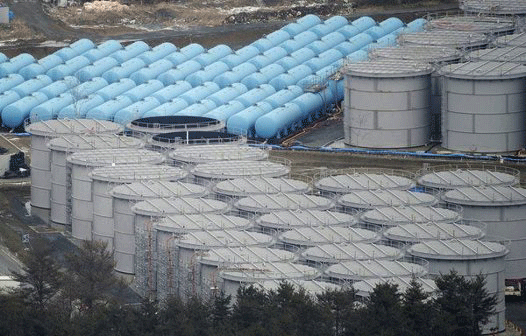
Late last night, Tepco said water leaking from the storage tank probably ran into the ocean, citing high radiation readings in a drainage ditch.
As much as 20 trillion becquerels of cesium and 10 trillion becquerels of strontium leaked into the ocean since May 2011, Tepco spokeswoman Mayumi Yoshida said today. The total amount of cesium and strontium is equivalent to about 100 times the annual limit on radiation from the plant to the ocean under normal conditions, according to calculations based on Tepco data……….
Leaking Tanks
Japan’s government has ordered an investigation into the safety of hundreds of other tanks storing contaminated water in Fukushima, the site of the world’s worst civilian nuclear disaster since the Chernobyl reactor exploded in 1986.
There are 226 tanks of similar bolted design to the leaking unit with the same 1,000-ton capacity at the site, said Tatsuya Shinkawa, director of the nuclear accident response office in the government’s Agency for Natural Resources and Energy, which called for the probe…… http://www.bloomberg.com/news/2013-08-21/tepco-shares-plunge-on-report-of-serious-radiated-water-leak.html
Solar energy shiningin Japan, amidst its nuclear nightmare
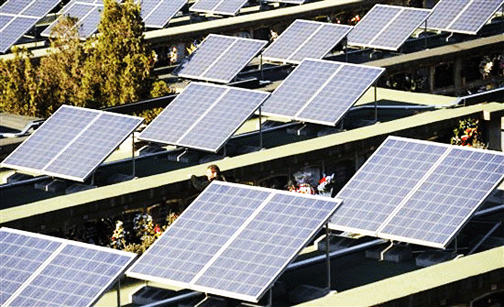 Japan Adds 2+ Gigawatts Of Solar PV by Energy Matters, 22 Aug 13, Japan’s love affair with solar blossoms while a massive radioactive contamination threat still looms large.
Renewable energy facilities that commenced operations during Japan’s 2012 fiscal year (1 April 2012 to March 31 2013) totaled 2.08 gigawatts capacity, equivalent to two nuclear reactors, said the nation’s Economy, Trade and Industry Ministry.
Of the 2.08 gigawatts, 1.98 gigawatts was contributed by residential, commercial and utility scale solar PV.
The Ministry describes Japan’s shift towards a renewable future as “smooth”, with an additional 1.28 gigawatts of renewables added to the nation’s energy infrastructure in April and May this year.
All told, the amount of renewable capacity approved between July 2012 and March this year was 21.09 gigawatts, meaning far more is yet to be built.
While solar is enjoying smooth sailing, the country’s nuclear industry is experiencing anything but; with crisis after crisis occurring at the crippled Fukushima nuclear power station…… http://www.energymatters.com.au/index.php?main_page=news_article&article_id=3905
The race to lead the world in renewable energy
A Bright Future for Renewable Energy HUFFINGTON POST,Phyllis Cuttino Director, Clean Energy, The Pew Charitable Trusts 23 Aug 13 After several decades in laboratories and niche applications, clean energy technologies are primed for accelerated and widespread expansion in the global power sector. In the United States and around the world, solar, wind, and other renewable energy sources will represent a significant share of the new generating capacity deployed in the coming years and decades. These technologies will also be in demand as the world addresses persistent and emerging local and global environmental challenges and because clean energy will be sought after in the push to achieve greater energy security.
For all these reasons, the future of clean energy is bright. Less certain is the forecast for the United States’ competitive position in this fast-growing sector. On a variety of key measures–from innovation and manufacturing to deployment and exports–the United States is struggling to maintain its lead in the global economic and technological race……..http://www.huffingtonpost.com/phyllis-cuttino/a-bright-future-for-renew_b_3795222.html
Latest market resource: Europe Renewable Energy Policy Handbook 2013
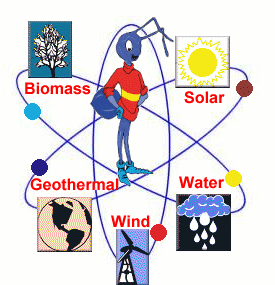
 Europe Renewable Energy Policy Handbook 2013 Market Watch NEW YORK, Aug. 22, 2013 /PRNewswire via COMTEX/ — Reportlinker.com announces that a new market research report is available in its catalogue:
Europe Renewable Energy Policy Handbook 2013http://www.reportlinker.com/p0254459/Europe-Renewable-Energy-Policy-Handbook-2013.html#utm_source=prnewswire&utm_medium=pr&utm_campaign=Renewable_energy
Europe Renewable Energy Policy Handbook 2013
Summary
“Europe Renewable Energy Policy Handbook 2013” is the latest policy report from GlobalData, the industry analysis specialists that offer comprehensive information on major policies governing renewable energy market in the region. The report presents an in-depth analysis of the renewable energy policies across the major countries in Europe namely Germany, France, Italy, the UK, Spain, Austria, the Netherlands, Norway, Poland, Sweden and Turkey.
The report provides the current and future renewable energy targets and plans along with the present policy framework, giving a fair idea of overall growth potential of their renewable energy industry. The report also provides major technology specific policies and incentives provided in each of these countries.
The report also provides insights to major policy initiatives for the market development of renewable energy sources such as wind, solar, geothermal, biopower and biofuels A comparative snapshot of major policy instruments in these countries to support the renewable energy industry has also been provided. Information related to energy efficiency schemes in these countries has also ben provided.
The report is built using data and information sourced from industry associations, government websites and statutory bodies. The information is also sourced through other secondary research sources such as industry and trade magazines…..To order this report:Renewable_energy Industry: Europe Renewable Energy Policy Handbook 2013
__________________________Contact Clare: clare@reportlinker.comUS:(339) 368 6001Intl:+1 339 368 6001
SOURCE Reportlinker. http://www.marketwatch.com/story/europe-renewable-energy-policy-handbook-2013-2013-08-22
Breakthrough in solar energy storage battery
 No Mem-Brainer Flow Battery Delivers Big http://www.energymatters.com.au/index.php?main_page=news_article&article_id=3904 23 Aug 13, A palm-sized experimental flow battery developed by Massachusetts Institute of Technology researchers has the potential to solve intermittency challenges in utility-scale renewable energy systems.
The MIT team has engineered a prototype flow battery storage system without the expensive membrane usually required. Continue reading
Japan getting desperate about Fukusima leaks, at last asking for overseas help
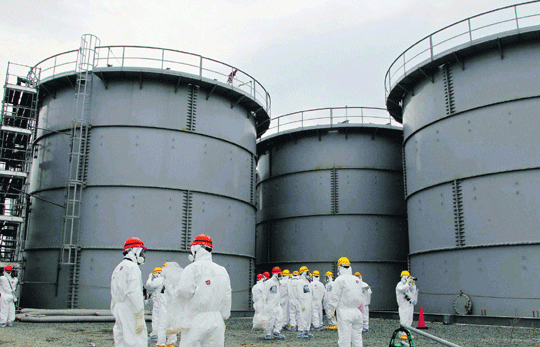 Radioactive Leaks in Japan Prompt Call for Overseas Help, Bloomberg, By Yuji Okada, Jacob Adelman & Peter Langan – Aug 21, 2013 The crippled nuclear plant at Fukushima is losing its two-year battle to contain radioactive water leaks and its owner emphasized for the first time it needs overseas expertise to help contain the disaster.
Tokyo Electric Power Co. (9501) is grappling with the worst spill of contaminated water since the March 2011 earthquake and tsunami caused a meltdown at the Fukushima Dai-Ichi plant. The call for help from Zengo Aizawa, a vice president at the utility, follows a leak of 300 metric tons of irradiated water. Japan’s nuclear regulator labeled the incident “serious” and questioned Tepco’s ability to deal with the crisis. Prime Minister Shinzo Abe made similar comments earlier this month.
“We will revamp contaminated-water management to tackle the issue at the Fukushima Dai-Ichi plant and seek expertise from within and outside of the country,” Aizawa said at a press conference last night in Tokyo. “There is much experience in decommissioning reactors outside of Japan. We need that knowledge and support.”
The International Atomic Energy Agency in Vienna and the U.S. Nuclear Regulatory Commission said they are prepared to help.http://www.bloomberg.com/news/2013-08-21/tepco-shares-plunge-on-report-of-serious-radiated-water-leak.html
Nuclear deterrence – a dangerous myth

 Nuclear deterrence is overrated, THE HINDU RAMESH THAKUR , 23 Aug 13 The real risks and costs of having these weapons, both monetary and human, far outweigh their security benefits The Indian Navy has figured in three recent, global news items. The launch of the indigenously developed aircraft carrier, INS Vikrant, expected to be operational by 2018, makes India only the fifth country after the United States, Russia, the United Kingdom and France to have such capability. …. The strategic rationale is to acquire and consolidate the three legs of land, air and sea-based nuclear weapons to underpin the policy of nuclear deterrence. Unfortunately, however, the whole concept of nuclear deterrence is deeply flawed.
Desensitised
Nuclear weapons are uniquely destructive and hence uniquely threatening to our common security. There is a compelling need to challenge and overcome the reigning complacency on the nuclear risks and dangers, to sensitise policy communities to the urgency and gravity of nuclear threats and the availability of non-nuclear alternatives as anchors of national and international security.
A nuclear catastrophe could destroy us any time. Because we have learnt to live with nuclear weapons for 68 years, we have become desensitised to the gravity and immediacy of the threat. The tyranny of complacency could yet exact a fearful price if we sleepwalk our way into a nuclear Armageddon. It really is long past time to lift the shroud of the mushroom cloud from the international body politic. Continue reading
Another uranium mining company gets the financial jitters
 Bannerman waits for uranium price to turn around, The Northern Miner, 2013-08-21
A recently reported leak at the Fukushima nuclear plant in Japan has reawakened concerns over the development of new nuclear reactors in the country, with most experts agreeing that the current build-up would likely be put on hold until the situation is resolved.
The news is the latest reason being offered for why uranium prices continue to remain at low levels, but whatever the reason may be, the consequences are real for Bannerman Resources (TSX: BAN)…….
With the spot price for U3O8 still a ways off from the breakeven point outlined in its feasibility study on its flagship Etango project, Bannerman recently pushed back expected first production date for the project by two years. The mine was originally set to enter production in 2016 but now will have to wait until 2018…….
Challenge to renewal of uranium exploration license in Slovakia
European Uranium’s Kuriskova License Renewal Challenged Daily Finance, by Business Wire via The Motley Fool Aug 22nd 2013 VANCOUVER, British Columbia – European Uranium Resources Ltd. (TSX-V:EUU) (OTCQX:EUUNF) (FWB:TGPN) reports that following an appeal from anti-uranium mining activists in Slovakia, the General Prosecutor of Slovakia has challenged the renewal of the exploration license on which the Kuriskova uranium deposit is located (the “Kuriskova Licence”). The Kuriskova License was renewed by the Geology Division of the Ministry of Environment (the “Ministry”) until April 19, 2015. The Ministry originally refused to consider the appeal but has now agreed to review its decision to renew the licence.
The issue being reviewed is whether the renewal was simply a renewal of the existing Kuriskova License, which can be done by the Ministry without public comment, or whether it was a modified or new license, in which case renewal would require input and approval from local municipalities and the Regional Government as stakeholders….. http://www.dailyfinance.com/2013/08/22/european-uraniums-kuriskova-license-renewal-challe/
Low level nuclear alert issued at Hanford
Hanford issues low-level nuclear alert http://q13fox.com/2013/08/22/hanford-issues-low-level-nuclear-alert/#ixzz2cp68IuEI BENTON COUNTY, Wash. — An alert was issued late Wednesday night at the Hanford Nuclear Site in southeast Washington for the lowest level emergency following the detection of radiation on Hanford’s grounds.
The low-level emergency was issued at 10:32 a.m. when higher than expected levels of radiation were found on a routine test of the C Tank Farm, indicating the “potential of a waste transfer leak.” All operations were halted, and personnel were evacuated from the C Tank Farm area. Other affected facility personnel were instructed to take cover, or shelter in place.
Benton and Franklin Counties’ Emergency Operations Centers were activated shortly after the first reading, but the emergency alert was relegated to Hanford’s grounds. Additional radiological tests found no detectable levels of contamination, and the alert-level emergency was lifted at 5:05 a.m. Higher than expected levels of radiation were confirmed, but there was no indication of a leak or spill, and the levels were less than originally discovered, officials with Hanford said. Workers were instructed to report to the site as normal. C Tank Farm prepared to return to normal operations.
Built by early Hanford scientists, engineers, and constructors, single-shell and double-shell storage tanks were constructed throughout Hanford’s 200 Area to store the radioactive liquid wastes generated from the processing facilities on site.
1 This Month
Chernobyl: The Lost Tapes – A good documentary on Chernobyl on SBS available On Demand for the next 3 weeks– https://www.sbs.com.au/ondemand/tv-program/chernobyl-the-lost-tapes/2352741955560

of the week–London Campaign for Nuclear Disarmament

Tell the Ukrainian Government to Drop Prosecution of Peace Activist Yurii Sheliazhenko
To see nuclear-related stories in greater depth and intensity – go to https://nuclearinformation.wordpress.com
-
Archives
- April 2026 (152)
- March 2026 (251)
- February 2026 (268)
- January 2026 (308)
- December 2025 (358)
- November 2025 (359)
- October 2025 (376)
- September 2025 (257)
- August 2025 (319)
- July 2025 (230)
- June 2025 (348)
- May 2025 (261)
-
Categories
- 1
- 1 NUCLEAR ISSUES
- business and costs
- climate change
- culture and arts
- ENERGY
- environment
- health
- history
- indigenous issues
- Legal
- marketing of nuclear
- media
- opposition to nuclear
- PERSONAL STORIES
- politics
- politics international
- Religion and ethics
- safety
- secrets,lies and civil liberties
- spinbuster
- technology
- Uranium
- wastes
- weapons and war
- Women
- 2 WORLD
- ACTION
- AFRICA
- Atrocities
- AUSTRALIA
- Christina's notes
- Christina's themes
- culture and arts
- Events
- Fuk 2022
- Fuk 2023
- Fukushima 2017
- Fukushima 2018
- fukushima 2019
- Fukushima 2020
- Fukushima 2021
- general
- global warming
- Humour (God we need it)
- Nuclear
- RARE EARTHS
- Reference
- resources – print
- Resources -audiovicual
- Weekly Newsletter
- World
- World Nuclear
- YouTube
-
RSS
Entries RSS
Comments RSS
 nuclear-news