Gloomy future for nuclear energy in South Carolina
 Doubts dampen S.C.’s nuclear future The State, South Carolina, August 19, 2013 By RODDIE BURRIS — rburris@thestate.com The hallmark of the future of nuclear power right now is uncertainty.
Utilities largely have backed off any rush to forge ahead in constructing the next generation of expensive, new nuclear reactor plants — even though they seemed plausible just a few years ago. Continue reading
2 workers sue Department of Energy over radiation exposure

 Radiation-exposed workers demand release of nuke plant accident video http://rt.com/usa/radiation-exposed-workers-suit-687/ August 19, 2013 Two workers have filed a lawsuit against the Department of Energy for failing to comply with the Freedom of Information Act by refusing to hand over a video of an incident in which 16 men, including the two plaintiffs, were exposed to radiation.
Brian Simmons and Ralph Stanton, two operators from the Idaho National Laboratory (INL) in Boise, are trying to force the agency to release the video through a lawsuit filed in federal court. Continue reading
Fukushima – a clean -up for all eternity?
http://rt.com/op-edge/tepco-fukushima-sea-water-reactor-194/
Japan buying lots of solar panels

 REC Supplies 15,000+ Panels To Japanese Solar Farms, by Energy Matters. 20 Aug 13, REC is continuing to make its presence felt in Japan, with 2 new solar farms using REC Peak Energy Series solar panels.
The 2.5 MW Toyobo Mie (Kusu) C-Energy plant; located in Yokkaichi, Mie Prefecture, started operation last month and is expected to generate 2.5 million kWh of electricity annually.
The second REC-based installation is a ground-mounted 1.3 MW array situated at the Research Institute in Ohtsu City, Shiga Prefecture. Construction of that facility began last month and will be completed in December.
Japan is becoming a lucrative market for REC, with 29 percent of REC’s solar panel shipments heading to the nation in the second quarter of 2013….. http://www.energymatters.com.au/index.php?main_page=news_article&article_id=3897
USA’s Nuclear Regulatory Commission allows nuclear plant to run after its license expires
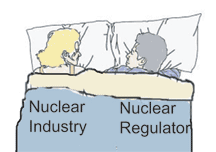 Indian Point nuclear plant can operate after license expires in September, regulators say,http://www.dailyfreeman.com/articles/2013/08/19/news/doc5212d0d93b28c839747942.txt August 19, 2013 WHITE PLAINS, N.Y. (AP) — Federal regulators have ruled, as expected, that a nuclear power reactor in the New York City suburbs can keep running after its license expires next month.
The Nuclear Regulatory Commission said Monday that Indian Point 2 in Buchanan can operate while its license renewal application is being reviewed.
That could be more than a year, given the controversy involved. New York state and environmental groups are opposing a new 20-year license.
NRC regulations allow continued operation if a plant applies for a new license five years before expiration. Indian Point’s owners applied in 2007.
Plants also must show they’ve taken any steps necessary to assure safe operation during the review.
The plant is 35 miles from Manhattan. Another reactor there, Indian Point 3, has a license that expires in 2015.
Czech Republic’s new anti renewable energy law
Activists criticise law on renewable energy, industry hails it, Prague Daily Monitor Prague, Aug 16 (CTK) – Environmentalist groups and solar industry associations in the Czech Republic have expressed criticism of the amended law on renewable sources, approved by the Chamber of Deputies Friday, but representatives of industrial companies have welcomed the bill.
Environmentalists say the law will end support to environmentally friendly production of electricity while maintaining subsidies to burning coal, gas and waste.
In contrast, representatives of industrial companies focusing on energy-intensive production welcome the bill, saying it will help to maintain competitiveness of Czech businesses.
“The law brings no end to subsidised electricity. It only ends support to projects of pure renewable energy for municipalities and households, while it continues to subsidise large companies which operate waste incinerators and coal-fired power plants,” Jiri Kozelouh of environmentalist movement Hnuti Duha (Friends of the Earth) said.
“If the law is approved by the Senate too, it will give more power to fossil fuel barons who get billions of crowns from the sale of gas, oil and coal whose prices continue to rise. The law will secure further state subsidies for them, but will complicate the possibility to abandon fossil fuels for families and municipalities,” Kozelouh added.
The Alliance for Energy Self-Sufficiency and Czech Photovoltaic Industrial Association (CZEPHO) said in a joint statement that the law aimed to boost the start of production of clean energy will paradoxically turn into a subsidy mechanism for coal and gas burning and for the construction of waste incinerators because of the gradual drop in support to new renewable sources…… http://praguemonitor.com/2013/08/19/activists-criticise-law-renewable-energy-industry-hails-it
250 tonnes of documents about UK’s Dounreay nuclear reactor
Dounreay documents set for nuclear archive The Scotsman, 20 Aug 13, A STAGGERING 250 tonnes of historic documents, charting the development of Britain’s first fast-breeder nuclear reactor at Dounreay, will be among the first items to be stored in the new National Nuclear Archive to be built in Caithness, it was revealed today.
The £20 million national archive centre for the nuclear industry is to be built close to Wick Airport, near the Dounreay experimental power complex, and will eventually house an estimated 30 million digital, paper and photographic records from civil nuclear sites throughout the UK, dating back to the 1940s.
The archive will include records from the UK Atomic Energy Authority in Harwell where the Atomic Energy Research Establishment, the UK centre for research and development into civil nuclear power, was first based.
A spokesman for the Nuclear Decommissioning Authority (NDA) said that the new archive building would be open for business by 2016, just in time for the majority of the documents in the Dounreay archive to be moved offsite, before the existing archive building is vacated.
Ian Pearson, the Dounreay archivist, explained that the site’s archive currently held 250 tonnes of records which if laid out would stretch nearly two-and-a-half miles. Some of these date back to the early days on construction and operation of Dounreay……. http://www.scotsman.com/lifestyle/heritage/dounreay-documents-set-for-nuclear-archive-1-3052390
Reliable and cheap renewable energy storage
Rechargeable flow batteries could be cheaper solution to renewable energy storage http://www.treehugger.com/clean-technology/rechargeable-flow-batteries-could-be-cheaper-solution-renewable-energy-storage.html Megan Treacy August 19, 2013 Researchers at MIT have developed a battery that could bring us reliable and cheap large scale energy storage. Based on flow battery technology, the researchers took out the costly membrane and created a battery that has a power density that is an order of magnitude higher than lithium-ion batteries and three times greater than other membrane-less systems.
MIT reports, “The device stores and releases energy in a device that relies on a phenomenon called laminar flow: Two liquids are pumped through a channel, undergoing electrochemical reactions between two electrodes to store or release energy. Under the right conditions, the solutions stream through in parallel, with very little mixing. The flow naturally separates the liquids, without requiring a costly membrane.”
The reactants used are liquid bromine and hydrogen fuel, which is cheap, but also has had issues with breaking down the membrane in other flow batteries. By taking out the membrane they were able to speed up energy storage and extend the life of the battery.
“Here, we have a system where performance is just as good as previous systems, and now we don’t have to worry about issues of the membrane,” says Martin Bazant, a professor of chemical engineering. “This is something that can be a quantum leap in energy-storage technology.”
As we bring more renewable technologies like wind and solar into the grid, affordable and reliable energy storage is increasingly important. While solar and wind energy output varies based on weather conditions, large scale energy storage systems can smooth out the power delivery from those technologies by storing any excess energy when it’s produced and using it when the output is lower or demand is higher.
“Energy storage is the key enabling technology for renewables,” says Cullen Buie, an assistant professor of mechanical engineering. “Until you can make [energy storage] reliable and affordable, it doesn’t matter how cheap and efficient you can make wind and solar, because our grid can’t handle the intermittency of those renewable technologies.”
MIT says, “Braff built a prototype of a flow battery with a small channel between two electrodes. Through the channel, the group pumped liquid bromine over a graphite cathode and hydrobromic acid under a porous anode. At the same time, the researchers flowed hydrogen gas across the anode. The resulting reactions between hydrogen and bromine produced energy in the form of free electrons that can be discharged or released.
The researchers were also able to reverse the chemical reaction within the channel to capture electrons and store energy — a first for any membraneless design.”
Now that the team’s experiments have lined up with their computer models, they’re focused on scaling up the technology and seeing how it performs. They predict that the technology will be able to produce energy costing as little as $100/kWh, which would make it the cheapest large scale energy storage system built yet.
Renewable energy creates many more jobs than there are in fossil fuel energy
Debunking the Renewables “Disinformation Campaign”, Mother Earth News, Despite vast evidence supporting the advancement of renewable energy, various media outlets insist on denying its progress, blurring the lines between inefficient reporting and deliberate lying. By Rocky Mountain Institute August 19, 2013 “……..a recent study commissioned by Germany’s Federal Environment Ministry found that the renewable energy sector provided around 382,000 jobs in 2011, up four percent in a year, and more than doubled in seven years. More jobs have been created than lost in Germany’s energy sector—plus any jobs gained as heavy industry moves to Germany for its competitive electricity.

Yet a myth persists that countries lose more jobs then they gain when they transition to renewables. This upside-down fantasy rests largely on a 2009 study from King Juan Carlos University in Spain, by an economist reportedly tied to ExxonMobil, the Heartland Institute, and the Koch brothers. His study asserted that, on average, every renewable energy job in Spain destroys 2.2 jobs in the broader Spanish economy. This story was picked up by news media around the world and is still promoted by U.S. anti-renewables groups. But its methodology and assumptions were promptly demolished by the National Renewable Energy Laboratory and the Spanish government, among others. A 2012 report for the International Labour Organization (ILO) even cites Spain, which built a renewable export industry, as a counterexample: “The green economy presents a good opportunity to increase competitiveness, promote the creation of quality employment and reduce the economy’s environmental impact,” says Joaquín Nieto, who heads the ILO Office in Madrid, especially “when Spain needs to kick-start its economy.” Sure enough, despite new electricity taxes and a halt to subsidies for new renewable projects, Spain’s latest solar projects continue to be built to compete without subsidy.
The disinformation campaign about job creation is not limited to Europe. A Cato Institute article claimed that if people believe a commitment to renewables will fuel job growth “we’re in a lot of trouble.” Yet in 2012 alone, more than 110,000 new U.S. clean-energy direct jobs were created, and in 2010, the U.S. had more jobs in the “clean economy” than in the fossil-fuel industries. The Bureau of Labor Statistics reports that direct employment in May 2012 totaled 181,580 for oil and gas extraction, 87,520 for coal mining, and 93,200 for iron and steel production. BLS doesn’t similarly classify solar or wind jobs, but reputable analysts have determined from bottom-up industry surveys that in September 2012, for example, the U.S. had 119,016 direct solar jobs (89 percent full-time, the rest at least half-time), up 27 percent in two years—more than in steel-making or coal-mining. Had you heard that before? Why not? …….. http://www.motherearthnews.com/renewable-energy/debunking-the-renewables-disinformation-campaign-zm0z1308zsal.aspx#axzz2cYi1w7VS
US doctors owning radiation facilities: conflict of interest
Gov’t report: Doctors with financial interests order more radiation Doctors who invest in radiation treatments and centers are more likely to prescribe it to their prostate cancer patients, a government report finds. CBS NEWS/ MICHELLE CASTILLO / August 19, 2013,
The U.S. Government Accountability Office said that most Medicare patients with prostate cancer who went to doctors with a vested interest were not made privy to the fact that there were alternative options to radiation therapy. Many of these other treatments were less expensive and may have been just as effective.
“We are extremely concerned that many older male patients are receiving such vigorous, possibly unnecessary treatment by urology groups,” Dr. Michael L. Steinberg, the chairman of the American Society for Radiation Oncology, said in astatement. “Clearly, these self-referring urology groups are steering patients to the most lucrative treatment they offer, depriving them of their full range of treatment choices, including potentially no treatment at all.”
Doctors who had a monetary stake in radiation treatment included those who invested in a treatment center or doctors who owned radiation therapy equipment that they shared with others in a medical group.
Between 2006 and 2010 the number of intensity-modulated radiation therapy (IMRT) procedures billed by self-referring medical organizations rose from 80,000 to 366,000 — an increase of 456 percent. IMRT involves using radiation beams to reshape a tumor in order to avoid touching healthy areas and to limit side effects, the Mayo Clinic explained. In contrast, the number of IMRT procedures billed by non-self-referring medical professionals went down 5 percent in the same time period.
IMRT spending by doctors who referred patients to their own centers or used their own equipment went up $138 million, compared to non-self-referral groups which just increased their spending by $91 million.
Urologists who were financially involved in radiation treatments advised 38 percent of their patients in 2007 to undergo the treatments. By 2008 to 2009, that number was as high as 54 percent.
In 2009, doctors with a vested interest were more 53 percent more likely to refer their patients to undergo radiation compared to other procedures like radical prostatectomy (removal of the prostate) or brachytherapy (radiotherapy where radiation is placed inside or next to the treatment area). Brachytherapy typically causes fewer side effects and has shorter overall treatment time compared to IMRT because it allows doctors to deliver more specific, higher doses of radiation to affected areas, the Mayo Clinic pointed out…….
“Unfortunately, when you look at the numbers in this report, you start to wonder where health care stops and where profiteering begins,” said Senate Finance Committee Chairman Max Baucus, D-Mont., in a statement. “Enough is enough. Congress needs to close this loophole and fix the problem.”……http://www.cbsnews.com/8301-204_162-57599131/govt-report-doctors-with-financial-interests-order-more-radiation/
Europe to develop cross-border electrical grids, as renewable eneergy grows
Demand for renewable energy will drive Europe transmission market 08/08/2013 By Editors of Electric Light & Power/ POWERGRID International
Key European countries, including Germany, France, U.K., Norway, Italy, Ireland and France, will spend substantial sums on grid expansion and upgrade programs in order increase security of electricity supply, deploy smart gridtechnology and accommodate new sources of power generation — particularly renewable energy……..
“Europe is expected to invest heavily in the establishment of transmission infrastructure as it strives to create cross-border grid interconnections and harness the energy generated from renewable sources around the continent,” http://www.elp.com/articles/2013/8/demand-for-renewable-energy-will-drive-europe-transmission-market0.html
Toxic puddles at Fukushima nuclear plant: report
Read more at: http://phys.org/news/2013-08-toxic-puddles-fukushima-nuclear.html#jCp
19 August 2013
Puddles with extremely high radiation levels have been found near water storage tanks at the crippled Fukushima nuclear plant, Japan’s atomic regulator and operator said Monday, according to a report.
The radiation level, measured around 50 centimetres (20 inches) above the toxic water, was about 100 millisieverts per hour, Kyodo news agency reported, citing the Tokyo Electric Power Co. (TEPCO).
Around 120 litres is believed to have leaked out from a water storage tank.
TEPCO denied that toxic water had flowed into the adjacent Pacific ocean, but the Nuclear Regulation Authority ordered the utility to study the possibility that it had escaped into the sea through nearby drains.
The NRA released a preliminary assessment that the incident was a level one incident on an eight-point international scale, defined as an “anomaly”.
A low barrier around the tanks is meant to block water when a leak occurs, but drain valves may have been left open, allowing water to flow outside, the report said.
A TEPCO employee found water leaking from a valve at about 9:50 am (0050 GMT) Monday. One of the puddles outside the barrier had an area of about three square metres and was one centimetre deep.
TEPCO has faced a growing catalogue of incidents at the plant including several leaks of radioactive water, more than two years after the worst nuclear disaster in a generation triggered by a huge quake and tsunami in March 2011.
The company—which faces huge clean-up and compensation costs—has struggled with a massive amount of radioactive water accumulating as a result of continuing water injections to cool reactors.
The embattled utility in July admitted for the first time that radioactive groundwater had been leaking outside the plant and this month started pumping it out to reduce leakage into the Pacific.
While no one is officially recorded as having died as a direct result of the meltdowns at Fukushima, large areas around the plant had to be evacuated, with tens of thousands of people still unable to return to their homes.
 Explore further: Fukushima operator pumps out toxic groundwater
New renewable energy system under development in Japan
Modec currently developing hybrid renewable energy system
Posted on 19 August 2013.

Image source ; http://www.treehugger.com/wind-technology/worlds-first-floating-windcurrent-hybrid-generator.html
Modec, a Japanese engineering firm, is currently developing a new system that harnesses the power of ocean and wind currents in order to generate electricity. The firm is currently developing a small-scale prototype of this system in order to demonstrate its capabilities and how it can be used to produce energy and send this power back to the mainland. The system is designed to generate electrical power offshore and will take advantage of the strong wind and ocean currents that can be found at sea.
System to produce power from the wind and waves
The renewable energy system is to be equipped with vertical-axis wind turbine that will, of course, be located above the water. Below the water’s surface, the system will make use of a vertical-axis wave-powered generator. Ocean currents will cause the generator’s turbines to spin, thereby generating electrical power. This electricity will then be sent back to the mainland to be funneled into an existing energy grid. The system is meant to generate up to 1.5 megawatts of electricity, enough to power 500 average homes.
Utility-scale system planned for the near future
While the prototype system is relatively small, the final form of the renewable energy system will be relatively large. The system’s wind turbine may be its largest component, as Modec expects that the turbine itself will account for 80% of the system’s energy potential. The system will be tethered to the mainland by cables that will also transmit the electricity it generates from the sea to the land.
Renewable energy may help protect Japan against major disasters
Modec’s Takuju Nakamura is responsible for the design of the renewable energy system. In the wake of the 2011 Fukushima disaster, Nakamura saw that Japan’s energy infrastructure was not suited for withstanding the impact of major natural disasters. As such, Nakamura has been working to find ways to solve this problem. Renewable energy may be an appropriate solution as clean technologies, such as fuel cells, were able to help keep Japan powered in the weeks following the disaster.
http://www.hydrogenfuelnews.com/new-renewable-energy-system-under-development-in-japan/8513476/
1 This Month

Petition to revoke the licensing of the Near Surface Nuclear Disposal Facility (NSDF) at Chalk River. https://www.ourcommons.ca/petitions/en/Petition/Details?Petition=e-7247

18 March Webinar @ 1 PM EST: An Assessment of SMR Projects: The Case of Canada
register for the zoom:
https://us02web.zoom.us/webinar/register/WN_o8BIIOUvQ2ONJR1nta65DQ#/registration


of the week – STOP SMALL MODULAR REACTORS IN CANADA
To see nuclear-related stories in greater depth and intensity – go to https://nuclearinformation.wordpress.com
-
Archives
- March 2026 (152)
- February 2026 (268)
- January 2026 (308)
- December 2025 (358)
- November 2025 (359)
- October 2025 (376)
- September 2025 (258)
- August 2025 (319)
- July 2025 (230)
- June 2025 (348)
- May 2025 (261)
- April 2025 (305)
-
Categories
- 1
- 1 NUCLEAR ISSUES
- business and costs
- climate change
- culture and arts
- ENERGY
- environment
- health
- history
- indigenous issues
- Legal
- marketing of nuclear
- media
- opposition to nuclear
- PERSONAL STORIES
- politics
- politics international
- Religion and ethics
- safety
- secrets,lies and civil liberties
- spinbuster
- technology
- Uranium
- wastes
- weapons and war
- Women
- 2 WORLD
- ACTION
- AFRICA
- Atrocities
- AUSTRALIA
- Christina's notes
- Christina's themes
- culture and arts
- Events
- Fuk 2022
- Fuk 2023
- Fukushima 2017
- Fukushima 2018
- fukushima 2019
- Fukushima 2020
- Fukushima 2021
- general
- global warming
- Humour (God we need it)
- Nuclear
- RARE EARTHS
- Reference
- resources – print
- Resources -audiovicual
- Weekly Newsletter
- World
- World Nuclear
- YouTube
-
RSS
Entries RSS
Comments RSS
 nuclear-news