Fukushima Awareness Contest! Please Remix! To enter, please Subscribe & message Andrew Ebisu HERE: http://tinyurl.com/ljqtg5k
Fukushima Awareness Contest. Please watch, share and enter. Watch this video and consider entering his contest to spread the word about the Fukushima crisis. 400 tons (ADMITTED by TEPCO, so Multiply THAT amount by a factor of X!) of radioactive water are going into the Pacific Ocean every day! We don’t have much time. I need at least 50 entries to go ahead with this competition.
Fukushima GAME ON…Let’s DO THIS! YOU are Formally Invited to Join Us All. http://youtu.be/sEqOlF_–_E
NOTE: THERE HAS BEEN A CHANGE OF DATE FOR THIS GET TOGETHER MARCH (due to conflict of scheduling). IT HAS BEEN CHANGED TO SEPTEMBER 28, 2013. This is your Formal invitation 🙂 I HOPE TO SEE YOU ALL THERE! We Can and Have been making a difference. Let’s continue to make a difference Together 🙂 LET OUR VOICES BE HEARD! Stand up and Say Something 🙂
All of YOU and All of your Friends, Family, neighbors, or Anyone is invited to join in! http://tinyurl.com/k9hen2j
http://youtu.be/rXoV0RWDf28 http://youtu.be/vJaOuTYSGSQ
Fukushima is a nightmare disaster area, and no one has the slightest idea what to do. The game is to prevent the crippled nuclear plant from turning into an “open-air super reactor spectacular” which would result in a hazardous, melted catastrophe.
Busby: Can’t seal Fukushima like Chernobyl – it all goes into sea http://youtu.be/x-3Kf4JakWI
Since then, huge amounts of radioactivity have flowed from the wrecked reactors directly into the Pacific Ocean. Attempts to stop the flow of contaminated water from Fukushima into the sea were always unlikely to succeed. It is like trying to push water uphill. Now they all seem to have woken up to the issue and have begun to panic.
Contact Kevin D Blanch for more info Here:
537 South 4700 West
Ogden, Utah 84404
801-452-1908
September 28, 2013 at 1:00 PM EST
Washington Square Park, Washington DC
PLEASE NOTE THAT PALLADIN REGULARLY HARASS OLD LADIES AND CAN STILL AFFORD HEAVY SOLICITORS FEES TO SUE AND HARASS THE OWNER OF THIS BLOG AS WELL AS ANY OTHER LITTLE OLD LADIES IT HAS IN ITS SITES.. DO THE SHAREHOLDERS ENJOY LOSING MONEY TO A COMPANY THAT SPENDS BEFORE THINKING?? 1 DOLLAR AND DROPPING? WHAT DID YOU EXPECT FROM A DEFUNCT INDUSTRY? ARCLIGHT2011/RANT (SORRY IF THIS IS REPOSTED BUT….. 🙂 .. IT FEELS SO GOOD! )
The company’s shares went into a trading halt on Thursday at $1.00
Published on Friday August 02 2013 (AEST)
Paladin Energy has scrapped the sale of a stake in its flagship African uranium mine after it failed to attract a high enough bid. The Australian-listed company instead will use a shareholder-diluting $88 million capital raising to reduce about $US670 million ($A753.95 million) of debt. Paladin had been negotiating with two nuclear power companies to sell 15-20 per cent in its Langer Heinrich mine in Namibia.
The company’s shares went into a trading halt on Thursday at $1.00
In late June, managing director John Borshoff maintained a sale would go ahead. But the global uranium market is still depressed more than two years since Japan’s Fukushima nuclear disaster and the spot price is at seven-and-a-half-year lows of about $US35 a pound. Paladin blamed that anaemic price for its failure to get what it believes is the strategic value of the asset and harmed shareholder value.
Based on investment bank UBS’s recent $US1.1 billion valuation of Langer Heinrich, a successful sale would have gained $US165 million-$US220 million. The mine produced 5.3 million pounds, out of Paladin’s 8.26 million pounds, of uranium production in the year to June 30.
The company’s shares went into a trading halt on Thursday at $1.00
“Although, there remains interest in the asset, Paladin believes that the current weakness in the spot uranium price should not overly influence the valuation of a flagship asset such as Langer Heinrich,” it said in a statement on Friday.
It said it would wait until prices lifted before going to the market to sell again. A price of at least $US70 a pound was needed, it said. In other bad news for Paladin, the company said it expected to have to write down the value of assets including its other producing mine, Kayelekera in Malawi, by $US180 million.
The company’s shares went into a trading halt on Thursday at $1.00
The capital raising involves the equivalent of 15 per cent of its stock being issued to private institutions.
The company’s shares went into a trading halt on Thursday at $1.00
Dar es Salaam — There are traces of uranium at Lake Jipe, located in northern Tanzania according to preliminary findings by the Tanzania Minerals Adult Agencies (TMAA) .
For several leading industrial countries, a guaranteed supply of uranium is extremely important for their future energy security.
However, this resource is also a key component of nuclear weapons.
TMAA’s Planning and Research Development Manager, Julius Moshi told East African Business Week the geologists are currently conducting tests to determine the quantity and economic viability of the uranium.
The discovery of uranium in Mwanga, Kilimanjaro (Northern Tanzania), brings to four regions where uranium deposits have been found.
The other key uranium projects countrywide are Bahi North in Dodoma region, Manyoni in Singida and Mkuju River situated in Tunduru district, Ruvuma regions.
Moshi said exploiting the uranium deposits will help the country to boost its foreign exchange earnings. Tanzania is one of the few producers of radioactive minerals in the world.
The Mkuju River Uranium project has estimated resources of 101.4 million pounds (24 million kilograms) of uranium oxide concentrate, about 77% of global mined output in 2010.
The country is estimated to have a total deposit of 54 million kilograms of Uranium Oxide. It is projected to produce about 14,000 tons of uranium annually. This will generate over $249 million in royalties.When opening the new offices of the Tanzania Atomic Energy Commission in Arusha, President Jakaya Kikwete said Tanzania was eyeing the world’s biggest uranium producer slot. “If all the reserves we have are fully exploited, Tanzania can become the seventh leading uranium producer in the world,” Kikwete said.
Already Mantra Resources and a Russian firm ARMZ have entered into a joint venture to mine uranium.
Tanzania has so far confirmed the presence of multiple thick zones of sandstone-hosted uranium mineralization at shallow depths at the Nyota Prospect.
An Inferred Mineral Resource of 35.9 million pounds has been estimated for the prospect. Kikwete said this initial resource estimate is based on drilling which covers only a small part of the total area of the prospect. The potential exists to substantially grow the resource base with ongoing work.
The Japanese Company also signs mineral exploration deal with Tanzania: A Memorandum of Understanding (MoU) signed between Japan Oil, Gas and Metal National Corporation (JOGMEC) and the Geological Survey of Tanzania (GST) will see the two institutions join efforts to explore and assess mineral resources.
In Tanzania, uranium prospection and exploration is being performed by Uranex NL, Omegacorp Ltd, Mantra Resources Ltd, Uranium Resources plc, Indago Resources Ltd, Sabre Resources Ltd , Uranium Hunter Corporation , Trimark Explorations Ltd. Others are IBI Corporation , Gambaro Resources, Douglas Lake Minerals Inc. , Canaco Resources Inc. , Sub-Sahara Resources NL, East Africa Resources Ltd,
Three years ago a defector from the Myanmar military fled the country with extensive documentation of a nascent secret nuclear programme. The chain of custody and validation of the material he possessed rivals the equivalent information currently attributed to Iran, whose own ambitions have become the target of threats of war from the US and Israel.
But after initial alarm, the world has largely fallen silent on Myanmar’s programme. In November last year the government made a welcome promise that it would sign the International Atomic Energy Agency’s (IAEA) Additional Protocol, thereby allowing the IAEA to carry out nuclear inspections inside the country to resolve outstanding allegations of a past nuclear programme.
To date, however, no such protocol has been signed, and Myanmar remains hidden behind an old agreement that allows them to state that they have no significant nuclear materials, and avoid inspections or even answering questions.
The upshot is that the world remains as in the dark about the work being undertaken in highly secretive factories operated by the military as it did when photos and testimonies first emerged. In addition to the evidence of the early stages of a nuclear programme aired in a documentary co-produced by the Democratic Voice of Burma and Al Jazeera in June 2010, it is widely known that some 5,000 young Myanmar engineers have been trained in Moscow in missile, engineering and nuclear technologies. So when senior Myanmar officials deny the existence of any nuclear programme and stonewall the IAEA, suspicions are aroused.
Myanmar’s immediate neighbours have also fallen silent on the issue. The Association of Southeast Asian Nations (ASEAN) bloc has not followed through in investigating the allegations, given the rush to take advantage of opening markets and lucrative oil and gas contracts. Perhaps this selectivity has also guided Washington’s reluctance to press Myanmar as hard as it has other global nuclear threats.
The U.S. Energy Department wrongly assumed it had resolved all of Nevada’s concerns about a pending shipment of highly radioactive atomic waste, the Las Vegas Sun reported on Sunday, citing a review of government documents.
A Dec. 4, 2012, DOE memo reveals that department officials were at the time preparing to ship more than 400 containers, filled with uranium waste, to the Nevada National Security Site from the nuclear weapons site at Oak Ridge, Tenn. Energy officials apparently believed they had adequately assuaged all of Nevada’s concerns about how the material would be stored during federal meetings with state personnel in late November.
Nevada commonly receives low-level excess nuclear material, but the uranium-waste shipment is judged to pose a higher security risk because of its suitability as fuel for a radiological “dirty bomb.”
Leo Drozdoff, who heads the Nevada Conservation and Natural Resources Department, told the Sun that DOE officials had only addressed Nevada’s issues with how the uranium containers would be stored at the Nevada National Security Site, but not how they would be transported to the state. Also left unresolved, according to Drozdoff, is whether Nevada’s allowance of the waste within its borders would constitute a precedent for receiving potential similar shipments of extremely radioactive used nuclear material.
Nevada’s current position is that it has not agreed to accept the radioactive waste.
The State of Vermont may not shut down a federally-approved nuclear power plant, the federal appeals court for the Second Circuit in New York ruled last week. Vermont has sought to prevent the Vermont Yankee reactor, whose original 40-year license expired in March 2012, from being re-licensed, but the court ruled that federal regulation of nuclear power safety preempts state authority over safety completely. The Nuclear Regulatory Commission has already re-licensed the plant for another 20 years.
The wrinkle in the case, Entergy v. Shumlin, is that neither of the two laws struck down by the Court—known as Act 74 and Act 160—attempted to regulate safety. Passed in 2003 in response to Entergy’s request to expand its on-site waste storage facilities, Act 74 allowed the expansion, but barred the storage of waste generated after the plant’s license expiration in March 2012…
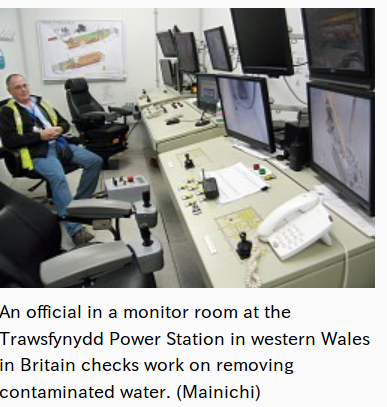
GWYNEDD, Wales — The Trawsfynydd Power Station in western Wales in Britain is one of the world’s most advanced nuclear power plants when it comes to decommissioning work. It had two gas-cooled reactors with a combined output capacity of 235,000 kilowatts.
The operator of the power station started decommissioning the power plant in 1993. A senior official in charge of the decommissioning work says 99 percent of radioactive materials have been removed. But it will still take 70 more years for the operator to finish decommissioning the nuclear plant.
The Mainichi witnessed firsthand the ongoing decommissioning operation of the plant in Wales, which is taking a lot of time and at huge cost, and got a reminder of the tough road ahead for Japan to decommission the crippled Fukushima No. 1 Nuclear Power Plant in the aftermath of the 2011 Great East Japan Earthquake and tsunami.
Two concrete buildings cover the nuclear reactors in Wales, which sit by a manmade lake.
Magnox Ltd. instructed us to wear helmets and special eyeglasses to protect our eyes. The Mainichi Shimbun was the first Japanese news organization to be admitted to this power station since the March 2011 nuclear disaster at the Fukushima power plant, which is owned by Tokyo Electric Power Co. (TEPCO).
As we entered the nuclear reactor building, there was a huge dark brown container, which officials say is a portion of a boiler to produce vapor for hydroelectric turbine operations. On the top floor of the building, scaffolding was in place along the wall, and workers were preparing to carefully dismantle upper portions of the building. The structure’s height will be trimmed from about 53 meters to about 30 meters to maintain the safety of the concrete wall until the power station is decommissioned.
The Trawsfynydd Power Station started operations in 1965 and was shut down in 1991. Spent nuclear fuel (fuel rods) were removed from the nuclear reactors in 1995, but the radiation dose of low-level radioactive substances around pressure vessels and inside interim storage facilities is still high. Accordingly, Magnox will temporarily halt decommissioning work in 2026 before embarking on the final phase of the decommissioning campaign such as the permanent disposal of nuclear waste in 2073.
Vic Belshaw, programme delivery manager at Magnox, said nuclear power plants built in the initial phase of nuclear power generation were not designed with future decommissioning in mind. Workers are encountering many new things and feeling their way in their decommissioning operations.
Cesium levels in Fukushima water 8 times higher than after disaster Asahi Shimbun By SHUNSUKE KIMURA/ Staff Writer 16 Aug 13Tokyo Electric Power Co. has reported finding radioactive cesium levels in underground water at the crippled Fukushima No. 1 nuclear power plant that is eight times greater than what it recorded right after the accident.
TEPCO, which operates the facility, said Aug. 15 that it detected 11,600 becquerels of radioactive cesium per liter of contaminated water in a tunnel near the No. 1 reactor building on the side facing the ocean.
That compares with 1,490 becquerels per liter it recorded at the site shortly after the accident in March 2011.
TEPCO said it believes the readings have soared due to rainwater containing cesium flowing into the tunnel. But the amount detected is roughly one-100,000th of that found in radioactive water in a tunnel near the No. 2 reactor building……http://ajw.asahi.com/article/0311disaster/fukushima/AJ201308160041
Oregon’s GOP Chair Wants to Sprinkle Nuclear Waste From Airplanes Mother jones, —By Tim Murphy Fri Aug. 16, 2013 After months of in-fighting, the beleaguered Oregon Republican Party elected a new chairman last weekend. His name is Art Robinson, and he wants to sprinkle radioactive waste from airplanes to build up our resistance to degenerative illnesses. …. Robinson, who has a Ph.D. in chemistry, has marketed himself for the last three decades as an expert on everything from nuclear fallout to AIDS to climate science in the pages of a monthly newsletter, Access to Energy, which he published from his compound in the small town of Cave Junction……
On nuclear waste: “All we need do with nuclear waste is dilute it to a low radiation level and sprinkle it over the ocean—or even over America after hormesis is better understood and verified with respect to more diseases.” And: “If we could use it to enhance our own drinking water here in Oregon, where background radiation is low, it would hormetically enhance our resistance to degenerative diseases……
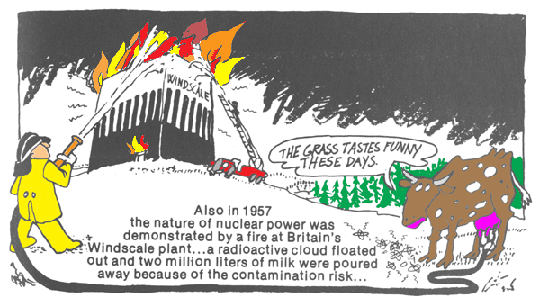
The Windscale Pile One chimney at the Cumbria plant has been sealed and cut off since the 1957 disaster.
There is still highly charged material trapped inside the shaft of the 400ft chimney, and more than 10 tons of melted radioactive uranium fuel remains inside the structure itself.
The reactor was built after World War II to make some of Britain’s first nuclear bombs, and then pressed into service to make tritium for an H-bomb, pushing the reactors beyond their limits and causing the blaze.
Workers at the plant were exposed to 150 times a safe lifetime’s dose of radiation, and for a month the government destroyed all milk produced within 200 miles of the site. Environmentalists and campaigners have since pointed to Sellafield as a warning of the potentially catastrophic effects of nuclear energy. Continue reading →
German energy giants pull plug on coal, nuclear The Local, 18 Aug 2013 Ever since Chancellor Angela Merkel announced a phase-out of nuclear energy over the next decade and pledged to generate as much as 80 percent of the country’s electricity from renewables by 2050, big question marks have been hanging over the future of coal and gas-fired plants in Germany.
Merkel, seeking a third term in general elections on September 22nd, is a staunch supporter of this hugely popular policy move.
But the turnaround is depriving utilities, including market leaders RWE and E.ON, of massive profits from their atomic plants and turning their gas and coal-fired stations into loss-makers as they are sidelined by rival renewable sources of energy.
Last week, the two biggest players in the German sector unveiled steep drops in profits, and “many of our plants are operating at a loss,” complained RWE’s finance chief Bernhard Günther.
Indeed, RWE announced that it would shut down a number of plants –representing combined capacity of 4,300 megawatts — in both Germany and the Netherlands. And more could follow, Continue reading →
The report sheds light on a mysterious $150 million cleanup operation paid for in large part by the United States, whose nuclear scientists feared that terrorists would discover the fissile material and use it to build a dirty bomb.
Over the years, hints emerged that something extraordinarily dangerous had been left behind in a warren of underground tunnels — like the American aerial drones that circled over the site, looking for intruders, or the steel-reinforced concrete that was poured into tunnels and over stretches of earth.
Among the report’s new revelations is that the Soviet testers left behind components, including high-purity plutonium, that could have been used to build not just a dirty bomb but a “relatively sophisticated nuclear device,” an American official told the report’s authors. Continue reading →
Two months since The Japan Times’ June 11 editorial “Cease promoting nuclear power,” things seem to have gotten alarmingly worse. […]
Most disquieting is the cynical disregard for human life and dignity, as exemplified by the scant attention paid to the victims of the Fukushima nuclear crisis, that seems to continue unabated.
Some 150,000 Fukushima residents are left for homeless, and many others live in fear of exposure to radiation released by the crippled nuclear power plant. The power plant, meanwhile, is said to be releasing up to 300 tons of radioactive water each day into the Pacific Ocean, a valuable common asset for mankind. […]
Uranium Centrifuge Details Released by Iran’s Former Nuclear Chief (INFOGRAPHIC) By Gracie Lee , Christian Post August 18, 2013 Iran has 18,000 Uranium centrifuges, according to the country’s outgoing nuclear chief, Fereydoun Abbasi-Davani who spoke on the country’s nuclear program on Saturday. The claim has come from Abbasi-Davani, who was speaking to Iranian media on Saturday.
Iran has continued to build its uranium-enrichment centrifuges as part of its nuclear program despite the United States and the international community pressuring the Middle Eastern nation to stop its nuclear push.
However, Iran has refused to comply with their requests, and has insisted that its nuclear program has nothing to do with weapons, but is simply for “peaceful purposes.”
Recently the new Iranian president, Hassan Rouhani, has expressed a slightly more open rhetoric about opening talks with world powers over the country’s nuclear program. However, he has been clear that Iran has every right to enrich uranium and has shown no intentions of halting the program.
Questions, concern surround plan to store nuclear waste near Lake Huron http://www.detroitnews.com/article/20130818/METRO08/308180008/Jim Lynch
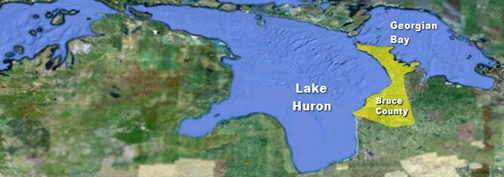
On Monday, two state legislators will host a town hall meeting in Detroit focusing on the plan to store low- to intermediate-level nuclear waste 2,230 feet below the ground near the Lake Huron shore. One of the legislators, Sen. Hoon-Yung Hopgood, D-Taylor, also posted a Facebook video on the project, laying out his concerns.
“This nuclear waste repository will be surrounded by Lake Huron on three sides and be located just upstream from the main drinking water intake for southeast Michigan,” he says in the two-minute video. “If this radioactive material leaks, the drinking water for 40 million people could be contaminated.”
The town hall, titled “Save the Great Lakes from Nuclear Waste,” will be held from 6:30-8 p.m. at Wayne State University’s Keith Center Lecture Hall.
For several years, Ontario Power Generation has been moving ahead with designs for an underground nuclear waste repository near Kincardine. During that time, the proposal has drawn sporadic interest and opposition in the United States — often in the form of isolated press releases by elected officials.
Ontario Power Generation officials have long argued their repository would be situated amid low-permeability limestone and shale formations that will keep the material there safe for “thousands” of years. U.S. and Canadian critics are concerned that, despite the company’s stated intentions, the repository could one day be used to house high-level nuclear waste.
In mid-September, Ontario’s federal review panel will begin a lengthy public hearing on the storage project. Then it will move north for additional hearings in Port Elgin in October.
“Some time in February would be the (earliest) that the panel would release its conclusions,” said Ted Grtuzner, an Ontario Power Generation spokesman. From there, the proposal would go on to the province’s Ministry of the Environment for a final review. jlynch@detroitnews.com(313) 222-2034












 nuclear-news