Critically dangerous – removing radioactive rods from Fukushima’s elevated cooling pool
The deadliest part of Japan’s nuclear clean-up Stuff.co.NZ AARON SHELDRICK AND ANTONI SLODKOWSKI 14 Aug 13, The operator of Japan’s crippled Fukushima nuclear plant is preparing to remove 400 tonnes of highly irradiated spent fuel from a damaged reactor building, a dangerous operation that has never been attempted before on this scale.
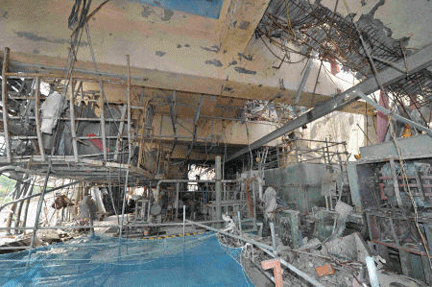
INADVERTENT CRITICALITY “There is a risk of an inadvertent criticality if the bundles are distorted and get too close to each other,” Gundersen said. He was referring to an atomic chain reaction that left unchecked could result in a large release of radiation and heat that the fuel pool cooling system isn’t designed to absorb.
“The problem with a fuel pool criticality is that you can’t stop it. There are no control rods to control it,” Gundersen said. “The spent fuel pool cooling system is designed only to remove decay heat, not heat from an ongoing nuclear reaction.”
The rods are also vulnerable to fire should they be exposed to air, Gundersen said.
The fuel assemblies are situated in a 10 metre by 12 metre concrete pool, the base of which is 18 metres above ground level. The fuel rods are covered by 7 metres of water, Nagai said.
The pool was exposed to the air after an explosion a few days after the quake and tsunami blew off the roof. The cranes and equipment normally used to extract used fuel from the reactor’s core were also destroyed. Tepco has shored up the building, which may have tilted and was bulging after the explosion, a source of global concern that has been raised in the US Congress……….
Under normal circumstances, the operation to remove all the fuel would take about 100 days. Tepco initially planned to take two years before reducing the schedule to one year in recognition of the urgency. But that may be an optimistic estimate.
“I think it’ll probably be longer than they think and they’re probably going to run into some issues,” said Murray Jennex, an associate professor at San Diego State University who is an expert on nuclear containment and worked at the San Onofre nuclear plant in California.
“I don’t know if anyone has looked into the experience of Chernobyl, building a concrete sarcophagus, but they don’t seem to last well with all that contamination.” Corrosion from the salt water will have also weakened the building and equipment, he said….. http://www.stuff.co.nz/world/asia/9041215/The-deadliest-part-of-Japans-nuclear-clean-up
1 Comment »
Leave a reply to troneill Cancel reply
1 This Month

Chernobyl: The Lost Tapes – A good documentary on Chernobyl on SBS available On Demand for the next 3 weeks– https://www.sbs.com.au/ondemand/tv-program/chernobyl-the-lost-tapes/2352741955560

of the week–London Campaign for Nuclear Disarmament

Tell the Ukrainian Government to Drop Prosecution of Peace Activist Yurii Sheliazhenko
To see nuclear-related stories in greater depth and intensity – go to https://nuclearinformation.wordpress.com
-
Archives
- April 2026 (181)
- March 2026 (251)
- February 2026 (268)
- January 2026 (308)
- December 2025 (358)
- November 2025 (359)
- October 2025 (376)
- September 2025 (257)
- August 2025 (319)
- July 2025 (230)
- June 2025 (348)
- May 2025 (261)
-
Categories
- 1
- 1 NUCLEAR ISSUES
- business and costs
- climate change
- culture and arts
- ENERGY
- environment
- health
- history
- indigenous issues
- Legal
- marketing of nuclear
- media
- opposition to nuclear
- PERSONAL STORIES
- politics
- politics international
- Religion and ethics
- safety
- secrets,lies and civil liberties
- spinbuster
- technology
- Uranium
- wastes
- weapons and war
- Women
- 2 WORLD
- ACTION
- AFRICA
- Atrocities
- AUSTRALIA
- Christina's notes
- Christina's themes
- culture and arts
- Events
- Fuk 2022
- Fuk 2023
- Fukushima 2017
- Fukushima 2018
- fukushima 2019
- Fukushima 2020
- Fukushima 2021
- general
- global warming
- Humour (God we need it)
- Nuclear
- RARE EARTHS
- Reference
- resources – print
- Resources -audiovicual
- Weekly Newsletter
- World
- World Nuclear
- YouTube
-
RSS
Entries RSS
Comments RSS
 nuclear-news
If these greedy idiots drop that tank, Earth will be dead in 50 years. Run the numbers and the immediate consequences.
Let’s all just sit on our hands and watch what happens, right?