Nuclear Waste Administration Act of 2013 a step towards USA action
 Finally, there is a glimmer of hope that – more than 30 years after the Nuclear Waste Policy Act passed, and 15 years after the feds guaranteed they’d start accepting the waste – paralysis and dithering might give way to action
The new bill would:
essentially yank all responsibility from the Department of Energy (which spent about $10 billion on moribund Yucca Mountain) and would create a new organization solely devoted to solving the nuclear waste storage and disposal problem (as was recommended by the president’s Blue Ribbon
Commission, and is widely hailed as a solid idea by Republicans and Democrats alike).
develop the aforementioned “consensual process” for figuring out where to actually put nuclear waste by engaging with willing, rather than unwilling, communities, thus hoping to avoid the gridlock that resulted from 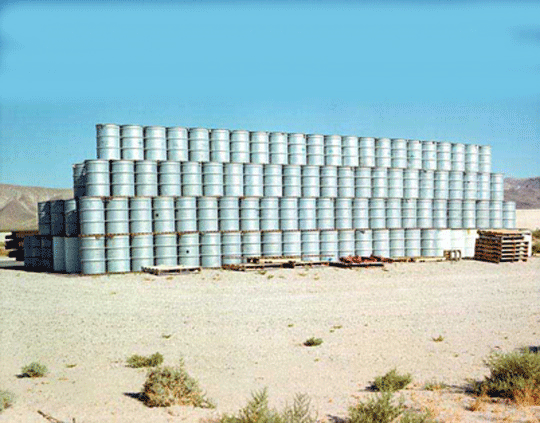 Nevada’s rabid opposition to deep, permanent geologic storage at Yucca Mountain.
emphasize getting the ball rolling for short-term storage first, and for permanent disposal second. This means pushing the new agency to start accepting waste as soon as possible at an “interim storage” site or sites, while it wrestles with the more thorny issue of where to put a permanent, deep geologic repository (or repositories).
End of paralysis on nuclear waste disposal? Orange County Register, August 9th, 2013, by By TERI SFORZA At this very moment, the vast majority of America’s highly radioactive nuclear waste – and San Onofre’s as well — is cooling in steel-lined concrete pools filled with water, which “are essentially loaded guns aimed at neighboring communities,” a scientist testified at a Congressional hearing last week.
“Unlike the reactor cores, the spent fuel pools are not protected by redundant emergency makeup and cooling systems and/or housed within robust containment structures having reinforced . “Thus, large amounts of radioactive material – which under the (Nuclear Waste Policy Act of 1982) should be stored within a federal repository designed to safely and securely isolate it from the environment for at least 10,000 years – instead remains at the reactor sites.” Continue reading
Small Modular Reactors (SMRs) won’t save moribund nuclear ndustry
 Report: Nuclear industry shouldn’t rely on SMRs Malia SpencerReporter-Pittsburgh Business Times 9 Aug 13 A report this week from the nonprofit Institute for Energy and Environmental Research asserts that relying on the development of small modular reactors “is unlikely to breathe new life into the increasingly moribund U.S. nuclear power industry.”….
The reasons for the critical findings? According to the report, SMRs will likely need tens of billions of
purchase orders or government subsidies, will create new reliability vulnerabilities, and will raise concerns about safety and proliferation.
Westinghouse was cited in the report along with Pennsylvania as one of the companies and states that could see “major implications” if SMRs fail to take off……
http://www.bizjournals.com/pittsburgh/blog/energy/2013/08/report-nuclear-industry-shouldnt.html
A solar diesel energy hybrid – an economic boon for developing countries
 Renewables: A rising power. Ft.com By Pilita Clark, Environment Correspondent, 8 Aug 13 Developing nations: Cheap solar could ‘leapfrog’ subsidies The plummeting cost of solar power systems is driving more than a surge in suburban rooftop panels in Bavaria and Barcelona.
It also promises to provide regular electricity to the 1.2bn people who have no access to it today. Low-cost solar panels could help them leapfrog traditional power grids in the same way parts of the developing world sidestepped fixed-line telecommunications networks and went straight to mobile phones.
An 80 per cent fall in the cost of solar panels since 2008 has opened up new business opportunities for companies such as Germany’s Donauer, which has just developed the D: Hybrid, a system that allows thousands of solar panels to be attached to the diesel generators that are a fixture in industrialising countries with rickety electricity systems. Continue reading
Zimbabwe to sell ‘raw materials for nuclear weapons’ to Iran

A deal has been struck between Iran and the Zimbabwe government which would see the country sell raw materials for nuclear weapons to the Middle Eastern state, Telegraph report.
Gift Chimanikire, the Zimbabwean Deputy Mining Minister, told the Times newspaper that a memorandum of understanding had been signed to export uranium to Tehran, a move likely to prompt alarm in western capitals, particularly in Washington.
The United States and the European Union have imposed crippling sanctions on Iran over its nuclear programme, which Tehran insists is for peaceful energy uses but which they fear is intended to build a bomb.
Zimbabwe is also subject to international sanctions over its human rights record and its state-owned mining companies are banned from international trade, but a deal with Tehran circumnavigates such restrictions.
A report compiled by the United Nations’ nuclear watchdog more than two years ago warned of such an outcome, detailing a visit from Iran’s then Foreign and Co-operative Ministers to Zimbabwe to strike a deal, with the Iranians also sending engineers to assess uranium deposits.
Chimanikire told the Times that a deal had been reached last year.
A Chinese company has been surveying yellow-cake deposits in the far northeast of the country and the Zimbabwe government has been actively looking for buyers, according to Mr Chimanikire, who, as an opposition politician, served in the outgoing coalition Government under President Robert Mugabe.
Taiwan watchdog agency says nuclear plant leak has not been stopped; operator downplays threat
TAIPEI, Taiwan – Taiwan’s government watchdog has said a small leak at one of the island’s three nuclear power plants has yet to be halted 3 1/2 years after it started.
The report comes as the island’s legislature is mired in a debate on whether to hold a referendum on operating a fourth nuclear plant, scheduled to open in 2016.
Officials at the Shihmen plant, north of Taipei, say the leak cited by the watchdog body is condensate from vapour generated by routine maintenance and posed no threat to the environment or to plant staff.
Nuclear power is a lightning rod issue in Taiwan, particularly after the 2011 Fukushima disaster in nearby Japan.
| Nuclear Power Plants are Designed to Leak Radioactive Gas | |
| Series: | A Nuclear World |
| Subtitle: | |
| Program Type: | Interview |
| Featured Speakers/Commentators: | Dr. Ernest Sternglass |
| Contributor: | Pete Bianco [Contact Contributor] |
| Broadcast Restrictions: | For non-profit use only. |
| License: | Attribution Non-commercial (by-nc)  |
| Broadcast Advisory: | No Advisories – program content screened and verified. |
Summary: Dr. Sternglass has had his books burned along with others on the dangers of mercury and how to fight polluters. Most destructive to the ozone layer are radioactive gases. Nuclear power plants are designed to leak radioactive gasses even when operating properly. Milk around nuclear power plants is diluted and shipped out of State and into big cities to obscure the effect nuclear power plants have on milk causing low birth weights and miscarriages. A few months after Chernobyl there was a sharp increase in the number of AIDS cases. Exposure to continuous low level radiation increases ones likelihood of developing Cancer and AIDS. Radiation exposure depletes the immune system. If the immune system is strengthened one can cope with or overcome these diseases.
Download audio here>> http://www.radio4all.net/responder.php/download/70354/77949/90538/?url=http://www.radio4all.net/files/pencil@riseup.net/3609-1-sternglass1.mp3
From this link
Age of young volcanic field near the Palo Verde nuclear power plant
The Arizona Geological Survey has a new report on the age of young volcanic rocks near the Palo Verde nuclear power plant. The report was produced over concern of geologic hazards near the generating station.
You can download the full report here and a video abstract here.
The report concerns the Sentinel – Arlington volcanic field which extends over about 50 miles from Sentinel volcanic field west of Gila Bend northeastward to Arlington volcano west of Buckeye. That puts it within 6 miles of the power plant.
Arlington Volcano is located 6 miles southeast of the power plant. Six potassium-argon radiometric dates of basalt rock samples from Arlington volcano range from 1.28- to 3.28 million years old. Although there is a two-million-year spread in the age dates, AZGS notes that the Arlington “volcano is geologically simple, consisting of a single, small, low-relief volcano with no soil horizons between flows. Most likely it was erupted in a single volcanic episode of short geologic duration (<10,000 years), …about 2.1 million years ago.
Gillespie volcano occurs about 12 miles south of the Palo Verde Nuclear Generating Station. It is a morphologically similar low shield volcano without soil horizons or multiple eruptive centers. Four of five potassium-argon dates range from 2.67- to 3.6 million years, suggesting an age of 3 million years. AZGS infers that this eruption temporarily dammed the Gila River.
The report goes on to discuss other volcanoes more distant from the Palo Verde nuclear station. The AZGS report concludes with a caveat:
“The Sentinel – Arlington volcanic field produced extensive, low relief basalt lava flows and small, gently sloping basalt shield volcanoes. Available geochronologic data suggest that the Sentinel – Arlington volcanic field has erupted intermittently over the past 1.1-3.5 Ma, with no clear migration of volcanic activity within the field. Although there is no geochronologic evidence for eruptions during the past one million years, the large range of geochronologic dates from the Sentinel volcanic field, the uncertainties inherent in many of the older potassium-argon dates, and the large number of eruptive centers, allow for the possibility of more recent activity that is as yet undocumented.”

more here
Korean Nagasaki bombing victims remembered on 68th anniversary
…The group also called for the Japanese government to abolish the upper limit on medical bills for overseas atomic bomb victims, to share the medical records of overseas victims, and to apply the victims’ support act to victims living in North Korea…
An estimated 10,000 Koreans perished in the 1945 bombing; most had been forcibly mobilized to Japan
Posted on : Aug.10,2013

Ethnic Korean residents of Japan and descendants of the Korean victims of the 1945 nuclear bombing of Nagasaki, along with members of civic groups, hold a moment of silence at a commemorative event in Nagasaki, August 9. (by Ahn Gwan-ok)
By Ahn Gwan-ok, Gwangju correspondent in Nagasaki
A commemorative gathering to bring peace to the souls of Koreans killed in the nuclear attack was held in Nagasaki on Aug. 9, exactly 68 years after the nuclear bomb was dropped on the city. On Aug. 9, 1945, the US dropped a nuclear bomb on Nagasaki, a city of 240,000 people.
73,884 people were killed in the blast, including an estimated 10,000 Koreans who were living in Nagasaki at the time. About 200 people, including members of a citizen group for defending the human rights of Korean-Japanese in the Kyushu region of Japan and North Koreans living in Nagasaki, took part in the 68th commemorative gathering for bomb victims.
The gathering took place in front of a cenotaph for Korean victims of the nuclear attack, which is located near a park in Heiwa-machi, Nagasaki, which marks ground zero of the blast.
“Japan calls itself the only country in the world to have been attacked by a nuclear bomb, but it ignores the existence of Koreans who suffered the double and triple damage of being pressed into work gangs [during the Japanese colonial occupation of Korea] and then being hurt in the nuclear attack,” said Yasuhiro Takazane, president of the group, during his address.
Falsified Reports After Fukushima Fan Anti-Nuclear Korea
By Sungwoo Park & Heesu Lee –
Aug 9, 2013 12:39 PM

For Seoul residents, South Korea’s decision to keep four nuclear reactors offline because of faked safety reports means power shortages, and a summer of sweltering homes and offices. Lee Jin Gon has bigger concerns.
“We feel unsafe day and night,” Lee said, pointing at the cause of his nervousness, one of the closed reactors in the town of Yangnam, a four-hour journey southeast of the capital. “We became worried about nuclear safety after the Fukushima accident. Now it’s worse,” he said, adding that locals have held protests to close the whole plant.
Lee, 60, is emblematic of growing opposition to atomic power in South Korea, a movement galvanized by the meltdown of three reactors in neighboring Japan’s Fukushima in 2011. It gained more support when an investigation found nuclear plants were using components with faked safety certificates. That cost Kim Kyun Seop his job as head of state-run Korea Hydro & Nuclear Power Co., which runs the 23 operating reactors.
The anti-nuclear lobby is forcing President Park Geun Hye to take note. Her administration said it will review the role of nuclear power to reflect “social acceptability” in its energy plan due by the end of this year. The government had planned to build more reactors to cope with electricity demand it forecast to surge almost 60 percent by 2027.
Surveys show nuclear power is becoming increasingly socially unacceptable. Sixty-three percent of respondents to a March survey by pollster Hangil Research said they consider domestic reactors unsafe. That compared with 54 percent in a year earlier poll by the non-profit Korean Federation for Environmental Movement.
Reactor Isolation
In Yangnam, Lee, head of the local branch of Nonghyup, the nationwide cooperative federation of farmers, says concern that nuclear power isn’t safe is damaging sales of the area’s rice and other farm produce.
1 This Month


Tell the Ukrainian Government to Drop Prosecution of Peace Activist Yurii Sheliazhenko

Petition to revoke the licensing of the Near Surface Nuclear Disposal Facility (NSDF) at Chalk River. https://www.ourcommons.ca/petitions/en/Petition/Details?Petition=e-7247


of the week – STOP SMALL MODULAR REACTORS IN CANADA
To see nuclear-related stories in greater depth and intensity – go to https://nuclearinformation.wordpress.com
-
Archives
- March 2026 (204)
- February 2026 (268)
- January 2026 (308)
- December 2025 (358)
- November 2025 (359)
- October 2025 (376)
- September 2025 (258)
- August 2025 (319)
- July 2025 (230)
- June 2025 (348)
- May 2025 (261)
- April 2025 (305)
-
Categories
- 1
- 1 NUCLEAR ISSUES
- business and costs
- climate change
- culture and arts
- ENERGY
- environment
- health
- history
- indigenous issues
- Legal
- marketing of nuclear
- media
- opposition to nuclear
- PERSONAL STORIES
- politics
- politics international
- Religion and ethics
- safety
- secrets,lies and civil liberties
- spinbuster
- technology
- Uranium
- wastes
- weapons and war
- Women
- 2 WORLD
- ACTION
- AFRICA
- Atrocities
- AUSTRALIA
- Christina's notes
- Christina's themes
- culture and arts
- Events
- Fuk 2022
- Fuk 2023
- Fukushima 2017
- Fukushima 2018
- fukushima 2019
- Fukushima 2020
- Fukushima 2021
- general
- global warming
- Humour (God we need it)
- Nuclear
- RARE EARTHS
- Reference
- resources – print
- Resources -audiovicual
- Weekly Newsletter
- World
- World Nuclear
- YouTube
-
RSS
Entries RSS
Comments RSS
 nuclear-news