
VI) 東大WBC研究の矛盾点Controversies on WBC Study by Tokyo University
東大ホールボディーカウンター研究の矛盾点
Controversies on WBC Study by Tokyo University
Former TVA chief ‘s advice – shut down all nuclear power plants
This is the first in EON’s series of ‘preview interviews’ of participants in the forthcoming documentary SHUTDOWN: The Case of San Onofre – a look at the reborn Nuclear Free California movement.
S. David Freeman, legendary former Tennessee Valley Authority (TVA) and the Sacramento Municipal Utility District (SMUD) administrator, who has shutdown many a nuke in his career – and is now working in his 85th year to help local residents and Friends of the Earth decommission San Onofre – explains why we have to ‘kill nuclear power before it kills us.’
Future SHUTDOWN ‘Preview Interviews’ will include SanOnofreSafety.org Founder, Donna Gilmore; San Clemente Green co-founders Lauri & Gary Headricks; Emergency Response Expert Deanna Polk; Investigative Reporter Harvey Wasserman; Urban Planner Torgen Johnson; WomensEnergyMatters.org Founder Barbara George and others-to-be-posted. Stay tuned….
Wholebody counter has been used for cover-up for the danger of internal exposure Part 3
Wholebody counter has been used for cover-up for the danger of internal exposure Part 3
29 July 2013

Mr. Masamichi Nishio is one of a few doctors who has been commenting on the danger of internal exposure to ionizing radiation right from the start, soon after the Fukushima disaster. He is former head of the Cancer Centre in Sapporo in Hokkaido. He also works at Kyodo Clinic in Fukushima city occasionally. The Kyodo Clillnic is the only independent clinic in Fukushima prefecture and it is run by citizens and on donations.
Mr. Nishio gives the service of measuring radiation the level using a wholebody counter. It takes 30 min. while the one run at hospitals and clinic that has connection with the Fuksuhima Health Survey including Hirata Central Hopital (Prof. Hayakawa is in charge) only measure for 2-5 min. ( The longer the time of measurement and more acurrately the machine can detect radiation from the body.
Mrs. Nishio runs the WBC measurement service at his cancer centre once a week. Because it takes 30min, he can only do 10 people a week. Also, if people in Fukushima prefecture would like to go to his clinic, travelling costs would be more than £150. And the cost is not free while hospitals that have ties with the Fukushima Health Survey are free for under 18 years old. Therefore, only people who could afford to pay the cost could come to his centre.
(Editor’s note)
With the above reasons we should re-evaluate any data or reports that are based on wholebody counter measured by the Fukushima Health Survey.
*Prof.Hayano said “No children were exposed to internal radiation” but now 27 children developed thyroid cancer!
http://fukushimaappeal.blogspot.co.uk/2013/07/27-profhayano-said-no-children-were.html
*Prof.Hayano said “No children were exposed to internal radiation”
福島の住民内部被曝、15歳以下ゼロ 12年5月以降 11/4/2013 Nikkei Shimbun
Canada, Sweden -Nuclear power plant puts radioactive shipping plans on hold

in Politics
A plan to ship 16 radioactive steam generators through the Great Lakes and the St. Lawrence River for recycling in Sweden has been cancelled after delays caused by public opposition.
An agreement was reached in 2009 between Bruce Power in Tiverton, Ont., and Swedish company Studsvik, but Bruce Power president Duncan Hawthorne said the plans have been put on hold to allow further discussion with First Nations, Métis and other groups.
The move has been strongly opposed by aboriginal groups, the Bloc Quebecois, the NDP and a number of community and environmental organizations over the past two years.
Emma Lui of the Council of Canadians said there are many concerns, but the “big one” is the possible threat to the Great Lakes if something went wrong with the shipment.
Kahnawake Mohawk Council spokesman Joe Delaronde said the change in plans shows that public pressure can keep companies like Bruce Power in check.
“We’re pretty happy that they’ve done the right thing here. And, when they come up with other options, I’m sure they’ll be publicized as well,” Delaronde said.
“You can’t keep this kind of thing secret and try to sneak it through.”
James Scongack, a spokesman for Bruce Power, said the company didn’t actually bow to pressure.
Rather, he said a one-year transport licence and certificate from the Canadian Nuclear Safety Commission expired in February 2012 and the company simply didn’t renew it.
Scongack said Bruce Power hasn’t abandoned the option of having its steam generators recycled in Sweden.
“We still believe reducing our waste [and]… solid international principles of waste management is the thing to do,” he said.
He said the company is planning more public outreach and consultation on the issue.
With files from The Canadian Press
Article source: http://www.cbc.ca/news/politics/story/2013/07/28/montreal-quebec-ontario-great-lakes-bruce-power-st-lawrence-seaway-nuclear.html?cmp=rss
Waiting for a nuclear disaster in India
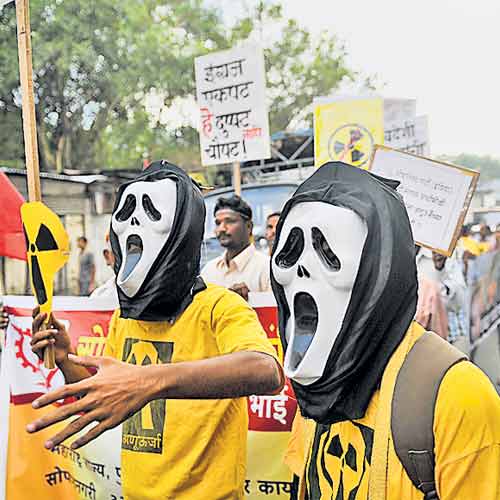
Sunday, Jul 28, 2013,
http://www.dnaindia.com/analysis/1866686/column-waiting-for-a-nuclear-disaster
Friday was the day for protesters of nuclear energy. In many parts of the country, a charter was released against the continuing expansion of nuclear facilities. A seminar at Vidyapith was poorly attended but fascinating in the facts that were laid out.
Little notice was taken in the population when the Kudankulam project went “critical”. And yet the potential dangers involved are so enormous and inescapable that all of us should have cried foul. Around the same time in China, a country intolerant of public protests and brutal in reprisals, several hundred people marched against a proposed nuclear facility forcing the government to cancel the 6 billion dollar project.
In India, protests against nuclear power have gone on for many years and, like elsewhere in the world, heightened after the Fukushima disaster. Rightly so, for the estimate of 5,000 people affected in Fukushima has gone to over 10 times that, and the effect will last for many generations.
The nuclear lobby in India is strong and hidden in obfuscation. Leading the pack perhaps is the Department of Atomic Energy. (To think that my father headed PUGWASH, a global body against nuclear proliferation while he was head of DAE, and stood against India going nuclear with all he could muster!)
In direct violation of a Supreme Court verdict on ensuring safety and to report back to the courts, the Nuclear Power Corporation, the DAE and its Board and the Ministry of Environment and Forests went ahead with making Kudankulam critical before the courts could have time to check on findings and reassure themselves and the public of the overall safety of people and the earth.
Long-time nuclear critic and senior journalist Praful Bidwai writes, “Yes, such grave breach of public trust, and contempt for democratic processes, conforms to a well-established pattern. India’s Department of Atomic Energy, with its subordinates, NPCIL and AERB, has always defied accountability to Parliament and the public. Glorified by an ill-informed media, coddled by policy makers who love the bomb and hate life, and shielded by the Atomic Energy Act 1962 – which empowers it to hide any information it likes – the DAE has become a law unto itself, and a negative object lesson for democracy theorists”.
The Untold Story of Pilgrim’s Nuclear Thermal Pollution – Death Plume!
by Karen Vale on July 28, 2013
http://www.capecodbaywatch.org/2013/07/a-journey-into-the-death-plume-the-untold-story-of-pilgrims-thermal-pollution/
Adam Augello, CCBW’s intern, writes about the effects of thermal pollution and the cooling system on the ecosystem – primarily fish – in Cape Cod Bay.
Pilgrim Nuclear Power Station is located in one of the most important habitats in the world. Coastal zones, such as those located around Cape Cod Bay, have some of the highest levels of biological productivity in the world, and now produce about 10% of the world’s fish harvest[i].
It is within this context that Pilgrim currently runs its operation, and in its 40 year history has developed an “interesting” relationship with the bay. In order to cool its reactor at the same time as it generates steam for electricity, Pilgrim takes in up to 510 million gallons of water a day from Cape Cod Bay. The cooling water, in the process of passing through the reactor, is heated up before being returning to the bay[ii]. Because of Pilgrim’s day-to-day operations, a thermal plume of about 5 square miles (which may be smaller or larger at times depending upon tidal and wind conditions) containing water at least 2⁰F hotter than the ambient waters, has developed in Cape Cod Bay[iii].
Temperature changes of as little as 2⁰F will trigger responses in marine organisms of either avoidance or attraction[iv]. This stratification of the food web poses a significant problem in itself. However, often times the presence of food will override thermal preferences and cause fish that would normally avoid a thermal plume to venture into waters that could be lethal[v]. Once inside a thermal plume for a short period of time, it becomes very difficult for the fish to leave because their bodies become acclimated to the warmer temperature, which depletes their energy level and swimming endurance[vi]. Then when the power plant suddenly goes offline for maintenance, which happened six times from 2011 to January 2013, virtually all trapped adult fish as well as free-floating eggs, larvae, and juveniles who happen to be passing through the plume can be killed from cold shock[vii].
Often times the plume attracts fish towards the intake canal, causing the smaller fish, if they are not impinged on the power plant’s intake screens, to get sucked into the pipes of the plant where many are scalded, pulverized and then spewed back out into the bay as lifeless sediment[viii]. It is in this way that the waters around Pilgrim act as a sort of biological sink, beguiling marine organisms across Cape Cod Bay to their deaths along our shores.
Many of these fish stocks are in decline, and accordingly the commercial fishing industry is highly regulated in terms of quantities of catch to protect these species[ix]. Why then is Pilgrim allowed to kill these species en mass in its day-to-day operations? When you take into account the rippling effect the destruction of zooplankton and fish stocks has on the ecosystem of Cape Cod Bay, Pilgrim’s actions reach far beyond the ill-defined boundaries of the thermal plume.
There is also concern that the development and survival of fish eggs and larvae, as well as the spawning success and migration patterns of the adult fish, may be affected by the increase in temperature[x].
Controversies on WBC Study by Tokyo University 東大WBC研究の矛盾点
Image source ; http://www.thetimes.co.uk/tto/news/world/asia/article2874151.ece
29 July 2013
ベラルーシのエートス計画では、医師も協力し、ホールボディーカウンター(WBC)によるモニタリングで内部被曝線量が下がるのを成功裡に記録して いたと言います(とはいっても最も大事な健康の改善はみられていなかったわけですが。エートスの章を参考にしてください。 http://savekidsjapan.blogspot.jp/2013/01/blog-post_8310.html)
..
In ETHOS Belarus, residents’ internal radiation had been measured with whole body counter and the report said that the figures were successfully decreased, though the most important health improvement was not reflected by it.
..
さらに、このWBCでは、ガンマ線しか計測できず、アルファ線、ベータ線核種は検出できません。内部被曝でより危険なのは、体を突き抜けるガンマ線ではなく、アルファ線、ベータ線核種ですから、本来は尿検査が必要です。
WBC can measure only gamma rays and cannot detect alpha and beta rays, which are much more harmful on human bodies as internal exposure sources. To detect these, we need to conduct a urine test.
..
福島エートスでも、ご存知かとは思いますが、福島の避難地域から外れた南相馬市でも、WBCによる体内被曝の調査が行われ、2012年8月に米国医師会(JAMA)で発表されています。
As you probably know, in Minimisoma city, which is outside of evacuation zone, Dr. Masaharu Tsubokura from Tokyo University Medical Science Institute, measured the residents’ internal exposure using WBC and submitted the thesis to JAMA in August 2012
..
この論文の著者の東京大学医科学研究所の坪倉正治医師には、私も沖縄で2011年11月に放射能の勉強会でお会いしております。そこで私は直接氏に バンダジェフスキー論文を読んだことがあるかと聞いたところ、「読みました。実は私も大変困っています。福島では、人が食べるものは全数検査しなければい けないが、機材が足りません。」とおっしゃっていました。
I met Dr. Tsubokura in person at a radiation seminar held in Okinawa and directly asked him whether he had read the paper by Dr. Bandazhevsky. His answer was, “Yes, I have. As a matter of fact, I feel troubled. Every food should be measured before the local residents could eat it, but we do not have enough equipment.”
..
また、坪倉医師は、2012年2月に書いたご自身のブログhttp://medg.jp/mt/2012/02/vol410wbc.htmlにバ ンダジェフスキーの研究について言及しています。この中で、坪倉医師は、はっきりとバンダジェフスキーによれば、10Bq/kgー20Bq/kgで心臓に 影響が出ているという報告があるから、病院で心電図の検査もやり始めた、住民の長期的なフォローアップが必要であると記しています。
..
In Febrary 2012, Dr. Masaharu Tsubokura mentioned Dr. Bandazhevsky’s study in his own blog,
http://medg.jp/mt/2012/02/vol410wbc.html. In here, he stated that long-time follow-up will be needed, including electrocardiogram test for residents since there is a report by Bandazhevsky that says 10Bq/kgー20Bq/kg cesium concentration in the body, causes heart malfunction.
..
ところが、この坪倉医師の8月の研究報告では、大人でも小児でも最も高い人は50Bq/kg以上、10Bq/kgー20Bq/kg以上はざらに見ら れます。これは大変なことかと思いますが、なぜか論文の結論としては、これらのベクレルの体内濃度からシーベルトに換算し、
1.07mSVを浴びた1人を 除いてすべての住民の実効預託線量は1mSV以下であり、被曝レベルは低いと結論されています。
..
According to the JAMA report by Dr. Tsubokura in August 2012, there were people with more than 50Bq/kg and many with 10Bq/kgー20Bq/kg among the adults and children. This figure is of grave concern itself in the light of Dr. Bandazhevsky’s study. However, strangely, the conclusion of Dr. Tsubokura’s study was the residents’ exposure level was low, with all the subjects’ exposure less than 1mSV with only one exception of 1.07mSV effective committed dose.
..
不思議なことに、その後坪倉氏がバンダジェフスキーをでたらめと言っているというサイトが作られていました。そのサイトの中では、上述の福島の地方 局TVユー福島の報道局長の大森真氏(http://savekidsjapan.blogspot.jp/2013/01/medias- sins.html参照)が、坪倉氏がバンダジェフスキーを酷評していたというコメントしているのです。坪倉医師が私に直接話したこととも、上述のネット で坪倉医師が書いたこととはまったく正反対の記述です。
..
However, quite strangely, an internet site was made in May 2012, saying that Bandazhevsky`s findings were denied by Dr. Tsubokura and quite harshly too (http://togetter.com/li/303308). This was stated by Mr. Makoto Omori(See http://savekidsjapan.blogspot.jp/2013/01/medias-sins.html), the chief of broadcast section at TV You Fukushima. What Mr. Omori was saying was quite contrary to the saying I heard from Dr. Tsubokura directly.
,,
この体内濃度が初期被ばくによるものなのか、または飲食物によるものなのか、判断できませんが、いずれにせよ、既にこれだけの体内濃度になった人に、さらに汚染された空気を吸わせ、食べ物を食させるのは殺人行為だと思います。
,,
Nobody knows whether this cesium concentration in the body came from the initial exposure or from food intake afterwards, but in any case, it would be a act of murder not to relocate residents instead, making them breath contaminated air and consume contaminated foods.
..
このWBCを使った研究については、東京大学医科学研究所の上昌弘特任教授が責任者となっており、研究目的には、「原発災害で大きな影響を受けた福 島県浜通り地方において、住民の健康不安を解消する目的、および低線量被ばくを含む原発災害が人体へ及ぼす影響について調査するため、一般健診および健康 相談会を行う。」と書かれてあります。
..
As for the WBC study, Professor Masahiro Kami, Tokyo University Medical Science Institute, is in charge. Amazingly, the purpose of the study says;
“The purpose of this study is to conduct medical checkup and medical consultations to resolve anxiety of the residents in costal line area in Fukushima greatly damaged by the nuclear disaster and to study the effects of nuclear disaster on human bodies including low-level radiation effects.”
“The purpose of this study is to conduct medical checkup and medical consultations to resolve anxiety of the residents in costal line area in Fukushima greatly damaged by the nuclear disaster and to study the effects of nuclear disaster on human bodies including low-level radiation effects.”
..
低線量被曝が人体へ及ぼす影響について調査すると明記されているのです!これは放射線を使った人体実験に他なりません!
..
It clearly stipulates the purpose as studying low-level radiation effects on human body! This is nothing but a human experiment using radiation!
..
さらには、上昌広教授のこういうセリフを聞いた人がいます。
「福島市も郡山市も、とてもじゃないが避難させられない。将来奴らは、集団訴訟とかするんだろうなあ」
「南相馬はあぶないよ。」
「福島市も郡山市も、とてもじゃないが避難させられない。将来奴らは、集団訴訟とかするんだろうなあ」
「南相馬はあぶないよ。」
..
Moreover, one of my friend’s acquaintances and my own acquaintance heard Professor Kami’s personal statement as follows;
“It would be impossible to evacuate residents in Fukushima City and Kohriyama City. I guess in the future, they would file a class action lawsuit.”
“Minamisoma City is at risk. “(Minamisoma is one of the cities along the coastal area of Fukushima where the WBC study is being conducted by Professor Kami himself.)
“It would be impossible to evacuate residents in Fukushima City and Kohriyama City. I guess in the future, they would file a class action lawsuit.”
“Minamisoma City is at risk. “(Minamisoma is one of the cities along the coastal area of Fukushima where the WBC study is being conducted by Professor Kami himself.)
..
この危ないと言っている地域で、上昌弘教授は、部下の坪倉氏に、子供達まで含む住民を使った低線量被曝の研究を進めさせているわけです。これはまさに時間軸の延びた731部隊の人体実験に他ならないと私は思います。
..
In this area at risk, Professor Kami himself is conducting WBC study including local children and pregnant women with his subordinate doctor Masahiro Tsubokura. This is nothing but a recurrence of Unit 731 evil human experiments with a prolonged time span.
..
そして彼らが所属している東京大学医科学研究所は、731部隊研究の拠点の一つでもありました!以下のサイトを参照ください。
http://savekidsjapan.blogspot.jp/2013/01/japan-victim-and-perpetrator.html
http://savekidsjapan.blogspot.jp/2013/01/japan-victim-and-perpetrator.html
..
As a matter of fact, Tokyo University Medical Science Institute used to be a hub for Unit 731 human experiment studies. http://savekidsjapan.blogspot.jp/2013/01/japan-victim-and-perpetrator.html
..
どうかこれらの犯罪的な東大の医師たちの悪魔の実験を即刻辞めさせ、危険な地域にいる住民、特に妊婦、子供たちを安全な場所に移動させてください。
..
I sincerely ask for international organizations to stop these Tokyo University doctors’ medical experiments and please relocate the residents in high risk area, especially pregnant women, children.
———————————————————
———————————————————
*Wholebody counter has been used for cover-up for the danger of internal exposure – Prof. Katsuhiko Yagasaki of Ryukyus University WBC
http://fukushimaappeal.blogspot.co.uk/2013/07/wholebody-counter-has-been-used-for_14.html
http://fukushimaappeal.blogspot.co.uk/2013/07/wholebody-counter-has-been-used-for.html
Airborne Radiation Spread – The facts with Marco Kaltofen

Talking Stick TV interview with Marco Kaltofen on how radiation spreads via airborne dust particles.
[NOTE} Marco also describes issues with the radiological testing in the USA and deficits in Japans response to the contamination of its lands and sea. [Arclight2011part2]
Science with a Skew: The Nuclear Power Industry After Chernobyl and Fukushima Japanese translation is available.
Gayle Greene
It is one of the marvels of our time that the nuclear industry managed to resurrect itself from its ruins at the end of the last century, when it crumbled under its costs, inefficiencies, and mega-accidents. Chernobyl released hundreds of times the radioactivity of the Hiroshima and Nagasaki bombs combined, contaminating more than 40% of Europe and the entire Northern Hemisphere.1 But along came the nuclear lobby to breathe new life into the industry, passing off as “clean” this energy source that polluted half the globe. The “fresh look at nuclear”—in the words of a New York Times makeover piece (May 13, 2006)2—paved the way to a “nuclear Renaissance” in the United States that Fukushima has by no means brought to a halt.
That mainstream media have been powerful advocates for nuclear power comes as no surprise. “The media are saturated with a skilled, intensive, and effective advocacy campaign by the nuclear industry, resulting in disinformation” and “wholly counterfactual accounts…widely believed by otherwise sensible people,” states the 2010-2011 World Nuclear Industry Status Report by Worldwatch Institute.3 What is less well understood is the nature of the “evidence” that gives the nuclear industry its mandate, Cold War science which, with its reassurances about low-dose radiation risk, is being used to quiet alarms about Fukushima and to stonewall new evidence that would call a halt to the industry.
Consider these damage control pieces from major media:
• The “miniscule quantities” of radiation in the radioactive plume spreading across the U.S. pose “no health hazard,” assures the Department of Energy (William Broad, “Radiation over U.S. is Harmless, Officials Say,” NYT, March 22, 2011).
• “The risk of cancer is quite low, lower than what the public might expect,” explains Evan Douple, head of the Radiation Effects Research Foundation (RERF), which has studied the A-bomb survivors and found that “at very low doses, the risk was also very low” (Denise Grady, “Radiation is everywhere, but how to rate harm?” NYT, April 5, 2011).
• An NPR story a few days after the Daiichi reactors destabilized quotes this same Evan Douple saying that radiation levels around the plant “should be reassuring. At these levels so far I don’t think a study would be able to measure that there would be any health effects, even in the future.” (“Early radiation data from near plant ease health fears,” Richard Knox and Andrew Prince,” March 18, 2011) The NPR story, like Grady’s piece (above), stresses that the Radiation Effects Research Foundation has had six decades experience studying the health effects of radiation, so it ought to know.
• British journalist George Monbiot, environmentalist turned nuclear advocate, in a much publicized debate with Helen Caldicott on television and in the Guardian, refers to the RERF data as “scientific consensus,” citing, again, their reassurances that low dose radiation incurs low cancer risk.4
Everyone knows that radiation at high dose is harmful, but the Hiroshima studies reassure that risk diminishes as dose diminishes until it becomes negligible. This is a necessary belief if the nuclear industry is to exist, because reactors release radioactive emissions not only in accidents, but in their routine, day-to-day operations and in the waste they produce. If low-dose radiation is not negligible, workers in the industry are at risk, as are people who live in the vicinity of reactors or accidents—as is all life on this planet . The waste produced by reactors does not “dilute and disperse” and disappear, as industry advocates would have us believe, but is blown by the winds, carried by the tides, seeps into earth and groundwater, and makes its way into the food chain and into us, adding to the sum total of cancers and birth defects throughout the world. Its legacy is for longer than civilization has existed; plutonium, with its half life of 24,000 years, is, in human terms, forever.
What is this Radiation Effects Research Foundation, and on what “science” does it base its reassuring claims?
– See more at: http://www.japanfocus.org/-gayle-greene/3672#sthash.521ThFsF.dpuf
1 This Month

of the week – Shut Down Drone Warfare!


Tell the Ukrainian Government to Drop Prosecution of Peace Activist Yurii Sheliazhenko

Petition to revoke the licensing of the Near Surface Nuclear Disposal Facility (NSDF) at Chalk River. https://www.ourcommons.ca/petitions/en/Petition/Details?Petition=e-7247
To see nuclear-related stories in greater depth and intensity – go to https://nuclearinformation.wordpress.com
-
Archives
- April 2026 (57)
- March 2026 (251)
- February 2026 (268)
- January 2026 (308)
- December 2025 (358)
- November 2025 (359)
- October 2025 (376)
- September 2025 (257)
- August 2025 (319)
- July 2025 (230)
- June 2025 (348)
- May 2025 (261)
-
Categories
- 1
- 1 NUCLEAR ISSUES
- business and costs
- climate change
- culture and arts
- ENERGY
- environment
- health
- history
- indigenous issues
- Legal
- marketing of nuclear
- media
- opposition to nuclear
- PERSONAL STORIES
- politics
- politics international
- Religion and ethics
- safety
- secrets,lies and civil liberties
- spinbuster
- technology
- Uranium
- wastes
- weapons and war
- Women
- 2 WORLD
- ACTION
- AFRICA
- Atrocities
- AUSTRALIA
- Christina's notes
- Christina's themes
- culture and arts
- Events
- Fuk 2022
- Fuk 2023
- Fukushima 2017
- Fukushima 2018
- fukushima 2019
- Fukushima 2020
- Fukushima 2021
- general
- global warming
- Humour (God we need it)
- Nuclear
- RARE EARTHS
- Reference
- resources – print
- Resources -audiovicual
- Weekly Newsletter
- World
- World Nuclear
- YouTube
-
RSS
Entries RSS
Comments RSS
 nuclear-news