Czech Nuclear Plans Now Face Delays from Potential Contractors
“It’s absolutely clear that a government without a mandate from parliament simply cannot do this. There is no way to rush things,” Mr. Bartuska said.
July 4, 2013,
By Sean Carney
Construction delays in China and Russia could be the latest stumbling block in the Czech Republic’s plan to choose among builders for its nuclear reactors–possibly now pushing the project back several years, according to the senior Czech official overseeing the process.
Westinghouse Electricity Co., a unit of Japan’s Toshiba Corp. and Russian state-owned Rosatom, are both falling behind in the construction of their all-new third-generation reactor designs that are considered reference projects by the Czech government.
“To sell something for $10 billion to $12 billion, bidders must be able to show that they can deliver,” said Vaclav Bartuska, the Czech government’s special envoy in the tender for two reactors at the Temelin nuclear power plant in southern Czech Republic.
Europe’s energy sector is now at a crossroads. It is suffering a prolonged economic slowdown that has hit electricity demand while often-conflicting European Union energy-sector directives have thrown a virtual fog around the sector.
The nuclear renaissance that some thought was emerging just a few years ago is stalling as nuclear engineering companies are unable to deliver products on time and on budget and as anti-nuclear sentiment remains buoyant following Japan’s nuclear disasters in 2011.
The Czech tender, the EU’s only active competition for new nuclear capacity, is now at risk of falling by the wayside as the investor is losing faith in the ability of the bidders to honor committments.
Russias new “Atomic Dustbin” (Surrounded by water?)

THE Laughably named facility near Murmansk to carry out grave nuclear fuel and radioactive waste handling procedures
http://www.bellona.org/articles/articles_2013/nuclear_island
MURMANSK – A so-called “nuclear island” has been carved out in the Russian icebreaker port of Atomflot, which aims to concentrate all potentially dangerous spent nuclear fuel and solid radioactive waste operations in one consolidated area, allowing for greater monitoring and reduced radiation doses to personnel.
ATOMFLOTS “NUCLEAR iSLAND” (click here for rabbithole) 🙂
The new area includes new safety systems, radiation monitoring, additional ventilation and far more limited access to personnel. The “nuclear island” also includes a technological complex, a container-type storage system for radioactive waste, and an onshore building with an aqueduct system. The project, which cost 9 billion rubles ($271 million) was 85 percent financed by foreign investors.
Atomflot Deputy Director Mustafa Kashka told reporters that, “as of now, all work with legacy low and medium level radioactive, which we have stored for decades, is complete.”
He said the contents of more than 650 aged metal containers that were in various stages of disrepair have now be transferred to reinforced concrete containers, which will be shipped to the former naval base of Sayda Bay. Atomflot also how has the capability of dealing with solid and combustible radioactive waste. This year, said Kashka, the construction of a shore based post for unloading spent nuclear fuel from ships will be completed, and will make redundant the work of the highly irradiated Lotta nuclear service vessel.Kashka also added that hopes are high that the spent nuclear fuel houses on the Lotta will be transferred to onshore storage next year.
But Bellona Murmansk Director Andrei Zolotkov was dubious of denoting the new facility with a name more befitting an amusement park or a fairy tale village.
“When I first heard the word combination ‘nuclear island’ and saw it appearing in the media, I doubted that spreading the term widely was necessary,” said Zolotkov. “There is a tendency to think up new creative expressions like ‘nuclear renaissance,’ and ‘nuclear island’ is among these dubious concoctions – Just look at the uses of the adjectives ‘atomic’ and ‘nuclear.’ They’re not exactly same words, you know.”
“And the noun “island” also imparts the notion that the facility will far away,” continued Zolotkov. “Really, however, it will all be at Atomflot, a mere two kilometers from Murmansk and it 300,000-strong population. “I don’t think that ‘nuclear island’ is a successful or especially necessary initiative of Atomflot’s managers.”
TEPCO to Restart Nuclear Plant, Fire at Fukushima: Sociopathic behaviour?


Published on 2 Jul 2013
TEPCO to apply for Kashiwazaki Nuclear plant restart (NOTE: USING MOX FUEL that has already arrived from France)
Tokyo Electric Power Company will seek government permission to restart 2 reactors at its Kashiwazaki Kariwa nuclear plant on the Sea of Japan coast in Niigata Prefecture.
To resume operation, nuclear power plants in Japan must meet new safety standards that go into effect on Monday next week.
On Tuesday, TEPCO’s board of directors decided to apply for government screening of the No. 6 and No. 7 reactors at the Kashiwazaki plant as soon as the new guidelines take effect.
The utility raised electricity fees last year to cover the growing cost of fuel for its thermal power plants, following the shutdown of nuclear plants across the country. But it continues to struggles with a huge deficit.
The utility hopes to move into the black this business year by restarting the reactors as early as possible.
But resumption of operation would also require local government approval.
Niigata Governor Hirohiko Izumida has repeatedly said there can be no discussion about restarting Kashiwazaki until the 2011 accident at Fukushima Daiichi nuclear plant is fully investigated.
TEPCO has idled all of its 17 reactors due to regular inspections, accident cover-up scandals or other reasons.
TEPCO is hoping to return to the black by restarting the huge nuclear plant in central Japan.
The utility logged about 6.8 billion dollars in losses for the year through March, its 3rd consecutive year in the red. That’s despite hiking electricity rates last year.
All its nuclear reactors are offline in the aftermath of the Fukushima Daiichi accident in 2011.
TEPCO says the key to its turnaround plan is the phased restart of 4 of 7 reactors at the Kashiwazaki Kariwa plant.
The utility intends to return to profitability by March 2014.
The plant can generate a total of more than 820 megawatts in power, the largest in the world.
TEPCO says restarting just one reactor would save about 10 million dollars a month on oil and gas costs. The utility stresses it has received public funds and bank loans on condition that it aims at fiscal turnaround by next March.
http://tinyurl.com/la3jru2
Jul. 2, 2013 – Updated 09:49 UTC
Profile of the Sociopath
http://tinyurl.com/yp7f3z
Bring back our Poet Talha Ahsan!! The USA has him!

The police came for Talha Ahsan six years ago. Hamja, his younger brother, was upstairs in the family’s terraced house in Tooting, south London, when officers stormed through the back door.
“By the time I came down both my parents were in tears,” Hamja recalls, sitting in the same room where the police first smashed their way into his home. “They just told me that Talha had been taken away.”
When the initial shock wore off, his parents began to console themselves with the idea that, whatever their son may or may not have done, he would at least be able to go to a court of law and try to prove his innocence.
Interview with Hamja Ahsan with an update on the situation
Canada – Underground Nuclear Storage Needs 250 Acres
Mahrez Ben Belfadhel, Director of APM Geoscience, said the site will have to be safe for hundreds of thousands of years. Even through another ice age over North America.

July 3rd, 2013 5:25am
Written by Ken Kilpatrick

Officials in Huron-Kinloss got a look at the immense scope of a proposed underground nuclear waste site.
The Huron-Kinloss Nuclear Waste Community Advisory Committee, meeting for the first time last night, was told the project will need an investment of from $16 to $24 billion dollars.
It would require a dedicated surface area of 250 acres and a subsurface area of 2.5 kilometres times 1.5 kilometres or 930 acres.
The project would be sustainable for more than 100 years. A number of staff from the Nuclear Waste Management Organization spoke at the meeting. Mahrez Ben Belfadhel, Director of APM Geoscience, said the site will have to be safe for hundreds of thousands of years. Even through another ice age over North America.
Experts say the site will be used for roughly 30 years to store nuclear waste. Huron-Kinloss, along with 28 other communities across Canada, is going through stages in the process leading up to a final choice for the site, A number of private citizens along with Mayor Mitch Twolan and Deputy-Mayor Wilf Gamble, are on the committee.
Member Rob Thompson lobbed a number of hardballs at the nuclear group. He asked what Huron-Kinloss was getting out of the process. Will there be a cheque to entice the community, Thompson asked.
It’s kind of like going for a Sunday drive, he said.
You know where you’re going but you don’t know where you are going. Later, when asked to expand on his thoughts, Thompson said he couldn’t talk because the committee had decided that the mayor would speak for everyone.
Mayor Mitch Twolan said the experience of being in a project such as this was new for everyone.
Armenia should have nuclear weapons to combat Azerbaijan Smerch missiles
IS NUCLEAR PROLIFERATION ALREADY OUT OF CONTROL?
BLIMEY!
DONT TELL THE IAEA!! SCHHH! (Something else for them to worry about? Not discussed at the recent meeting)
I HAD TO SCREENSHOT THIS WEBSITE AS IT WOULD NOT ALLOW ME TO CUT AND PASTE..
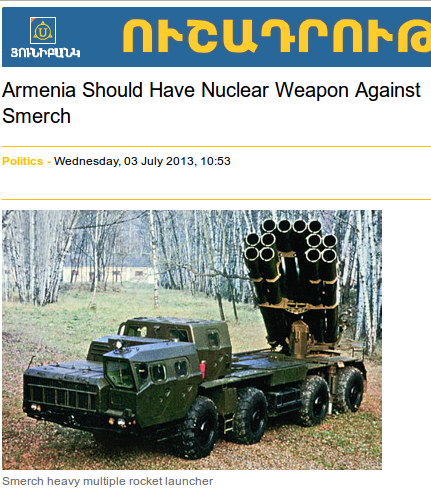
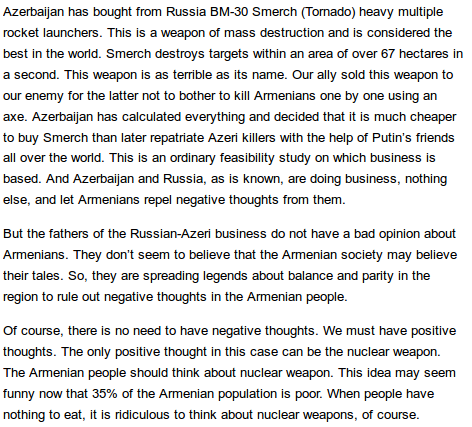
 http://www.lragir.am/index/eng/0/politics/home/30344
U.S. Forcing Japan to Burn Plutonium In Nuclear Reactors
The AMERICAN Government Is Dictating Japanese Nuclear Policy

Image source ; http://laughingsquid.com/bully-a-touching-documentary-about-bullying-in-american-schools/
Mainichi reports:
A Japanese prime ministerial envoy secretly promised to the United States that Japan would resume its controversial “pluthermal” program, using light-water reactors to burn plutonium, according to documents obtained by the Mainichi.
***
The revelation comes as Japan’s pluthermal project remains suspended in the wake of the Fukushima No. 1 Nuclear Power Plant disaster due to safety concerns. The fact that a Japanese official promised to the U.S. to implement such a controversial project without a prior explanation to the Japanese public is expected to stir up controversy.
***
Under the pluthermal plan, spent nuclear fuel generated in light-water reactors is reprocessed to extract plutonium, which is then mixed with uranium to create mixed-oxide (MOX) fuel for use in power generation. However, many experts have raised questions about the program, citing its high costs and the risks posed by the fuel’s comparatively low melting point and the decreased effectiveness of control rods.
***
The documents that the Mainichi obtained are a compilation of cables recording the Ogushi-Poneman talks in the U.S. on Sept. 12 last year. During the meeting, Ogushi explained that Japan would inject all available policy resources to break away from nuclear power generation in the 2030s, that it would steadfastly promote the nuclear fuel cycle program in the medium and long term….
***
Despite the country not knowing which nuclear reactors will be authorized to resume operations following the July implementation of the new regulatory standards, the government has been pushing ahead with its plans to restart the controversial pluthermal program.
“It is abnormal for sure,” said one official with the Agency for Natural Resources and Energy. “But it can’t be helped if the Rokkasho plant is to be put into operation.”
We explained last year:
The former Japanese Ambassador to Switzerland – Mitsuhei Murata – said recently:
In the US there are 31 [sic] units the same type of that of Fukushima nuclear plant [23 are virtually identical to Fukushima]. So, if the accident be spread too far that really embarrasses the US. So that is why the crisis of Unit 4 has been toned down recently. The USA is actually the main reason.
***
This is not the only indication that the U.S. has had a large role in Japanese nuclear policy after the Fukushima disaster. For example – in an effort to protect the American nuclear industry – the U.S. has joined Japan in raising “acceptable” radiation levels after the disaster.
U.S. Secretary of State Hillary Clinton also purportedly signed a pact with her counterpart in Japan agreeing that the U.S. will continue buying seafood from Japan, despite the fact that the FDA is refusing to test seafood for radiation in any meaningful fashion. So U.S. actions are helping to protect a pro-nuclear policy in Japan.
Indeed, leading Japanese newspaper Nikkei also reports that it was President Obama and Secretary of State Clinton who pressured the Japanese to re-start that country’s nuclear program after the Japanese government vowed to end all nuclear power in the wake of the Fukushima disaster.
Ex-SKF reports:
Japanese media has been saying for some time that it was the US government who pressured the Noda administration to drop the “zero nuke by 2030″ (which morphed into “zero nuke sometime in 2030s) from its new nuclear and environmental policy decision. Tokyo Shinbun reported it a while ago, and now Nikkei Shinbun just reported it with more details. There is no news reported in the US on the matter.
The difference of the Nikkei Shinbun’s article is that it names names: President Obama and Secretary of State Hillary Clinton.
It’s hard for me to believe that this president has time for trivial matters like actually governing the affairs inside and outside the US in the election year (he must be very busy right now preparing for the big “debate”), but that’s what Nikkei Shinbun wants us to believe. The article also mentions Secretary of State Clinton pressuring the Noda administration officials by strongly indicating it was the wish of President Obama and the US Congress that Japan scrap that silly nuclear energy policy.
Fennovoima has ended negotiations with Japan’s Toshiba to supply a nuclear reactor
…..Fennovoima said on Wednesday it had ended negotiations with Japan’s Toshiba on supplying a 1,600 megawatt reactor for the facility in northern Finland. In February it dropped France’s Areva from the process….
….consider the possibility of a smaller reactor because it not need to produce as much electricity as originally thought…..

| Bellona’s nuclear expert Andrei Ozharovsky being detained by the Finnish police during an anti-nuclear protest near Olkiluoto. 2011 |
| Tatyana Novikova |
UPDATE 2-Fennovoima homes in on Rosatom for nuclear project
* Rosatom may acquire a 33 pct stake in Fennovoima
* They aim to reach deal on reactor, stake by year-end
* Consortium ends talks with Toshiba
* Government to consider if original permit valid (Adds minister comment on permit approval issue)
HELSINKI, July 3 (Reuters) – Rosatom is the only player left in talks to supply a reactor to Finnish nuclear consortium Fennovoima for its planned power plant, and the Russian company may also take a stake in the consortium.
Fennovoima said on Wednesday it had ended negotiations with Japan’s Toshiba on supplying a 1,600 megawatt reactor for the facility in northern Finland. In February it dropped France’s Areva from the process.
The consortium’s CEO, Juha Nurmi, said Rosatom’s medium-sized reactor turned out to be more suitable for its owners’ needs than Toshiba’s larger one and said Rosatom’s interest in taking a stake in the project also played a role.
Rosatom, however, was not listed as a possible supplier in Fennovoima’s original permit, granted by the Finnish government and approved by the parliament in 2010, creating a judicial dilemma on whether the permit needs fresh approval.
Ghana lines up for nuclear cash hand outs!
…..In the US, for example, the size of the exclusion
area is such that an individual, located at any point on
its boundary for two hours immediately following the
onset of postulated fission product release, would not
receive a total radiation dose to the whole body in
excess of 25 rem (0.25 Sieverts) or a total radiation
dose in excess of 300 rem (3 Sieverts) to the thyroid
from iodine exposure (US NRC 2012). In most
countries the exclusion zone around a nuclear power
plant is about 0.5 km to 1 km and may even be more
in some countries (IAEA 1982)….Ghana’s Nuclear Energy Programme Implementation Organization (NEPIO), called the Ghana Nuclear Power Programme Organization (GNPPO), was inaugurated in September last year forming part of the first milestones required by the IAEA.
Image source ; www.erem.ktu.lt/index.php/erem/article/view/2655/2205

03 July 2013, Accra –
Ghana’s consideration of nuclear energy as a viable option has received a major boost last week following intense discussions between the State Atomic Energy Corporation of Russia -ROSATOM- and the Ministry of Energy and Petroleum, on the specifics of joint projects facilitating the implementation of plans by Ghana to develop a nuclear industry.
According to the Minister for Energy and Petroleum, Emmanuel Armah-Kofi Buah, the discussions now pave the way for the legal teams of both entities to put together a final memorandum of understanding (MoU) for real work to take off.

The move is a follow up to a MoU signed between the Ministry and ROSATOM last year in which the parties agreed to establish a bilateral cooperation in the field of nuclear energy for peaceful purposes.
The Minister, who took part in the International Atomic Energy Agency (IAEA) Ministerial Conference on Nuclear Power in 21st Century in Russia from June 27 to 29, 2013, of which sidelines the discussions took place, said Ghana is committed to considering Nuclear energy as a viable option in power generation and is putting the necessary measures in place to ensure the realization of that goal.

[Note ; Earthquake faults diagrams in report but not tsunami threat nor security issues]
He observed that the increasing demand for power in the country called for accelerated measures to venture into nuclear power, adding that the time has come for critical consideration of this option.
1 This Month

of the week – Shut Down Drone Warfare!


Tell the Ukrainian Government to Drop Prosecution of Peace Activist Yurii Sheliazhenko

Petition to revoke the licensing of the Near Surface Nuclear Disposal Facility (NSDF) at Chalk River. https://www.ourcommons.ca/petitions/en/Petition/Details?Petition=e-7247
To see nuclear-related stories in greater depth and intensity – go to https://nuclearinformation.wordpress.com
-
Archives
- March 2026 (230)
- February 2026 (268)
- January 2026 (308)
- December 2025 (358)
- November 2025 (359)
- October 2025 (376)
- September 2025 (257)
- August 2025 (319)
- July 2025 (230)
- June 2025 (348)
- May 2025 (261)
- April 2025 (305)
-
Categories
- 1
- 1 NUCLEAR ISSUES
- business and costs
- climate change
- culture and arts
- ENERGY
- environment
- health
- history
- indigenous issues
- Legal
- marketing of nuclear
- media
- opposition to nuclear
- PERSONAL STORIES
- politics
- politics international
- Religion and ethics
- safety
- secrets,lies and civil liberties
- spinbuster
- technology
- Uranium
- wastes
- weapons and war
- Women
- 2 WORLD
- ACTION
- AFRICA
- Atrocities
- AUSTRALIA
- Christina's notes
- Christina's themes
- culture and arts
- Events
- Fuk 2022
- Fuk 2023
- Fukushima 2017
- Fukushima 2018
- fukushima 2019
- Fukushima 2020
- Fukushima 2021
- general
- global warming
- Humour (God we need it)
- Nuclear
- RARE EARTHS
- Reference
- resources – print
- Resources -audiovicual
- Weekly Newsletter
- World
- World Nuclear
- YouTube
-
RSS
Entries RSS
Comments RSS
 nuclear-news