The government is leading a debate on the nation’s energy mix. Hollande has pledged to diversify generation by adding renewable energies such as wind and solar.
Electricite de France SA must improve safety at its 58 nuclear plants in the nation including ensuring spent fuel storage and reactor vessels are secure before it can win the regulator’s approval to operate them beyond 40 years.
“EDF must propose ambitious improvements for the safety of spent fuel storage” and be prepared to replace equipment on a large scale, Autorite de Surete Nucleaire said in a statement.
EDF, the biggest European power generator, has set aside billions of euros to improve safety and keep reactors running for as long as six decades. While some models due to run for 30 years were given approval to operate an extra decade, President Francois Hollande has ordered the halt of EDF’s oldest plant at Fessenheim in a first step to cutting reliance on atomic power.
While EDF’s program to extend the life of its reactors is “satisfactory,” it needs to be bolstered in some areas, the regulator said in a statement on its website. The demands for improved safety, beyond measures required after the Fukushima meltdown in Japan, seek to bring standards closer to those of newer nuclear models like the EPR, according to the regulator.
The safety of spent fuel storage at current reactors doesn’t meet the level of new installations, it said.
Under the regulatory system, the ASN carries out in-depth inspections of reactors every 10 years to determine whether they can function for another decade. This method will continue even as EDF seeks regulatory approval to replace equipment and carry out other work needed to enable reactors to run for 60 years.
“We are a long way from making a decision” on a possible extension beyond 40 years, Pierre-Franck Chevet, head of the ASN, told a parliamentary hearing in Paris in April. “We are at the very beginning of a process.”
The government is leading a debate on the nation’s energy mix. Hollande has pledged to diversify generation by adding renewable energies such as wind and solar.
The EU should stop “skewing” Europe’s energy market in favour of renewables and allow the UK to build a £14 billion nuclear reactor at Hinkley C, the deputy director-general of the Confederation of British Industry (CBI) has told EurActiv.
“We would hope that the European Commission would see nuclear as being a core part of our energy mix,” said Neil Bentley. “We have to start somewhere and Hinkley C is exactly the right place.”
“Let us get on with it,” he said.
Hinkley C would be the UK’s first new nuclear plant in a generation but because of the massive and potentially market-distorting subsidies it would need, the European Commission will probably need to approve it first.
EU sources say that while the UK is yet to formally notify the Commission of its plans, “there has been a lot of contact.”
“They know exactly what could fly and has a reasonable argumentation,” one EU official said on condition of anonymity. “These issues are very difficult, at national level as well.”
EurActiv understands that capacity markets and ‘aid to generation’ are two areas which Brussels believes could potentially square the circle between the UK’s energy strategy and EU subsidy rules.
Despite continental anti-nuclear trends since the Fukushima nuclear disaster in 2011, the UK is determined to plough ahead with nuclear builds.
With new capacity, “we can send out a powerful signal to overseas investors that we’re serious about a new nuclear renaissance, the decarbonisation of our electricity supply, and a huge creation of jobs in the engineering and construction supply chain,” Bentley said. “This is a massive prize.”
Terms of a UK-EDF deal reportedly involve a minimum ‘strike price’ of just under £100 per megawatt hour – around double the market rate – under a 30-40-year ‘Contract for Difference,’ which the Energy Commissioner, Günther Oettinger, has dubbed ‘Soviet’.
The British government is also offering generous strike prices to new wind farms – of £155 (€181) per megawatt hour for offshore, and £100 (€116) per megawatt hour for onshore plants – but over a much-shorter five-year time frame, before these begin declining.
The CBI supports the British government’s opposition to a 2030 target for renewable sources in the energy mix, arguing that the EU’s 20% baseline for renewables in 2020 has slanted investors against nuclear power.
A Christchurch couple, prominent in the anti-nuclear movement here and in the UK, have made an impassioned plea to the prime minister to use his powers to stop them being spied on.
Kate Dewes and Robert Green spoke of the stress surveillance had put them under when they appeared before parliament’s intelligence and security committee on Wednesday.
The committee is considering law changes which will allow the GCSB to snoop on New Zealanders.
The pair say the GCSB needs greater oversight and accountability to protect people from criminal activity by such agencies.
Dr Dewes said she had been spied on by the Security Intelligence Service since at least the mid-1980s while as a peace and anti-nuclear campaigner.
Things had escalated when she met former Royal Navy commander, Robert Green, a 20-year veteran who had piloted aircraft with nuclear weapons. Since leaving the services he has written a book about the 1984 murder of his aunt, Hilda Murrell, 78, an anti-nuclear campaigner.
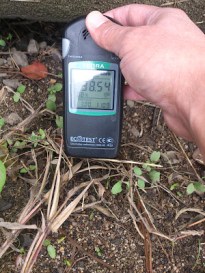
(Translation by Mia)Government officials held a meeting in Tamura-city in Fukushima prefecture to explain to residents that they need to look after themselves from now on. Originally they were aiming to reduce the level of contamination down to 0.23uSv/h (=added ionizing radiation 1mSv/y). However, they have now abandoned this aim and are not going to repeat any more decontamination.
The officials have suggested to residents that it’s ok to live there even if the level of radiation doesn’t go down below 0.23uSv/h as long as they monitor their exposure level by wearing the dosimeter and manage to live carefully inside their house so as not to be exposed to more than 0.23uSv/h.
The ‘decontamination’ effort in Fukushima continues despite the seemingly insurmountable obstacles, among which are:
1. After a specific property (or school) is ‘decontaminated’, it is nearly impossible to prevent it from becoming re-contaminated with radiation from neighboring properties that have yet to be ‘decontaminated’ when it rains or when the wind blows.2. Short of actually cutting down all the forests and shaving the topsoil (both large sources of radiation) off the surface of the mountains in the entire contaminated area, true ‘decontamination’ will be impossible.
3. Many companies in charge of ‘decontamination’ are simply small, local construction companies that have no experience or expertise in ‘decontamination’ and offer employees nearly no specialized training and even less personal protection.
4. During ‘decontamination’, which often takes place around schools and homes where children live, the actual act of cutting down trees and removing contaminated dirt in and of itself causes radiation to become airborne once again and causes danger to people, and especially to children, breathing in the contaminated dust.
5. ‘Decontamination’ is viewed by many citizens of Fukushima as a way for the government to make residents “feel safe”, therefore terminating the discussion of evacuation and, more importantly, the associated cost to the government of providing financial compensation to those affected.
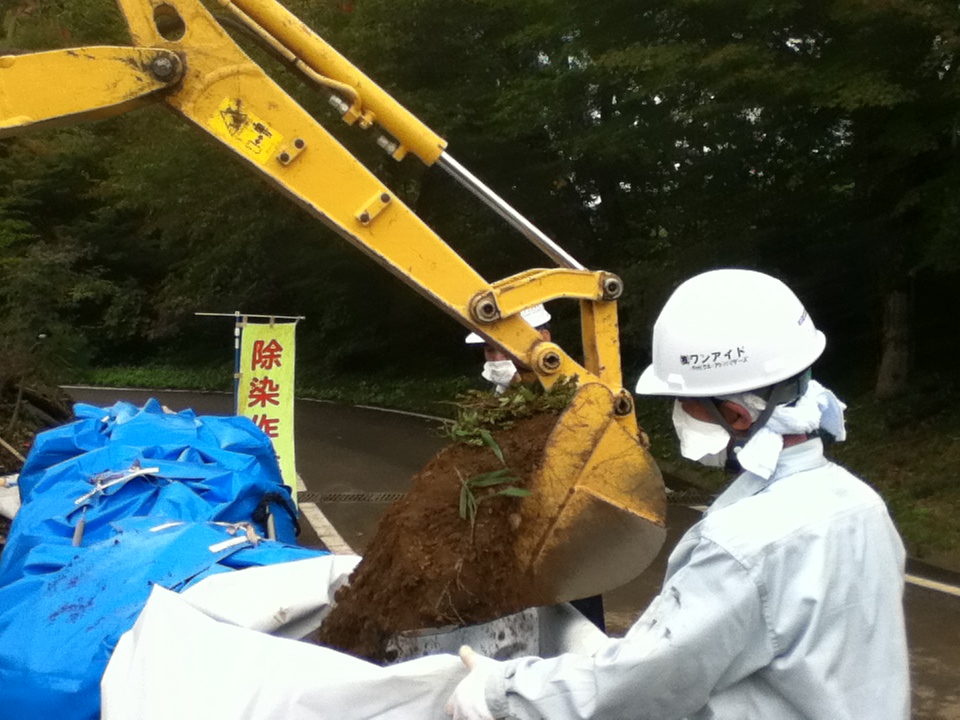
A worker fills sacks with contaminated dirt during the ‘decontamination’ of a home in Date City, Fukushima.
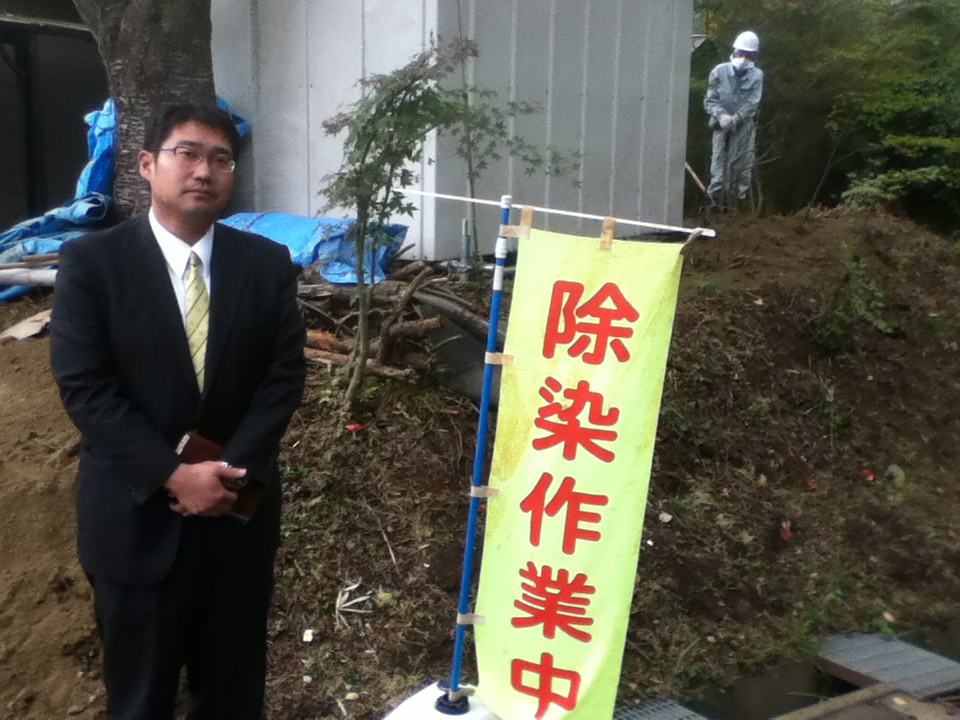
Today I met with Date City council member Mr. Yoshiaki Kanno to discuss the concerns of the citizens living in the area. We met on the property of one of his constituents whose home is currently undergoing ‘decontamination’. He told me that like the people he represents, he too, thinks ‘decontamination’ is impossible, and that the people should at least be given the option to evacuate and receive compensation. Mr. Kanno did make it clear that this needed to be an “option” as there are people, including some elderly, who have expressed their desire to remain in their homes and on their ancestral land.
Mr. Yoshiaki Kanno, a Date City council member, visits the decontamination site of one of his constituents.
I spoke with one of the ‘decontamination’ workers and asked him where all the radioactive dirt was being taken. He told me that the government hadn’t been able to figure that out yet, so individual municipalities were required to find local places to “temporarily” collect the sacks of contaminated soil until a long-term solution could be found. I asked him how long “temporarily” meant, and he said his guess would be “somewhere around 10 years”. The mountains of bags containing contaminated soil are exposed to the air and are, in some cases, just hundreds of meters away from homes where children are currently living.









 nuclear-news