

Nuclear waste cleanup a financial bonanza for UK firm
 Nuclear waste: Clean-up Quandary.FT, By Sylvia Pfeifer, 1 July 13, More reactors are to be built but a permanent solution for high-level waste remains elusive …….
More than 50 years after the world’s first commercial nuclear power plants started operating in the UK and the US, the tens of thousands of tonnes of spent nuclear fuel in the world still has to find a permanent home.
The absence of a permanent solution for high-level waste is one of the biggest challenges facing the industry as it tries to recover from the deadly disaster at Japan’s Fukushima plant in 2011. Several governments scaled back their expansion plans, with Germany announcing plans to close all its reactors. The International Energy Agency last year predicted that global nuclear generating capacity would reach 580GW in 2035 – a 10 per cent drop from its forecast a year before.
Yet new reactors, and more waste, are not far off…..
Alvin Weinberg, an American nuclear pioneer, famously said that atomic power represents a Faustian bargain: a valuable source of electricity that carries with it an obligation to deal with the waste. “New nuclear should not go ahead until we have sorted out the waste problem,” says Doug Parr, chief scientist at Greenpeace, adding that the environmental organisation is “concerned about a new round of spent fuel set to be created”…..
“We have an obligation to get it right . . . We are like a shopfront for the nuclear industry,” admits Tony Price, brought in recently by Nuclear Management Partners (NMP),as the managing director of Sellafield Limited. “It’s time now to really focus on delivery,” he adds………

In the short term, the pressure is on NMP to deliver at Sellafield. Yet the potential prize is much bigger than just cleaning up one of the world’s most polluted sites. There are potential export contracts for companies involved in the decommissioning work and for west Cumbria it offers much-needed employment opportunities. Success at Sellafield would also mean success on a wider scale.http://www.ft.com/cms/s/0/77c177ba-dcba-11e2-b52b-00144feab7de.html#axzz2XvB1ouop
Japan’s wind energy systems to increase, with off shore turbines
What is not well known is that Japan has considerable wind power, and that its string of wind turbines continued to function throughout the 2011 tsunami disaster.
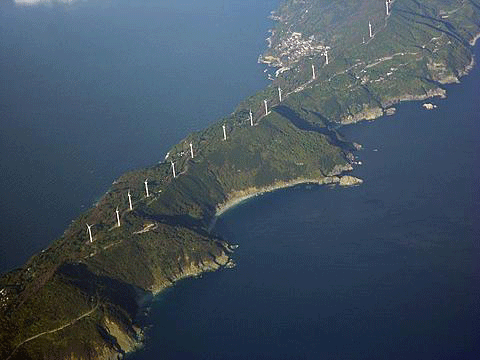
Work starts on Fukushima floating project Wind Power Monthly 25 June 2013 by Martin Foster, JAPAN: Installation of wind turbines in the testing phase of the biggest offshore floating project to date will finally get under way this week, 20 kilometres off the coast of Fukushima. Two 2MW downwind floating turbines are scheduled to be towed from shipyards belonging to Mitsui Engineering and Shipbuilding in Chiba prefecture to Onahama port on 28 June, according to a new schedule released by Takeshi Ishihara a civil engineering professor at the University of Tokyo and technical adviser to the project…….
The cable is scheduled to be loaded on ship, laid and sunk in the seabed from the end of July until the end of August. It is planned to connect the cable some time in the month of August, with the project due to start generating power in mid-September.
The massive floating wind farm project, which is being developed by an 11-entity consortium lead by Marubeni Corporation, may eventually see 132 floating turbines come on line. It has been named Fukushima Mirai, literally the future of Fukushima, and has been planned as part of post-nuclear disaster recovery efforts in the area.
The project fulfils a ten-year dream for Ishihara.
“I feel that we have taken the first real step towards finally realising the dream I have embraced for the past ten years. I am really pleased,” he told Windpower Monthly. http://www.windpowermonthly.com/article/1187536/work-starts-fukushima-floating-project
Edward Snowden speaks out, from Moscow
 Statement from Edward Snowden in Moscow Edward Joseph Snowden 1st July 2013 One week ago I left Hong Kong after it became clear that my freedom and safety were under threat for revealing the truth. My continued liberty has been owed to the efforts of friends new and old, family, and others who I have never met and probably never will. I trusted them with my life and they returned that trust with a faith in me for which I will always be thankful.
On Thursday, President Obama declared before the world that he would not permit any diplomatic “wheeling and dealing” over my case. Yet now it is being reported that after promising not to do so, the President ordered his Vice President to pressure the leaders of nations from which I have requested protection to deny my asylum petitions.
This kind of deception from a world leader is not justice, and neither is the extralegal penalty of exile. These are the old, bad tools of political aggression. Their purpose is to frighten, not me, but those who would come after me.
For decades the United States of America has been one of the strongest defenders of the human right to seek asylum. Sadly, this right, laid out and voted for by the U.S. in Article 14 of the Universal Declaration of Human Rights, is now being rejected by the current government of my country. The Obama administration has now adopted the strategy of using citizenship as a weapon. Although I am convicted of nothing, it has unilaterally revoked my passport, leaving me a stateless person. Without any judicial order, the administration now seeks to stop me exercising a basic right. A right that belongs to everybody. The right to seek asylum.
In the end the Obama administration is not afraid of whistleblowers like me, Bradley Manning or Thomas Drake. We are stateless, imprisoned, or powerless. No, the Obama administration is afraid of you. It is afraid of an informed, angry public demanding the constitutional government it was promised — and it should be.
I am unbowed in my convictions and impressed at the efforts taken by so many.
Japan’s nuclear industry hope to restart, but delay safety upgrades
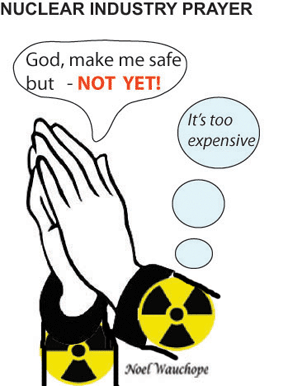
I couldn’t help being reminded of Saint Augustine’s famous prayer – “God make me pure – but not yet!”
The cost of upgrading all of the nuclear power plants is expected to exceed ¥1 trillion.
Nuclear safety rules put onus on utilities Japan Times, BY KAZUAKI NAGATA , 1 July 13, The Nuclear Regulation Authority on July 8 will begin enforcing new safety standards at atomic power stations, more than two years after Tokyo Electric Power Co.’s Fukushima No. 1 plant experienced three reactor core meltdowns…………
Utilities are meanwhile hoping that the regulators will be lenient with reactor restarts as long as they agree
to upgrade their plants to the new safety regime over time……
A major difference is that it will now be mandatory for utilities to install defenses that can prevent meltdowns from being caused by natural disasters — such as earthquakes, tsunami and tornadoes — as well as defenses against terrorist attacks…… Continue reading
UK’s nuclear waste mess at Sellafield, like USA’s at Hanford?
Nuclear waste: Clean-up Quandary.FT, By Sylvia Pfeifer, 1 July 13, More reactors are to be built but a permanent solution for high-level waste remains elusiveMore reactors are to be built but a permanent solution for high-level waste remains elusiveA hulking building faced with dirty yellow concrete, B30 sits at the heart of Sellafield, a sprawling nuclear site on the windswept coast of Cumbria in northwest England. Surrounded by a fence topped with razor wire, this is no ordinary building. But it’s only when the small device hooked to the pocket of my guide’s overalls begins to click as we draw closer to the building that my heart skips a beat.
The exterior tells you nothing but inside B30 lies some of the most radioactive waste in the world. It is one of four pond and silo facilities built in the 1950s and 1960s to store irradiated fuel from Britain’s first atomic reactors.
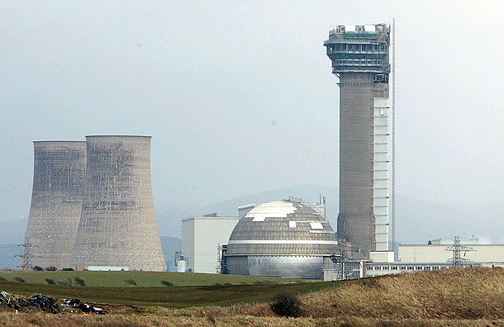
Over the years, it has accumulated large amounts of waste, sludge from corroded fuel casings and other debris that has blown in. B30 is as nasty as they come – hence the clicks from my guide’s pocket gadget, which measures the amount of radiation to which we are exposed. On the outside, we are safe but just a glimpse of B30 is an unsettling reminder of Britain’s nuclear legacy.
The site of a former munitions factory, Sellafield has seen it all. By the early 1950s, the site’s two Windscale reactors, as Sellafield was then known, were making plutonium for nuclear weapons. By the middle of the decade, Calder Hall, the world’s first commercial nuclear power station, was opened. More reactors followed, as did reprocessing activities. Today, the site’s main focus is on managing waste safely and cleaning up the legacy of the past. The estimated cost is £67.5bn and rising.
“Our aim is to put ourselves out of business, to tidy the toys away,” says John Clarke, chief executive of the Nuclear Decommissioning Authority, the government body set up in 2005 to oversee the job….. . http://www.ft.com/cms/s/0/77c177ba-dcba-11e2-b52b-00144feab7de.html#axzz2XvB1ouop
A bad idea, burning radioactive trash in Fukushima
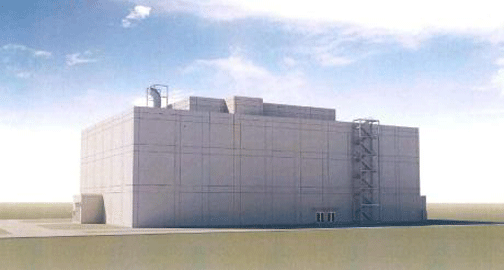
Nuclear Information and Resource Service Now here’s a bad idea: Tepco building incinerator for Fukushima radwaste. Will spread radiation through the air. http://bit.ly/11YFs9M Fukushima waste incinerator takes shape Construction of an incinerator is underway at the Fukushima Daiichi plant to burn the low-level waste (LLW) being generated from the clean-up and decommissioning of the site. (Diagram of planned incinerator below)
Update:
Small fire reported at Fukushima nuclear plant
TOKYO —
A fire broke out in a rubbish pile at the crippled Fukushima Daiichi nuclear complex on Tuesday, the operator said, the latest in a series of incidents at the crippled plant.
Workers discovered flames licking at piles of cardboard boxes placed near an incineration facility shortly before 1 p.m., Tokyo Electric Power Co said.
The fire damaged an area of about four meters by two meters, but was put out in a hour, it said.
The fire did not affect radiation levels in the plant, and no one was injured, it said.
TEPCO has struggled with a growing number of incidents at the plant including several leaks of radioactive water, more than two years after the worst nuclear disaster in a generation.
Improvised fixes put in place since the disaster leave it vulnerable to problems and at the mercy of nature, with no immediate end in sight, critics say.
© 2013 AFP
Ernest Moniz – the nuclear lobby’s man in government
Platts reported (1 July 13) on USA’s Energy Secretary’s enthusiasm for nuclear power – “Energy Secretary Ernest Moniz on Monday reiterated the Obama administration’s commitment to promoting nuclear energy ”
Australia’s scandalous history of disease and death from nuclear bomb testing
A powerful manuscript entitled “The Black Mist and its Aftermath — Oral Histories by Lallie Lennon” (2010) was submitted to the South Australian and federal governments as well as to the International Atomic Energy Agency
Now aged in her 80s, Lallie has never had her health issues properly investigated, much less received any compensation. She continues to suffer from the beta burn-related skin condition to this day.
Professor Sir Ernest Titterton, the duplicitous architect of nuclear testing in Australia, typified the official contempt for survivors when he dismissed the Black Mist event as a “scare campaign”.
More recently, the ultra-right wing Herald Sun columnist Andrew Bolt has repeated this line.

 Australian atomic massacre still ignored http://www.greenleft.org.au/node/54394, June 29, 2013 By David T. Rowlands Nearly 60 years have passed since Totem 1, a British nuclear test in the Australian desert, was recklessly conducted in unfavourable meteorological conditions.
Nuclear testing of any sort, even in the most “controlled” of circumstances, is inherently abusive, a crime against the environment and humanity for countless generations to come. Yet the effects of Totem 1 were particularly bad, even by the warped standards of the era.
The mushroom cloud did not behave in the way it was supposed to. Instead of rising uniformly, part of it spread laterally, causing fallout to roll menacingly at ground level over a remote yet still populated corner of South Australia, sowing injury, illness and death in its wake.
The number of casualties is unknown because the secretive and unaccountable nuclear establishment has always declined to investigate the full impact of its own criminal negligence. But it has been suggested by investigators that perhaps 50 short-term Aboriginal fatalities resulted.
In addition to those who died, many others were exposed to harmful levels of radiation. The long-term health effects on these individuals have never been charted — but anecdotal reports of high cancer rates and horrendous birth defects in isolated “downwinder” communities have circulated.
At the time of the tests, it was well known by authorities that communities of Aboriginal people were close by. Yet the official attitude was that the concerns of a “handful of natives” could not be allowed to interfere with the “interests” of the British Commonwealth. Continue reading
USA House Republicans want more weapons money, less money for renewable energy
 House Republicans Think $911 Million In 2014 Renewable Energy Funding Should Go To Military Clean Technica July 1, 2013 This past Tuesday, President Obama unveiled his second-term plan for cutting carbon emissions, and delivered a bracing call for the American economy to advance into a clean energy future. This past Wednesday, House Republicans responded by moving a bill out of the Appropriations Committee that would cut investments in renewables by nearly a billion dollars.
The legislation in question is the Energy and Water appropriations bill, which is the fifth of twelve spending bills the House must pass to establish the discretionary budget for 2014. Sequestration — the across-the-board spending cuts that went into effect earlier this year — set a top-line level of $967 billion for that spending. But Republicans are attempting to ease the cuts to the military by slicing even deeper into other programs. That led to a party-line vote in the committee to cut renewable investments in the bill by $911 million from their level in 2013……http://cleantechnica.com/2013/07/01/house-republicans-think-911-million-in-2014-renewable-energy-funding-should-go-to-military/
Global nuclear radioactive trash problem – no solution in sight
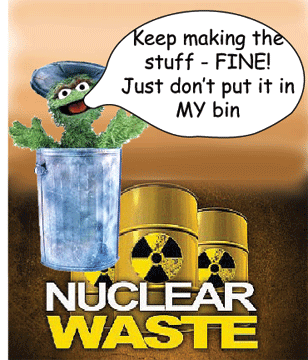

it’s just plain stupid to keep on making the stuff
Nuclear waste: Clean-up Quandary.FT, By Sylvia Pfeifer, 1 July 13 “….Today, apart from Finland and Sweden, most countries have not agreed on a site for their high-level waste. In the US, the issue has stalled after President Barack Obama withdrew support for a facility in the Yucca Mountains in Nevada. Britain, too, has gone back to the drawing board after Cumbria voted against storing the waste this year.
France, meanwhile, which derives 75 per cent of its electricity from nuclear energy, is seeking to store its waste underground near Bure, a remote area in the east of the country. Public debates have had to be postponed because of local opposition.
For now, spent fuel from the UK’s reactors is transported to Sellafield in specifically designed flasks, removed and stored in big ponds to cool. It is dissolved in nitric acid and separated into uranium (96 per cent), plutonium (1 per cent) and waste products (3 per cent). The high-level waste is fused into borosilicate glass using a process called vitrification. The resulting mixture is poured into stainless steel canisters and stored pending availability of an underground repository.
Intermediate waste, which includes materials such as fuel element cladding and contaminated equipment, is put into stainless steel drums that are then filled with cement before being stored at the sites where it is created.
Cleaning up the legacy of the past is a particular problem for western nations such as the US and the UK and, to a lesser extent, France, whose involvement in the arms race has left them with military as well as civil waste. In the US, the former plutonium production facility at Hanford in Washington is the subject of a big clean-up operation and political wrangling about rising costs and delays, as well as concerns about contamination of groundwater.
Cleaning up the legacy of the past is a particular problem for western nations such as the US and the UK and, to a lesser extent, France, whose involvement in the arms race has left them with military as well as civil waste. In the US, the former plutonium production facility at Hanford in Washington is the subject of a big clean-up operation and political wrangling about rising costs and delays, as well as concerns about contamination of groundwater.
In Europe, the true scale of the challenge is laid bare at Sellafield, the continent’s most complex facility which employs about 10,000 people. Decades of mismanagement and a lack of urgency have dogged the site, which was passed from one government agency to another. During the miners’ strike of 1972, when the imperative was to keep the lights on, the site’s Magnox power reactors were run flat-out, resulting in a faster build-up of spent fuel than they could handle. Much was dumped in the silos and ponds…….http://www.ft.com/cms/s/0/77c177ba-dcba-11e2-b52b-00144feab7de.html#axzz2XvB1ouop
AUDIO: nuclear lobby’s hype about thorium reactors doesn’t impress investors
investors are refusing to put their money into either nuclear power, or this supposedly ‘new’ thorium idea, which is actually a very old idea being recycled from the 1960′s when it was found not workable. So why should the public put their tax money into thorium reactors?
 http://agreenroad.blogspot.ca/2012/12/thorium-reactor-fort-st-vrain-power.html MSR Thorium Reactor Fort St. Vrain Power Station Experiment Failed – A Green Road Magazine, 1 July 13
In the video / audio above, Dr. Helen Caldicott MD interviews Dr. Arjun Makhijani (a plasma expert) who explains the downsides of the proposed MSR and LFTR thorium reactors and why renewable solar or other renewable energy sources such as wind, water, tides, geothermal and hydrogen will save money and save lives long term. http://ifyoulovethisplanet.org/?p=6100
Contrary to the claims made or implied by thorium proponents, however, thorium doesn’t solve the proliferation, waste, safety, or cost problems of nuclear power, and it still faces major technical hurdles for commercialization.

The pro-thorium lobby claim a single ton of thorium burned in a Molten Salt Reactor (MSR) – typically a Liquid Fluoride Thorium Reactor (LFTR) – which has liquid rather than solid fuel, will operate safely, efficiently and profitably. However, the investment industry is turning a cold shoulder to the idea that Thorium is anything but a boondoggle. Why? Maybe because these investors are putting their money on the line, and they do their due diligence. Maybe, just maybe, these investors have looked into this fantasy to see what the actual facts are behind the pro thorium lobby claims. Continue reading
Renewable energy the most economic choice for Tonga
 Tonga’s renewable energy push Petroleum Economist 01 July 2013 Following rising oil costs, the Kingdom is looking to alternative energy to reduce its reliance on imports, writes Helen Robertson TONGA is facing an energy crisis as soaring oil-import bills are crippling its economy. The Kingdom is now looking to renewable energy to alleviate its oil dependency.
Tonga is made up of an archipelago of 176 islands in the South Pacific, around 2,000 kilometres northeast of New Zealand. Tonga is highly susceptible to both climate change and energy-price volatility because of its high dependency on imported oil. All of Tonga’s grid-supplied power, which makes up 98% of its total electricity, is generated using imported diesel.
According to the US Energy Information Administration Tonga imported around 1,240 barrels of oil per day (b/d) last year. This is up from around 780 b/d in 2002.
Although the small Kingdom, of around 100,000 people, is no energy-consuming powerhouse its dependency on oil is a huge economic stranglehold. Between 2005 and 2008 Tonga’s electricity generation costs increased by 106%...( subscribers only) http://www.petroleum-economist.com/Article/3225512/Tongas-renewable-energy-push.html#ixzz2XvZJrWip
Abe reforms take aim at Japan’s $1 trillion pension fund – Pension scam?
…Sir Martin’s maximum annual bonus opportunity was 435% of his base salary in 2012, with 50% of the award deferred for two years and subject to clawback provisions. The proposed new long-term incentive plan provides for long-term awards of up to 9.74 times salary in the case of the CEO….
Reuters — Jul 02
Visitors to Japan’s public pension fund can’t miss signs of the low-cost, low-return culture that Prime Minister Shinzo Abe seems determined to change with a review of its operations that kicked off on Monday.
There is no receptionist at the dimly lit, 40-year-old Tokyo building where the headquarters of the Government Pension Investment Fund, the world’s largest pension, occupies the second floor.
The waiting area consists of two mismatched couches. Behind a single closed door, over $1 trillion – equivalent to the annual economic output of South Korea – is run almost on autopilot and invested largely in government bonds issued across the street by Japan’s Finance Ministry.
Equally worrying for critics, including members of Japan’s ruling Liberal Democratic Party, the fund has no independent board for oversight, no ability to hire in-house fund managers and no record of success during a period of economic growth of the kind Abe has pledged to deliver to voters and markets.
Officials led by chairman Takahiro Mitani say the fund, known as GPIF and which employs less than 80 people, has performed according to the mandate set by its supervisor, the Ministry of Health and Welfare: keep costs down and risks in check.
What happens next, they say, will depend on the reforms the Abe administration enacts in the coming months as it looks to mobilise public savings to help drive Japan out of two decades of deflation and sluggish growth.
http://newsonjapan.com/html/newsdesk/article/103423.php
Retirement Heist: How Firms Plunder Workers’ Nest Eggs
Ellen Schultz breaks down the scam nicely from 5.00 mins
10/19/2011
Why was GE closing its fully funded pension plan, while continuing its financially burdensome executive plan? This is the question to which Ellen Schultz’s incisive new book, Retirement Heist: How Companies Plunder and Profit from the Nest Eggs of American Workers (Portfolio, 2011) offers a powerful answer.
[…]
A carefully planned heist
She explains that the current retirement crisis is “not a demographic accident. It was manufactured by an alliance of two groups: top executives and their facilitators in the retirement industry—benefits consultants, insurance companies and banks.”
Executives are viewed “as beleaguered captains valiantly trying to keep their overloaded ships from being sunk in a perfect storm. In reality, they’re the silent pirates who looted the ships and left them to sink, along with the retirees, as they sailed away safely in their lifeboats.”
In 2000, most pensions were fully funded
UN chief warns of nuclear “dirty bomb” threat and of attacks on nuclear power plants
Amano earlier warned the IAEA-hosted conference against a “false sense of security” over the danger of nuclear terrorism.
Holding up a small lead container that was used to try to traffic highly enriched uranium in Moldova two years ago, the U.N. nuclear chief said it showed a “worrying level of knowledge on the part of the smugglers”.
“This case ended well,” he said, referring to the fact that the material was seized and arrests were made. But he added: “We cannot be sure if such cases are just the tip of the iceberg.”
Obtaining weapons-grade fissile material – highly enriched uranium or plutonium – poses the biggest challenge for militant groups, so it must be kept secure both at civilian and military facilities, experts say.
An apple-sized amount of plutonium in a nuclear device and detonated in a highly populated area could instantly kill or wound hundreds of thousands of people, according to the Nuclear Security Governance Experts Group (NSGEG) lobby group.
UN nuclear chief warns of “dirty bomb” threat
Published On Monday, July 01, 2013
By admin. Under: EU, NEWS, Uncategorized
[The article has been redacted and only a comment under a picture remains – Arclight2011part2]
emergency worker takes part in exercises during an emergency response drill to simulate the aftermath of a dirty bomb explosion outside Madrid December 2, 2010.
http://egazette.eu/uncategorized/un-nuclear-chief-warns-of-dirty-bomb-threat/
Fukushima new ‘blueprint’ for terrorists? Harvard Professor: “All you need to do is cut off power for an extended period”
Published: July 1st, 2013 at 9:42 pm ET
By ENENews
Title: Fukushima Shows Nuclear-Terrorism Risks at UN Meeting
Source: Bloomberg
Author: Jonathan Tirone
Date: Jul 1, 2013
Japan’s Fukushima Dai-Ichi nuclear plant, whose 2011 meltdowns dislocated 160,000 people, may provide a new blueprint for terrorists seeking to inflict mass disruption, security analysts said at a United Nations meeting.
The UN’s International Atomic Energy Agency convened a weeklong meeting of 1,300 diplomats, scientists and security analysts today in Vienna to examine ways to boost protection against nuclear terrorism. It is the IAEA’s first ministerial conference.
“Fukushima sent a message to terrorists that if you manage to cause a nuclear power plant to melt down, that really causes major panic and disruption in a society,” Matthew Bunn, a Harvard University professor and former White House adviser, said at a briefing. “All you need to do to do that is cut off the power for an extended period of time.” […]
IAEA chief sounds warning on nuclear terrorism<
[The News] 02 Jul, 2013
VIENNA: The head of the UN atomic agency warned on Monday against complacency in preventing “nuclear terrorism”, saying progress in recent years should not lull the world into a false sense of security. “Much has been achieved in the past decade,”
Yukiya Amano of the International Atomic Energy Agency told a gathering in Vienna of some 1,200 delegates from around 110 states including 35 ministers to review progress on the issue.
“Many countries have taken effective measures to prevent theft, sabotage, unauthorised access, illegal transfer, or other malicious acts involving nuclear or other radioactive material. Security has been improved at many facilities containing such material.”
Partly as a result, he said,
“there has not been a terrorist attack involving nuclear or other radioactive material.”“But this must not lull us into a false sense of security. If a ‘dirty bomb’ is detonated in a major city, or sabotage occurs at a nuclear facility, the consequences could be devastating.
Tahiti nuclear fallout worse than previously admitted and French Test veterans reaction
“There is one document that says in Tahiti, the fallout of plutonium is 500 times higher than the maximum dose that human beings can have. This is a big worry for us.”
The petition we would like you to support can be accessed HERE
Image source ; http://www.ctbto.org/nuclear-testing/the-effects-of-nuclear-testing/frances-nuclear-testing-programme/

Posted at 03:36 on 02 July, 2013 UTC
Declassified French documents show that the fallout from the nuclear weapons tests in French Polynesia was far greater than previously admitted by Paris.
Following the release of more than 2,000 documents about the atmospheric tests of 1966-1974, the test veterans group says the French authorities measured a plutonium concentration in Tahiti of 500 times the safety limit.
Tahiti is about 1,400 kilometres from Moruroa but under current French law it’s outside the zone where compensation claims for poor health can be lodged.
The documents, which include 114 blank pages, confirm that the fallout from the tests affected all areas and not only the 21 atolls, which the French military had listed so far.
The documents also reveal that a total of 26 navy vessels were contaminated.
The Moruroa e tatou test veterans group has called on France to let it know the full truth about the tests’ impact.
The latest batch of documents was released on a court order amid a warning by the veterans that they would be taking France to the European Human Rights Court.
News Content © Radio New Zealand International
PO Box 123, Wellington, New Zealand
http://www.rnzi.com/pages/news.php?op=read&id=77235
Tuesday, 25 June 2013
Bruno Barrillot Champion of the victims of Nuclear Tests in French Polynesia Needs YOUR Support
|
In 2012 the BNTVA delegation to AVEN’s Conference in Bordeaux met with a very inspirational and humble person; Bruno Barrillot. It was with some concern we learned of the actions of the newly elected French Polynesian government and their attempts to silence Bruno.
Since 1984, Bruno Barrillot, a researcher with the Armaments Observatory, has repeatedly condemned the harm done to test sites personnel, local populations and the environment by the 210 French nuclear tests in the Sahara and in French Polynesia. He is one of the founders of AVEN (Nuclear Tests Veterans Association in France) as well as well as Moruroa and tatou (Nuclear Tests Veterans Association in French Polynesia).
|
| John Doom, Bruno Barillot et Roland Oldham © Anne-Laure GUFFROY |

In 2005, Bruno Barrillot (Pictured in the centre above) was asked by French Polynesia’s Government to ensure the consequences of nuclear testing in French Polynesia were properly addressed.
1 This Month
10 March A LIVE WEBINAR THE REAL EFFECTS OF NUCLEAR POWER
What the Industry Isn’t Telling Us
1:00 PM Mountain, 2 pm Central, 3 pm Eastern. Live on the Keepers of the Water Facebook page



18 March Webinar @ 1 PM EST: An Assessment of SMR Projects: The Case of Canada
register for the zoom:
https://us02web.zoom.us/webinar/register/WN_o8BIIOUvQ2ONJR1nta65DQ#/registration


of the week – STOP SMALL MODULAR REACTORS IN CANADA
To see nuclear-related stories in greater depth and intensity – go to https://nuclearinformation.wordpress.com
-
Archives
- March 2026 (119)
- February 2026 (268)
- January 2026 (308)
- December 2025 (358)
- November 2025 (359)
- October 2025 (376)
- September 2025 (258)
- August 2025 (319)
- July 2025 (230)
- June 2025 (348)
- May 2025 (261)
- April 2025 (305)
-
Categories
- 1
- 1 NUCLEAR ISSUES
- business and costs
- climate change
- culture and arts
- ENERGY
- environment
- health
- history
- indigenous issues
- Legal
- marketing of nuclear
- media
- opposition to nuclear
- PERSONAL STORIES
- politics
- politics international
- Religion and ethics
- safety
- secrets,lies and civil liberties
- spinbuster
- technology
- Uranium
- wastes
- weapons and war
- Women
- 2 WORLD
- ACTION
- AFRICA
- Atrocities
- AUSTRALIA
- Christina's notes
- Christina's themes
- culture and arts
- Events
- Fuk 2022
- Fuk 2023
- Fukushima 2017
- Fukushima 2018
- fukushima 2019
- Fukushima 2020
- Fukushima 2021
- general
- global warming
- Humour (God we need it)
- Nuclear
- RARE EARTHS
- Reference
- resources – print
- Resources -audiovicual
- Weekly Newsletter
- World
- World Nuclear
- YouTube
-
RSS
Entries RSS
Comments RSS
 nuclear-news