Japan disaster budget given to nuclear operator
“The funds were meant to help utility companies cope with higher operating costs when the government ordered them to suspend nuclear reactors,” said a ministry official.
In a town in the southern prefecture of Kagoshima, around 1,300 kilometres (800 miles) from the devastated city of Ishinomaki, three million yen was spent on the protection and observation of sea turtles.
Ten people were employed to count the creatures as they came ashore and to remind sightseers not to interfere with them.

Image source ; http://www.examiner.com/article/margaret-g-cahill-the-fact-behind-the-fiction-five-star-fraud-a-q-a
by Staff Writers
Tokyo (AFP) June 28, 2013
Money set aside to help earthquake, tsunami and nuclear victims has been allocated to power companies, officials in Japan said Friday, a move that could fuel fury among people who lost their homes.
About 10 billion yen ($100 million) of the 25 trillion yen pledged for disaster recovery over several years has been reserved to offset costs for utility companies that were ordered to shut nuclear power plants in the aftermath of the Fukushima disaster.
The news comes after it was revealed public cash had been used in areas seemingly unaffected by the natural catastrophe, including on beefing up security for Japan’s controversial whale hunt and on paying people to count turtles.
Officials said Friday that around 2 billion yen had already been given to Chubu Electric Power to help it make interest payments on bank loans taken out to fund the spiralling cost of fossil fuels.
Power companies had to ramp up their fuel imports to replace the power generation capacity lost when nuclear plants were shuttered.
Money was also used to provide heated water to local aquaculture facilities, which had previously received warm water from nuclear power plants, they said.
Future nuclear plans of Belarus dictatorship discussed at international forum
“..After Fukushima accident we recommended the Japanese government to address Belarus for help”. Amano
According to Vladimir Potupchik, Belarus will continue creating the infrastructure in spite of serious outside pressure.

Image source ; http://www.guardian.co.uk/world/2010/dec/17/wikileaks-belarus-leader-bizarre-disturbed
30 June 21:40
Vadim Shcheglov: The head of the IAEA Yukiya Amano has recently paid a visit to Belarus and was impressed by Ostrovets project. The Minister of Energy Vladimir Potupchik announced that Belarus is going to start the construction of the NPP. The experts of the IAEA thoroughly supervise every stage of the construction.
Yukiya Amano, director general of the IAEA: “I visited a special emergency response center in Belarus and was greatly impressed by it. I know that your country gives a high priority to emergencies response and has the corresponding facilities. After Fukushima accident we recommended the Japanese government to address Belarus for help”.
According to Vladimir Potupchik, Belarus will continue creating the infrastructure in spite of serious outside pressure.
Alexander Bychkov, Deputy Director General of the IAEA: “Unfortunately, Belarus lacks its own resources to develop the power and nuclear plant is one of the best solutions for such an economy, as it will provide stable electricity for the industry and population”.
Belarus has already spent 250m USD to prepare the construction site. Mostly the Belarusian contractors are working on the site. The total cost of the project is 10bn USD and the project should work for the Belarusian economy. The first reactor in Ostrovets will become operational in 5 years and in 20 years Belarus will be producing half of its power from the nuclear plant.
http://www.tvr.by/eng/news.asp?id=6741&cid=15
Belarus authorities try to suppress coverage of anti-nuke demos
Published on Monday 29 April 2013.
Update: Henadz Barbarych and Alyaksandr Yarashevich were sentenced today to three days in prison. As the time they had spent in pre-trial detention was deducted from the sentence, they were due to be released this evening.
Reporters Without Borders condemns the arrests of at least six journalists on 26 April while they were covering anti-nuclear marches that environmentalists and opposition activists organize each year on the anniversary of the Chernobyl nuclear disaster.
Fukushima – 27 children have developed thyroid cancer so far!

30 June 2013
The most recent data on thyroid cancer 甲状腺がんの最新データ
(Source)
takenouchimari.blogspot.com
2013年6月時点での福島県での18歳未満での甲状腺検査結果 を記します。2005年には日本で10万人に1人であった未成年の甲状腺がんが、まだ正確な数値はデータを取っている途中なので、確定しませんが、少なく とも数十倍規模で事故1,2年後から増えていることが読み取れます。
First of all, let me give you the latest data of thyroid cancer test in Fukushima as of June 2013. Though we do not know the exact number since the examination is still underway and especially the 2nd tests had not been completed with many of the suspected subjects, we can tell that the incidence rate has already jumped dozens of times compared to the 2005 statistics of 1 thyroid cancer out of 100,000 among Japanese minors.
以下が最新の福島県甲状腺検査の結果報告です。
http://www.pref.fukushima.jp/imu/kenkoukanri/250605siryou2.pdf
Below is the latest Fukushima Prefectural Thyroid Examination Report.http://www.pref.fukushima.jp/imu/kenkoukanri/250605siryou2.pdf
現在2011年の11人、2012年度の16人、合計27人の甲状腺がんが確定しています。
As of now, 11 thyroid cancer kids in fiscal year of 2011 and 16 in 2012, in total 27 thyroid cancer cases were found.
11ページをご覧ください。
See the page 11.
2011年度には、40704人中、11人の甲状腺がんが発生しています。
(ただし、表3によりますと、205人中166人しか2次検査を受けていないため、残りの39人が検査を受けると、11人より増える可能性があります。)
http://fukushimaappeal.blogspot.co.uk/2013/06/fukushima-27-children-developped.html
Radiation exposure to workers at Hanford
 Workers at U.S. nuclear site exposed — Levels “well above threshold for a High Contamination Area” #Hanford http://enenews.com/workers-at-u-s-nuclear-site-exposed-levels-well-above-threshold-for-a-high-contamination-area-hanford
Title: PNNL staffers exposed to radioactive tritium in Richland
Source: The Bellingham Herald
Author: Annette Cary
Date: June 27, 2013
Two Pacific Northwest National Laboratory employees inhaled small amounts of radioactive tritium while doing work in the Hanford 300 Area last month. […]
Tritium inadvertently spread outside the fume hood, including along the routes to radiological trash disposal.
“Contamination levels on the floor immediately adjacent to the fume hood were well above the threshold for a High Contamination Area,” according to the defense board staff report. […]
The event is still under investigation and it’s too soon to say if any changes will be made to laboratory procedures, [PNNL spokesman Greg Koller] said.
See also: TV: “It appears the worst case scenario has happened” at U.S. nuclear site — Most dangerous material on earth “out of control”? — A whopping 800,000 dpm measured outside tank (VIDEO) #Hanford
Tepco’s nuclear decommissioning plan rubbished by regulators
 There is apparently no “Plan B” if the fuel debris cannot be removed. The Agency for Natural Resources and Energy said in the meeting that the reason why the concrete steps toward removing the fuel debris ahead of schedule was not mentioned in the roadmap was because they couldn’t figure out those steps yet.
NRA has been consulted, never mind that the commissioners and experts blasted their plan. For TEPCO and the government, particularly the government, a mere gesture of consulting with NRA is more than enough for procedural purposes.
Looking at TEPCO’s plan for fuel debris removal, as posted at NRA’s site, it is painfully clear that TEPCO was told by the Agency what to write (garbage).
Japan’s Nuclear Regulatory Authority Blasts #Fukushima I Nuke Plant Revised Plan for Decommissioning As “Pie In The Sky” http://ex-skf.blogspot.jp/2013/06/japans-nuclear-regulatory-authority.html The original Japanese is “drawing a picture of mochi (sticky rice cake)” – it may look nice but can’t be eaten.
Sadly, their severe criticism won’t make a bit of difference. Continue reading
Thorium reactors – taxpayers to cough up for another nuclear fantasy?
http://agreenroad.blogspot.ca/2012/12/thorium-reactor-fort-st-vrain-power.html MSR Thorium Reactor Fort St. Vrain Power Station xperiment Failed – A Green Road Magazine, 1 July 13“……..The Molten Salt Reactor MSR program was defunded in 1976 after its patron Alvin Weinberg was fired.[9]……. studies assume some actinide losses and find that actinide wastes dominate thorium cycle waste radioactivity at some future periods.[18]…”http://en.wikipedia.org/wiki/Thorium_fuel_cycle

AUDIO: Japan correspondent tells story behind Fukushima
 http://www.abc.net.au/local/stories/2013/06/27/3790863.htm?site=conversations Mark Willacy tells the story of the massive 2011 tsunami that rocked Japan, and the resulting catastrophe at the Fukushima nuclear power station. He’s been the ABC’s North Asia correspondent for some years, and won his second Walkley for his coverage of the 2011 Japan tsunami and nuclear disasters.
The earthquake on 11 March 2011 was one of the largest ever recorded, and the resulting massive tsunami killed nearly 20,000 people. The waves rolled over the walls of the Fukushima nuclear reactor, and the result was a meltdown and the ejection of radioactive material into the air.
Mark reveals in his new book Fukushima why the catastrophe should not have happened.
Radiation stored in forests of Chernobyl: the fire danger
 27 Years Later, Radiation Still Hides Out in Chernobyl’s Trees (Fukushima’s Too) The April 26, 1986, meltdown of the Chernobyl Nuclear Power
  Plant scattered radioactive material across 58,000 square miles of eastern Europe. In a ring 18 miles from the destroyed plant, authorities set up the Chernobyl Exclusion Zone—a place where no one is supposed to live (though of course some do.) Scientific American has the story of how, though the disaster took place decades ago, radiation persists in a huge area around the defunct power plant—ready to be re-released to the environment. http://blogs.smithsonianmag.com/smartnews/2013/06/27-years-later-radiation-still-hides-out-in-chernobyls-trees-fukushimas-too/ 30 June 13
In the forests around Chernobyl, the trees have absorbed some of the radioactive fall-out. Washed from the air by the rain, radionuclides are taken up by trees and stored for long periods. The worry, says Scientific American, is that a forest fire could loose this radiation back to the environment.
For almost three decades the forests around the shuttered nuclear power plant have been absorbing contamination left from the 1986 reactor explosion. Now climate change and lack of management present a troubling predicament: If these forests burn, strontium 90, cesium 137, plutonium 238 and other radioactive elements would be released, according to an analysis of the human health impacts of wildfire in Chernobyl’s exclusion zone conducted by scientists in Germany, Scotland, Ukraine and the United States. Continue reading
Australia destroyed Aboriginals’ reputation, to get land for uranium mining
 Government had made it clear that it wished to re-engage itself more directly in the control of community land through leasing options as well as to open up Aboriginal land for development and mining purposes.
The plan was to empty the homelands, and this has not changed. However, it was recognised that achieving this would be politically fraught – it would need to be accomplished in a manner that would not off-side mainstream Australia. Removing Aboriginal people from their land and taking control over their communities would need to be presented in a way that Australians would believe it to be to Aboriginal advantage, whatever the tactics.
So began the campaign to discredit the people and to publicly stigmatise Aboriginal men of the Northern Territory
And even in 2009 when the CEO of the Australian Crime Commission, John Lawler, reported that his investigation had shown there were no organised paedophile rings operating in the NT, no formal apology was ever made to the Aboriginal men and their families who were brutally shamed by the false claims.
 Sixth Anniversary of the Northern Territory Intervention – Striking the Wrong Note Lateral Love Australia‘concerned Australians’ Michele Harris, 21 June 13 Aboriginal advocate Olga Havnen, in her Lowitja O’Donoghue oration has asked a critical question. She asks what has been the psychological impact of the Intervention on Aboriginal people of the Northern Territory. It is surprising that so little attention has been given to this critical, yet in some ways tenuous, link before now.
Even before the Intervention began in June 2007, government had long planned a new approach to the ‘management’ of Aboriginal people in the Northern Territory. It was no longer part of government thinking that self-determination and Aboriginal control over land could be allowed to continue. These were the Whitlam notions of 1975 and they were no longer acceptable. Continue reading
A new way to store solar energy efficiently?
 Australian Invention Could Revolutionise Solar Energy Storage July 13, ANU researchers have developed a material that can store large amounts of power rapidly – and with very little energy loss. Based on the mineral rutile, it is a ‘dielectric’ material; which are used in the construction of capacitors.
The researchers say their material is superior to current capacitors in energy absorption, is cheaper to manufacture and can function effectively in a massive temperature range: -190°C to 180°C. Continue reading
Japan’s ruling Party the only one (of 9) to promote nuclear power
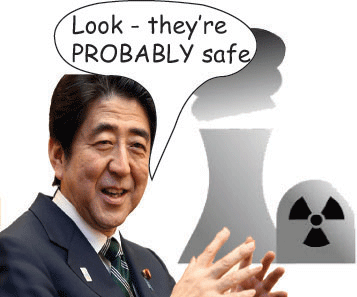 LDP alone in fighting nuclear power exit JAPAN TIMES, JIJI, KYODO JUL 1, 2013 OSAKA – The ruling Liberal Democratic Party was the sole opponent of abolishing nuclear power in a policy debate involving the secretaries-general of nine major political parties Saturday….. Among the proponents, Japanese Communist Party Secretary-General Tadayoshi Ichida said it would be inconceivable to restart reactors or export Japan’s nuclear technologies given that the disaster at the Fukushima No. 1 plant has yet to be resolved. His Your Party counterpart, Kenji Eda, said it would be irresponsible to bring reactors back online when locations for disposal facilities for spent nuclear fuel have yet to be decided…..http://www.japantimes.co.jp/news/2013/07/01/national/ldp-alone-in-fighting-nuclear-power-exit/#.UdIdkTtwo6I
LDP opposes zero nuclear policy, Japan News, 1 July 13 The Yomiuri ShimbunWith the exception of the ruling Liberal Democratic Party, every party at a weekend meeting in Osaka of the secretaries general and equivalent figures from nine major parties expressed support for ending nuclear power generation in the future……. As for whether to aim for the abolition of nuclear power generation, all parties replied yes except the LDP. The DPJ, for example, clearly stated that no nuclear power plant should be in operation by the end of the 2030s in its upper house election platform. Hosono questioned Prime Minister Shinzo Abe’s efforts to promote exports of Japanese nuclear reactors.
“It makes me uncomfortable,” he said, to see the prime minister and other government officials actively promoting exports of Japanese nuclear plants while the crisis continues at the Fukushima No. 1 nuclear power plant…..http://the-japan-news.com/news/article/0000347382
Hospitak sewage potentially a source of ionising radiation
 Another Radiation Source To Consider: Hospital Sewage Forbes, Jeff McMahon, 30 June 13 Researchers found higher than expected levels of radioactive iodine at a Long Island sewer plant that receives effluent from the thyroid cancer treatment center at Stony Brook University, they report in the latest issue of Health Physics.
The research highlights the need for studies of wastewater treatment plants that receive effluent from thyroid cancer treatment facilities, say researchers Paula S. Rose and Lawrence R. Swanson of Stony Brook’s Marine Sciences Research Center.
“This study highlights that medical use can cause substantial fluctuations of I-131 in sewage sludge and the general need for more surveys of I-131 in municipal WCPCs (Wastewater Polution Control Plants),” they write in the August 2013 issue of Health Physics (subscription required).
Rose and Swanson found a concentration of radioactive iodine four times higher than previously published studies of the Stony Brook plant, and at levels that sometimes exceeded the federal dose limit for members of the public……. “Further evaluation of treatment plant worker dose at this plant has been recommended to the Suffolk County Sewer District based on the radiation doses presented here.”
The researchers studied three wastewater treatment plants on Long Island, but found the highest doses at Stony Brook, perhaps because a relatively small treatment plant there serves a regional thyroid cancer center. The Stony Brook Medical Center treats about 60 inpatient thyroid cancer patients per year.
Iodine-131 can be both a cause of thyroid cancer and a solution. Cancers can develop when the thyroid absorbs I-131 instead of stable iodine, and can be included in the cure after doctors remove the thyroid gland and use I-131 to destroy remaining cells. Patients dosed with I-131 become temporarily radioactive, as does their urine. ”Patient excreta” are exempt from regulation in the U.S., and are therefore released into sewer systems.
Iodine 131 has a half life of about eight days.
“Iodine-131 is readily measured in sewage sludge at the Stony Brook WPCP,” according to the study. “The primary source of this radionuclide is excreta from thyroid cancer inpatients treated at the Stony Brook University Medical Center. Frequent inpatient treatments, flow recycling, and sewage sludge removal practices cause 131I to remain in sewage sludge for at least 13 days after patients have left the hospital.” http://www.forbes.com/sites/jeffmcmahon/2013/06/30/another-radiation-source-to-consider-hospital-sewage/
Missing nuclear material may pose attack threat!

VIENNA |
(Reuters) – Nuclear and radioactive materials are still going missing and the information the United Nations atomic agency receives about such incidents may be the tip of the iceberg, said a senior U.N. official.
Any loss or theft of highly enriched uranium, plutonium or different types of radioactive sources is potentially serious as al Qaeda-style militants could try to use them to make a crude nuclear device or a so-called dirty bomb, experts say.
Khammar Mrabit, a director of the U.N.’s International Atomic Energy Agency (IAEA), said there had been progress in recent years to prevent that from happening. But he said more still needed to be done to enhance nuclear security.
“You have to improve continuously because also on the other side, the bad guys, they are trying to find ways how to evade such detection,” Mrabit said in an interview.
“The threat is global because these people operate without borders,” he said on Thursday before an IAEA-hosted meeting of more than 100 states in Vienna next week on how to ensure nuclear materials do not fall into the wrong hands.
The U.N. agency is helping states combat smuggling of uranium, plutonium or other items that could be used for a nuclear weapon or a dirty bomb, which uses conventional explosives to scatter radioactive material across a wide area posing health risks and massive cleanup costs.
About 150-200 cases are reported annually to the IAEA’s Incident and Trafficking Database. More than 120 countries take part in this information exchange project, covering theft, sabotage, unauthorized access and illegal transfers.
While making clear that most were not major from a nuclear security point of view, Mrabit said some were serious incidents involving nuclear material such as uranium or plutonium.
1 This Month

of the week – Shut Down Drone Warfare!


Tell the Ukrainian Government to Drop Prosecution of Peace Activist Yurii Sheliazhenko

Petition to revoke the licensing of the Near Surface Nuclear Disposal Facility (NSDF) at Chalk River. https://www.ourcommons.ca/petitions/en/Petition/Details?Petition=e-7247
To see nuclear-related stories in greater depth and intensity – go to https://nuclearinformation.wordpress.com
-
Archives
- April 2026 (91)
- March 2026 (251)
- February 2026 (268)
- January 2026 (308)
- December 2025 (358)
- November 2025 (359)
- October 2025 (376)
- September 2025 (257)
- August 2025 (319)
- July 2025 (230)
- June 2025 (348)
- May 2025 (261)
-
Categories
- 1
- 1 NUCLEAR ISSUES
- business and costs
- climate change
- culture and arts
- ENERGY
- environment
- health
- history
- indigenous issues
- Legal
- marketing of nuclear
- media
- opposition to nuclear
- PERSONAL STORIES
- politics
- politics international
- Religion and ethics
- safety
- secrets,lies and civil liberties
- spinbuster
- technology
- Uranium
- wastes
- weapons and war
- Women
- 2 WORLD
- ACTION
- AFRICA
- Atrocities
- AUSTRALIA
- Christina's notes
- Christina's themes
- culture and arts
- Events
- Fuk 2022
- Fuk 2023
- Fukushima 2017
- Fukushima 2018
- fukushima 2019
- Fukushima 2020
- Fukushima 2021
- general
- global warming
- Humour (God we need it)
- Nuclear
- RARE EARTHS
- Reference
- resources – print
- Resources -audiovicual
- Weekly Newsletter
- World
- World Nuclear
- YouTube
-
RSS
Entries RSS
Comments RSS
 nuclear-news