No nuclear renaissance- instead, a nuclear terminal illness
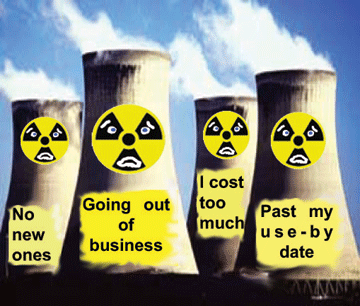 Nuclear plant closures show industry’s struggles, Anchorage Daily News, 8 June 13, LOS ANGELES — The decision to close California’s San Onofre nuclear plant is the latest setback for an industry that seemed poised for
growth not long ago.
In Wisconsin, a utility shuttered its plant last month after it couldn’t find a buyer. In Florida – and now California – utilities decided it was cheaper to close plants rather than spend big money fixing them and risk the uncertainty of safety reviews.
Meanwhile, the low cost of natural gas is discouraging utilizes from spending billions of dollars and lots of time to build nuclear reactors…………In places where utilities sell power into the open market, the low prices don’t offset the financial risk of buildingexpensive and time-consuming nuclear plants……….
Only three nuclear construction projects have moved forward, and they
are all under financial pressure. The Tennessee Valley Authority is finishing a long-mothballed reactor at its Watts Bar plant. Initially budgeted at $2.5 billion, the utility has said finishing the project could cost up to $2 billion
more.
Atlanta-based Southern Co. owns a 46 percent share of two new reactors being constructed at Plant Vogtle in eastern Georgia, a project originally estimated at $14 billion. Southern Co. subsidiary Georgia Power recently asked regulators to raise its share of the construction budget by $737 million to roughly $6.85 billion.
It may cost more. Georgia Power and the companies designing and building the plant are in a legal fight that may cost the utility more money. Separately, an independent monitor hired by Georgia regulators has warned of additional potential costs.
SCANA Corp. announced this week that it expects its costs to rise by around $200 million and the construction schedule to slip while building two reactors at the V.C. Summer Nuclear Station in SouthCarolina.
http://www.adn.com/2013/06/08/2931913/nuclear-plant-closures-shows-industrys.html#storylink=cpy
A crack appears in Tea Party’s opposition to solar emergy
 Even if the Public Service Commission forces Georgia Power to expand its use of solar power in their energy plan, Dooley said the fight is far from over. She plans to continue her efforts by pushing for upcoming legislation that would allow private companies to set up solar farms and feed their energy into Georgia Power’s grid, continuing to put pressure on Georgia Power for cost overruns at its Vogtle nuclear power plant, and possibly even challenging the law that grants monopoly rights to utilities. http://theenergycollective.com/josephromm/234916/tea-party-takes-georgia-power-over-lack-solar-energy
Tea Party Takes on Utility Over Lack of Solar Energy, Energy Collective, Joseph Romm , 9 June 13 The fight to bring cheaper, clean energy to Georgia is uniting some unlikely allies. Renewable energy advocates and leaders of the Atlanta Tea Party are taking on utility giant Southern Co., and its subsidiary Georgia Power, over resisting the call to expand its development of solar energy.
As Debbie Dooley, co-founder of the Atlanta Tea Party explained in an interview with Climate Progress, the group’s interest in the debate is quite simple: “The free market has been one of the founding principles of the Tea Party since it began and a monopoly is not a free market.” Continue reading
Radioactive waste from uranium mining poisons water in Jharkhand, India

 Uranium waste contaminates water in Jharkhand , Jun 8, 2013, New Delhi | Agency: DNA Reckless dumping of radioactive waste in Jharkhand is contaminating surface and ground water, putting thousands of locals at risk of developing cancer, according to a report by independent researchers.
The Uranium Corporation of India Limited (UCIL), a subsidiary of the Department of Atomic Energy, supplies uranium (yellow cake) to nuclear power plants in the country. It mines and processes uranium at seven mines in Jharkhand’s Jaduguda area. According to atomic experts, sludge and waste from uranium mines has to be scientifically disposed of as it contains around 85% radioactive substances.
Scientific disposal means creating pits that are covered, protected, cordoned off and made flood-proof. A tailing pond over an area of 30-40 acres must be created for disposal of sludge. These ponds too have to be cordoned off, made flood-proof and ensure that it prevents overflow. The waste decays to produce radium-226, which in turn produces Radon gas, a very powerful cancer-causing agent. For its three new mines i.e. Turamdih, Banduhurang and Mohuldih Uranium Mine, UCIL has one tailing pond at Talsa village, which fails to prevent sludge overflow and is not even fenced.
PT George, director of research institute Intercultural Resources, and independent writer Tarun Kanti Bose, spent six months studying the effects of uranium mining in the areas around the mines. Their report, Paradise Lost, released recently, states that UCIL’s irresponsible dumping in the vicinity of Jaduguda village (in Purbi Singhbhum district) is extremely worrisome as continued exposure to radiation will lead to increased cases of leukaemia and other blood diseases.
Heaps of uranium mining wastes have been abandoned in Dhodanga, Kerwadungri villages and those around Banduhurang open cast mine, according to the report. “The dumping has been going on for the last five years,” said Ghanshyam Birulee, a 45-year-old resident of Jaduguda village. “Despite complaints to UCIL, it has failed to take any action.”
Their report, Paradise Lost, states that UCIL’s irresponsible dumping in the vicinity of Jaduguda village (in Purbi Singhbhum district) is extremely worrisome as continued exposure to radiation will lead to increased cases of leukaemia and other blood diseases…… http://www.dnaindia.com/india/1845207/report-uranium-waste-contaminates-water-in-jharkhand
Negotiations going on between the two Koreas
 Koreas meet in border village after tensions marked by nuclear threats Sam Kim,CTV News The Associated Press , June 9, 2013 SEOUL, South Korea — Government delegates from North and South Korea began preparatory talks Sunday at a “truce village” on their heavily armed border aimed at setting ground rules for a higher-level discussion on easing animosity and restoring stalled rapprochement projects.
The meeting at Panmunjom, where the truce ending the 1950-53 Korean War was signed, is the first of its kind on the Korean Peninsula in more than two years. Success will be judged on whether the delegates can pave the way for a summit between the ministers of each country’s department for cross-border affairs, which South Korea has proposed for Wednesday in Seoul. Such ministerial talks haven’t happened since 2007.
The intense media interest in what’s essentially a meeting of bureaucrats to iron out technical details is an indication of how bad ties between the Koreas have been……. If the Koreas can arrive at an agreement for ministerial talks, that meeting will likely focus on reopening the factory park in the North Korean border town of Kaesong that was the last remaining symbol of inter-Korean co-operation, and on other scrapped rapprochement projects and reunions of families separated by the Korean War…..
The talks between the Koreas on Sunday could represent a change in North Korea’s approach, analysts said, or could simply be an effort to ease international demands that it end its development of nuclear weapons, a topic crucial to Washington but initially not a part of the envisioned inter-Korean meetings.
Pyongyang, which is estimated to have a handful of crude nuclear devices, has committed a drumbeat of acts that Washington, Seoul and others deem provocative since Kim Jong Un took over in December 2011 after the death of his father, Kim Jong Il. http://www.ctvnews.ca/politics/koreas-meet-in-border-village-after-tensions-marked-by-nuclear-threats-1.1316934#ixzz2Vqp2UIeV
Global Impact Award goes to Solar Aid
 SolarAid Recipient Of £500,000 Google Award. http://www.energymatters.com.au/index.php?main_page=news_article&article_id=3783, 9 June 13, by Energy Matters Last week, SolarAid became the winner of a £500,000 Google Global Impact Award.We first covered SolarAid back in 2009. The group’s mission is make solar energy as widely available as possible to the poorest people in developing countries by providing affordable (and in some instances free) solar lighting.
Its core focus is the social enterprise, SunnyMoney. Lights are sold to local entrepreneurs; who then resell the equipment in their communities at a reasonable price. The approximate payback time of a basic light through savings on kerosene fuel is around 12 weeks. The group also offers a donate-a-light initiative; where donors can sponsor a light for a family.
SunnyMoney has sold over 338,000 lights in the last 12 months, growing over 550% year on year to become the largest seller of solar lights in Africa. In total, the organisation has distributed over a half a million solar lights. With the average household size in East Africa being five, SolarAid’s work has helped to transform the lives of over two and a half million people.
SolarAid says it will use the half a million pound prize to distribute 144,000 solar lights in rural Tanzania and recruit 400 school leavers to create a new generation of solar entrepreneurs.
“The support pledged by Google to the four Award winners will help SolarAid raise its profile, gain more supporters and ensure the injustice of living without clean light gets onto the world radar,” says SolarAid.
With 85% of Africans not having access to electricity, the entrepreneurial approach has massive potential – not just in lighting up lives, but improving health and creating employment. SolarAid has set a lofty goal of eradicating the kerosene lamp from Africa by 2020.
Google’s Global Impact Awards support nonprofits using technology and innovation to tackle tough human challenges.
Canada’s nuclear operators to pay more, in the event of an accident
Federal government poised to raise nuclear liability cap The Canadian Press Jun 9, 2013 Federal Natural Resources Minister Joe Oliver is set to roll out his plan to raise the amount in damages that Canadian nuclear operators would have to pay in case of an accident, the Canadian Press has learned.
He is expected to announce the details at a nuclear conference in Toronto on Monday morning, although he will likely hold off on tabling legislation until the fall.
The liability cap is now set at $75 million but that is widely considered outdated, especially in the wake of the 2011 Fukushima disaster that has led to tens of billions of dollars of damage claims…….. ritics say anything except unlimited liability acts as a subsidy to the nuclear industry.
“Increasing the cap only decreases the subsidy; it does not eliminate it. The government of Canada should proceed with legislation that removes the liability cap entirely rather than legislation that maintains it, or increases it to be harmonious with other jurisdictions,” wrote Joel Wood, a senior research economist at the Fraser Institute, in a 2011 analysis.
In February, the federal government introduced new financial penaltiesfor companies found in violation of the law in an effort to increase pipeline safety. http://www.cbc.ca/news/politics/story/2013/06/09/pol-federal-government-poised-to-raise-nuclear-liability-cap.html
Why is World Health Organisation not releasing Iraq birth defects report?
 What’s delaying the WHO report on Iraqi birth defects http://www.aljazeera.com/indepth/opinion/2013/06/201365101540408281.html A 2012 World
  Health Organization study on congenital birth defects in Iraq has still not been released to the public. 06 Jun 2013 Mozhgan Savabieasfahani Dr Mozhgan Savabieasfahani, a native of Iran, is an environmental toxicologist based in Michigan. She is the author of over two dozen peer reviewed articles and the book, Pollution and Reproductive Damage (DVM 2009).

Iraq is poisoned. Thirty-five million Iraqis wake up every morning to a living nightmare of childhood cancers, adult cancers and birth defects. Familial cancers, cluster cancers and multiple cancers in the same individual have become frequent in Iraq.
Sterility, repeated miscarriages, stillbirths and severe birth defects – some never described in any medical books – are all around, in increasing numbers. Trapped in this hellish nightmare, millions of Iraqis struggle to survive, and they and they call for help.
At long last, public pressure and media attention to this public health catastrophe prompted a joint study by the World Health Organization (WHO) and the Iraqi Ministry of Health to determine the prevalence of birth defects in Iraq. This study began in May-June 2012 and was completed in early October 2012. Continue reading
Closure of San Onofre nuclear plant hastens the death of nuclear power
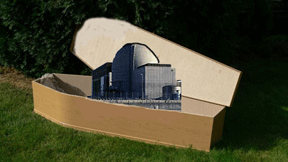 San Onofre is Dead & So is Nuclear Power, Nukefree.org, Harvey Wasserman, 7 June 13 From his California beach house at San Clemente, Richard Nixon once watched three reactors rise at nearby San Onofre. As of June 7, 2013, all three are permanently shut.
It’s a monumental victory for grassroots activism. it marks an epic transition in how we get our energy…… In the early 2000s, Units 2 & 3 needed new steam generators of their own. In the usual grasp for more profits, Edison chose untested, unlicensed new designs.
But they failed. And the whole world was watching. In the wake of Fukushima, two more leaky tsunami-zone reactors surrounded by earthquake faults were massively unwelcome.
So a well-organized non-violent core of local, state and national activists and organizations rose up to stop the madness.
At Vermont Yankee, Indian Point, Seabrook, Davis-Besse and dozens of other reactors around the US and world, parallel opposition is escalating.
Make no mistake—this double victory at San Onofre is a falling domino. Had the public not fought back, those reactors would have been “fixed” at public expense.
Today, they are dead…… we have yet another proof that citizen action makes all the difference in our world…… http://www.nukefree.org/editorsblog/san-onofre-dead-so-nuclear-power
California can now move to safe, clean renewable energy
The End of the San Onofre Nuclear Plant — An Advance for Safe, Clean, Renewable Energy Technologies http://karlgrossman.blogspot.com.au/2013/06/the-end-of-san-onofre-nuclear-plant.html
 Southern California Edison’s announcement this week that it will close its troubled twin-reactor San Onofre nuclear power plant—along with other recent setbacks for atomic energy in the United States—marks a downward spiral for nuclear power.
Environmentalists win 50 year battle to close San Onofre nuclear plant
opponents of the plant acknowledged that questions remain regarding what will happen to radioactive waste generated by the site and to the region’s energy needs.
Environmentalists Celebrate Nuclear Plant Closing, abc news, By GILLIAN FLACCUS and AMY TAXIN Associated Press axin reported from Tustin. AP Writer Elliot Spagat contributed to this report from SAN CLEMENTE, Calif. June 8, 2013 (AP)
Using a cane and wearing a hat reading “Peace No Nukes,” 85-year-old Lyn Harris Hicks shuffled to the front gates of the San Onofre nuclear power plant on Friday to celebrate a utility company’s decision to close the seaside facility for good.
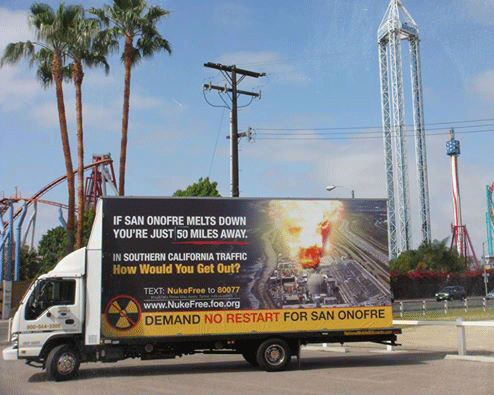
A long-time resident of San Clemente in Southern California, Harris Hicks said she has been fighting the plant — which has been idle since last year — since the 1960s over safety concerns. Continue reading
Youtube: Fallujah birth defects and US depleted uranium weapons
 Inside Story Americas – Did the US cause Fallujah’s birth defects? http://www.youtube.com/watch?v=V9YQ1GimBDc 1 Aug 2012
New research is under way on the alarming increase in birth defects in the Iraqi city of Fallujah, showing elevated levels of radioactivity in the city and across the country. Iraqi doctors have long reported a spike of cases involving severe birth defects in Fallujah since 2004 which are shocking in their severity. So is the US being honest about the weapons it used in the 2004 battle for the city, and in its other theatres of war? Guests: Ross Caputi, Dai Williams, Raed Jarrar.
Higherdeath rate for those living near Browns Ferry Nuclear Plant
The full report may be downloaded at www.matrr.org or www.bredl.org

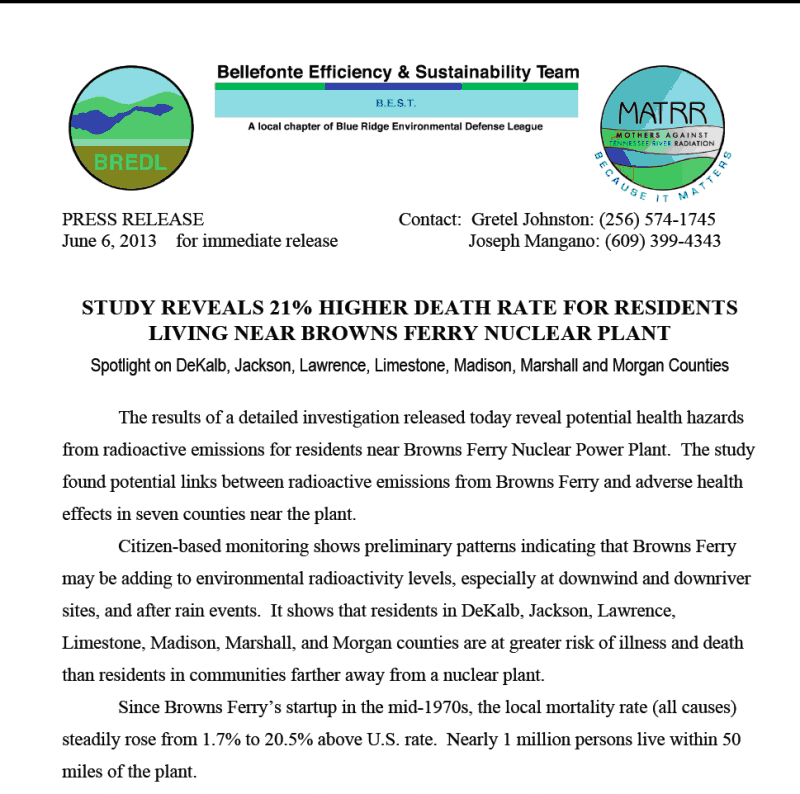
Major findings of the report• Continue reading
Nuclear waste rolling in to Texas dump site

 Texas Site Begins Taking Federal Nuclear Waste http://abcnews.go.com/US/wireStory/texas-site-begins-taking-federal-nuclear-waste-19343196#.UbJENOdwo6I By BETSY BLANEY Associated Press ANDREWS, Texas June 7, 2013 (AP) Republican mega-donor Harold Simmons’ remote hazardous waste dump in West Texas began accepting low-level radioactive material Thursday from a federal lab in New Mexico — the latest step in Simmons’ vision of site that accept all types of waste. Continue reading
Uranium mining continues to radioactively poison land and water in USA
Uranium Mine Pits Continue to Leak Radiation Today
Radiation and heavy metals from uranium mines continue to pollute the land, air and water today and very little action is being taken to stop it.
America’s “Secret Fukushima”: Uranium Mining is Poisoning the Bread Basket of the World By Margaret Flowers and Kevin Zeese Global Research, June 07, 2013 Truthout Early in the morning of July 16, 1979, a 20-foot section of the earthen dam blocking the waste pool for the Church Rock Uranium Mill caved in and released 95 million gallons of highly acidic fluid containing 1,100 tons of radioactive material. The fluid and waste flowed into the nearby Puerco River, traveling 80 miles downstream, leaving toxic puddles and backing up local sewers along the way.

Although this release of radiation, thought to be the largest in US history, occurred less than four months after the Three Mile Island partial nuclear meltdown that sent radioactive gases and iodine into the air, the Church Rock spill received little media attention. In contrast, the Three Mile Island accident made the headlines. And when the residents of Church Rock asked their governor to declare their community a disaster area so they could get recovery assistance, he refused. Continue reading
Safety upgrades required will cost U.S. nuclear plant operators $billions
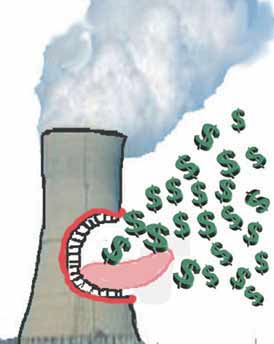 U.S. plants covered under the directive are older, boiling-water reactors mainly similar in design to the Fukushima facility…..
Plant operators may have to spend nearly $3.6 billion over the next three to five years on modifications to the nation’s 102 nuclear facilities in response to the Fukushima accident, according to a Platts survey released on Thursday.
U.S. orders new safety upgrades at nuclear plants By CNN Staff June 7, 2013 –– Washington — U.S. regulators are directing 31 nuclear reactors similar in design to the Fukushima Daiichi plant in Japan, where an earthquake and tsunami caused a meltdown two years ago, to take additional steps to help contain radiation and other damage from any accident that is not quickly halted.
The Nuclear Regulatory Commission directive on Thursday requires enhancements to systems for venting accumulated pressure from containment structures during an emergency. Vents must also be able to safely handle rising temperatures, hydrogen concentrations and radiation levels.
The changes also aim to ensure that plant personnel can continue to operate vents safely if a reactor core melts down, the agency said. Continue reading
1 This Month
22 June – Virtual Event –Climate Change: New Data, New Debate

Monday, June 22, 2026 2:30 p.m. – 3:15 p.m. CT
YouTube. Register here

Protect Sazan Island from the Trump family! https://secure.avaaz.org/campaign/en/protect_sazan_island_from_the_trump_family_loc/?bqFCVab&v=174511&cl=22707147157&_checksum=5e9dde668860e8231c33699735e16a1fbf22ab2cb01da50c999fe8732b9775ef&utm_source=email&utm_medium=blast_email&utm_campaign=174511
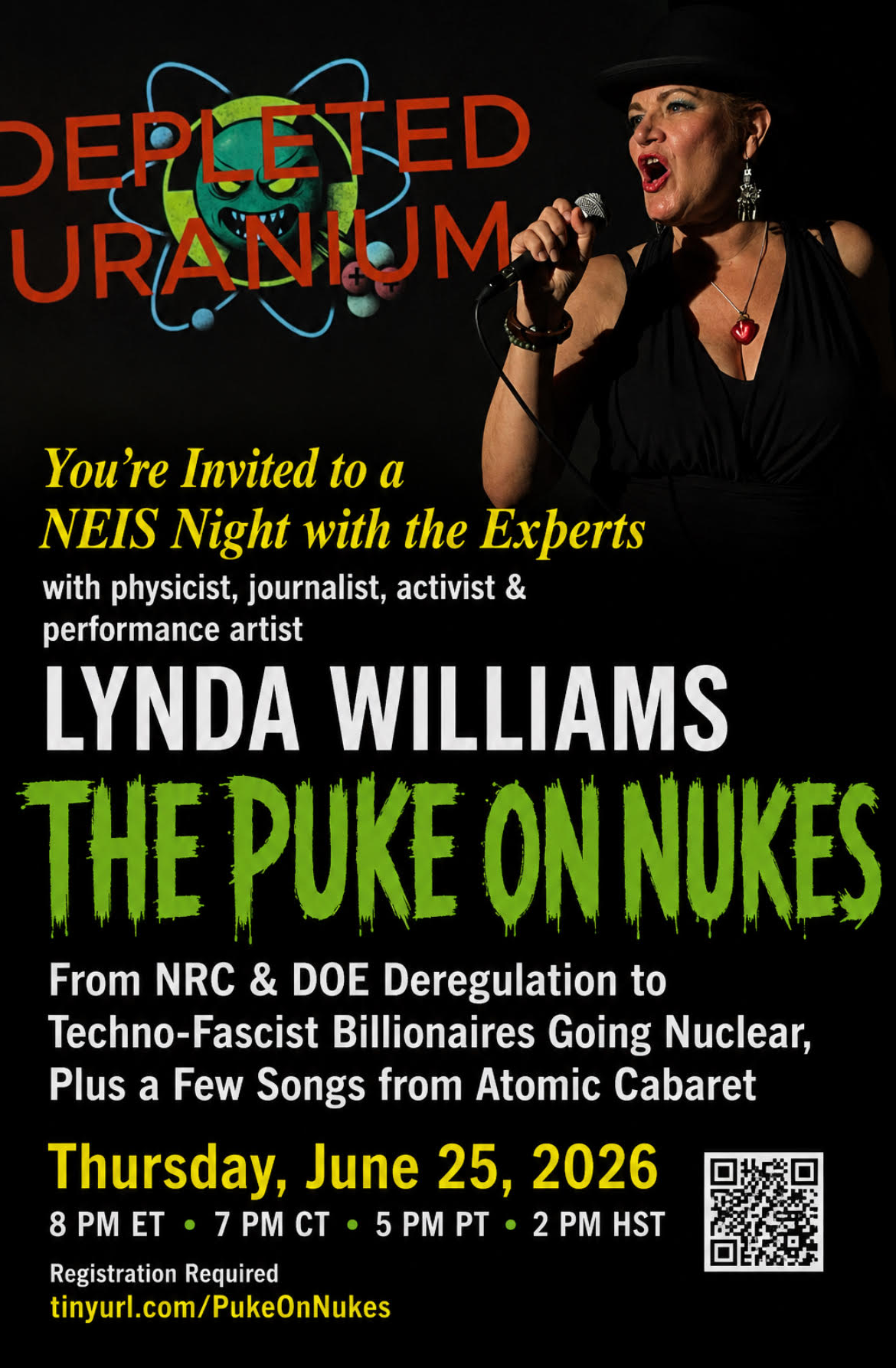
25 June- THE PUKE ON NUKES
Thursday, June 25, 2026
7pm Central Time (8pm ET, 6pm MT, 5pm PT) UTC – 5
From NRC & DOE Deregulation to Techno-Fascist Billionaires Going Nuclear, Plus a Few Songs from Atomic Cabaret REGISTER
26 June – Radiation Trainwreck at the NRC / Join the Protect Better Campaign – https://us02web.zoom.us/meeting/register/4ZlZ5_qLSHGiLSCg8FF6Bg#/registration


Cuba Is Not a Failed State – It Is a Besieged State
PETITION: “Global Appeal to Endorse Palestinian Right of Return of Refugees”
To see nuclear-related stories in greater depth and intensity – go to https://nuclearinformation.wordpress.com
-
Archives
- June 2026 (193)
- May 2026 (306)
- April 2026 (356)
- March 2026 (251)
- February 2026 (268)
- January 2026 (308)
- December 2025 (358)
- November 2025 (359)
- October 2025 (376)
- September 2025 (257)
- August 2025 (319)
- July 2025 (230)
-
Categories
- 1
- 1 NUCLEAR ISSUES
- business and costs
- climate change
- culture and arts
- ENERGY
- environment
- health
- history
- indigenous issues
- Legal
- marketing of nuclear
- media
- opposition to nuclear
- PERSONAL STORIES
- politics
- politics international
- Religion and ethics
- safety
- secrets,lies and civil liberties
- spinbuster
- technology
- Uranium
- wastes
- weapons and war
- Women
- 2 WORLD
- ACTION
- AFRICA
- Atrocities
- AUSTRALIA
- Christina's notes
- Christina's themes
- culture and arts
- Events
- Fuk 2022
- Fuk 2023
- Fukushima 2017
- Fukushima 2018
- fukushima 2019
- Fukushima 2020
- Fukushima 2021
- general
- global warming
- Humour (God we need it)
- Nuclear
- RARE EARTHS
- Reference
- resources – print
- Resources -audiovicual
- Weekly Newsletter
- World
- World Nuclear
- YouTube
-
RSS
Entries RSS
Comments RSS
 nuclear-news