Laurie Penny on the UK and the faiiure of the opposition 2013
A discussion on why the UK “opposition” is not responding to the attack on the human rights of its citizens. Mark interviews Laurie Penny an independent UK journalist.
Published on 13 Jun 2013
The artist taxi driver
A UK take on this story
Published on 10 Jun 2013
Edward Snowden has leaked top secret documents that show just how big the NSA’s surveillance program has got. Boundless Informant and Prism together can monitor your email, your Facebook, and even your Skype calls.
arclight2011part2 – Coming soon!
 Dear subscribers
Owing to a nice little operation by MI5 (or more specifically “The Domestic Extremist Database” ) I have gone from a hard working, high earning person with a working (if slightly hacked ) mobile phone to a homeless and soon to be bankrupted person with a brand new but still VERY hacked mobile phone. All this within 6 months!
However, I have secured a roof over my head and some cash work to keep me going.. so no donations needed.. I always wanted to live the rustic life anyway..
So i have been busy organising, encrypted emails, messaging and video calls.. running Linux and using TOR browser where necessary, working out a pay up front dongle and access to hi speed broadband from libraries etc for the you tube stuff..
you may have noticed my new handle as arclight2011part2
heres a link to my older posts (before i was so rudely interupted by “persons unknown”)
https://nuclear-news.net/author/arclight2011/
you can scroll through if you are new to the blog to find out where i am coming from.
Needless to say i have been busy trying to wind down the chaos that is now my old life and wait for better political times to sort out the loose ends.
I am staggered and surprised at how easy it was for MI5 and friends to make me homeless. I hope to do an article on the details of this, for posterity, but it needs some more research and some time for other news to develop! Like this news for instance
NSA Surveillance Whistleblower Interview Edward Snowden
The bit that is relevant to you and me is at 10.50 mins.
I live in the UK. (somewhere.. 😦 )
I have about another week or so of organising but the plan is now in place.. so i will be back posting on many censored and largely ignored matters..
But there are many other subjects that need discussion to concerning manipulation of statistics to increase the “normal background radiation” to suit the nuclear lobby to the way they cover up 30 children with thyroid cancer in Fukushima (so far) that hardly anyone is talking about. I could go on..
Thank you Christina for all your great posts and hard work on nuclear-news while i have been busy.
And thank you to the subs and bookmarkers for your increasing support of the blog! It has made things easier to cope with my situation and given me constructive focus..
To Note: I started posting on nuclear-news.net in September 2012 and in December 2012 the more viscous and damaging attacks on me began.. so if you want to know what annoys MI5 have a look at that date range on the old arclight2011 link above. 😉 I know I will be giving that period some review over a cup of tea or two! 🙂 Oh yeah!
peace light and love to you all!
Sean
Unconvincing film advertisement for the nuclear industry
 Movie Review: Put “Pandora’s Promise” Back in the Box, Union of Concerned Scientists Ed Lyman, senior scientist June 12, 2013 “….. By oversimplifying the issues, trivializing opposing viewpoints and mocking those who express them, and selectively presenting information in a misleading way, it serves more to obfuscate than to illuminate. As such, it adds little of value to the substantive debate about the merits of various energy sources in a carbon-constrained world.
“Pandora’s Promise,” taking a page from late-night infomercials, seeks to persuade via the testimonials of a number of self-proclaimed environmentalists who used to be opposed to nuclear power but have now changed their minds, including Stewart Brand, Michael Shellenberger, Gwyneth Cravens, Mark Lynas and Richard Rhodes. The documentary tries to make its case primarily by impressing the audience with the significance of the personal journeys of these nuclear power converts, not by presenting the underlying arguments in a coherent way. This strategy puts great emphasis on the credibility of these spokespeople. Yet some of them sabotage their own credibility. …. the audience may reasonably wonder why it should accept what they believe now that they are pro-nuclear.
My hand got tired trying to jot down all the less-than-half truths put forth by the talking heads in the film, which could have benefited from some fact-checking. Here’s just one example. Gwyneth Cravens, when prompted by the interviewer about the leak of tritium from the Vermont Yankee nuclear plant, stated that someone would get more radiation from eating one banana than from drinking all the water coming out of the plant. Well, I thought I would double-check this one. The dose from eating a single banana is about 0.01 millirem. Entergy, Vermont Yankee’s owner, estimated in a 2011 report to the NRC that the leak detected in early 2010 released 2.79 curies of tritium into groundwater. Assuming someone consumed all of this tritium in the form of tritiated water, that person would receive a dose of 185,000 millirem. Ms. Cravens was only off by a factor of twenty million. Perhaps she was referring to the actual amount of tritium that would end up in the wells of the plant’s neighbors, given dilution effects—but that isn’t what she said. These sloppy soundbites greatly diminish the film’s credibility.
A more egregious example of dishonesty is in the discussion of the health effects of Chernobyl…… there is no mention of the fact that the Chernobyl Forum only estimated the number of cancer deaths expected among the most highly exposed populations in Ukraine, Belarus and Russia and not the many thousands more predicted by published studies to occur in other parts of Europe that received high levels of fallout. Nor is there mention of the actual health consequences from Chernobyl, including the more than 6,000 thyroid cancers that had occurred by 2005 in individuals who were children or adolescents at the time of the accident. And the film is silent on the results of more recent published studies that report evidence of excesses in other cancers, as well as cardiovascular diseases, are beginning to emerge…….
The film also puts forth the Integral Fast Reactor, a metal-fueled fast breeder reactor, as a visionary nuclear reactor design that could solve all of nuclear power’s problems by being meltdown-proof and consuming its own waste as fuel. However, it glosses over the myriad safety and security problems associated with fast-breeder reactors…….
The biggest failing of the film, however, is the lack of any discussion of what the real obstacles to an expansion of nuclear energy are and what would need to be done to overcome them. In fact, nuclear power’s worst enemy may not be the anti-nuclear movement, as the film suggests, but rather nuclear power advocates whose rose-colored view of the technology helped create the attitude of complacency that made accidents like Fukushima possible. Nuclear power will only be successful through the vision of realists who acknowledge its problems and work hard to fix them—not fawning ideologues like filmmaker Robert Stone and the stars of “Pandora’s Promise.”http://allthingsnuclear.org/movie-review-put-pandoras-promise-back-in-the-box/#.Ubkvd1qPsGs.facebook
Fukushima’s nuclear reactors – still on the brink of disaster

Australia’s very right wing and pro nuclear newspaper made a little mistake in publishing this one. Perhaps the editors didn’t read it properly. The headline is completely misleading!
Fukushima nuclear reactor back from the brink BY:RICK WALLACE, TOKYO CORRESPONDENT , THE AUSTRALIAN June 13, 2013 ”……..More than 1500 radioactive spent fuel rods sit immersed in water in the open-air pool, which is located about 30m above the ground in what’s left of the reactor No 4 building.
The rods are extremely volatile and, unlike the fuel in the reactors, are not surrounded by any containment structure. If exposed, they can spontaneously combust, creating a tragedy nuclear workers say would put 2011 – the worst nuclear disaster since Chernobyl in 1986 – in the shade.
Asked about other risks and challenges to the recovery process at Fukushima, Mr Takahashi cited removal of the melted nuclear fuel from the reactors and the ongoing build-up of contaminated water. “There are many difficult processes and among all of them the removal of the damaged fuel is the most difficult because no country has experience in doing this,” he said.
“The other main difficulty is treatment of the water and preventing the inflow of incoming water, and then we need to treat and dispose of the waste from that water.” Fukushima Daiichi is dotted with more than 300 giant tanks to store this water, each one holding some 1000 tonnes. TEPCO says it wants to expand its storage capacity to 700,000 tonnes and is digging underground tanks, too.
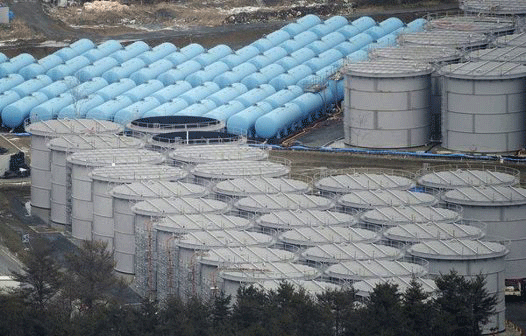
The company is also trying to lower the water table around the plant by digging wells to stem the entry of groundwater into the subterranean spaces of the reactors and minimise the outflow of contamination.
Each day, more than 3000 workers travel to Fukushima Daiichi to work, braving high radiation levels. Much of the debris at the plant has been cleared, although crumpled cars and trucks still dot the side that fronts the ocean. Pumps, and pipes that snake throughout the site, are keeping the situation stable for now but it’s readily apparent a huge amount of decontamination work remains before workers can turn to the task of decommissioning the reactors themselves.
Readings during yesterday’s press visit peaked at 1500 microsieverts near the reactor No 3 building. Standing in this spot for about 13 hours would give a person the 20 millisievert dose deemed as the trigger for evactuating civilians on an annual basis…..
The tour follows a series of embarrassing episodes for TEPCO, including a blackout that shut down cooling to the fragile plant for several hours.The company also recently revealed there had been a leak in one of the steel tanks storing radioactive water, and it had found radioactive cesium leaking into the groundwater near the plant. .http://www.theaustralian.com.au/news/world/fukushima-nuclear-reacto
Uncertainty over the location of melted nuclear fuel in Fukushima reactors
 Asahi: Locations and condition of melted Fukushima fuel unknown — Mainichi: 450 tons of scattered radioactive rods… unknown where holes in reactors are… plans may be delayed http://enenews.com/asahi-locations-and-condition-of-melted-fukushima-fuel-rods-unknown-mainichi-450-tons-of-scattered-radioactive-material-unknown-where-holes-in-reactors-are-plans-may-be-delayed-further
Asahi Shimbun, June 11, 2013: The workers have yet to gain a grasp of the locations and condition of the fuel debris. They have yet to develop extraction equipment and determine removal methods.
Mainichi,, June 11, 2013: Uncertainty over the location of melted fuel inside the crisis-hit Fukushima No. 1 Nuclear Power Plant continues to cast a shadow over plans to remove the fuel at an early date […] Reactor Nos. 1-3 at the plant contained a total of 1,496 rods of nuclear fuel in their cores. […] Each fuel rod weighs about 300 kilograms, and a high level of technical expertise would be required when undertaking a remote control operation to cut up and retrieve clumps of scattered radioactive materials weighing a combined 450 tons or thereabouts. […] the cores of reactors at the Fukushima plant have holes, and the task at hand is finding which parts have been damaged […] In a news conference on June 10, a representative of the Ministry of Economy, Trade and Industry’s Agency for Natural Resources and Energy said that bringing forward the plans would be dependent on developing technology, and suggested that the plans might even end up being delayed. […]
State of melted fuel at Fukushima plant unknown — Worker: “We opened the Pandora’s box” — Journalist: “We’re headed toward a real crisis”
Cutbacks as TVA struggles to revive Bellefonte Nuclear Power Station, Alabama
 TVA cuts 530 jobs, spending on Ala. nuclear plant Knox News, RAY HENRY – Associated Press (AP) June 12, 2013 The Tennessee Valley Authority will cut 530 jobs and trim millions of dollars in spending on its effort to revive a mothballed nuclear plant in Alabama, utility officials said Wednesday in a decision that calls into question the project’s future.
A total of 35 TVA employees and 495 contractors will lose their positions at the Bellefonte Nuclear Power Station northeast of Scottsboro, Ala. The budget will fall from $182 million to $66 million, a reduction of roughly 64 percent. Some of the affected TVA employees may be reassigned to other roles within the utility.
The decision comes as the price of natural gas has plummeted, making it difficult for the electric industry to justify the massive costs of new nuclear plants. Utilities in California, Florida, New Jersey and Wisconsin have either shut down plants or will halt operations in the future because they are too costly to repair or upgrade. While the industry proposed building a new wave of reactors just a few years back, only a handful are likely to be completed in the Southeast because of the same economics.
Finishing the first reactor at Bellefonte by 2020 was expected to cost roughly $4.9 billion……. Already, the TVA is under pressure to control its costs. An effort to finish another of its mothballed reactors at the Watts Bar Nuclear Plant in Spring City, Tenn., was originally expected to cost $2.5 billion. Finishing the project may require as much as $2 billion more, according to utility estimates…… http://www.knoxnews.com/news/2013/jun/12/tva-cuts-400-jobs-spending-on-ala-nuclear-plant/
Akie Abe – Japan’s anti nuclear “ opposition party within the family.”

 Akie Abe, His “Anti-Nuclear” Wife JUNE 12, 2013 In Japan, wives aren’t part of the show. Back in the day, they walked a few feet behind their husbands. Old couples can still be seen progressing down the sidewalk in that manner. In politics, wives still aren’t part of the show – though recently, they’ve been seen deplaning with their husbands when they alight in Western countries, even holding hands while waving to photographers.
But when a wife suddenly invites herself to the show, and not demurely behind or next to her husband, but vocally at the opposite end of where he stands, it causes a stir. In particular if she takes on the nuclear power industry. Continue reading
Film Pandora’s Promise – an infomercial for the nuclear lobby
Paper: CNN’s nuclear propaganda film “is dishonest to its core” — It’s “actually an infomercial” http://enenews.com/cnns-nuclear-propaganda-film-is-dishonest-to-its-core-pandoras-promise-is-actually-an-infomercial
Title: Pandora’s Promise: Would You Buy a Nuclear Reactor
Source: Seattle Weekly
Author: Brian Miller
Date: Jun 11 2013
My ears prick up whenever I hear how Bill Gates and Paul Allen are spending their money. Putatively a documentary about the resurgence of nuclear power, Pandora’s Promise is actually an infomercial for a business still stigmatized by Three Mile Island, Chernobyl, Fukushima, and our fears of all things atomic. […]
[…] Pandora’s Promise, which was produced by CNN and Paul Allen’s Vulcan Productions. (Robert Stone is the director-for-hire.) […]
But the doc’s bigger flaw is that no one is allowed to make a reasoned anti-nuclear argument. […] And when I hear Pulitzer-winning author Richard Rhodes (The Making of the Atomic Bomb) say that “to be anti-nuclear is fundamentally to be in favor of burning fossil fuels,” it sounds perfectly sensible. And that’s the problem with Pandora’s Promise: Though many of its claims may be truthful, the film is dishonest to its core.
See also: Experts: The planet can be powered solely by wind, water and solar energy (NO ‘fossil fuels’ or nuclear power)
Renewable energy investment going strong in emerging nations
 Renewable Energy Investments Shift to Developing Nations http://www.bloomberg.com/news/2013-06-12/renewable-energy-investments-shift-to-developing-nations.html By Alex Morales – Jun 12, 2013 Renewable energy investments are shifting to developing nations as countries from Morocco to Chile pursue power sources that wean them off fossil fuel imports, two studies promoted by the United Nations said.
China’s $67 billion of investment in wind, solar and other renewable projects led developing nations to $112 billion of spending in 2012, according to an e-mailed statement today from the UN and other groups involved in the studies. That compares with $132 billion of expenditure in the industrialized world.
The gap on renewables spending between richer and developing countries shrank to 18 percent last year from 250 percent in 2007, marking a “dramatic change” in investment patterns, the statement said. Two-thirds of the 138 nations that now have clean-energy targets are in the developing world.
“The uptake of renewable energies continues worldwide as countries, companies and communities seize the linkages between low-carbon green economies and a future of energy access and security,” UN Environment Program Executive Director Achim Steiner said in the statement. “More and more countries are set to take the renewable energy stage,” he said, citing “the logic and the rationale of embracing a green development path.” Continue reading
Rio Tinto’s losses mean that Rossing uranium mining’s future is precarious
Rössing Uranium fights on for survival INFORMANTE BY FLORIS STEENKAMP 12 JUNE 2013 Rio Tinto Rössing Uranium incurred an operational loss of N$474 million in 2012, some N$10 million more than the losses the mine made in 2011. Despite this, the mine will continue to battle on and bolster cost savings and operational efficiency to ensure its long term survival.
This was the message of the outgoing managing director of Rio Tinto Rössing, Chris Salisbury, on 6 June Swakopmund.
Uranium mines globally continues to operate in adverse economic conditions…… Since Japan and many other nations started to shy away from nuclear power generation as the future of clean energy, uranium market prices plummeted by more than 36%.
Uranium mines globally continues to operate in adverse economic conditions…… Since Japan and many other nations started to shy away from nuclear power generation as the future of clean energy, uranium market prices plummeted by more than 36%.
At the Rössing mine not even a production output increase of 36% and drastic cost-saving measures could avert the 2012 losses, as this market dip was too severe….. Salisbury confirmed that he will be assuming another position in the Rio Tinto Group in Australia and said a successor would be sourced within months.http://www.informante.web.na/index.php?option=com_content&view=article&id=12165:roessing-uranium-fights-on-for-survival&catid=1:coastal&Itemid=103
Serious safety flaw – Monticello nuclear power plant not prepared for major flood
Feds fault Monticello nuclear power plant’s flood planning by: DAVID SHAFFER , Star Tribune June 11, 2013 Inspectors said Monticello plant wasn’t prepared for a major flood, but also said Xcel’s response means site is not now a “safety concern.” Xcel Energy’s Monticello nuclear power plant on the bank of the Mississippi River has long been unprepared for worst-case flooding, federal regulators said Tuesday in a finding they classified as having “substantial safety significance.”
U.S. Nuclear Regulatory Commission (NRC) inspectors said Xcel’s flood-fighting efforts, including dikes, could not have been completed in the 12 days required, and some work would take twice that time.
Xcel, which owns and operates the plant 40 miles northwest of the Twin Cities, said it has addressed the problem by putting dike-building materials on site. As a result, NRC inspectors said, the issue is “not a current safety concern.”
But the finding, which is preliminary, is the Monticello plant’s most serious safety shortcoming since the NRC adopted a color-coded, four-step ranking system for inspection results. This problem was ranked “yellow,’’ one level short of the “red,’’ or most serious, level. (The two lowest levels are “green” and “white.” )
Xcel has 10 days to challenge it, and the plant faces enhanced inspections if the finding stands.
Three other U.S. nuclear power plants belonging to other utilities also have been cited recently for unsatisfactory flood-fighting plans after a round of inspections prompted by the 2011 tsunami and disaster at the Fukushima Daiichi nuclear power plant in Japan, an NRC official said…… http://www.startribune.com/business/211107961.html
Nuclear Regulatory Commission will take safety allegations seriously
Nuclear Energy Activist Toolkit #8: Allegations, Union of Concerned Scientists Dave Lochbaum, director, Nuclear Safety Project June 11, 2013 The NRC’s Allegations Program handles accusations that NRC’s requirements are being violated. The NRC receives allegations from workers at NRC-licensed facilities as well as from other sources. For example, workers sometimes seek to protect their identities (and their jobs) by voicing their concerns to media and groups like UCS. The NRC’s 250-word definition of allegation contains three footnotes containing 206 words of “clarification.” Ignoring that legal mumbo-jumbo, the NRC’s Allegations Program looks into reports that the agency’s requirements may have been violated.
The NRC can process allegations submitted anonymously, but would prefer to know the sources of allegations. The NRC seeks to ensure it correctly understands the allegations before dispatching inspectors to examine the issues. And sometimes the NRC re-contacts sources for additional information during the course of its investigations. The NRC also sends a letter summarizing the scope of its investigation and its findings to sources it knows.
With very few exceptions (such as when an allegation is made in a newspaper article or posted on a website), the NRC treats all sources confidentially even within the agency. For example, while the NRC’s allegations staff know the identity of a source, the NRC’s inspectors who investigate the allegations would not know this information…… Continue reading
Exelon Nuclear’s Limerick Generating Station nuclear reactors need system replaced
NRC wants system replaced at Limerick nuclear plant http://www.phoenixvillenews.com/article/20130612/NEWS01/130619977/nrc-wants-system-replaced-at-limerick-nuclear-plant- By Evan BrandtLIMERICK — In an effort to prevent hydrogen explosions like the one that destroyed parts of Japan’s Fukushima nuclear plant two years ago, the government is requiring 31 U.S. nuclear plants with a similar reactor design to install an upgraded ventilation system in six years.
The order, issued June 6, applies to GE Mark I and Mark II Boiling Water Reactors. The two nuclear reactors at Exelon Nuclear’s Limerick Generating Station are of the Mark II design.
This new order supersedes one issued in March 2012 , which also required new venting systems.
UK emergency services not up to dealing with a nuclear transport radiation accident
Nuclear convoy disaster exercise reveals weaknesses in emergency response Rob Edwards The Guardian, 13 June 2013 Internal report highlights five-hour wait for weapons experts and confusion over radiation monitoring. An emergency exercise has exposed serious weaknesses in Britain’s ability to cope with a catastrophic motorway pileup in which a nuclear bomb convoy burns and spreads a cloud of radioactive contamination over nearby communities.
An internal report released by the Ministry of Defence reveals that the emergency services faced “major difficulties” in responding to the mocked-up accident near Glasgow because they had no help from MoD weapons experts for more than five hours.
At times the response, which involved 21 agencies, was disorganised, the report says. Heated disputes with ambulance staff over how to handle casualties contaminated with radioactivity at the crash site caused “considerable delay”, resulting in one victim being declared dead.
Other problems included outdated, paper-based communications systems, poor mobile phone signals, conflicting scientific advice on health hazards and confusion over radiation monitoring.
Nuclear weapons are transported in heavily guarded road convoys up to six times a year between bomb factories at Aldermaston and Burghfield in Berkshire and the Royal Naval Armaments Depot at Coulport on Loch Long in Argyll. The trips are needed to ensure that Britain’s stockpile of about 200 Trident missile warheads is properly maintained…. http://www.guardian.co.uk/world/2013/jun/12/nuclear-convoy-disaster-exercise-emergenc
1 This Month

of the week – Shut Down Drone Warfare!


Tell the Ukrainian Government to Drop Prosecution of Peace Activist Yurii Sheliazhenko

Petition to revoke the licensing of the Near Surface Nuclear Disposal Facility (NSDF) at Chalk River. https://www.ourcommons.ca/petitions/en/Petition/Details?Petition=e-7247
To see nuclear-related stories in greater depth and intensity – go to https://nuclearinformation.wordpress.com
-
Archives
- April 2026 (79)
- March 2026 (251)
- February 2026 (268)
- January 2026 (308)
- December 2025 (358)
- November 2025 (359)
- October 2025 (376)
- September 2025 (257)
- August 2025 (319)
- July 2025 (230)
- June 2025 (348)
- May 2025 (261)
-
Categories
- 1
- 1 NUCLEAR ISSUES
- business and costs
- climate change
- culture and arts
- ENERGY
- environment
- health
- history
- indigenous issues
- Legal
- marketing of nuclear
- media
- opposition to nuclear
- PERSONAL STORIES
- politics
- politics international
- Religion and ethics
- safety
- secrets,lies and civil liberties
- spinbuster
- technology
- Uranium
- wastes
- weapons and war
- Women
- 2 WORLD
- ACTION
- AFRICA
- Atrocities
- AUSTRALIA
- Christina's notes
- Christina's themes
- culture and arts
- Events
- Fuk 2022
- Fuk 2023
- Fukushima 2017
- Fukushima 2018
- fukushima 2019
- Fukushima 2020
- Fukushima 2021
- general
- global warming
- Humour (God we need it)
- Nuclear
- RARE EARTHS
- Reference
- resources – print
- Resources -audiovicual
- Weekly Newsletter
- World
- World Nuclear
- YouTube
-
RSS
Entries RSS
Comments RSS
 nuclear-news