The fight to save Grand Canyon from uranium radioactive contamination
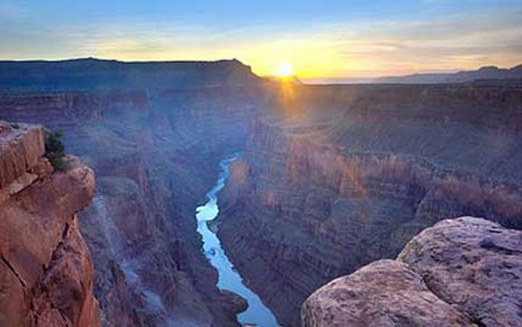 Tribes, Enviros Fight Uranium Mining Near Grand Canyon KPBS, June 3, 2013 By Laurel Morales “……environmentalists and Indian tribes oppose mining near the canyon. On a recent sunny day EcoFlight pilot Gary Kraft steered the six-seat Cessna onto the tarmac of the Grand Canyon Airport and gracefully took off. He flew a group over the Grand Canyon to check out mines from above.
“As Gary brings the plane around we’ll get a little better look at the site,” said Grand Canyon Trust’s Roger Clark who served as our guide.
He has been fighting uranium mining companies for many years. Last year he scored a victory. The Obama Administration put a ban on any new mining claims on federal land surrounding the park. In the 1980s and 1990s a dozen mines pocked the landscape surrounding the park. All but a few have been cleaned up and reseeded. But a handful of older claims are still being mined.
“Pinenut’s off to our right at the end of that dirt road,” Clark said.
From 11,000 feet the Pinenut Mine looked like a postage stamp, with little evidence of mining. It’s actually about the size of a Walmart parking lot. Clark said the big concern is what happens below the surface. Mining companies often drill 2,000-3,000 feet before they hit an ore body. And Clark said that’s where they run into trouble.
“When they reopened it here in 2011 they found millions of gallons of water had filled up shaft,” Clark said. “And they had to dewater the shaft. The source was most likely an aquifer they punctured on the way down to the ore body.”
Clark said the water likely became contaminated when it sat with the exposed uranium ore. As we could see from above, the mine isn’t far from drainages and creeks. The U.S. Geological Survey conducted studies in 2010 that showed 15 springs and five wells contained dissolved uranium concentrations in excess of environmental standards for drinking water.
Next we fly through the area off-limits to mines and what’s known as the Dragon Corridor where the earth below drops away to a dark green ribbon sparkling in the sun — the Colorado River.
Mining companies have recently tried a new strategy — going after ore deposits on state land. Clark explained the high desert we were flying over is a checkerboard of federal, private, tribal and state land. A proposed mine site called the Wate Mine sits on state land completely surrounded by the area off-limits to mining…….
The site is eight miles from the nearest spring that flows into Havasu Creek and its picturesque waterfalls. Havasupai Chairman Don Watahomigie has been battling the mining companies in court for many years. He’s concerned about the potential for drinking water contamination.
“Water, rain, snowmelt up on top of the rim flows into our creek down here,” Watahomigie said. “We have a lot of drainages. Anything that’s up there flows down here.”
But the mining company faces another obstacle. The site is surrounded by a ranch that’s owned by the Navajo Nation. The tribe has said it would not allow the company to transport uranium across its land, because the industry has caused the Navajo people so much suffering. The federal government is still cleaning up mines on the reservation.
Dave Uberuaga, the superintendent of Grand Canyon National Park, said he’s also concerned about the Grand Canyon watershed and the Havasupai’s drinking water.
“How would you ever compensate?” Uberuaga said. “How would you ever make up for that damage, that loss of a community that’s lived there for 700 years and literally rely on that water source for almost everything that they do and for the reasons that they’re there? The risks associated with that need to be weighed very clearly.”
The mining company VANE Minerals, along with its Russian partner, didn’t respond to requests for comment on this story. But in their application to the state land department they have claimed mining activities would not impact groundwater. In all, the company has identified 126 sites it would like to explore and possibly mine on this parcel of state land. http://www.kpbs.org/news/2013/jun/03/tribes-enviros-fight-uranium-mining-grand-canyon/
1 Comment »
1 This Month
23 April – WEBINAR – Why new nuclear reactors are the wrong tools for decarbonization Thursday, April 23 • 1 AM – 2 AM AEST
World Nuclear Power. Reactors 1951-2026, 75 Years of Nuclear Power.
Interactive Map– https://dv.worldnuclearreport.org/

Chernobyl: The Lost Tapes – A good documentary on Chernobyl on SBS available On Demand for the next 3 weeks– https://www.sbs.com.au/ondemand/tv-program/chernobyl-the-lost-tapes/2352741955560

of the week–London Campaign for Nuclear Disarmament


Tell the Ukrainian Government to Drop Prosecution of Peace Activist Yurii Sheliazhenko
To see nuclear-related stories in greater depth and intensity – go to https://nuclearinformation.wordpress.com
-
Archives
- April 2026 (220)
- March 2026 (251)
- February 2026 (268)
- January 2026 (308)
- December 2025 (358)
- November 2025 (359)
- October 2025 (376)
- September 2025 (257)
- August 2025 (319)
- July 2025 (230)
- June 2025 (348)
- May 2025 (261)
-
Categories
- 1
- 1 NUCLEAR ISSUES
- business and costs
- climate change
- culture and arts
- ENERGY
- environment
- health
- history
- indigenous issues
- Legal
- marketing of nuclear
- media
- opposition to nuclear
- PERSONAL STORIES
- politics
- politics international
- Religion and ethics
- safety
- secrets,lies and civil liberties
- spinbuster
- technology
- Uranium
- wastes
- weapons and war
- Women
- 2 WORLD
- ACTION
- AFRICA
- Atrocities
- AUSTRALIA
- Christina's notes
- Christina's themes
- culture and arts
- Events
- Fuk 2022
- Fuk 2023
- Fukushima 2017
- Fukushima 2018
- fukushima 2019
- Fukushima 2020
- Fukushima 2021
- general
- global warming
- Humour (God we need it)
- Nuclear
- RARE EARTHS
- Reference
- resources – print
- Resources -audiovicual
- Weekly Newsletter
- World
- World Nuclear
- YouTube
-
RSS
Entries RSS
Comments RSS
 nuclear-news
[…] The fight to save Grand Canyon from uranium radioactive contamination (nuclear-news.net) […]
Pingback by British mining company sues U.S. government over Grand Canyon uranium mining moratorium | Summit County Citizens Voice | June 26, 2013 |