Czech minister ‘disappointed’ by Temelin nuclear power bids
‘I must say that offers of both bidder surprised us very unpleasantly in terms of price,’

PRAGUE, May 24 (Reuters) – Bids submitted for the expansion of the Czech Republic’s Temelin nuclear power plant have been disappointing, Finance Minister Miroslav Kalousek was quoted as saying in a newspaper on Friday.
Westinghouse, a unit of Japan’s Toshiba Corp, has taken the lead in competition with a consortium led by Russia’s Atomstroyexport in the tender competition to build two new units at Temelin with a capacity of more than 1,000 megawatts.
Temelin is owned by state-controlled power utility CEZ
‘I must say that offers of both bidder surprised us very unpleasantly in terms of price,’ Kalousek is quoted as saying in the newspaper, Hospodarske Noviny.
French group Areva has been excluded from the tendering but has appealed.
(Reporting by Jana Mlcochova; Editing by Greg Mahlich)
Japan NRA Finds that Tsuruga NPP sits on Active Fault Line
Published on May 23, 2013
The NRA in Japan has accepted a report that Tsuruga NPP it sitting directly on an active fault line.
Are the big nuclear companies cushioned from this type of scrutiny? Is Japan Atomic being used as a a sacrificial lamb to appease the regulators and the public?
Fukushima Rad News 5/23/13: 56,000 Bq/m3 of Strontium-90 Reactor 2; Robot For Decommissioning
Published on May 23, 2013
NRA: Tsuruga nuclear plant built on active fault
Japan’s Nuclear Regulation Authority has officially endorsed a report by its expert panel that said a reactor in Fukui Prefecture, central Japan, sits on an active fault.
NRA Chairman Shunichi Tanaka announced the conclusion at a meeting on Wednesday. He said his organization takes seriously the result of the expert panel’s probe into the Number 2 reactor at the Tsuruga nuclear power plant, which was released last week.
Robot for nuclear decommissioning
The government and Tokyo Electric Power Company say they plan to build a facility to develop a robot to help decommission the reactors at the Fukushima Daiichi nuclear plant.
Radiation levels in the plant are too high for workers to remove melted nuclear fuel rods.
Finland to bury nuclear waste underground
Country plans to solve problem of disposing radioactive waste permanently by using tunnels.
Finland has struggled with disposal of radioactive waste for decades, with temporary storage sites requiring constant monitoring.
Stricken Japan Fukushima nuclear plant struggles to keep staff
AP | May 23rd, 2013, 7:43am
Keeping the meltdown-stricken Fukushima nuclear plant in northeastern Japan in stable condition requires a cast of thousands. Increasingly the plant’s operator is struggling to find enough workers, a trend that many expect to worsen and hamper progress in the decades-long effort to safely decommission it.
http://www.scpr.org/news/2013/05/23/3…
http://fukushima-diary.com/2013/05/th…
http://www.youtube.com/watch?feature=…
http://fukushima-diary.com/2013/05/56…
http://fukushima-diary.com/2013/05/pl…
[Major leakage] Tritium detected from 13 of 14 observation holes, “To be discharged to the sea”
http://fukushima-diary.com/2013/05/ma…
Mayor of Fukushima-devastated town: Say no to nuclear energy
http://www.bellona.org/articles/artic…
Fukushima Nuclear Crisis Update for May 21st to May 22nd, 2013
http://www.greenpeace.org/internation…)
San Onofre Power Plant And It`s Potential Fallout In A Disaster
Thu, May 23, 2013, 6:55pm EDT
What would happen in the event of different natural disaster striking San Onfore, specifically the environmental and economic fallout of how a tsunami, earthquake, etc. would impact the region.
Fukushima breaking news A historical NUCLEAR . S.O.N.G.S PUBLIC Hearing
Kevin Blanch
http://www.youtube.com/watch?v=Q9et0x…
Expert: “Incipient collapse” of radioactive waste tanks possible at U.S. nuclear site (AUDIO)
http://fairewinds.org/podcast/great-h…
http://enenews.com/report-terrorist-a…
http://enenews.com/object-dropped-nuc…
Countdown to Nuclear Ruin at Paducah
Disaster is about to strike in western Kentucky, a full-blown nuclear catastrophe involving hundreds of tons of enriched uranium tainted with plutonium, technetium, arsenic, beryllium and a toxic chemical brew. But this nuke calamity will be no fluke. It’s been foreseen, planned, even programmed, the result of an atomic extortion game played out between the U.S. Department of Energy (DOE) and the most failed American experiment in privatization, the company that has run the Paducah plant into the poisoned ground,
http://ecowatch.com/2013/countdown-to…
IAEA Outlines ‘Challenges And Uncertainty’ For Fukushima Decommissioning
24 May (NucNet): Relatively stable cooling of fuel and fuel debris in the reactors and spent fuel pools has been established at Fukushima-Daiichi, but there are still “several challenges” to be met before “a sustainable situation” is achieved at the plant, the International Atomic Energy Agency has said.
http://www.nucnet.org/all-the-news/20…
Japan’s Tsuruga nuclear reactor ruled unsafe, for permanent closure

 JAPAN NUCLEAR REACTOR ATOP ACTIVE FAULT: REGULATOR, Yahoo 7 News, May 23, 2013TOKYO (AFP) – Japan’s nuclear watchdog said Wednesday that one reactor was sitting directly above an active tectonic fault, effectively ruling out a restart forever.
The Nuclear Regulation Authority (NRA) said it had approved a report from experts which found a crack in the Earth’s crust lying underneath the reactor at a plant in Tsuruga, western Japan, was active. ”There is a need for us to take the report seriously,” NRA chairman
Shunichi Tanaka said.
It is the first time the newly-minted NRA has made such a ruling. It is still investigating possibly-active faults under five other
reactors. A second reactor at Tsuruga, which sits 300 metres (328 yards) away, is not one of this number.
The final decision on a restart rests with the government, who are expected to be asked by plant operator Japan Atomic Power to overrule
the watchdog.
Observers say despite its pro-nuclear stance, Prime Minister Shinzo Abe’s administration is unlikely to risk public ire by backing the
operator, meaning the reactor would become the first to be permanently shuttered since the Fukushima disaster……
http://au.news.yahoo.com/latest/a/-/latest/17290072/japan-nuclear-reactor-atop-active-fault-regulator/
Latest earthquake caused leak from Fukushima Daiichi Units 5-6
Tepco: M6 quake caused leak at Fukushima Daiichi — Water coming from pipe of Units 5, 6 http://enenews.com/m6-quake-caused-leak-at-fukushima-daiichi-water-coming-from-pipe-of-units-5-6
Title: Earthquake Occurred on May 18, 2013 (Fukushima Daiichi and Daini Nuclear Power Stations) (Follow-up Information No.2)
Source: Tepco Press Release
Date: May 20, 2013
h/t Anonymous tip
This is a follow-up report on the statuses of Fukushima Daiichi and Daini Nuclear Power Stations after the earthquake occurred in the offshore of Fukushima Prefecture (M5.9) at around 2:48 PM on May 18.
At around 4:10 PM in Fukushima Daiichi Nuclear Power Station, a TEPCO employee found water dropping from an overflow pipe of Units 5-6 RO treated water tank (D7 tank) where the leakage was found yesterday on the site patrol after the earthquake. […]
Regarding the treated water dropping from an overflow pipe of Units 5-6 RO treated water tank, the leakage area is estimated to be about 2 m x about 2 m and the leakage amount is estimated to be about 4 liters. […]
The water dropping is assumed to be caused by the earthquake occurred at around 2:48 PM today since the treated water tank was at full capacity from yesterday. […]
See also: Strong M6 quake hits near Fukushima nuclear plant — Intensity 5+ on JMA scale — Officials: “No reports of damage so far”
Germany’s post-nuclear vision is working, a practical transition to renewables
 the sudden shutdown of seven nuclear power plants had no detrimental effect on security of supply, and was compensated for within the German energy infrastructure
Nuclear futures: renewables blossom in Germany’s post-nuclear vision .http://theconversation.com/nuclear-futures-renewables-blossom-in-germanys-post-nuclear-vision-14364 Erik Gawel, Sebastian Strunz 22 May  2013, When the Fukushima Daiichi nuclear power plant in Japan was hit by a tsunami in March 2011, the disaster had a profound effect on German energy policy. Chancellor Angela Merkel reasoned that “Fukushima has forever changed the way we define risk in Germany.”
Three days after the news of meltdown in three of Fukushima’s reactors, Chancellor Merkel drew a line under German nuclear power. The seven oldest nuclear power plants in Germany were immediately taken off the grid, and two months later the government made this permanent. The remaining German nuclear power plants, it was decided, would be shut down by 2022.
This decision was a spectacular policy U-turn, as the same conservative government had only recently overturned an earlier attempt to ban nuclear power in Germany. In 2010, Chancellor Merkel’s coalition had argued that nuclear power was a “bridge technology” ecessary to pave the way towards a carbon-free energy system. The prolonged use of nuclear power would be indispensable in order to guarantee security of supply, it was claimed.
This raises two questions: did removing seven power plants endanger the security of supply to the German national grid? And what convincing long-term strategy is there in place to manage the shift to carbon-free energy without nuclear power? Continue reading
1957 Mayak nuclear disaster – the forgotten event near Ozyorsk
Ozyorsk was and remains a closed town because of its proximity to the Mayak plant,
To consider how insanely radioactive Lake Karachay is, think about this: Chernobyl disaster: 5-12 exabecquerels blown over thousands of square miles Lake Karachay: 4 exabecquerels in this tiny lake, less than a quarter of a mile in diameter. Even approaching the lake will get you a lethal dose within an hour. And they ARE starting to cover it up with concrete and gravel as the water evaporates. As the water recedes, they lay down dirt, gravel and concrete over the area so it can’t fill back in and the sediment doesn’t get disturbed by the wind.
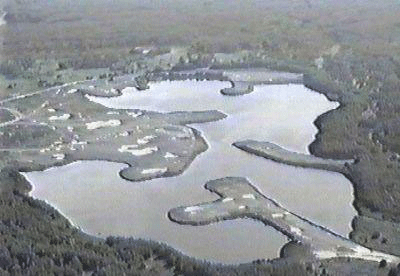
The 10 Worst Civilian Nuclear Accidents in History http://www.neatorama.com/2013/05/21/The-10-Worst-Civilian-Nuclear-Accidents-in-History/ Miss Cellania , May 21, 2013 Quick -how many nuclear accidents can you name? Chernobyl, Three Mile Island, Fukushima …any more? There have been quite a few nuclear accidents of varying danger that you probably never heard of, including some fatal incidents. For example, in 1957, nuclear waste exploded at a reactor near the Soviet town of Ozyorsk.
One of the storage tanks contained around 70 to 80 tons of radioactive liquid waste, and its cooling mechanism stopped working and wasn’t fixed. The tank’s contents, made up mostly of ammonium nitrate and acetates, began to dry out as the liquid heated up and evaporated. Moreover, the temperature increase caused an explosion whose force was equivalent to 70 to 100 tons of TNT, and this sent huge amounts of radioactivity – roughly 20 MCi (800 PBq) – into the environment. The fallout cloud from the explosion contaminated an area of up to 7,722 square miles (20,000 square kilometers).
Over a period of nearly two years, about 10,000 people were evacuated from the surrounding area. In terms of fatalities, the exact cost of the incident is not known, but immediately around the site of the explosion there were 66 diagnosed cases of chronic radiation syndrome.
Read more about the Ozyorsk incident and nine others in a list at Tech Graffiti. Link -via the Presurfer
VIDEO: continuing damage at Hanford radioactive waste facility
 VIDEO: Great Haste Made Great Waste at Hanford http://fairewinds.org/podcast/great-haste-made-great-waste-at-hanford The Hanford nuclear site, located on the Columbia River in Washington state, was built as part of the Manhattan Project to process plutonium for nuclear weapons. Operated until the end of the Cold War, the decades of weapons production has left Hanford as the most contaminated nuclear site in the US, with a long history of cover-ups about the leaking high-level radioactive waste. In a project that is currently 10-years behind schedule, the DOE is attempting to build a vitrification plant at Hanford to process and neutralize the massive amounts of radioactive waste left behind by the creation of nuclear bombs. Today, nuclear policy expert Robert Alvarez joins Kevin and Arnie to discuss the ongoing environmental damage to the Hanford site.
Whistleblower revealed CIA’s complicity with AQ Khan’s nuclear design thefts
(i cludes video)Nuclear Secrets: How America Helped Pakistan Get the Bomb http://www.corbettreport.com/nuclear-secrets-how-america-helped-pakistan-get-the-bomb/ by James Corbett BoilingFrogsPost.com May 21, 2013 In this series of Eyeopener  reports, we have been exploring the whistleblowers in the national intelligence establishment of the United States that have put their careers (and in some cases even their lives) on the line to shine a spotlight on the fraud, corruption and treason in the highest positions of power in the land. From the abuses of the NSA in its war against the American citizenry to the shocking details of Homeland Security informants participating in murders in Mexico with the full complicity of their government handlers, there is sadly no shortage of stories to explore. Perhaps one of the most unsettling stories, however, concerns what has been for the past half century regarded as one of the primary security threats not just to the United States but to the entire planet: nuclear proliferation.
Abdul Qadeer Khan, a Pakistani national, was working at a centrifuge production facility in the Netherlands in 1974 when he first offered his services to the Pakistani government to offer them help with their nuclear program. After convincing them to develop a uranium-based bomb, he began stealing nuclear designs from the Dutch company he was working for. What followed was a three decade affair in which Khan and the nuclear network he developed not only successfully helped Pakistan acquire the knowledge, equipment and materials to build their own bomb, but allegedly helped to proliferate that technology to Iran, Libya and North Korea as well.
As we explored in a previous edition of the Eyeopener, however, the Khan network was known about and actively protected from its very inception by the CIA. Continue reading
3 year study of cancers near nuclear facilities: where are the results?

 Nuclear Powered Cancer Clusters By Roger Witherspoon April 7, 2010 For the past 20 years, the Nuclear Regulatory Commission has used an epidemiologically invalid study to reassure the public that the continuous release of radioactive material from power plants into the surrounding regions did not contribute to increases in cancer.
To correct that unsubstantiated claim, the NRC has contracted with the National Academy of Sciences to conduct a two year study of both cancer incidence and mortality around former, current, and proposed nuclear reactor sites. The $5 million study, which is expected to take a year to design and two more years to complete, would be the first, comprehensive, government study of the health implications of the continuous release of radioactive into the air and water around nuclear facilities. Continue reading
Radiation exposure is of growing concern in medicine.
 Intermountain Healthcare alerts patients to cumulative radiation exposure The cancer risk from a single CT scan or chest X-ray is low, but radiation exposure is of growing concern in medicine. By Kirsten Stewart The Salt Lake Tribune, 22 May 13, Roughly 25 patients a day are wheeled into Intermountain Medical Center’s “cath lab” for CT scans to look for calcium buildup in their coronary arteries.
Coronary artery scans — the newest addition to radiologists’ growing arsenal of diagnostic tools — can aid doctors in diagnosing heart problems early. But they expose patients to 50 to 150 times the radiation of a chest X-ray, raising their risk for developing cancer later in life. “We want to make sure patients are getting tests only for the right reasons,” said cardiologist Donald Lappe at a new conference Wednesday touting a 9-month-old initiative aimed at ensuring just that.
Since August 2012 Intermountain Heathcare’s 168 clinics and 22 hospitals have been tracking patients’ cumulative radiation exposure from high-dose tests: CT scans, nuclear medicine scans and interventional radiology exams. Later the hospital chain hopes to also track x-rays, mammograms and other screens.
Generally the cancer risk from a single test is low, but radiation exposure is of growing concern in medicine.
The U.S. population’s exposure to ionizing radiation has nearly doubled over the past two decades, largely due to medical tests, according to the U.S. Food and Drug Administration, which requires all hospitals to disclose radiation doses to patients upon request…….http://www.sltrib.com/sltrib/news/56343948-78/radiation-exposure-patients-risk.html.csp
Germany’s move away from nuclear is part of a rational European trend
Nuclear futures: renewables blossom in Germany’s post-nuclear vision, The Conversation, 23 may“….The idea that it is irrational German angst that has led Germany to forge a path distinct from its neighbours doesn’t stand up to scrutiny: of 27 European Union member states, 11 have no civil nuclear power, and most have no intention of developing any. Four other European countries are joining Germany in phasing out nuclear power, while Italy closed its last nuclear power station in the 1980s, and in 2011 rejected plans to look at the issue again.
So Germany turning away from nuclear power is not a panicky reaction that endangers the country’s security of supply, more an important and well-integrated part of her transformation to use renewables exclusively.
Which is not to say that the Energiewende is without problems. Rising electricity bills and the costs of expanding many thousands of miles of transmission lines threaten to strain public acceptance. Rampant nimbyism and ecological and economic trade-offs have to be addressed; any plan for large offshore-wind farms that promise to provide efficient, renewable energy inevitably leads to conflicts with environmentalists.
Maintaining the power grid’s stability in a renewable-based system remains a challenge. But there is nothing to suggest that turning off nuclear power will jeopardise Germany’s clean energy vision. And where Germany leads, others may follow.http://theconversation.com/nuclear-futures-renewables-blossom-in-germanys-post-nuclear-vision-14364
Large scale batteries for renewable energy storage now growing in use
 Large Scale Energy Storage Roundup http://www.energymatters.com.au/index.php?main_page=news_article&article_id=3755 23 May 13,
As the world increasingly moves towards renewable energy; it will need many individual energy storage locations distributed across the grid to address issues of variability in electricity production. The idea of a battery being a relatively small device or a series of small boxes cobbled together with wiring is changing fast. Batteries capable of storing huge amounts of energy are being developed using all sort of materials and technologies.
The following are just a few we’ve reported on in the past; some of which are have now been deployed in commercial applications: Continue reading
European countries can save €45bn by co-operative renewable energy
 Siemens: Europe can save €45bn by optimising renewable energy generation 22 May 2013 http://www.renewableenergyfocus.com/view/32558/siemens-europe-can-save-45bn-by-optimising-renewable-energy-generation/ Siemens – which is hosting six Round Table discussions around the globe to discuss levers for optimising energy systems worldwide – says if regional characteristics were given higher priority when investments were made in renewable energy installations, Europe could save billions of Euros. The European energy system is inefficient to the point of damaging the continent’s competitiveness, it adds.
The company estimates that building and expanding renewable energy installations in the wrong locations is costing Europe around €45bn in unnecessary investment – the preliminary findings come via an ongoing studySiemens is conducting with the Technical University of Munich to examine energy systems worldwide. Significantly, the €45bn figure includes associated extension of the power grid.
In Germany alone, the potential savings are possible on a magnitude of 4-5 times the annual investment in solar and wind power plant construction, the firm says. The crux, according to Siemens, lies in the choice of location: installations must be built at the sites in Europe that offer the highest power yields. Continue reading
Nuclear deterrence has been a very dangerous system
Nuclear Winter of Our Discontent, TIME USA By Mark ThompsonMay 22, 2013 “…..By re-studying the U.S. nuclear bombing of Japan that ended World War II in 1945, and the brush with World War III that 1962’s Cuban missile crisis represented, Ward Wilson tries to revamp our understanding of the utility of nuclear weapons…… What this new scholarship reveals is that the failure rate of nuclear deterrence is potentially higher than theory admits.
Nuclear deterrence has to be perfect, or close to perfect. A catastrophic all-out nuclear war could result from any failure of nuclear deterrence, so there is little margin for error. One could say for nuclear deterrence, failure is not an option. Yet these documented cases of nuclear deterrence failure raise the possibility that we have been far luckier, and have run far greater risks, than we imagined. If nuclear deterrence has a high rate of failure, continuing to rely on it for the safety and security of the United States would seem to guarantee its eventual catastrophic failure.
One of the great strengths of the military mind is its insistence on experience-based thinking. In the case of nuclear weapons, there has historically been plenty of theory, but not as much sensible, pragmatic thinking. It is time for a little more pragmatic analysis.
Sobering stuff. Full thing here.- Rethinking the Utility of Nuclear Weapons http://strategicstudiesinstitute.army.mil/pubs/parameters/Issues/WinterSpring_2013/5_Article_Wilson.pdf
http://nation.time.com/2013/05/22/nuclear-winter-of-our-discontent/
1 This Month
22 June – Virtual Event –Climate Change: New Data, New Debate

Monday, June 22, 2026 2:30 p.m. – 3:15 p.m. CT
YouTube. Register here

Protect Sazan Island from the Trump family! https://secure.avaaz.org/campaign/en/protect_sazan_island_from_the_trump_family_loc/?bqFCVab&v=174511&cl=22707147157&_checksum=5e9dde668860e8231c33699735e16a1fbf22ab2cb01da50c999fe8732b9775ef&utm_source=email&utm_medium=blast_email&utm_campaign=174511
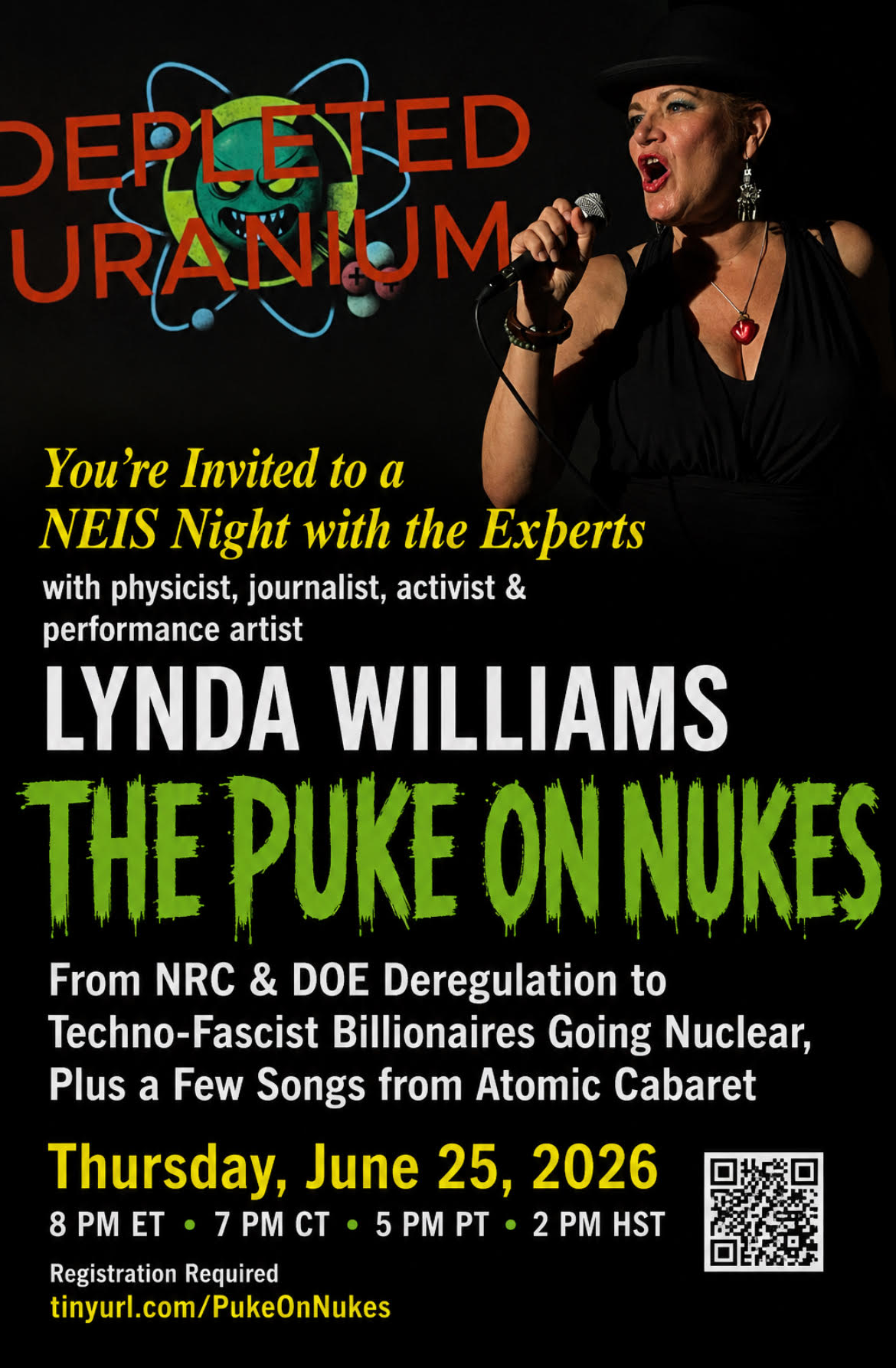
25 June- THE PUKE ON NUKES
Thursday, June 25, 2026
7pm Central Time (8pm ET, 6pm MT, 5pm PT) UTC – 5
From NRC & DOE Deregulation to Techno-Fascist Billionaires Going Nuclear, Plus a Few Songs from Atomic Cabaret REGISTER
26 June – Radiation Trainwreck at the NRC / Join the Protect Better Campaign – https://us02web.zoom.us/meeting/register/4ZlZ5_qLSHGiLSCg8FF6Bg#/registration


Cuba Is Not a Failed State – It Is a Besieged State
PETITION: “Global Appeal to Endorse Palestinian Right of Return of Refugees”
To see nuclear-related stories in greater depth and intensity – go to https://nuclearinformation.wordpress.com
-
Archives
- June 2026 (193)
- May 2026 (306)
- April 2026 (356)
- March 2026 (251)
- February 2026 (268)
- January 2026 (308)
- December 2025 (358)
- November 2025 (359)
- October 2025 (376)
- September 2025 (257)
- August 2025 (319)
- July 2025 (230)
-
Categories
- 1
- 1 NUCLEAR ISSUES
- business and costs
- climate change
- culture and arts
- ENERGY
- environment
- health
- history
- indigenous issues
- Legal
- marketing of nuclear
- media
- opposition to nuclear
- PERSONAL STORIES
- politics
- politics international
- Religion and ethics
- safety
- secrets,lies and civil liberties
- spinbuster
- technology
- Uranium
- wastes
- weapons and war
- Women
- 2 WORLD
- ACTION
- AFRICA
- Atrocities
- AUSTRALIA
- Christina's notes
- Christina's themes
- culture and arts
- Events
- Fuk 2022
- Fuk 2023
- Fukushima 2017
- Fukushima 2018
- fukushima 2019
- Fukushima 2020
- Fukushima 2021
- general
- global warming
- Humour (God we need it)
- Nuclear
- RARE EARTHS
- Reference
- resources – print
- Resources -audiovicual
- Weekly Newsletter
- World
- World Nuclear
- YouTube
-
RSS
Entries RSS
Comments RSS
 nuclear-news