USA and Japan corrupt United Nations “Optional Protocol” – Fukushima citizen groups lose out!
……In addition to the billions being contributed to various bodies within the U.N. system, the United States provides 22 percent of the U.N.’s operating budget, more than twice as much as the No. 2 contributor, Japan (10.8 percent)….
……“It’s disturbing that no one, including our ambassador to the United Nations, knows exactly how much money we send the U.N. every year,” Enzi said in a statement.
“With a national debt exceeding $17 trillion, we need to be able to account for every dime we spend, including what we send to the U.N.”…..
…… 24 May 2013 – (The date of submission was JUST before the last meeeting so as to stop any challenges to the Japanese BAD SCIENCE)……

Published by nuclear-news.net
By Arclight2011
28 May 2013
HUMAN RIGHTS COUNCIL CONCLUDES DIALOGUE WITH SPECIAL RAPPORTEURS ON THE RIGHT TO HEALTH AND THE RIGHTS OF MIGRANTS
28 May 2013
[Extracts]
The Human Rights Council this morning concluded its interactive dialogue with the Special Rapporteurs on the right to health and on the human rights of migrants.
The Special Rapporteurs presented their reports on Monday, 27 May in the afternoon, and Azerbaijan, Tajikistan, Japan, European Union, Tunisia and Turkey spoke as concerned countries. Summaries of their statements can be found in HRC/13/54.
[…]
The Special Rapporteurs presented their reports on Monday, 27 May in the afternoon, and Azerbaijan, Tajikistan, Japan, European Union, Tunisia and Turkey spoke as concerned countries. Summaries of their statements can be found in HRC/13/54.
[,,,]
Human Rights Now said that the contamination of huge areas of Japan with radioactive materials following the Fukushima accidents created an important health risk for the population, particularly for children and pregnant women. Japan should urgently review current practices and ensure people’s right to live in a safe and health environment and take all measures to proactively prevent negative impact.
[…]
Peace Boat said that it was the right of those affected by radiation to resettle in a safe environment with all necessary assistance assured by the Japanese authorities. Affected citizens had to be entitled to unrestricted access to accurate and comprehensive information on radiation levels and risks and the evolving situation at the plant from independent sources.
[…]
Concluding Remarks by the Special Rapporteurs on the Right to Health and the Human Rights of Migrants
ANAND GROVER, Special Rapporteur on the right to the highest attainable standard of physical and mental health, stressed that the right to health framework required participation which was very meaningful for those affected by the decision-making process. Central and local authorities should proactively arrange meetings to seek and take into account the view of civil society. The participation of vulnerable groups including women and children and the elderly, had to be adequately ensured. Japan was urged to consider public participation in the manner just highlighted. The Committee on Economic, Social and Cultural Rights in its concluding observations had urged the Japanese Government to provide credible and accurate information on hazards, for prevention plans. On access to medicines, it was suggested that the right to health framework be rights-based. This was an opportune moment for Brazil, Russia, India and China, the BRICS countries, to transfer technologies to Least Developed Countries. On migration and data on irregular migrants, if irregular migrants were criminalised and stigmatised, then such information would not be obtainable.
[…]
http://www.unog.ch/unog/website/news_media.nsf/%28httpNewsByYear_en%29/2EFAFBD270514B47C1257B79003DC922?OpenDocument
Opening Statement by UN High Commissioner for Human Rights Navi Pillay at the 23rd session of the Human Rights Council, Geneva,
27 May 2013
[Extracts]
OPTIONAL PROTOCOL ON ECONOMIC, SOCIAL AND CULTURAL RIGHTS
Earlier this month, the Optional Protocol to the International Covenant on Economic, Social and Cultural Rights entered into force. By enabling individuals to bring complaints to the Committee on Economic, Social and Cultural Rights, this instrument ensures the same protection for economic, social and cultural rights as for civil and political rights. It therefore remedies the false hierarchies among ‘groups’ of rights that arose during the Cold War and were largely resolved twenty years ago in Vienna.
The current economic context is an opportune moment for States to ratify the Optional Protocol. In doing so, they will create an impetus to strengthen national protection mechanisms for economic, social and cultural rights and encourage policies that promote greater equality, sustainability, and protection.
NGOs AND VIENNA
The Vienna Conference that we will commemorate next month was remarkable in many ways; one was the participation of civil society.
Bearing that in mind, it is particularly depressing to observe policy debates and legislative measures — in many countries, across all regions — which may severely undermine non-governmental organizations that are vital to the healthy functioning of democracy. I am disturbed at continuing reports of reprisals against human rights defenders.
Civil society is crucial to the framework of human rights that was reinforced in Vienna twenty years ago. It remains vital to advancing the human rights agenda, both at the national level and internationally, and I must speak out to warn you of the real setbacks to human rights protection that will follow if civil society is threatened or restricted.
Thank you.
http://www.ohchr.org/EN/NewsEvents/Pages/Media.aspx

HUMAN RIGHTS COUNCIL HEARS STATEMENTS BY SPECIAL RAPPORTEURS ON THE RIGHT TO HEALTH AND ON THE HUMAN RIGHTS OF MIGRANTS
Concludes General Debate on the Update of the Annual Report of the High Commissioner, Decides to Hold Urgent Debate on Syria on 29 May
27 May 2013
[Extracts]
Anand Grover, Special Rapporteur on the right of everyone to the enjoyment of the highest attainable standard of physical and mental health, said one of his thematic reports focussed on the health of migrant workers. This group often faced inequality and discrimination in accessing healthcare, thus leading to reduced health outcomes. States should extend social and health protections to this group. The second report looked at access to medicines. The Special Rapporteur identified the need for a paradigm shift away from the market to ensure non-discriminatory access to medicines. He spoke of his missions to Azerbaijan, Tajikistan and Japan.
[…]
The following spoke as concerned countries or parties: Azerbaijan, Tajikistan, Japan, European Union, Tunisia, and Turkey. Italy and Greece will speak as concerned countries at the next plenary at 9 a.m. on Tuesday, 28 May.
[…]
Clustered Dialogue with the Special Rapporteurs on the Right to Health and the Rights of Migrants
Documentation
The Council has before it the report of the Special Rapporteur on the right of everyone to the enjoyment of the highest attainable standard of physical and mental health (A/HRC/23/41); an addendum to the report concerning the Special Rapporteur’s mission to Azerbaijan (A/HRC/23/41/Add.1), an addendum to the report concerning the Special Rapporteur’s mission to Tajikistan (A/HRC/23/41/Add.2); an addendum to the report concerning the Special Rapporteur’s mission to Japan on the report of the Special Rapporteur (A/HRC/23/41/Add.3); an addendum to the report concerning the comments by Azerbaijan on the report of the Special Rapporteur (A/HRC/23/41/Add.4); and an addendum to the report concerning the comments by Japan on the report of the Special Rapporteur (A/HRC/23/41/Add.5).
The Council has before it the Study of the Special Rapporteur on the right of everyone to the enjoyment of the highest attainable standard of physical and mental health (A/HRC/23/42).
The Council has before it the report of the Special Rapporteur on the human rights of migrants (A/HRC/23/46); an addendum to the report concerning the Special Rapporteur’s mission to Tunisia (A/HRC/23/46/Add.1); an addendum to the report concerning the Special Rapporteur’s mission to Turkey (A/HRC/23/46/Add.2); an addendum to the report concerning the Special Rapporteur’s mission to Italy (A/HRC/23/46/Add.3); a corrigendum to the addendum to the report concerning the Special Rapporteur’s mission to Italy (A/HRC/23/46/Add.3/Corr.1); an addendum to the report concerning the Special Rapporteur’s mission to Greece A/HRC/23/46/Add.4); an addendum to the report concerning the comments by Greece on the report of the Special Rapporteur (A/HRC/23/46/Add.5); and an addendum to the report concerning the comments by Italy on the report of the Special Rapporteur (A/HRC/23/46/Add.6).
[…]
Presentation of the Reports of the Special Rapporteurs on the Right to Health and the Rights of Migrants
ARNAND GROVER, Special Rapporteur on the right of everyone to the enjoyment of the highest standard of physical and mental health, said that he had undertaken country missions to Azerbaijan, Tajikistan and Japan. In presenting the results of his thematic reports, the Special Rapporteur said one report focussed on the health of migrant workers. He concluded that this group often faced inequality and discrimination in accessing healthcare, thus leading to reduced health outcomes. States should extend social and health protections to this group. Migrants were also prone to draconian immigration policies, detention and deportations due to a perceived health risk or their legal status. This created a “vicious circle” of the negation of rights and poor health outcomes that was untenable. The second report looked at access to medicines. The Special Rapporteur identified the need for a paradigm shift away from the market to ensure non-discriminatory access to medicines. Political will and a coherent policy framework was needed to underpin this shift, as well as price-controls enacted by States. For various political, economic and cultural reasons such medicines as those needed to treat mental and sexual health were often made difficult to access. A number of logistic and infrastructure weaknesses were identified that made these problems worse and a number of suggestions for good practice were made. States were encouraged to become more transparent in their inspection regimes with regard to the efficacy and availability of medicines.
During a visit to Azerbaijan to assess tuberculosis in the country, the Special Rapporteur identified some progress with regard to drinking water and other infrastructure problems but said that the focus remained too squarely fixed on secondary and tertiary care systems. Prisons were of great concern as tuberculosis was easily spread through the penal system and not enough was being done to combat or understand this.
A visit to Tajikistan also revealed an underdeveloped and underfinanced primary healthcare system with tuberculosis being a prominent problem. The Special Rapporteur said he was pleased the Government had taken his recommendations on board and had prepared an action plan.
With respect to his trip to Japan, the Special Rapporteur said that it was a great challenge given the seriousness of the after-effects of the Fukushima nuclear accident. He praised the Government for certain of its actions in the wake of the accident but identified some limitations in its response. Despite the actions that had been taken an increase in the incidence of cancers could be expected in the future. The lack of transparency in the nuclear industry was also covered by the Special Rapporteur’s report.
[…]
Statements by Concerned Countries
Japan, speaking as a concerned country, said that since the Great East Japan Earthquake of 2011 it had made earthquake recovery a priority issue. The Government recognised that the health management of the residents affected by the situation involving Fukushima Dai-ichi Nuclear Power Station was of great importance and in that respect it had been working to address their health management while respecting both the latest findings of medical experts and international standards. During the drafting of the Special Rapporteur’s report Japan had provided comments to clarify misunderstandings of the facts from scientific or legal viewpoints but there remained areas of the report in which these explanations were not accurately reflected. Japan refused to be simply satisfied with the status quo and was committed to perpetual improvement.
[…]
http://www.unog.ch/unog/website/news_media.nsf/%28httpNewsByYear_en%29/0D18CAB73565D7B4C1257B78005D7C7A?OpenDocument
Japan must continue efforts to deactivate Fukushima nuclear plant – UN agency
24 May 2013 –
[Extract]
Although Japan has made progress towards stabilizing the damaged reactors of the Fukushima Daiichi nuclear plant crippled by a devastating earthquake two years ago, there are still issues to be resolved before it can begin its deactivation, the United Nations atomic agency said in a report released today.
The report was released after an expert team from the UN International Atomic Energy Agency (IAEA) completed an initial review of Japan’s efforts to implement a Mid-and-Long-Term Roadmap to decommission the Fukushima Daiichi power plant. The visit was the first of what is planned to be a two-mission review, at the request of the Japanese Government.
“Our final report reflects that the Roadmap was developed early after the accident and that Japanese workers have achieved reasonable stable cooling of the damaged reactor cores and spent fuel pools,” said the Director of the IAEA’s Division of Nuclear Fuel Cycle and Waste Technology, Juan Carlos Lentijo.
“But the continuing accumulation of contaminated water at the site is influencing the stability of the situation and must be resolved in the near term before other recovery and decommissioning steps can begin.”
http://www.un.org/apps/news/story.asp?NewsID=44992&Cr=nuclear&Cr1=#.UaUE7tdx0xA
America Is Throwing a Ton of Money at the UN
Take a deep, deep breath because you will likely be livid after reading this article.
Read from Israel Matzav:
Just how much money does the United States spend on the United Nations every year? You won’t believe the answer (or perhaps you will):Those who know aren’t saying.
In its fiscal 2014 State and Foreign Operations budget proposal released in April, the Obama administration asked for $1.57 billion for contributions to international organizations, including $617.6 million for the U.N. operating budget — up from $568.8 million in fiscal 2012.
But other agencies giving to the U.N. include the Departments of Labor, Energy, Agriculture, Defense, and Health and Human Services, CNS News reported.
Fiscal 2007 legislation stipulated that the Office of Budget and Management (OMB) report all federal agencies’ contributions, but the requirement expired in 2011.
Now Republican Sens. Mike Enzi of Wyoming and Mike Lee of Utah, and others, are submitting legislation that would reinstate the requirement.
“It’s disturbing that no one, including our ambassador to the United Nations, knows exactly how much money we send the U.N. every year,” Enzi said in a statement.
“With a national debt exceeding $17 trillion, we need to be able to account for every dime we spend, including what we send to the U.N.”
And here’s a hint of how much the US is really spending:
The last OMB report to Congress on U.N. contributions was issued in June 2011 and covered fiscal 2010. It showed that State was just one of 17 government agencies giving money to U.N. organizations, funds, affiliates and other bodies, and the total expenditure that year was $7.69 billion — more than 10 times the amount requested for State in fiscal 2014.
In addition to the billions being contributed to various bodies within the U.N. system, the United States provides 22 percent of the U.N.’s operating budget, more than twice as much as the No. 2 contributor, Japan (10.8 percent).
Your tax dollars at work! What could go wrong?
http://exposingliberallies.blogspot.co.uk/2013/05/america-is-throwing-ton-of-money-at-un.html
ICRP, WHO and UNSCEAR and their effect on the Fukushima children
[EXTRACT]
I hope this helps to stimulate some discussion. The children of Fukushima need us to discuss this health issue as the nuclear lobby is having a lot of meetings and not telling anyone. They are changing the rules to suit the nuclear industry and mitigate any future legal claims made against them. No media are challenging this or even reporting it.
The rest of the report s here..
The normal background level in Japan is said to be 2.1 mSv/y and the USA and Europe are quoted as being nearly as bad at approx 3 mSv/y, making an extra 1 mSv/y from the Fukushima nuclear disaster in Japan seem normal.
Oddly enough, as i sit here typing i am getting a steady 0.11 mcSv/hr after rain in London (one of the worst polluted cities in Europe because of nuclear MOX processing and waste – NO2 and associated radon Daughters), that gives me a normal background of just under 1 mSv/y. So how do the Japanese (supported by the ICRP and UNSCEAR) work the annual doses out to 3 mSv/y?
Also, according to Safecast citizen radiation monitoring, the levels are more in line with my London reading in many parts of Japan presently. The Japanese officials would have us believe a 3 mSv/y is only 1mSv/y more than background??
https://nuclear-news.net/2013/05/28/icrp-who-and-unscear-and-their-effect-on-the-fukushima-children/
3 Comments »
Leave a reply to Christina MacPherson Cancel reply
1 This Month
26 April – Chernobyl: Inside the Meltdown airs on National Geographic on Sunday 26th April from 4pm
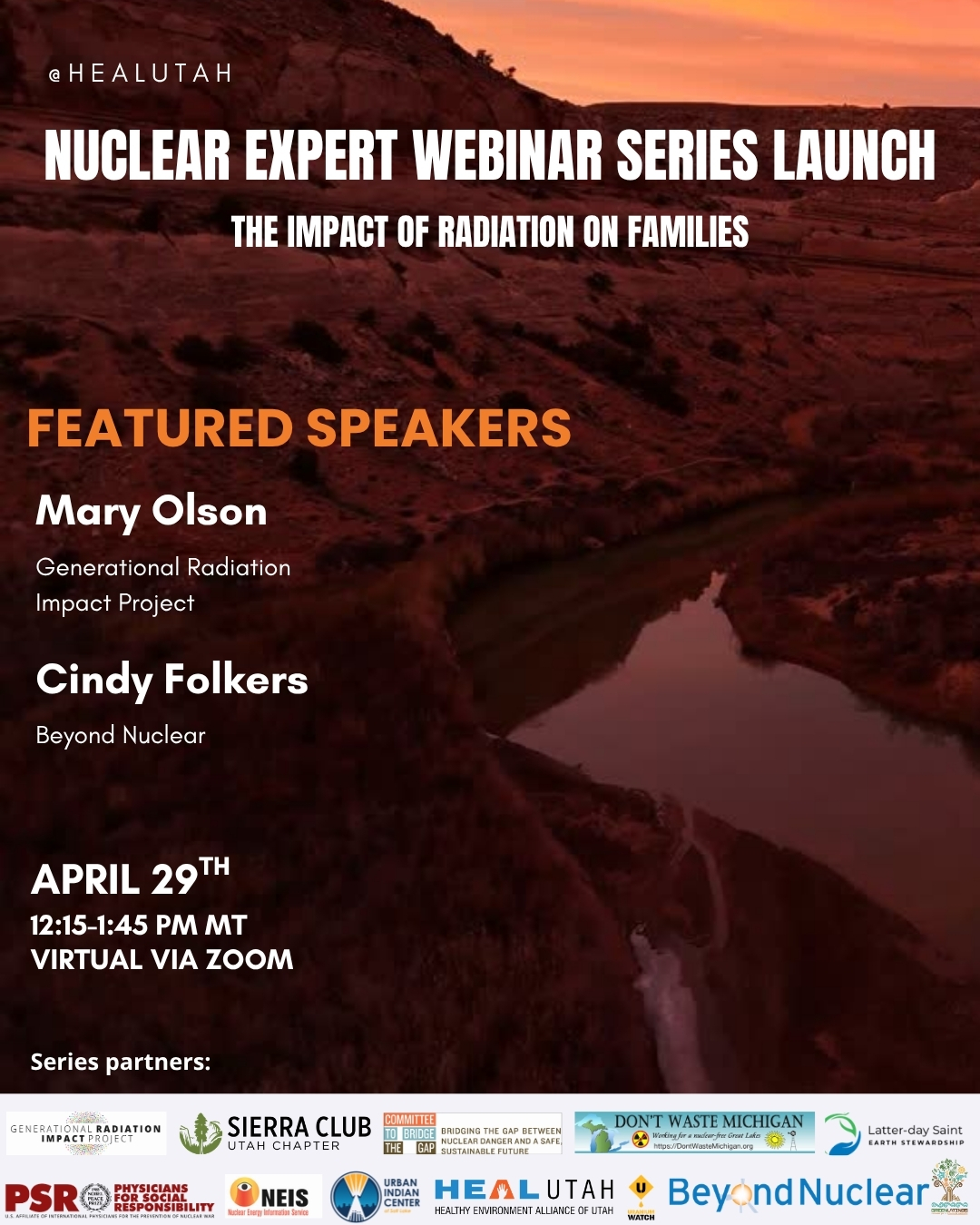
29 April – Nuclear Expert Webinar #1 – Radiation Impacts on Families with Mary Olson and Cindy Folkers
- 12:15 PM MT – 1:45 PM MT
- Location: Virtual – REGISTER TODAY

4 May -West Suburban Peace Coalition to discuss Iran war at May Educational Forum
Monday, May 4, 7:00 – 8:00 PM Central Standard Time
Title: : How Trump’s Narrative Tries to Shape the Reality of the War on Iran.
Contact Walt Zlotow, zlotow@hotmail.com 630 442 3045 for further information
14 May – online event From Bombs to Data Centres: the Face of Nuclear Colonialism

Pine Ridge Uranium is the real threat, not Tehran- Tell Burgum: Stop the Extraction.
Chernobyl: The Lost Tapes – A good documentary on Chernobyl on SBS available On Demand for the next 3 weeks– https://www.sbs.com.au/ondemand/tv-program/chernobyl-the-lost-tapes/2352741955560
To see nuclear-related stories in greater depth and intensity – go to https://nuclearinformation.wordpress.com
-
Archives
- April 2026 (317)
- March 2026 (251)
- February 2026 (268)
- January 2026 (308)
- December 2025 (358)
- November 2025 (359)
- October 2025 (376)
- September 2025 (257)
- August 2025 (319)
- July 2025 (230)
- June 2025 (348)
- May 2025 (261)
-
Categories
- 1
- 1 NUCLEAR ISSUES
- business and costs
- climate change
- culture and arts
- ENERGY
- environment
- health
- history
- indigenous issues
- Legal
- marketing of nuclear
- media
- opposition to nuclear
- PERSONAL STORIES
- politics
- politics international
- Religion and ethics
- safety
- secrets,lies and civil liberties
- spinbuster
- technology
- Uranium
- wastes
- weapons and war
- Women
- 2 WORLD
- ACTION
- AFRICA
- Atrocities
- AUSTRALIA
- Christina's notes
- Christina's themes
- culture and arts
- Events
- Fuk 2022
- Fuk 2023
- Fukushima 2017
- Fukushima 2018
- fukushima 2019
- Fukushima 2020
- Fukushima 2021
- general
- global warming
- Humour (God we need it)
- Nuclear
- RARE EARTHS
- Reference
- resources – print
- Resources -audiovicual
- Weekly Newsletter
- World
- World Nuclear
- YouTube
-
RSS
Entries RSS
Comments RSS
 nuclear-news
USA is very choosy about giving money to the U.N. For example, about a year ago UNESCO had the temerity to make some move in support of Palestine. I think they were recommending Palestine as a member of something – perhaps the UN. Anyway, very quickly America withdrew some planned funding to UNESCO. USA while often sneering at UN, does its best to try to control UN policy.
i wonder what the budget is for UNSCEAR, ICRP, IAEA , IMF as well as some of the myriad committees that are in the UN coming from Japan and the USA?
the money is obviously going to be biased towards pro buisness policies!
now i have retired from “normal” living i suspect i will have the time to find out 🙂
and improve me blogging 🙂 🙂
[…] https://nuclear-news.net/2013/05/28/usa-and-japan-corrupt-united-nations-optional-protocol-fukushima-… […]
Pingback by Study claims -Fukushima Radiation May “have little long-term effect on wildlife” but the “Tsunami” is likely to be the cause for any effects perhaps? « nuclear-news | March 7, 2014 |