Slide Show – history of environmental movement
 Slide Show Green Activism Evolution Since The First Earth Day (PHOTOS) http://www.huffingtonpost.com/2013/04/18/green-activism-evolution-photos_n_3103118.html The Huffington Post | By James Gerken 04/18/2013 April 22 marks the 43rd observance of Earth Day in the United States. Organized by Sen. Gaylord Nelson (D-Wis.), the first Earth Day in 1970 saw an estimated 20 million Americans demonstrate in support of the environment. By 2012, over one billion people in 192 countries took part in Earth Day festivities.
Tracing its roots to the 19th century conservation movement, modern environmentalism — and its accompanying protests — has gained support since the first Earth Day, despite modest progress on the policy front. A number of U.S. lawmakers have tried repeatedly to advance bills aimed at protecting the environment and reducing carbon emissions, as the international community warns that global investments in clean energy may be progressing too slowly to limit the effects of climate change.
The second decade of the 21st century -– marked by America’s largest oil spill, thehottest year on record for the continental U.S. and the bitterly divisive Keystone pipeline proposal — has already confirmed the growing relevance of environmental issues in America.
From dramatically unfurled banners across world landmarks to a “toilet protest” and an underwater government cabinet meeting, the demonstrations captured in the images in the slideshow below reflect a spirit unlikely to wane.
Serious worries about safety of Iran’s Bushehr nuclear power plant.
 Another Cause for Alarm in Iran’s Nuclear Program:
  Earthquakes, The Atlantic, Jill Keenan, 18 April 13, The country’s nuclear power plant is built near tectonic plates, and reports show it may not be safe in the event of a major seismic event. On April 16, a massive 7.8-magnitude earthquake hit southeast Iran, sending tremors across the region and causing casualties that are expected to reach into the hundreds. According to an Iranian official , it was the biggest earthquake to hit the country in 40 years. This devastation comes only one week after another earthquake hit the town of Kaki, also in southern Iran, killing at least 37 people and injuring more than 850 others. Shockwaves from both earthquakes were felt as far away as Bahrain, Kuwait, Qatar, the UAE, and western Saudi Arabia. They are only the two most recent in a series of earthquakes that regularly haunt this seismically unstable country.
Most ominously, the epicenter of the April 9 earthquake’s first tremor, which measured a 6.3 on the Richter scale, was centered only 62 miles away from Iran’s Bushehr nuclear power plant. Continue reading
French company EDF quite prepared to pull out of building Britain’s new nukes
” As far as I am concerned, negotiations can also fail,” Proglio told reporters on the sidelines of a debate about France’s energy policy
 EDF SAYS “IN NO HURRY” FOR UK NUCLEAR PROJECTS PARIS
 Reuters April 19, 2013 – EDF chief executive officer Henri Proglio said on Thursday talks are continuing between the French utility and the British government about its nuclear projects in Britain but added that he was “in no hurry” to sign an agreement. Continue reading
Muslumovo, a town radioactively poisoned for 60 years
Soviet radiation biology took a different trajectory from science in the United States. American researchers at that time were working with the highly politicized medical studies of Japanese bomb survivors. They narrowed the list of radiation-related illnesses to leukemia, a few cancers, and thyroid disease. Soviet doctors in formulating chronic radiation syndrome had grasped the effects of radiation on the body more holistically. They determined that radiation illness is not a specific, stand-alone disorder, but that its indications relate to other illnesses. They determined that radioactive isotopes weaken immune systems and damage organ tissue and arteries, causing illnesses of the circulation and digestive tracts and making people susceptible to conventional diseases long before they succumb to radiation-related cancers.
 Strange illnesses in one of the most contaminated towns in the world challenge what we think we know about the dangers of radioactivity. Slate, By Kate Brown, April 18, 2013, ”…… the sad fact is that there are irradiated zones that are fully inhabited, and have been since the first years of the nuclear arms race. Despite a media culture enthralled with nuclear accidents, the cameras generally turn off after the first clouds of radioactive vapors dissipate.
“………..For Soviet leaders, the river dwellers were a unique opportunity in the history of health physics—what scientists call “a natural experiment” that promised to answer an important civil defense question about how to survive a nuclear attack. In 1962, the Cheliabinsk branch of the Soviet Institute of Bio-Physics, called FIB-4, started conducting regular medical exams of the Muslumovo population. FIB-4 doctors invited village children playing on the streets to a clinic room to take blood samples. In Cheliabinsk, they set up a repository of irradiated body parts: hearts, lungs, livers, bones. They started a collection of genetically malformed babies who died soon after birth, each infant preserved in a two-quart glass jar. A Dutch photographer, Robert Knoth, visited the repository and saw hundreds of babies in jars. He photographed one infant with skin like patched, rough burlap. Another boy had eyes on top of his head like a frog. During the examinations, doctors did not inform the villagers of their exposures or of diagnoses of radiation-related illness.
In 1986, soon after the Chernobyl disaster, Glufarida Galimova, working as chief doctor at a pediatric clinic in Muslumovo, her native town, was puzzled by the saturation of illness in her community. The illnesses were rare, strange, complex, and often genetic: hydrocephalic children, children with cerebral palsy, missing kidneys, extra fingers, anemia, fatigue, and weak immune systems. Many kids were orphaned or had invalid parents. Continue reading
Zwentendorf Nuclear Power Plant now a Solar Power Plant
 The Zwentendorf Nuclear Power Plant http://en.wikipedia.org/wiki/Zwentendorf_Nuclear_Power_Plant was the first nuclear plant built in Austria, of 6 nuclear plants originally envisaged. The plant atZwentendorf, Austria was finished, but never operated. Start-up of the Zwentendorf plant, as well as construction of the other 5 plants, was prevented by a referendum on 5 November 1978. A narrow majority of 50.47% voted against the start-up.[1][2]
Construction of the plant began in April 1972, as a boiling-water reactor rated at 692 megawatts electric power output. It was built by a joint venture of several Austrian electric power utilities, and was envisioned as the first of several nuclear power plants to be built. The initial cost of the plant was around 14 billions Austrian schillings, about 1 billion Euros today.[3] The ventilation stack chimney of the plant is 110 metres tall. The plant has been partly dismantled. Since 1978 Austria has a law prohibiting fission reactors for electrical power generation.
The plant is now owned by Austrian energy company EVN Group and used as Solar Power Plant and for education purposes.
The Dürnrohr Power Station was built nearby as a replacement thermal power station.
Following the 1978 referendum, no nuclear power plant that was built for the purpose of producing electricity ever went into operation in Austria. However, three small nuclear reactors for scientific purposes have been built and used since the 1960s, with one still being in operation.[4]
Gregory Jaczko appointed to advisory panel on nuclear security
 Reid Appoints Besieged Regulator to Nuclear-Weapons Panel National Journal, By Amy Harder April 18 Late in the evening on Wednesday, one of the busiest and most unnerving times Washington has seen in a long while, Senate Majority Leader Harry Reid quietly appointed a controversial former nuclear-energy regulator to a key but obscure panel.
Reid appointed Gregory Jaczko, the beleaguered former chairman of the Nuclear Regulatory Commission, to a newly created congressional advisory panel that oversees the Energy Department’s National Nuclear Security Administration, which manages the nation’s nuclear-weapons stockpile and nuclear nonproliferation with about $8 billion taxpayer dollars……..
Jaczko also made waves recently in the wake of multiple interviews, including with the trade publication Nuclear Intelligence Weekly and the New York Times, where he called to phase out all nuclear power plants. “What is needed is a phaseout of all nuclear plants in this country,” Jaczko said, according to a March 29 issue of the Nuclear Intelligence Weekly. “They’re not safe.” http://www.nationaljournal.com/energy/reid-appoints-besieged-regulator-to-nuclear-weapons-panel-20130418
Radioactive trash sailing from France to Japan
 Nuclear fuel leaves French port for Japan, first since Fukushima PARIS |
  Michael Rose, Apr 18, 2013 (Reuters) – A shipment of highly radioactive nuclear fuel to Japan left the port of Cherbourg in northern France on Wednesday for the first time since the Fukushima disaster, French energy group Areva said on Thursday.
The shipment of mixed oxide fuel (MOX) is likely to be controversial inJapan, where
 public opposition to nuclear power and reactor restarts remains strong a month after the second anniversary of the March 11, 2011 catastrophe. France’s state-owned nuclear group, whose activities range from uranium mining and enrichment to reactors and waste recycling, said the shipment will go round the Cape of Good Hope and then through the south-west of the Pacific Ocean.
The group added in a statement it expected the Pacific Heron and Pacific Egret cargoes of British nuclear shipping company PNTL to reach Japanese waters in the second half of June….. The MOX shipment is destined for Kansai Electric Power Co’s Takahama nuclear plant west of Tokyo.
Because MOX fuel contains around 7 percent plutonium, it is perceived as a national security threat, and special precautions are taken during transportation….. http://www.reuters.com/article/2013/04/18/us-areva-mox-japan-idUSBRE93H0EO20130418
Virginia gets an agency to promote nuclear power
 Nuclear authority generates controversy Rapp News By Stephen Nielsen Capital News Service, 18 April 13 RICHMOND – Virginia is creating a new agency to support development of nuclear power – a move that has upset environmentalists and open-government advocates, because the entity won’t have to comply with the state’s Freedom of Information Act and other laws….. In January, Garrett introduced House Bill 1790, which sought to create the Virginia Nuclear Energy Consortium Authority. Sen. Jeffrey McWaters, R-Virginia Beach, sponsored companion legislation – Senate Bill 1138 – in his chamber. Both bills were passed by the General Assembly and signed into law by Gov. Bob McDonnell…..
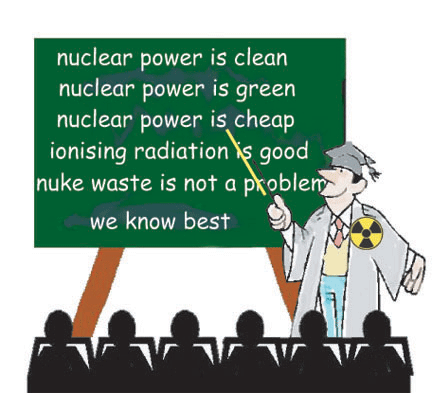
By Jan. 1, the authority will create the Virginia Nuclear Energy Consortium. By law, the consortium will seek to make Virginia “a leader in nuclear energy” Continue reading
Solar power developments in Japan: battery storage
Japan To Implement 60,000 kWh Capacity Battery http://www.energymatters.com.au/index.php?main_page=news_article&article_id=3697 19 April 13 The Japanese government plans to install a massive battery at an electrical substation on the island of Hokkaido.
According to the Japan Times, the country’s Ministry of Economy, Trade and Industry (METI) says the battery will be put in place by the end of the first quarter in 2015 to help develop a stable electricity supply generated by solar and wind power sources. The battery system will have a storage capacity of around 60,000 kWh and will use up a large portion of ¥29.6 billion earmarked for battery projects.
Hokkaido is Japan’s second largest island and the largest and northernmost of Japan’s 47 prefectures. It has become a hive of renewable energy activity due to the availability and low prices of suitable land. According to Bloomberg, the island’s power infrastructure is approaching its limit for handling the amount of clean electricity being generated.
Japan has seen solar uptake skyrocket since the introduction of a feed in tariff scheme, currently paying 38 yen per kilowatt hour (around AUD 38 cents) for rooftop solar power systems under 10kW and slightly more for larger systems.
In other renewables news out of Japan, METI states based on data compiled by the Agency for Natural Resources and Energy (ANRE), the total combined new renewable energy capacity added between April 1, 2012, and January 31, 2013,reached 1,394,000 kW .
Photovoltaic power facilities accounted for 1,329,000 kW, with household solar panel systems making up 1,023,000kW of that amount. METI notes that 37,000kW capacity was added by January 31 – with all of that being added after June 2012.
METI also announced Japan and India have decided to hold the “India-Japan Energy Forum 2013” in September in New Delhi and Greater Noida, which aims to reinforce the two nation’s cooperation in the field of energy.
Leaking nuclear power station in Kent, UK
Nuclear power station has been leaking radioactive waste ‘for months’, says Environment Agency. Dungeness B in Kent has been leaking more than agreed levels of Tritium Mail Online, By STEVE NOLAN, 18 April 2013 A nuclear power station in Kent has been leaking radioactive waste, which can increase the risk of developing cancer, for months according to the Environment Agency. Routine tests on boreholes drilled close to the Dungeness B plant found traces of tritium measuring more than seven times the agreed level……. http://www.dailymail.co.uk/news/article-2311217/Nuclear-power-station-leaking-radioactive-waste-months-says-Environment-Agency.html#ixzz2QyKFyAZl
Emergency Declared At US Nuclear Plant In Illinois 4/18/13; TMI Conducts Emergency Drill
Published on 18 Apr 2013
Emergency declared at U.S. nuclear plant after lightning strike — “Venting of Unit 1 primary containment” — ‘Normal’ radiation levels reported — NRC mobilizes response center
http://enenews.com/emergency-declared…
Exelon Generation’s La Salle County Generating Station declared an Unusual Event at 3:11 p.m. today, after both units automatically shut down when power from the switchyard into the site was interrupted during a severe thunderstorm. […] Technical experts are working to restore power to the switchyard. […] LaSalle Generating Station is located about 75 miles southwest of Chicago […]
http://www.nrc.gov/reading-rm/doc-col…
http://hisz.rsoe.hu/alertmap/site/?pa…
Three Mile Island: Public can hear safety-related report on Friday
Print By David Wenner | dwenner@pennlive.com
Follow on Twitter
on April 18, 2013 at 10:37 AM, updated April 18, 2013 at 11:30 AM
This year’s version of the drill, which is held every two years, included the scenario of a terrorist attack on Three Mile Island, located near Middletown. The Nuclear Regulatory Commission recently began requiring all U.S. Nuclear plants to plan for such attack. TMI is the first one to be formally drilled.
Friday’s meeting at the Hilton Garden Inn at 3943 TecPort Drive in Swatara Twp. will cover preliminary results of the drill. The final assessment will be contained in reports that will become public over several months.
http://www.pennlive.com/midstate/inde…
GAO REPORT FINDS NRC DOES NOT UNDERSTAND,NOR DO ITS REGS
ADEQUATELY CONSIDER, “SHADOW EVACUATION” PHENOMENON AT
NUCLEAR REACTOR SITES
But report misses another key issue: Americans will want to be protected from radiationinduced cancer and disease, not just acute effects
The U.S. Government Accountability Office today released a report finding that the Nuclear
Regulatory Commission does not adequately understand the “shadow evacuation” phenomenon
at nuclear reactors, and that its emergency planning regulations do not adequately account for the
strong likelihood that far more people would evacuate, from much further distances than NRC
plans, in a real nuclear emergency
http://www.nirs.org/reactorwatch/emer…
ENVIRONMENTAL PROTECTION AGENCY
[EPA-HQ-OAR-2007-0268; FRL-9707-2]
Updates to Protective Action Guides Manual: Protective Action Guides (PAGs) and
Planning Guidance for Radiological Incidents
AGENCY: Environmental Protection Agency (EPA)
http://cryptome.org/2013/04/epa-13-04…
All material provided on this channel is for educational purposes only. No copyright infringement intended.
Shocking report – Toxic Depleted Uranium Fallout in Fallujah report by team in 2013!

http://live.huffingtonpost.com/r/segment/toxic-fallout-in-fallujah/516ee568fe344406360002ac
Since the assaults on Fallujah in 2004, the city has seen an astronomical rise in birth defects and abnormalities, including some too new to even have a proper medical name. VICE went back to Iraq to investigate
How the BBC’s John Simpson obscures the truth on depleted uranium
 Depleted Uranium: The BBC’s John Simpson does a hatchet job on Fallujah’s genetically damaged children by William Bowles http://dandelionsalad.wordpress.com/2013/04/04/depleted-uranium-the-bbcs-john-simpson-does-a-hatchet-job-on-fallujahs-genetically-damaged-children-by-william-bowles/
UK soldier dying, after exposure to depleted uranium
Soldier dying after being exposed to uranium in Iraq must raise £110,000 for treatment because the NHS can’t help her Mail Online 4 Apr 13,
- Katrina Brown, 30, was exposed to radioactive material in Basra
- Diagnosed with rare systemic sclerosis which is slowly attacking her organs
- She believes the illness is linked to exposure to depleted uranium
Depleted Uranium Destroys Generations | Brainwash Update
Published on 22 Mar 2013
Abby Martin takes a closer look at the continued use of depleted uranium, and the impact of DU contamination on the lives of innocent Iraqis.
LIKE Breaking the Set @ http://fb.me/BreakingTheSet
FOLLOW Abby Martin @ http://twitter.com/AbbyMartin
petition now closed…. Image at top was from here..
Petition to Ban the Use of Depleted Uranium – The Petition Site
US House of Representatives passes CISPA cybersecurity bill shock!
….When Rep. Ruppersberger reintroduced CISPA at the start of this congressional season, he evoked the terrorist attacks of September 11, 2001 to suggest that Congress can and will do whatever is necessary in the wake of another tragedy.
“We don’t do anything well after a significant emotional event,” said Ruppersberger. Should there be a cyberattack on America on par with 9/11, Congress “will get all the bills passed we want,” he said….

Published time: April 18, 2013 16:17
Edited time: April 18, 2013 18:07
The US House of Representatives has passed the controversial Cyber Intelligence Sharing and Protect Act (CISPA).
Lawmakers in the House voted 288-to-127 Thursday afternoon to accept the bill. Next it will move to the Senate and could then end up on the desk of US President Barack Obama for him to potentially sign the bill into law. Earlier this week, though, senior White House advisers said they would recommend the president veto the bill.
Should CISPA earn the president’s autograph, private businesses will be encouraged to voluntarily share cyberthreat information with the US government. The authors of the bill say this is an effort to better combat the reportedly increasing attempts to harm America’s critical computer networks and pilfer the systems of private companies for intellectual property and other sensitive trade secrets.
One of the bill’s creators, Rep. Dutch Ruppersberger (D-Maryland), said during a round of debate on Wednesday that $400 billion worth of American trade secrets are being stolen by US companies every year. Passing CISPA, he said, would be a common sense solution to a threat that’s growing at an alarming rate.
“If your house is being robbed, you call 911 and the police department comes. That’s the same scenario we are looking at here,” he said.
Also testifying Wednesday, Rep. Alcee Hastings (D-Florida) said CISPA could be used to combat the 25 million cybercrime victims she claims are targeted every day. (but not activist victims? Arclight2011 )
West will pay for supporting “Al Qaeda” based Syrian rebels – Assad
Published time: April 18, 2013 00:34
Edited time: April 18, 2013 01:42
Syrian President Bashar Assad has cautioned in a TV interview that the West will pay a heavy price for allegedly helping Al Qaeda extremists in the country’s two-year uprising, adding that the government’s defeat is out of the question.

In the statement that was made on Wednesday to state channel Al Ikhbariya, Assad warned that “The West has paid heavily for funding Al-Qaeda in its early stages. Today it is doing the same in Syria, Libya and other places, and will pay a heavy price in the heart of Europe and the United States.”
He stressed that “from the first day, what is happening in Syria is dictated from abroad.”
Assad’s interview also comes within a week of jihadist extremists the Al Nusra Front swearing support to Al Qaeda’s commander Ayman al-Zawahiri, who’s idea it had been initially to turn Syria into an Islamic state.
The president continued to say that Syria was “facing a new war, a new method, with fighters, some of whom are Arabs, not Syrians,” and that the “army is not fighting a war to liberate Syrian territory, but a war on terror.”
While the president did say that progress was being made, he also pointed toward some “big powers, in particular the United States, that do not accept countries to be independent; they want them to be submissive.” Although the West has claimed on occasion not to be supporting Al Qaeda, Assad added that “everyone who carries weapons and attacks civilians is a terrorist, be they Al-Qaeda or not.”
The president went on to say that the defeat of his government would herald Syria’s downfall, and therefore he could and would not surrender. “The truth is there is a war and I repeat: no to surrender, no to submission”, he said.
“There is no option but victory. Otherwise it will be the end of Syria, and I don’t think that the Syrian people will accept such an option,” he added.
When questioned about his own future, he only said that the decision should be up to the people of Syria.
“The position (of president) has no value without popular backing. The people’s decision is what matters in the question of whether the president stays or goes”, which could mean the president’s intention to run for another term in next year’s elections.
http://rt.com/news/us-syria-assad-rebels-032/
In order to have a dialogue, you have to prepare for it – Russias and the nuclear liquid waste problem!
…..At the forum, we heard information about new technologies for the processing of liquid radioactive waste that are one hundred to a thousand times more effective than current ones. If we begin developing them, the necessity of the barbaric process of injecting liquid radioactive waste into underground formations will fall away.It is also necessary to conduct research on the possibility of liquidating the already created underground reservoirs of liquid radioactive waste. We need to understand the economic, technical and technological sides of the problem.”….
ST. PETERSBURG – The eighth international public forum “Atomic Energy, Society, Safety – 2013” wrapped up last week in Moscow, and, if during previous forums Russia’s state nuclear corporation Rosatom had the floor and reported on its successes, and NGOs gathered with grumbles, then at this forum the situation seemed to be changing – and actual problems are being discussed.

Alexander Nikitin, chairman of the Environmental Rights Center (ERC) Bellona participated in the forum’s “Contemporary Practice and Perspectives for Handling Radioactive Waste in the Russian Federation,” and he here shares some of his impressions, as told to Lina Zernova, editor of ERC Bellona’s Ecopravo magazine:
Roundtable that overflowed the seminar
NIKITIN: During our preparations for the forum, Academic Alexei Yablokov and I decided it was very important to discuss the issue of radioactive waste handling. We are very concerned about the situation in Russia. A number of questions came up regarding the actions of the national operator for handling radioactive waste, which began its operations a few months ago.
 |
| Alexander Nikitin (left) and Alexei Yablokov during the Rosatom forum last week |
| Nils Bøhmer/Bellona |
We invited speakers to the roundtable who could discuss this question professionally. We put together the agenda for the round table, identified speakers, worked hard to invite colleagues from NGOs, and arranged the discussion scenario.
The co-chair of the roundtable was Andrei Abramov, director of state policy for radioactive waste, spent nuclear fuel and the decommissioning of nuclear and radioactively dangerous installations. Other leaders also took part. For instance, Dmitry Polyakov, director of the National Operator for Handling Radioactive Waste, Liliya Kuryndina, the head of the section for radio-ecology and inspection of the Department of Government Policy of the Ministry of Natural Resources, and others.
1 This Month

Protect Sazan Island from the Trump family! https://secure.avaaz.org/campaign/en/protect_sazan_island_from_the_trump_family_loc/?bqFCVab&v=174511&cl=22707147157&_checksum=5e9dde668860e8231c33699735e16a1fbf22ab2cb01da50c999fe8732b9775ef&utm_source=email&utm_medium=blast_email&utm_campaign=174511


Cuba Is Not a Failed State – It Is a Besieged State
PETITION: “Global Appeal to Endorse Palestinian Right of Return of Refugees”
To see nuclear-related stories in greater depth and intensity – go to https://nuclearinformation.wordpress.com
-
Archives
- June 2026 (129)
- May 2026 (306)
- April 2026 (356)
- March 2026 (251)
- February 2026 (268)
- January 2026 (308)
- December 2025 (358)
- November 2025 (359)
- October 2025 (376)
- September 2025 (257)
- August 2025 (319)
- July 2025 (230)
-
Categories
- 1
- 1 NUCLEAR ISSUES
- business and costs
- climate change
- culture and arts
- ENERGY
- environment
- health
- history
- indigenous issues
- Legal
- marketing of nuclear
- media
- opposition to nuclear
- PERSONAL STORIES
- politics
- politics international
- Religion and ethics
- safety
- secrets,lies and civil liberties
- spinbuster
- technology
- Uranium
- wastes
- weapons and war
- Women
- 2 WORLD
- ACTION
- AFRICA
- Atrocities
- AUSTRALIA
- Christina's notes
- Christina's themes
- culture and arts
- Events
- Fuk 2022
- Fuk 2023
- Fukushima 2017
- Fukushima 2018
- fukushima 2019
- Fukushima 2020
- Fukushima 2021
- general
- global warming
- Humour (God we need it)
- Nuclear
- RARE EARTHS
- Reference
- resources – print
- Resources -audiovicual
- Weekly Newsletter
- World
- World Nuclear
- YouTube
-
RSS
Entries RSS
Comments RSS
 nuclear-news