


nuclear-news

The News That Matters about the Nuclear Industry Fukushima Chernobyl Mayak Three Mile Island Atomic Testing Radiation Isotope

Kudankulam nuclear plant has faulty technology

flag-indiaIndia’s nuclear watchdog finds faulty valves in Kudankulam plant by Pallava Bagla, Edited by Ashish Mukherjee: April 19, 2013 New DelhiFor the very first time, India’s nuclear watchdog, the Atomic Energy Regulatory Board (AERB), has indicated that faulty parts have been found at the Kudankulam nuclear power plant. The problematic valves are being replaced, said officials.

The Department of Atomic Energy, which reports to the Prime Minister, has been insisting that the nuclear facility in coastal Tamil Nadu is safe and ready to be commissioned in weeks.

Protesters, including local fishermen and villagers who have campaigned long and hard against the nuclear plant, have repeatedly shared their concern that sub-standard equipment has been installed at the facility.
The AERB confirms that “performance of four valves of a particular type were found to be deficient”…… SP Udayakumar, leader of the anti-Kudankulam protesters, said the nuclear watchdog’s finding proves that the plant is not safe. “Not just valves, the reactor pressure vessel itself is deficient. The project should be scrapped,” he said. http://www.ndtv.com/article/south/india-s-nuclear-watchdog-finds-faulty-valves-in-kudankulam-plant-356391

April 20, 2013 Posted by | India, safety | Leave a comment

Sri Lanka finds radioactive particles from Chernobyl in its soil!

text-radiationRadiation of Chernobyl blast discovered in Sri Lankan soil Hiru TV Sri Lanka,  19 April 2013 – A sample test carried out by the Sri Lankan Atomic Energy Authority has found some acute radioactive particles which were released by the Chernobyl nuclear explosion of Ukraine in Sri Lankan soil……. The catastrophe which caused various illnesses to many thousand believed to be the world’s most disastrous nuclear accident.

Later its radiation effects were spread to many parts of Western Russia and Europe.

The new threat of radiation to the country was found during a soil testing program to ascertain whether there are any possible dangers being posed to the country by the recently commenced Kundankulam Nuclear Plant in South India…… http://www.hirunews.lk/57432


April 20, 2013 Posted by | ASIA, radiation | Leave a comment

Australian doctors reject uranium lobby’s push to remove safeguards

  It is essential that appropriate environmental and human safeguards remain, and that uranium mining and milling remains within the definition of “nuclear actions” for the purposes of the EPBC Act. There is a clear need for federal oversight to ensure clear and consistent implementation of these measures

AustantinukeMedical Assocation for the Prevention of War (MAPW)  SUBMISSION ON FEDERAL REGULATION OF URANIUM MINING, by Dr Margaret Beavis April 2013   The uranium mining industry is attempting to remove federal overview of uranium mining. MAPW Vice-President Dr Margaret Beavis has prepared this submission to the Productivity Commission arguing that federal oversight should remain, and noting that as risks to health and the environment become more apparent, radiation regulation is increasing internationally.:

It is concerning that the uranium industry has used the expression “mild radiation” to describe its radiological environmental impacts, when there is no regulatory basis or definition to use this term, potentially giving the impression that the levels of radiation in the uranium mining industry are without risk to the environment. The evidence is clear and unassailable that this is not correct. Furthermore, it is appropriate that uranium mining continue to be considered a ‘nuclear action’ as specified by the EPBC Act as the radioactivity derives specifically from nuclear decay processes. Tailings from uranium mining are radioactive for millennia, resulting in unique environmental considerations for every uranium mine.

The International Commission on Radiological Protection has determined that the dose  coefficient for radon gas, one of the sources of radioactivity from uranium mining, needs to  be doubled, indicating that it is actually thought to be double the previously estimated carcinogenic hazard.1. ARPANSA is currently in the process of revising dose estimates to  workers. It follows that risks to others is doubled and makes it even more essential appropriate mitigation strategies are introduced. It also follows that the environmental risk is also increased. Continue reading

April 20, 2013 Posted by | AUSTRALIA, opposition to nuclear | Leave a comment

Ontario’s high electricity bills due to nuclear costs, not renewables

money-lobbyingMad about your hydro bill? Blame nuclear and gas plants flag-canadahttp://www.thestar.com/business/personal_finance/2013/04/18/mad_about_your_hydro_bill_blame_nuclear_and_gas_plants.html

Payments to nuclear and gas-fired generators are the main ingredients in the largest component on Ontario hydro bills By:  Business reporter,  Apr 18 2013 Payments to nuclear and gas-fired generating plants — not to renewable energy suppliers — are the main ingredients in the biggest component of your hydro bill.

That’s the conclusion of a study done for the Independent Electricity System Operator (IESO), which runs Ontario’s power market.

Renewable power has frequently been the whipping boy for hydro price increases, because of the highly visible prices it commands. It’s also a political flashpoint: the provincial Progressive Conservatives have presented a bill in the Legislature that would gut the renewable energy policies adopted by the Liberals.

But a study by Navigant Consulting Ltd. shows that payments to nuclear and gas-fired generators are responsible for two-thirds of the “global adjustment” charge, which is the biggest part of the “electricity” line in your hydro bill. Continue reading

April 20, 2013 Posted by | business and costs, Canada | 1 Comment

Fate of a nuclear waste whistleblower at Hanford

whistleblowerNuclear Whistleblower Gives His Testimony Occupy the NRC (Nuclear Regulatory Commission) 18 April 13 “…… Between March, 2003, and July, 2010, I was the Research & Technology (R&T) Manager for the Hanford Waste Treatment Plant (WTP) project in Hanford, WA. In this capacity, I had responsibility for about $500M of programs over the 7 year period.
The Hanford Waste Treatment Plant (WTP) project is a Department of Energy (DOE) project. It is essentially the largest project in our Country. It is the largest nuclear waste treatment plant to be built in the world. Bechtel is the prime contractor for DOE and the URS Corporation, whom I work for, is the prime subcontractor for Bechtel. Profits on this project are split 50/50 between Bechtel and URS so the financial relationship is closer to a partnership than a contractor-subcontractor relationship……

On July 1, 2010, I was suddenly terminated from my WTP job as a result of continually raising technical concerns and submitting technical issues. 

I am still employed by URS but confined to a basement office with little to no meaningful work and essentially no contact with URS management. I have been assigned to the basement office now for almost 16 months. I will provide more details about this shortly.

After my abrupt termination I investigated legal means to address this retaliation and found absolutely no help within the State of Washington legal system and very limited help in the Federal system. Before I describe what happened I would like to provide some more pertinent background on the Hanford site. READ MORE HERE: www.hsgac.senate.gov/download/tamosaitis-testimony-120611

April 20, 2013 Posted by | civil liberties, USA | Leave a comment

India’s Green Power Market Development Group is expanding

renewable-energy-picture Green Power Market Development Group Announced at Clean Energy Ministerial World Resources Institute April 19, 2013 Business group will help increase the uptake of renewable energy sources in India

A group of leading businesses and organizations announced the expansion of India’s Green Power Market Development Group(GPMDG) at the Clean Energy Ministerial in New Delhi. The objective of the GPMDG is to transform energy markets and enable corporate buyers to access reliable and clean energy, diversify their energy portfolios with green power, and reduce their impact on climate change.

According to the latest reports, clean energy investment dipped in 2012, but it still was nearly $270 billion, which is a five-fold increase over the past decade…… Continue reading

April 20, 2013 Posted by | India, renewable | Leave a comment

Changing policy in China about the use of nuclear weapons?

Is China Changing Its Position on Nuclear Weapons? NYT, By JAMES M. ACTON April 18, 2013 NTERPRETING any country’s pronouncements about its nuclear weapons can be a study in fine distinctions, but occasionally a state says — or fails to say — something in a clear break from the past. A Chinese white paper on defense, released on Tuesday, falls into this category and now demands our attention, because it omits a promise that China will never use nuclear weapons first…….

April 20, 2013 Posted by | China, weapons and war | Leave a comment

Protest in Taiwan against slanted referendum question

Nuclear referendum question protested, Taipei Tmes By Lee I-chia  /  Staff Reporter, 19 Apr 13, Members of the Green Citizens’ Action Alliance demand that the construction of the Fourth Nuclear Power Plant in Gongliao District, New Taipei City be discontinued without a referendum, outside the Legislative Yuan in Taipei yesterday. Continue reading

April 20, 2013 Posted by | politics, Taiwan | Leave a comment

Fukushima report: Plutonium should be in the leakage! 汚染水問題に関する小出先生のコメント、報道するラジオより。 追加報告:プルトニウムも汚染水に混じっているはず!

Op Ed by Mia (JANUK)

http://fukushimaappeal.blogspot.co.uk/

…..The last one was plutonium241, which had radiation dose about 50 times as much as the total of the other three(PU238, PU239 & PU240)…..

….The underground tanks were meant to store low level of radioactive water after being filtered through ALPS.  But they have been using them to store high level of radioactive water (including β (beta) emitting nuclide, Strontium and α (alpha)emitting nuclide, Plutonium)…..

  • Screenshot from 2013-04-20 01:27:03

Thursday, 18 April 2013


A MBS radio interview with Prof. Koide: the repeated leaking problems at Fukushima Crippled Plant. Additional report: Plutonium should be in the leakage! 汚染水問題に関する小出先生のコメント、報道するラジオより。 追加報告:プルトニウムも汚染水に混じっているはず!

(Extract)
The most recent report on the leakage problem said that about 22 liters of radioactive water had leaked from gaps between the pipes used to transfer it from underground water storage tank into an another tank, and that the level of radioactivity in the water was 290,000Bq/m3.  
This is so high that the leakage is unsafe to approach.  Prof. Koide commented that according to Japanese law, the safety level of radioactive water that can be discharged into the environment is 0.05Bq/m3, or 0./03Bq/m3 if it contains strontium, so it is easy to imagine how high 290,000Bq/m3 actually is!
Dousing it or injecting it with water is the only way of continuing to cool the molten fuel, and this requires 400tons of water every day.  Prof. Koide also observed that the leaks will carry on for as long as Tepco keeps using water to cool the molten fuel, possibly for at least 40 more years, or as long as it takes to decommission the plant.  
Screenshot from 2013-04-20 01:33:12
He also commented that although Tepco keeps making new tanks to combat the problem, this solution would not work for ever, and urged the company again to bring a tanker to store the water.
On top of the reported leakage problems, Prof. Koide reckons that there must have been many cracks in many different places in the trenches and pits and also in the concrete basements of the reactor and turbine buildings, which must have been damaged by the M9 earthquake in March 2011.  
He has kept on advising right from the beginning that Tepco should have arranged to bring a tanker to store the contaminated water and should have built a huge underground dam to stop it leaking into the environment.  However Tepco has never followed his advice, citing cost as one of the reasons.
——————————————
It looks like a never ending problem!  One source said that these problems will mean a greater chance of TEPCO having to dump untreated contaminated water into the sea. 
It looks like leaking has been always happening anyway, and it became an apparent problem as the tanks and the pipes started to leak.  
The underground tanks were meant to store low level of radioactive water after being filtered through ALPS.  But they have been using them to store high level of radioactive water (including the β (beta) emitting nuclide, Strontium and the α (alpha)emitting nuclide, Plutonium).  
Tepco has been trying to get ALPS to work for some time but it’s still in its trial stage.  ALPS is supposed to filter 62 radioactive nuclides.  However Tepco seems not wanting to mention the α (alpha) emitting nuclide isotopes.
Screenshot from 2013-04-20 01:28:24
[Suspicion] Tepco stated they won’t analyze leaking water for the α emitting nuclide “by mistake” Posted by Mochizuki on April 15th, 2013
According to Mr. Koichi Oyama, a member of city council of Minami soma-city, Uranium fuel at Reactor 3 was consisting of 9% of Plutonium(MOX).  He shows a list of ionizing radiations that were discharged from the crippled plant in the video below.(9m45s)  
An interview with Mr. Koichi Oyama from Minamisoma (Oct.2011)
in the video at 9m45s Mr. Oyama shows four kinds of plutonium isotopes that were observed.  But in press conference held by Ministry of Education, Culture, Sports, Science and Technology on Sep.30th, 2011 just three of them were brought to light.  
The last one was plutonium241, which had radiation dose about 50 times as much as the total of the other three(PU238, PU239 & PU240).
A Plutonium contamination map by MEXT published on 12/8/12.
On Page7-10, is a list of the report on sixty one different locations in Fukushima, Miyagi, Ibaragi and Tochigi prefectures spanning a radius of 80km of the crippled plant.
Extract…
[…Prefecture – city/town/village – 緯度 latitude – 経度 longitude – PU241(lower limit of detection)-…]
You can see that different lower limit of detection have been applied, therefore..
“No Detection” does not mean that there are no isotopes!  On page11 only the places they detected more than the lower limit of detection level were marked.
 
by MEXT on 30/9/11
Half life: PU238(88y) decays into PU234(245,000y), PU239(24,100y), PU240(6,600y), PU241(13.2y) decays into Am241(=silver, 433y)
Multi-nuclide Removal Equipment (ALPS)  

(Reference) http://blog.goo.ne.jp/tarutaru22/e/a8f8b3e66c246ef3c3df8699b3a2ec45http://home.hiroshima-u.ac.jp/er/ReneN_P_P1.html

April 20, 2013 Posted by | Uncategorized | 4 Comments

Flower exposed to radiation from Fukushima nuclear facility Japan

19 April 2013 posted to

http://phatgenes.tumblr.com/post/48346678294/flower-exposed-to-radiation-from-fukushima-nuclear

Unverified .. but blimey!

Screenshot from 2013-04-20 00:35:02

April 19, 2013 Posted by | Uncategorized | 1 Comment

Canadian mining company Banda Aceh and others seeks to exploit Aceh’s protected forests

…..”We are very pleased with the recent news from the Indonesian Government. These new developments are good progress and positive news for mineral extraction in the area. This will help us realize the full value of our Miwah gold project in Aceh with a NI 43-101 compliant resource of 3.1 million ounces of gold.” said Edward Rochette, CEO of East Asia Minerals…… (April 16, 2013 Miwah gold project closer to reclassification in Aceh, Indonesia)

LJ-FB-Ad-v11 (1)

The price of gold should be going up! why is it  going down? Aceh?  Gerald Celente of Trends Journal asking the question at the start of this video! Published 19 April 2013

Source of copy below ; http://endoftheicons.wordpress.com/

PRESS RELEASE

18/04/2013

FOR IMMEDIATE DISTRIBUTION

PLEASE DISTRIBUTE THROUGH RELEVANT NETWORKS

CANADIAN MINING COMPANY ANNOUNCES INVOLVEMENT IN ACEH GOVERNMENT PLAN TO CLEAR OVER 1.2 MILLION HECTARES OF SUMATRA’S PROTECTED FORESTS AND RELATIONSHIP WITH FORMER INDONESIAN MINISTER NAMED AS CORRUPTION SUSPECT

East Asia Minerals admits key role in ‘illegal process’ and claims “good progress” in attempt to ‘reclassify’ over 1 million hectares of ‘protected forests.’ The mining company also claims to have hired Dr. Fadel Muhammad, a former senior Indonesian government official facing corruption charges, “to help them with these efforts.”

Aceh has world-renowned biodiversity, including critically endangered orangutans, rhinos, elephants and tigers. This change would also undermine its incalculable value as a major carbon sink.

BANDA ACEH, Indonesia – A Canadian mining company announced Tuesday that it expects the governor of Sumatra’s Aceh province to allow it and other extractive industries to destroy 1.2 million hectares of valuable and currently protected rainforest.

The company, East Asian Minerals, claims in a press release to be working closely with government officials and to have staff in Aceh lobbying to reclassify large tracts of the province from “protected forest” to “production forest.” The company’s website also states that it has hired a senior government official, former Golkar Deputy Chairman Fadel Muhammad “to help them with these efforts.”

Continue reading

April 19, 2013 Posted by | Uncategorized | 3 Comments

IAEA – Rafael Mariano Grossi, aide to UN nuclear chief unexpectedly resigns and UN Iran team undergoes reshuffle!

“Their departure deprives the agency of the two officials who have spent the most time in the last two years talking with Iranians at senior levels,”

VIENNA — Diplomats say a top aide to the chief of the U.N. nuclear agency has unexpectedly resigned, suggesting tensions among the organization’s top leadership.

By Associated Press, Updated: Friday, April 19, 6:33 PM

The move comes at a critical time for the International Atomic Energy Agency. It is the outside world’s only window on Iran’s nuclear program, which some nations fear may be turned toward making weapons.

Two diplomats told The Associated Press Friday that Rafael Mariano Grossi, handed in his resignation this week to IAEA chief Yukiya Amano.

Grossi, of Argentina, was touted by some diplomats as a possible successor to Amano, who was re-elected for a second term earlier this year.

Both diplomats demanded anonymity because they are not authorized to discuss confidential IAEA information.

Iran says its nuclear activities are peaceful and denies interest in atomic arms.

http://www.washingtonpost.com/world/diplomats-top-aide-to-un-nuke-chief-unexpectedly-resigns-suggesting-tensions-up-top/2013/04/19/3dde1e76-a917-11e2-9e1c-bb0fb0c2edd9_story.html

U.N. nuclear watchdog team on Iran faces reshuffle

April 19 2013

VIENNA — Two senior U.N. nuclear watchdog officials who have been leading talks with Iran will leave this year, potentially robbing it of experience and expertise in dealing with Tehran over its disputed atomic program.

The management reshuffle coincides with apparent deadlock in the agency’s push since early last year to coax Iran into allowing its inspectors to restart a long-stalled investigation into suspected atomic bomb research by the Islamic Republic.

Western diplomats blame Iranian stonewalling for the failure to come to an agreement, a charge Tehran denies, and some say the U.N. agency may soon need to reconsider its tactics. A new round of talks could be held in May.

“I think that we were approaching a potential re-set anyway. It is clear that Iran has been able to stall the process,” a diplomat in Vienna said.

Rafael Grossi, assistant director general of the International Atomic Energy Agency, has been named Argentina’s envoy to the Vienna-based IAEA, a job he is expected to start in the summer, a diplomatic source said on Friday.

The IAEA last month said a senior Finnish nuclear official, Tero Varjoranta, would succeed Herman Nackaerts when he retires in the autumn as chief nuclear inspector in charge of monitoring Iran’s atomic activities and other sensitive issues.

Nackaerts, a Belgian, and Grossi have headed the IAEA’s team of experts who have met nine times with Iranian envoys since early 2012 in an attempt – so far in vain – to secure access to sites, documents and officials in the country.

“Their departure deprives the agency of the two officials who have spent the most time in the last two years talking with Iranians at senior levels,” said Mark Fitzpatrick of the International Institute for Strategic Studies think tank.

Analysts and diplomats stressed, however, that it is IAEA Director General Yukiya Amano, who steered the agency into a tougher approach to Iran, who decides policy. He secured a second four-year term in March, signaling continuity.

“An administrative reshuffle by the agency below Amano will likely have little impact on the Iran talks,” said Mark Hibbs of the Carnegie Endowment think-tank.

The IAEA-Iran talks are separate from, but still closely linked to, broader diplomatic negotiations between Tehran and six world powers aimed at resolving the decade-old dispute peacefully and prevent a new Middle East war.

Continue reading

April 19, 2013 Posted by | Uncategorized | 1 Comment

VIDEO: North Korea now wants talks

see-this.wayVIDEO Nuclear showdown continues as North Korea issues list of demandsflag-N-Korea
http://www.euronews.com/2013/04/18/nuclear-showdown-continues-as-north-korea-issues-list-of-demands/North Korea has issued a list of conditions in the latest development
in their nuclear showdown. Continue reading

April 19, 2013 Posted by | general | 1 Comment

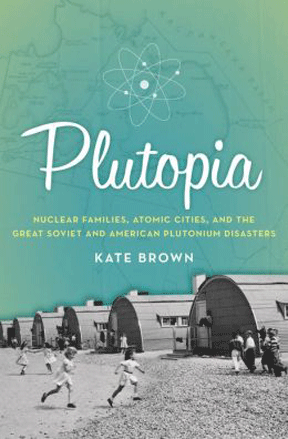
New book “Plutopia” exposes the horror legacy of nuclear weapons making

book-PlutopiaPlutopia: Nuclear Families, Atomic Cities, and the Great Soviet and American Plutonium Disasters Kate Brown   http://www.amazon.com/gp/product/0199855765/ref=as_li_ss_tl?ie=UTF8&camp=1789&creative=390957&creativeASIN=0199855765&linkCode=as2&tag=slatmaga-20  While many transnational histories of the nuclear arms race have been written, Kate Brown provides the first definitive account of the great plutonium disasters of the United States and the Soviet Union.

In Plutopia, Brown draws on official records and dozens of interviews to tell the extraordinary stories of Richland, Washington and Ozersk, Russia-the first two cities in the world to produce plutonium. To contain secrets, American and Soviet leaders created plutopias–communities of nuclear families living in highly-subsidized, limited-access atomic cities. Fully employed and medically monitored, the residents of Richland and Ozersk enjoyed all the pleasures of consumer society, while nearby, migrants, prisoners, and soldiers were banned from plutopia–they lived in temporary “staging grounds” and often performed the most dangerous work at the plant.

Brown shows that the plants’ segregation of permanent and temporary workers and of nuclear and non-nuclear zones created a bubble of immunity, where dumps and accidents were glossed over and plant managers freely embezzled and polluted. In four decades, the Hanford plant near Richland and the Maiak plant near Ozersk each issued at least 200 million curies of radioactive isotopes into the surrounding environment–equaling four Chernobyls–laying waste to hundreds of square miles and contaminating rivers, fields, forests, and food supplies.

Because of the decades of secrecy, downwind and downriver neighbors of the plutonium plants had difficulty proving what they suspected, that the rash of illnesses, cancers, and birth defects in their communities were caused by the plants’ radioactive emissions. Plutopia was successful because in its zoned-off isolation it appeared to deliver the promises of the American dream and Soviet communism; in reality, it concealed disasters that remain highly unstable and threatening today.

An untold and profoundly important piece of Cold War history, Plutopia invites readers to consider the nuclear footprint left by the arms race and the enormous price of paying for it.


April 19, 2013 Posted by | resources - print | 1 Comment

Japan’s nuclear future – very uncertain

flag-japanJapan’s nuclear future Don’t look now A series of mishaps comes at an awkward time for the government the Economist,  Apr 20th 2013 | TOKYO  In February this year, Shinzo Abe, leader of the then incoming Liberal Democratic Party (LDP), said the new government would restart reactors after they passed a forthcoming set of new safety tests. The country’s “nuclear village”, a cosy bunch from industry and government, cheered. But now the stricken Fukushima Dai-ichi plant is starting to alarm the public once more. Continue reading

April 19, 2013 Posted by | Japan, politics | 1 Comment