Nuclear power completely uncompetitive on costs
Jerry Taylor: For Now, Nuclear Can’t Compete. Jerry Taylor, WSJ, 17 April 13 Nuclear power simply cannot compete with gas-fired power. And absent some major technological breakthrough, it’s unlikely to do so in the future.
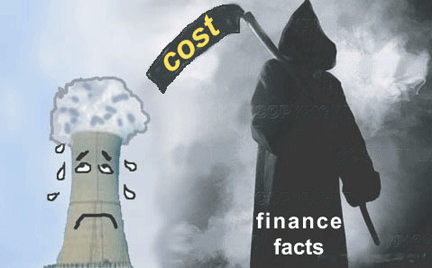
This is not a matter of opinion. This is a matter of economic fact. Even with all of the production tax credits, loan guarantees and a battery of other direct and indirect subsidies, nuclear power remains the most expensive source of conventional electricity on the grid once capital costs are plugged into the equation. That’s why no one has ordered a new nuclear power plant in decades. That’s why nuclear power plants are being retired today in the face of cheap natural gas for as far as the eye can see.
Nuclear proponents like to dodge the cost estimates and assert that it is environmental opposition preventing new plant orders. But there’s zero evidence for this proposition. The regulations governing new plant licensing and construction were overhauled in the 1990s at the behest of industry, and the Nuclear Energy Institute—the trade association for the industry—today offers no such complaints about federal regulation. We’ll only know about environmental opposition once new plants are able to clear the economic hurdle. And so far, they haven’t.
Nor does one find more favorable economics abroad. Construction costs in France—the most “nuclear friendly” free market economy in the world—are just as high as they are here. The same holds true in Japan prior to the Fukushima Daiichi disaster.
Were things to change and nuclear power became economically competitive, I would have no complaints. But market actors—not political agents—should decide what gets built in a free-market economy.
Jerry Taylor is a senior fellow at the Cato Institute in Washington, D.C. He has written studies on energy taxes, the oil market, electricity regulation, energy efficiency, renewable energy, sustainable development and trade and the environment.
1 Comment »
1 This Month
Chernobyl: The Lost Tapes – A good documentary on Chernobyl on SBS available On Demand for the next 3 weeks– https://www.sbs.com.au/ondemand/tv-program/chernobyl-the-lost-tapes/2352741955560

of the week–London Campaign for Nuclear Disarmament

Tell the Ukrainian Government to Drop Prosecution of Peace Activist Yurii Sheliazhenko
To see nuclear-related stories in greater depth and intensity – go to https://nuclearinformation.wordpress.com
-
Archives
- April 2026 (114)
- March 2026 (251)
- February 2026 (268)
- January 2026 (308)
- December 2025 (358)
- November 2025 (359)
- October 2025 (376)
- September 2025 (257)
- August 2025 (319)
- July 2025 (230)
- June 2025 (348)
- May 2025 (261)
-
Categories
- 1
- 1 NUCLEAR ISSUES
- business and costs
- climate change
- culture and arts
- ENERGY
- environment
- health
- history
- indigenous issues
- Legal
- marketing of nuclear
- media
- opposition to nuclear
- PERSONAL STORIES
- politics
- politics international
- Religion and ethics
- safety
- secrets,lies and civil liberties
- spinbuster
- technology
- Uranium
- wastes
- weapons and war
- Women
- 2 WORLD
- ACTION
- AFRICA
- Atrocities
- AUSTRALIA
- Christina's notes
- Christina's themes
- culture and arts
- Events
- Fuk 2022
- Fuk 2023
- Fukushima 2017
- Fukushima 2018
- fukushima 2019
- Fukushima 2020
- Fukushima 2021
- general
- global warming
- Humour (God we need it)
- Nuclear
- RARE EARTHS
- Reference
- resources – print
- Resources -audiovicual
- Weekly Newsletter
- World
- World Nuclear
- YouTube
-
RSS
Entries RSS
Comments RSS
 nuclear-news
[…] is not a matter of opinion. This is a matter of economic fact. Even with all of the production tax credits, loan guarantees and a battery of other direct and indirect subsidies, nuclear power remains the […]
Pingback by Nuclear power completely uncompetitive on costs | limitless life | April 22, 2013 |