Japan – Spent nuclear fuel reprocessing costs nearly triples, a blow to utilities!
“Britain plans to shut down its reprocessing plant after the last shipment of radioactive waste to Japan is finished,” Sawai said. “Japan should abandon the planned reprocessing activity and rather ponder how to restore and manage spent nuclear fuel.”
April 08, 2013
By SHIN MATSUURA/ Staff Writer
Source : The Asahi Shimbun
http://ajw.asahi.com/article/0311disaster/fukushima/AJ201304080007
The cost for overseas reprocessing of spent nuclear fuel from Japanese nuclear power stations has nearly tripled since 1995 because of problems at a contracted British plant, which is likely to further hurt utilities and be passed along in rate hikes for electricity users.
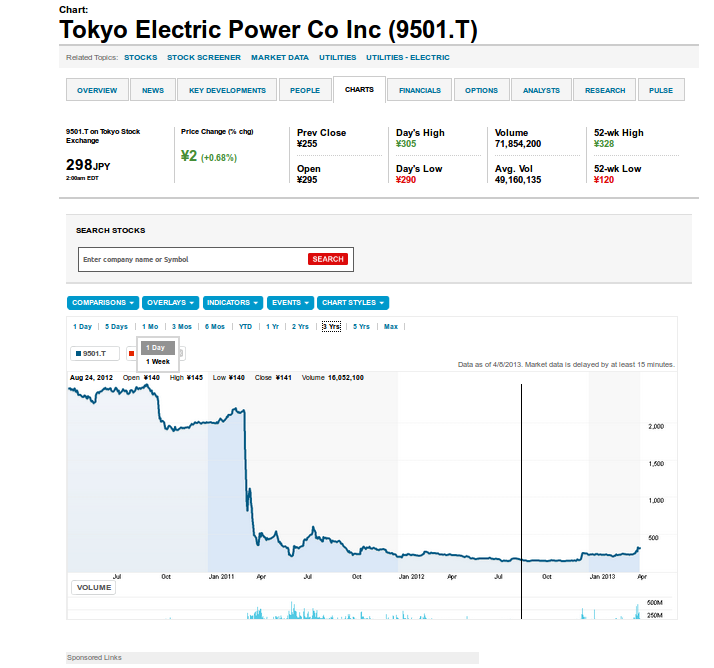
Image source ; http://www.reuters.com/finance/stocks/chart?symbol=9501.T
The cost surged apparently because the plant is plagued with a slew of problems, including leakage of waste liquid.
The current cost at the plant that Japanese utilities commissioned for reprocessing is 122 million yen ($1.28 million) per container of vitrified high-level radioactive waste. That compares with 44 million yen in 1995, when the shipment of such waste from France back to Japan started.
The overall cost for reprocessing spent nuclear fuel into 790 more containers of waste that are scheduled to be returned to Japan is expected to be around 100 billion yen.
A rise in reprocessing costs is will strain utilities’ balance sheets further, and to be passed on to consumers, according to experts.
Shipments of spent nuclear fuel from Japanese power stations to reprocessing plants in Britain and France started in the 1970s to extract plutonium and make nuclear fuel out of it. Large amounts of high-level radioactive waste, which is left over in the reprocessing work, is shipped back to Japan.
Ma Zhaoxu Attends Talks on Iran Nuclear Issue in Almaty
8 April 2013

From April 5 to 6, 2013, a new round of talks on the Iran nuclear issue was held in Almaty, Kazakhstan. Six countries on the Iran nuclear issue – the U.S., Britain, France, Russia, China and Germany as well as Iran attended the talks. China’s Assistant Foreign Minister Ma Zhaoxu led the Chinese delegation.
Ma pointed out that this round of talks is constructive and significant. For the first time the two parties conducted sincere, in-depth and substantive discussions on the solution to the Iran nuclear issue. They have common concerns while differences still exist in their stances. The Chinese side expects that all relevant parties, by continuing to narrow the gaps and gradually expand consensus during negotiations, would provide conditions where a comprehensive and long-term solution to the issue is possible. China is consistently committed to talks of peace and is ready to work with all sides to make continued and constructive efforts toward that end.
During the meeting, Ma also met with representatives of the U.S., Russia, Iran and France.
Breaking! EDF ‘in big trouble’ says French nuclear expert
Mr Schneider said that EDF with debts of €39bn (£33.3bn) might not have the cash to put into Hinkley and added: “It’s not certain it will go ahead.
“There are a long list of issues that need to be agreed, not only the strike price. Even if there is an agreement the financing package has to be put together. It’s a very long-term investment of very uncertain levels of realisation.”
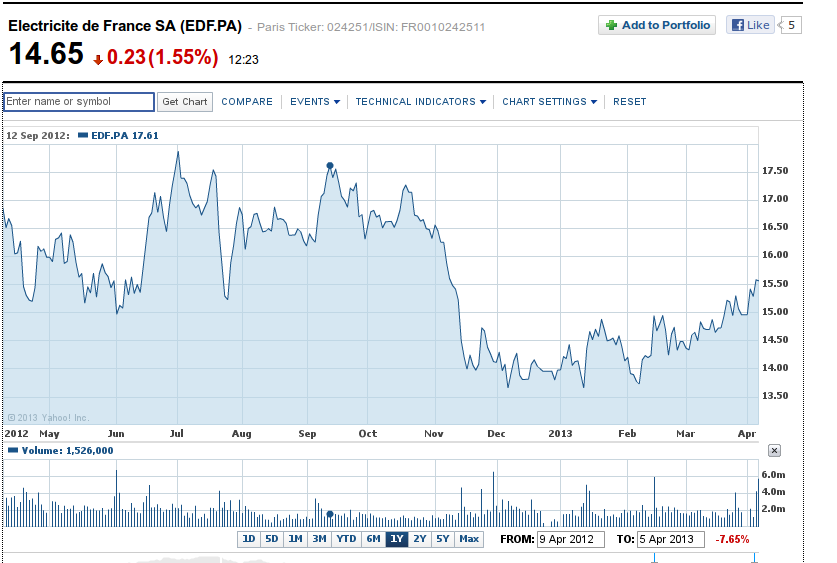
The top graph is the reaction to the news and the bottom graph shows you the dire situation over the last year (even with all the “good” news)
Telegraph
8 April 2013
Financial problems facing EDF (Paris: FR0010242511 – news) could force the French energy giant to pull out of the £14bn project to build the first of a new generation of nuclear power plants in Britain, a French expert has warned.
Mycle Schneider, a former energy adviser to the French government, questioned whether EDF could finance the investment.
“EDF is in big trouble. The whole of the nuclear power industry in France is in big trouble,” he said.
His comments, on the BBC Radio 4 Today programme, came as David Cameron prepared to raise the nuclear power issue with the president of France, Francios Hollande, during his lightning tour to try to win support for EU reforms.
President Hollande is seen as a pivotal figure because he wants state controlled EDF to curb its nuclear power ambitions and invest heavily in improving safety at plants in France as well as giving a higher priority to renewable energy.
Negotiations on a deal between EDF and the Government over the construction of a massive plant at Hinkley Point in Somerset are deadlocked because the two sides have failed to agree on a price for electricity and a range of other guarantees.
EDF is also trying to find a partner to fill the gap left by Centrica (LSE: CNA.L – news) which has abandoned nuclear power.
Lord Deighton, Treasury Commercial Secretary and former chief executive of the London Olympic organising committee, has been given the task of hammering out an agreement the Government regards as crucial to meet its nuclear power ambitions to reinforce the electricity generating network and avoid the “lights going out.”
Mr Schneider said that EDF with debts of €39bn (£33.3bn) might not have the cash to put into Hinkley and added: “It’s not certain it will go ahead.
“There are a long list of issues that need to be agreed, not only the strike price. Even if there is an agreement the financing package has to be put together. It’s a very long-term investment of very uncertain levels of realisation.”
http://uk.finance.yahoo.com/news/edf-big-trouble-says-french-104450052.html
Caldicott Versus The Nuclear Industry – an impressive symposium

 Conference Highlights Fukushima Consequences http://rense.com/general95/confhigh.htm By Richard Wilcox Ph.D.
4-6-13 ”….Caldicott Versus The Nuclear IndustryLong time activist and medical doctor, Helen Caldicott, recently assembled some of the world’s top experts to enlighten us about the situation:
“The Medical and Ecological Consequences of the Fukushima Nuclear Accident,” a two-day conference is now posted onlinehttp://www.totalwebcasting.com/view/?id=hcf#
North Korea not in a position for nuclear strike to reach USA
 North Korea lacks means for nuclear strike on US, experts say WASHINGTON (Reuters) 8 Apr 13—North Korea’s explicit threats to strike the United States with nuclear weapons are rhetorical bluster, as the isolated nation does not yet have the means to make good on them, Western officials and security experts say.
Pyongyang has slowly and steadily improved its missile capabilities in recent years and U.S. officials say its missiles may be capable of hitting outlying U.S. territories and states, including Guam, Alaska and Hawaii. Some private experts say even this view is alarmist. There is no evidence, the officials say, that North Korea has tested the complex art of miniaturizing a nuclear weapon to be placed on a long-range missile, a capability the United States, Russia, China and others achieved decades ago.
In other words, North Korea might be able to hit some part of the United States, but not the mainland and not with a nuclear weapon. Continue reading
Another water storage tank leaking at Fukushima Daiichi power plant
Second leak detected at Fukushima nuclear plant Reuters | Apr 8, 2013, TOKYO: Radioactive water has apparently leaked from another underground storage tank at the crippled Fukushima Daiichi power plant, Tokyo Electric Power Co (Tepco) said on Sunday.
The volume of the latest leakage was believed to be small, it said. On Saturday, it said as much as 120 tonnes of radioactive water may have %leaked from another nearby storage tank.
The plant’s seven storage tanks are lined with water proof sheets meant to keep the contaminated water from leaking into the soil.The power company has faced a range of problems with leaks and with the plant’s cooling system.
Tepco said on Friday it lost the ability to cool radioactive fuel rods in one of the plant’s reactors for about three hours, the second cooling system failure at the plant in three weeks.
Nuclear fuel, even after use, has to be kept cool to prevent it from overheating and beginning a self-sustaining atomic reaction that could lead to meltdown http://timesofindia.indiatimes.com/world/rest-of-world/Second-leak-detected-at-Fukushima-nuclear-plant/articleshow/19435752.cms
Rise in hypothyroidism in USA’s west Coast babies
US Babies sick with congenital hypothyroidism from Fukushima radiation http://ecochildsplay.com/2013/04/07/us-babies-sick-with-congenital-hypothyroidism-from-fukushima-radiation/ by JENNIFER LANCE APRIL 7, 2013 Despite assurances by the US government, many of us living on the West Coast were very concerned after the fallout from the Fukushima nuclear disaster. We stocked up on seaweed and potassium iodine. We gavekelp to our pets. Two years ago, I wrote
Japan Nuclear Crisis: Protect Your Family Naturally From Radioactive Emissions:
The magnitude of the Japanese earthquake is beyond comprehension. My children have watched images on the news, and my six-year-old son repeatedly asks, “Why?” I do my best to explain plate tectonics, but the truth is I have no idea how to explain to my children about the imminent nuclear catastrophe, other than we live in One World.
We live on the west coast. Prevailing winds will bring radioactive emissions to us in three to ten days, from various sources I have read. Some of it has probably already reached us.
Then, the news a year later was that the radioactive fallout that reached the United States was potentially responsible for an increase in deaths, especially for children under one year of age.
Despite assurances from the US government that the amount of radiation reaching America from the nuclear disaster at Japan’s Fukushima plant following the tragic earthquake were safe, many of us felt the need to protect our families. We were told radiation levels were no greater than taking a flight on an airplane or receiving dental x-rays, yet the fact that this was additional radiation to these “normal” sources was largely overlooked.
Did this increase in radiation from the nuclear disaster contribute to health problems that led to an increase in US death rates, especially for children under one year of age?
Now, a peer-reviewed study has examined the increase in US deaths following Japan’s nuclear disaster, and the numbers are staggering and comparable to Chernobyl. Continue reading
Fukushima Daiichi tank leaks 120 tons of radioactive water
Kyodo: Radioactive leak is up to 120 tons from Fukushima Daiichi tank http://enenews.com/kyodo-radioactive-leak-is-up-to-120-tons-from-fukushima-daiichi-tank-video 7 April 13
Kyodo News April 6, 2013: Tokyo Electric Power Co. said Friday that up to 120 tons of contaminated water may have leaked into soil from one of the seven underground reservoir tanks at the crippled Fukushima Daiichi nuclear power plant. Around 13,000 cubic meters of contaminated water remain in the tank, with TEPCO having begun transferring it to other tanks nearby on Saturday morning, the utility said. It will take roughly two weeks to complete the transfer, TEPCO added. […]
NHK WORLD English: Tokyo Electric Power Company says a small amount of radioactive water may have seeped out of an underground water storage facility at the Fukushima Daiichi nuclear power plant. The water contained strontium. […] The level of radioactivity is considered by the utility to be low. […] The utility recently constructed 7 large-scale underground facilities for storing the water after removing some radioactive substances. Each facility can accommodate up to 14,000 tons of water. […]
RIA Novosti: : The company operating the disaster-hit Fukushima Daiichi nuclear power plant (NPP) in northern Japan warned about the possibility of radioactive water leak, the Kyodo news agency reported on Friday. […] Radioactive substances have been detected in the water that accumulated outside the tank, covered by three layers of waterproof sheets. The exact volume of leak is unknown, but radiation levels in the water stand at about 6,000 Becquerel per cubic centimeter. […]
Sea lions sickness might be result of starvation, not radiation
Starvation, Not Radiation Likely Cause of Ailing Sea Lion Pups: Expert By Monica Garske, Apr 7, 2013 More than 1,000 ailing sea lion pups have been washed ashore in Southern California over the past three months, and a national fisheries expert says a lack of food source is likely the cause, not radiation as reported by some media outlets.
The National Oceanic and Atmospheric Administration (NOAA) has assembled a team of experts to research the cause of the beached sea lion pup problem.
NOAA has been granted an official declaration of what’s called an Unusual Mortality Event (UME). The status allows for the establishment of a panel of experts to convene to look for answers and will also provide for extra funding.
On Thursday, NOAA held a conference to discuss that research. Experts said the leading hypothesis their panel is looking at focuses on a lack of food source, starvation and dehydration. Other potential causes being studied include possible infectious diseases or pollutants in the ocean.
Experts believe pups are being affected in greater numbers than adult sea lions because they are limited in how far they can travel and unfamiliar with the environment.
Over the weekend, some news outlets reported that radiation from Japan’s March 2011 Fukushima nuclear power plant disaster is also being looked at as a possible cause for the UME concerning sea lion pups……
“Radiation is being looked at, just like everything else. We haven’t ruled it out, but we really don’t suspect this at all,” Milbury told NBC 7. “We don’t suspect radiation because this would also mean other animals in the ocean would be affected, especially in the oceans of Hawaii, closer to Japan, and we haven’t seen any of that.”Milbury says the more plausible cause is simply starvation….. http://www.nbcsandiego.com/news/local/Starvation-Not-Radiation-Likely-Cause-Sick-Sea-Lion-Pups-NOAA-201844981.html#ixzz2PuGOCdw0
North Korea’s longstanding fear of a USA nuclear attack
as more nations like North Korea obtain nuclear weapons, and as the US struggles to keep a credible nuclear umbrella over its allies from Asia to Europe to the Middle East, the world needs to find a replacement for the current system of maintaining stability based on the mutual fear of nuclear war.
North Korea’s threats show just how urgent that need is.
North Korea Has Feared An American Nuclear Attack For Decades http://au.businessinsider.com/north-korea-has-feared-an-american-nuclear-attack-for-decades-2013-4 THE CHRISTIAN SCIENCE MONITORTODAY THOSE AMERICANS WHO MAY BE FEARFUL OF NORTH KOREA‘S VERBAL THREATS AND ITS MISSILE-LAUNCH PREPARATIONS SHOULD TAKE NOTE: ITS LEADERS HAVE LONG EXPRESSED A FEAR OF AN AMERICAN NUCLEAR ATTACK.
 As historian Ward Wilson points out in a new book, “Five Myths About Nuclear Weapons,” atomic bombs “were born out of fear, nurtured in and sustained by fear.” Their power to devastate requires a mutual fear to avoid their use.
The current escalation of threats between the US and North Korea illustrates how this reliance on fear can falter. Nations that rely on maximizing fear as a primary tool for defence will find the emotion very difficult to manage in all cases.
The North’s threats, for example, have now led South Korea to consider ending its ban on developing its own nuclear weapons. It is asking for US support to start a nuclear program.
Many in Seoul, South Korea, see the American people as too weary for war and the Obama administration as too eager to reduce the US nuclear arsenal unilaterally. They fear that the American “nuclear umbrella,” which has protected South Korea for 60 years, may no longer be credible enough to deter North Korea from either launching nuclear weapons or using them as blackmail.
MONITOR’S VIEW: Cyberattack on South Korea needs constructive responseFor two decades, the US has tried to talk down North Korea from possessing nuclear weapons by offering hope in place of fear. It tried to convince Pyongyang that the US was not a threat while offering its food aid and oil supplies in return for nuclear disarmament. It hasn’t worked, despite some limited help from China.
Similar persuasion is now being tried on Iran: Give up your nuclear ambitions and instead become a regional power through the strength of your economy, ideas, and culture. In other words, replace the fear that looks to nuclear power for comfort and instead build up your nation’s “soft power.”
President Obama, who came into office with the goal of eliminating the world’s nuclear weapons, has had a difficult time making his case. Instead, he has to now send B-2 bombers near North Korea to assure South Korea of the US nuclear umbrella and as a threat to North Korea. The tit-for-tat of fear only keeps rising.
MONITOR’S VIEW: In Obama trip to Israel, signs of US redirectionHis recent trip to Israel was designed in part to persuade Iran to cease its uranium enrichment. His visit was an attempt to reinforce faith in the US nuclear umbrella for the region, especially Israel. But as with North Korea, the logic of deterrence assumes that the leaders in Iran will be both fearful and rational.
In the past few decades, a dozen countries have given up their nuclear programs or handed over nuclear weapons on their soil. After the breakup of the Soviet Union in 1991, for example,Kazakhstan cooperated with Russia and the US to hand over the weapons in its possession. Most of those nations chose to seek safety in being a nation of peace, goodwill, and prosperity while also relying on an international system that depends to a large degree on the US maintaining it.
And most nations abide by international agreements banning the use of chemical and biological weapons. Fear of those weapons has been largely contained.
Yet as more nations like North Korea obtain nuclear weapons, and as the US struggles to keep a credible nuclear umbrella over its allies from Asia to Europe to the Middle East, the world needs to find a replacement for the current system of maintaining stability based on the mutual fear of nuclear war.
North Korea’s threats show just how urgent that need is.
Diplomatic talks with Iran will continue
Iran says nuclear talks with P5+1 group to go on TEHRAN, April 7 (Xinhua) — The head of Iran’s Majlis ( parliament) National Security and Foreign Policy Commission said Sunday that the talks between Iran and world powers will continue, semi-official Fars news agency reported.
Boroujerdi said that the talks with the P5+1 group, namely the five permanent UN Security Council members plus Germany, should encompass Iran’s considerations……
While Iranian officials stressed that any mechanism to settle Iran’s nuclear issue in the talks should take into consideration the recognition of Iran’s right to uranium enrichment activities, the revised proposal by the world powers asked Iran to suspend its uranium enrichment and shut down its underground Fordow enrichment facilities in return for limited sanction relief…. http://news.xinhuanet.com/english/world/2013-04/07/c_132290704.htm
Scotland wants to be free of UK’s nuclear missile fleet
Salmond open to non-nuclear Nato bases in Scotland Reuters/New York 8 Apr 13 Alex Salmond wants to see an independent Scotland free of submarines laden with nuclear missiles, but he says he is open to hosting Nato bases without weapons of mass destruction.
As leader of the Scottish National Party (SNP), which controls the Scottish parliament in Edinburgh, the Scottish first minister announced last month that on September 18, 2014, Scots would have a chance to decide whether or not to break from the United Kingdom after more than 300 years.
A Scotland free of British Trident nuclear submarines has been a long-standing aim of the SNP….. http://www.gulf-times.com/uk-europe/183/details/348256/salmond-open-to-non-nuclear-nato-bases-in-scotland
New York’s progress towards 100% renewable energy
“Exclusive of hydropower, the state has developed more renewable energy than any other state in the Northeast,” “Including hydropower, New York’s renewable energy capacity is comparable to the entire renewable energy capacity of the other eight states in the Northeast.”
NY Renewable Energy Study Finds New York Could Soon Be Powered By Wind, Water And Sunlight HUFFINGTON POST, AP By MICHAEL HILL, 5 April 13— A new study says New York could get the power it needs from wind, water and sunlight by 2030 with a concerted push, though the state’s decade-long effort to significantly boost green energy shows how challenging that could be.
The study, led by researchers from Stanford and Cornell universities, provides a theoretical road map to how New Yorkers could rely on renewable energy within 17 years. It would require massive investments in wind turbines, solar panels and more from the windy shores off Long Island to sun-exposed rooftops upstate.
“It’s doable,” said co-author Robert Howarth, a Cornell professor of ecology and environmental biology. “It’s way outside of the realm of what most people are talking about … But I think people have been too pessimistic about what can be done.”
In fact, New York has been committed to significantly increasing green energy production for the past nine years under its renewable portfolio standard, which is funded by a surcharge of less than a dollar on monthly electricity bills. Then-Gov. George Pataki began the program in 2004 with the goal of New York relying on renewable resources for a quarter of its electricity by 2013. Continue reading
Today in history
In 1966, the U.S. Navy recovered a hydrogen bomb that the U.S. Air Force had lost in the Mediterranean Sea off Spain following a B-52 crash.
In 1978, President Jimmy Carter announced he was deferring development of the neutron bomb, a high-radiation weapon. http://abcnews.go.com/US/wireStory/today-history-18899295#.UWMieKJwpLu
There is a slight Problem with Mangano, Sherman Paper on Congenital Hypothyroidism in the US and Radiation from Fukushima
http://ex-skf.blogspot.co.uk/2013/04/ot-slight-problem-with-mangano-sherman.html
Sunday, April 7, 2013

From “Elevated airborne beta levels in Pacific/West Coast US States and trends in hypothyroidism among newborns after the Fukushima nuclear meltdown”, by Joseph J. Mangano, Janette D. Sherman, page 3 (link):
A national study conducted by the National Geological Survey examined concentrations of wet depositions of fission-produced isotopes in soil at sites across the US, for several radioisotopes, between March 15 and April 5, 2011. Results showed that for I-131, the highest depositions, in becquerels per cubic meter, occurred in northwest Oregon (5100), central California (1610), northern Colorado (833), coastal California (211), and western Washington (60.4). No other station recorded concentrations above 13. Similar results were observed for Cesium-134 and Cesium-137 [42]. All the cited locations are on or near the Pacific coast, with the exception of Colorado, in the western US.
Cubic meter??? That would be indeed catastrophic.
However, from “Wet Deposition of Fission-Product Isotopes to North America from the Fukushima Dai-ichi Incident, March 2011” by USGS, as cited by the authors (link):
Variable amounts of 131I, 134Cs, or 137Cs were measured at approximately 21% of sampled NADP sites distributed widely across the contiguous United States and Alaska. Calculated 1- to 2-week individual radionuclide deposition fluxes ranged from 0.47 to 5100 Becquerels per square meter during the sampling period.
It was “square meter”.
Open file report by USGS: http://pubs.usgs.gov/of/2011/1277/
Table 2 on pages 17 and 18 of the USGS report shows I-131, Cs-134, Cs-137 deposition. Many places have only Cs-137 detected, some places with I-131 and Cs-137, some with I-131 and Cs-134. For locations that have both Cs-134 and Cs-137, the ratio is mostly not in line with those of Fukushima-origin (Cs-134:Cs-137=1:1 to =1:1.2)
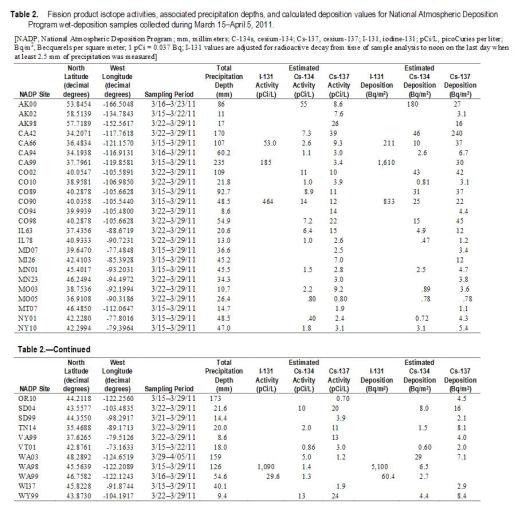
1,090 picocurie is 40.33 becquerels. 40.33 becquerels/liter was calculated into 5,100 becquerels/square meter, with the conversion factor of about 126.
1 This Month

Petition to revoke the licensing of the Near Surface Nuclear Disposal Facility (NSDF) at Chalk River. https://www.ourcommons.ca/petitions/en/Petition/Details?Petition=e-7247


of the week – STOP SMALL MODULAR REACTORS IN CANADA
To see nuclear-related stories in greater depth and intensity – go to https://nuclearinformation.wordpress.com
-
Archives
- March 2026 (153)
- February 2026 (268)
- January 2026 (308)
- December 2025 (358)
- November 2025 (359)
- October 2025 (376)
- September 2025 (258)
- August 2025 (319)
- July 2025 (230)
- June 2025 (348)
- May 2025 (261)
- April 2025 (305)
-
Categories
- 1
- 1 NUCLEAR ISSUES
- business and costs
- climate change
- culture and arts
- ENERGY
- environment
- health
- history
- indigenous issues
- Legal
- marketing of nuclear
- media
- opposition to nuclear
- PERSONAL STORIES
- politics
- politics international
- Religion and ethics
- safety
- secrets,lies and civil liberties
- spinbuster
- technology
- Uranium
- wastes
- weapons and war
- Women
- 2 WORLD
- ACTION
- AFRICA
- Atrocities
- AUSTRALIA
- Christina's notes
- Christina's themes
- culture and arts
- Events
- Fuk 2022
- Fuk 2023
- Fukushima 2017
- Fukushima 2018
- fukushima 2019
- Fukushima 2020
- Fukushima 2021
- general
- global warming
- Humour (God we need it)
- Nuclear
- RARE EARTHS
- Reference
- resources – print
- Resources -audiovicual
- Weekly Newsletter
- World
- World Nuclear
- YouTube
-
RSS
Entries RSS
Comments RSS
 nuclear-news