Physicians: Initial health consequences of Fukushima catastrophe are now scientifically verifiable
Published: March 7th, 2013 at 11:57 am ET
By ENENews
Title: Health consequences resulting from Fukushima
Source: International Physicians for the Prevention of Nuclear War
Author: Henrik Paulitz, Winfrid Eisenberg, and Reinhold Thiel
Date: March 6, 2013
h/t Anonymous tip
Summary
On 11 March 2011, a nuclear catastrophe occurred at the Fukushima Dai-ichi nuclear power plant in Japan in the wake of an earthquake and due to serious safety deficiencies. This resulted in a massive and prolonged release of radioactive fission and decay products. Approximately 20% of the radioactive substances released into the atmosphere have led to the contamination of the landmass of Japan with 17,000 becquerels per square metre of cesium-137 and a comparable quantity of cesium-134.
The initial health consequences of the nuclear catastrophe are now, two years after the incident, scientifically verifiable. Similar to the case of Chernobyl, a decline in the birth rate was documented in the nine months following the nuclear catastrophe. Throughout the whole of Japan, the total drop in number of births in December 2011 was 4362, with the Fukushima Prefecture registering a decline of 209 births. […]
Full report here
Radiation expert back from Fukushima: Radioactivity still very high… not declining — Health risk played down since it can’t be dealt with — Children’s playgrounds at 200 times normal levels
Published: March 7th, 2013 at 12:58 pm ET
By ENENews
Title: Greenpeace: Fukushima victims are victims once again
Source: DW
Author: Gui Hao
Date: March 7, 2013
[…] Heinz Smital, of Greenpeace, believes residents are being kept in the dark over the dangers.
You recently measured the radioactivity in and around Fukushima for Greenpeace Germany. What were your findings?
The radioactivity there is still very high. In the city of Fukushima, which has some 300,000 inhabitants, there are still children’s playgrounds that are highly contaminated. The values we measured there on the ground were 200 times higher than before the nuclear accident. In the evacuated ghost towns where there has been a great effort to clean things up, we have found that the radiation has not declined. It simply isn’t going away. […]
Have people been given enough information by the authorities about how great the risk is?
The health risks are played down, in part because it is something that can’t be dealt with. It’s not possible to decontaminate whole swathes of land, mountains, rivers and riverbanks. You can’t get rid of that contamination. Now there is an effort underway to get people to accept the higher radiation levels. They say it doesn’t have any effects, to stop people from worrying. In this respect, the victims of the disaster are becoming victims once again in that they are being encouraged to accept living in areas where the radiation levels are too high. […]
See also: Headline: “Rising doubts about Japan’s official radiation figures” — Large cities still exposed to high levels of radioactivity from Fukushima plant
BBC breaking news shows Fukushima protester interrupting high-profile press conference — Televised for nearly 2 minutes, event ended abruptly (VIDEO)
Title: Vicky Pryce Trial: Anti-Nuclear Campaigner Stuart Holmes Reveals Why He Is Protesting At Court
Source: Huffington Post UK
Author: Christopher York
Date: March 7, 2013
Watch any recent footage of Vicky Pryce [ex-wife of former UK Energy secretary Chris Huhne] approaching Southwark Crown Court and behind the defendant and the gaggle of lawyers, press and TV crews waiting outside, you might just catch a glimpse of Stuart William Holmes. […]
At the time of the catastrophe, Chris Huhne was the UK energy minister and was heavily criticised by some for his response to Fukushima.
E-mails that surfaced after the event appeared to show Huhne co-ordinating a strategy with the nuclear industry to play down the effects of the disaster.
At the time, the UK government was trying to promote its own nuclear agenda. […]
Holmes is angry that Huhne has gone through the legal wrangler for a relatively trivial crime yet he goes unpunished for what he did as energy minister. […]
See also: Vicky Pryce’s Emails With The Sunday Times Reveal Her Plot To Bring Down Chris Huhne
>>> Watch video from today’s breaking news on the BBC here
Chernobyl disaster. Чернобыльская катастрофа.
Uploaded on 27 Apr 2011
h/t beyond nuclear
The Chernobyl disaster was a nuclear accident that occurred on 26 April 1986 at the Chernobyl Nuclear Power Plant in the Ukrainian SSR (now Ukraine). An explosion and fire released large quantities of radioactive contamination into the atmosphere, which spread over much of Western Russia and Europe. It is considered the worst nuclear power plant accident in history, and is one of only two classified as a level 7 event on the International Nuclear Event Scale (the other being the Fukushima I nuclear incident, which is considered far less serious and has caused no direct deaths). The battle to contain the contamination and avert a greater catastrophe ultimately involved over 500,000 workers and cost an estimated 18 billion rubles, crippling the Soviet economy.
The disaster began during a systems test on 26 April 1986 at reactor number four of the Chernobyl plant, which is near the town of Pripyat. There was a sudden power output surge, and when an emergency shutdown was attempted, a more extreme spike in power output occurred, which led to a reactor vessel rupture and a series of explosions. These events exposed the graphite moderator of the reactor to air, causing it to ignite. The resulting fire sent a plume of highly radioactive smoke fallout into the atmosphere and over an extensive geographical area, including Pripyat. The plume drifted over large parts of the western Soviet Union and Europe. From 1986 to 2000, 350,400 people were evacuated and resettled from the most severely contaminated areas of Belarus, Russia, and Ukraine. According to official post-Soviet data,about 60% of the fallout landed in Belarus.
The accident raised concerns about the safety of the Soviet nuclear power industry, as well as nuclear power in general, slowing its expansion for a number of years and forcing the Soviet government to become less secretive about its procedures.
Russia, Ukraine, and Belarus have been burdened with the continuing and substantial decontamination and health care costs of the Chernobyl accident. Thirty one deaths are directly attributed to the accident, all among the reactor staff and emergency workers. A UNSCEAR report places the total confirmed deaths from radiation at 64 as of 2008. Estimates of the number of deaths potentially resulting from the accident vary enormously: the World Health Organization (WHO) suggest it could reach 4,000; a Greenpeace report puts this figure at 200,000 or more; a Russian publication, Chernobyl, concludes that 985,000 excess deaths occurred between 1986 and 2004 as a result of radioactive contamination.
разрушение 26 апреля 1986 года четвёртого энергоблока Чернобыльской атомной электростанции, расположенной на территории Украинской ССР (ныне — Украина). Разрушение носило взрывной характер, реактор был полностью разрушен, и в окружающую среду было выброшено большое количество радиоактивных веществ. Авария расценивается как крупнейшая в своём роде за всю историю атомной энергетики, как по предполагаемому количеству погибших и пострадавших от её последствий людей, так и по экономическому ущербу. На момент аварии Чернобыльская АЭС была самой мощной в СССР. 31 человек погиб в течение первых трех месяцев после аварии; отдалённые последствия облучения, выявленные за последующие 15 лет, стали причиной гибели от 60 до 80 человек. 134 человека перенесли лучевую болезнь той или иной степени тяжести, более 115 тыс. человек из 30-километровой зоны были эвакуированы. Для ликвидации последствий были мобилизованы значительные ресурсы, более 600 тыс. человек участвовали в ликвидации последствий аварии.
Update from the North Korean Press Agency – They are NOT happy!
The provocative war exercises of the U.S. and south Korean warmongers are increasing the danger of a nuclear war on the Korean Peninsula hour by hour. The present reality clearly proves that closer cooperation with outside forces will lead to nothing but a war.

|
DPRK People Hail Statement of KPA Supreme Command Spokesman
|
| Pyongyang, March 6 (KCNA) — Upon receiving the statement issued by a spokesman for the Supreme Command of the Korean People’s Army (KPA) on Tuesday, the servicepersons and civilians of the Democratic People’s Republic of Korea have hardened their will to mercilessly annihilate the U.S. imperialists and their allied forces bringing dark clouds of a nuclear war.
Choe Pong Il, a KPA officer, told KCNA: As was clarified in the statement of a KPA Supreme Command spokesman, it is needless for the DPRK to remain committed to the Korean Armistice Agreement. No one can vouch that the joint military exercises Key Resolve and Foal Eagle, kicked off by the U.S. and its allied forces, will not lead to an actual war. Now is the time to show the might of Songun (military-first) Korea to the U.S. by dint of nuclear deterrent. From March 11 onward, the world will see what tragic end waits for the U.S. imperialists who have ruthlessly violated other nations’ dignity and sovereignty. Kwak Song Nam, an officer of the Korean People’s Internal Security Forces, said: The important measures mentioned in the statement are indispensable and inevitable counteractions to defend the supreme interests of the country. The DPRK people have been exposed to a danger of war for over half century, which can be no longer allowed. My unit’s servicepersons are filled with will to rapidly advance southward under the operational plan approved by respected Supreme Commander Kim Jong Un. Pak Chol, a workteam head of the Chollima Steel Complex, said: Of late, Defence Minister Kim Kwan Jin and Chairman of the Joint Chiefs of Staff Jong Sung Jo of south Korea reportedly inspected puppet army units, calling for “deadly and pre-emptive strikes”. |
Strange Bedfellows: TEPCO & Lady Barbara Judge
Published on 6 Mar 2013
Info taken from the following articles: http://www.morningstaronline.co.uk/ne…
http://enenews.com/cnn-american-fukus…
http://www.standard.co.uk/news/judge-…
http://trends.knack.be/economie/nieuw…
http://www.nytimes.com/1990/01/01/bus…
and last but not least, and graphic lol:
http://www.glossynews.com/artman/publ…
TEPCO Hires UK Propaganda Chief
“…To be sure, the nuclear issue still divides opinion sharply. Judge admits that a repeat of the Chernobyl disaster would close the industry down for 20 years…” 22 July 2009 –Barbara Judge
Published on Feb 11, 2013
https://nuclear-news.net/2013/02/18/tepco-hires-uk-propaganda-chief/
More on UK BBC and nuclear science coverups on this link
Fukushima’s Nuclear Casualties – Two Years Later, the Battle for Truth Continues

by JOSEPH J. MANGANO
March 07, 2013
Exactly two years after the Fukushima nuclear disaster, perhaps the most crucial issue to be addressed is how many people were harmed by radioactive emissions.
The full tally won’t be known for years, after many scientific studies. But some have rushed to judgment, proclaiming exposures were so small that there will be virtually no harm from Fukushima fallout.
This knee-jerk reaction after a meltdown is nothing new. Nearly 12 years after the Three Mile Island accident in 1979, there were no journal articles examining changes in local cancer rates. But 31 articles in publications like the Journal of Trauma and Stress and Psychosomatic Medicine had already explored psychological consequences.
Eventually, the first articles on cancer cases showed that in the five years after the accident, there was a whopping 64% increase in the cancer cases within 10 miles of Three Mile Island. But the writers, from Columbia University, concluded radiation could not account for this rise, suggesting stress be considered instead. While this was later contested by researchers from the University of North Carolina, many officials still subscribe to the slogan “nobody died at Three Mile Island.”
In 1986, after the Chernobyl catastrophe, officials in the Soviet Union and elsewhere raced to play damage control. The Soviet government admitted 31 rescue workers had died soon after absorbing huge radiation doses extinguishing the fire and trying to bury the red-hot reactor. For years, 31 was often cited as the “total” deaths from Chernobyl. Journal articles on disease and death rates near Chernobyl were slow and limited. The first articles were on rising numbers of local children with thyroid cancer – a very rare condition.
Finally, 20 years after the meltdown, a conference of the World Health Organization, International Atomic Energy Agency, and other groups admitted to 9,000 cancers worldwide from Chernobyl. But this was a tiny fraction of what others were finding. A 2009 New York Academy of Sciences book estimated 985,000 deaths (and rising) worldwide fromChernobyl fallout. The team, led by Alexey Yablokov, examined 5,000 articles and reports, most in Slavic language never before available to researchers.
Accident at Hinkley Point nuclear plant could contaminate Austria, warns government agency
The Umweltbundesamt says that a release of 53.18 petabecquerels of caesium-137 from Hinkley “would result in a considerable contamination of the Austrian territory.” In most places the contamination would be above the safety levels requiring restrictions to be imposed on farmers.

07 March 2013
Austria could be badly contaminated by radioactive pollution from a serious accident at the new nuclear power station proposed for Hinkley Point in Someset, the country’s environment agency has warned.
The Austrian government’s Umweltbundesamt has lodged a formal objection to the application to build the station by the French power company, EDF Energy. The dangers of a worst-case accident should be assessed before the plant is given the go-ahead, it says.
The Vienna agency’s 39-page submission concludes that the environmental impact assessment of the proposed Hinkley reactors “does not permit a meaningful assessment of the effects of conceivable accidents”. EDF’s claim that the risk of a large release of radioactivity has been practically eliminated “is not sufficiently demonstrated”, it says.
Severe accidents leading to massive releases of caesium-137 similar to that from the explosion at the Chernobyl nuclear plant in 1986 “cannot be excluded”, the agency warns. Though they are unlikely, they should have been included in EDF’s assessment “since their effects can be widespread and long-lasting.”
The Umweltbundesamt says that a release of 53.18 petabecquerels of caesium-137 from Hinkley “would result in a considerable contamination of the Austrian territory.” In most places the contamination would be above the safety levels requiring restrictions to be imposed on farmers.
“It is recommended that this should be taken into consideration before granting further permissions,” it says. “Austria should be kept informed regarding the ongoing progress resolving the assessment findings concerning severe accidents.”
‘Nuclear refugees’ visit their home near stricken Fukushima plant – NBC

Wearing white protective masks and suits, Yuzo Mihara, left, and his wife Yuko pose for photographs on a deserted street in the town of Namie, Fukushima prefecture, Japan, on Feb. 22, 2013.
NBC News photoblog
7 March 2013
Until two years ago, Yuzo Mihara and his wife Yuko lived quietly in the Japanese town of Namie. Yuzo ran a store and Yuko a beauty salon. But their lives were upended on March 11, 2011, when an earthquake and tsunami crippled the nearby Fukushima Daiichi nuclear power plant.
Yuzo and Yuko are now among over 100,000 Japanese ‘nuclear refugees’, having had to abandon their home when the town was evacuated due to the nuclear alert.
European PressPhoto Agency photographer Franck Robichon followed the couple as they made a brief visit to their old home last month. They were able to collect a few belongings and clean the house, which had been invaded by mice.

Yuko Mihara offers prayers to her ancestors in front of a family Buddhist altar inside her house.
Located within the 20-kilometer exclusion zone, Namie saw its coastal area wiped out by the tsunami and its inland zone contaminated by radiation. Most of the town’s 21,000 former residents still hope to make a permanent move back in the future, but for now they are only allowed to return for a few hours to minimize their exposure to radiation.
Wearing white protective masks and suits, former Namie residents have to drive through Okuma and Futaba, towns where the radiation levels are so high that a future return is inconceivable.
Most of the former residents of the exclusion zone are still waiting for proper compensation to be negotiated with the government and TEPCO, the operator of the Fukushima plant. Two years have passed since the disaster and frustration is gaining ground in the community. Cloistered in cramped temporary accommodation, the evacuees face an uncertain future. The stigma of being seen as ‘assisted persons’ by the wider community only adds to their despair.

Yuzo Mihara looks at a collapsed house in his neighbourhood
More pictures by Franck Robichon on this link
JANUK London “for a nuclear-free world” demonstrations for the 9th, 10th and 11th March 2013

Monday 11 March: Candlelit Vigil & Public Meeting in London
URL: http://www.fukushima2013.com/
(Scroll down for Japanese/日本語呼びかけは英語の下)
Join us to march in London, to mark the 2nd anniversary of the ongoing Fukushima disaster, in international solidarity with people in Japan and for a nuclear-free world.
We, Japanese expats and UK citizens, are speaking with one voice as world citizens. We want all the governments to abolish nuclear power generation, to prevent the further release and spread of radioactive materials, to implement policies to protect people’s health and lives and to uphold citizens’ rights to engage in social activities and free speech.
We are deeply concerned that radioactive contamination from the nuclear catastrophe at the Fukushima Daiichi Nuclear Power Plant that started on March 11 2011, has been spreading across Japan.
The nuclear tragedies in Chernobyl and Fukushima have taught us that despite the guise of ‘peaceful use’, the destruction caused by a nuclear power disaster would be similar to nuclear war. Japan is the most earthquake prone country in the world and, currently, is in a very active seismic phase.
Nuclear catastrophe in Japan would lead to long-term worldwide radioactive contamination. There is no safe method to dispose of nuclear waste. Using nuclear power means passing a burden to our children and their descendants. In addition, throughout the nuclear fuel cycle from uranium mining to decommission and waste storage, nuclear energy relies heavily on the sacrifice of workers who are exposed to radiation as they carry out these tasks. Given the deadly long-term toxicity of radiation released to the environment through use of nuclear energy, it must be said that nuclear power is both extremely dangerous and irresponsible. Nuclear power is not welcome in Japan, in the UK, and anywhere in the world.
Japanese Against Nuclear, Kick nuclear and CND are calling all the people in the UK to join the march, vigil, and the public meeting explained below:
** Saturday 9 March: SOLIDARITY MARCH
Assemble 12 noon at Hyde Park Corner for solidarity March to Parliament
with rally there, in Palace Yard, at 2.30pm
** Monday 11 March: Candle-lit Vigil
5.30 – 6.30PM, outside Japanese Embassy
(101 Piccadilly, London, W1J 7JT)
(nearest tube: Green Park)
** Monday 11 March: Public Meeting
7.30 – 9.30PM, in the House of Commons
Organized by:Japanese Against Nuclear UK (JAN UK), Kick Nuclear, and CND
Fukushima2013 draft resources as of now
* Web draft: http://www.fukushima2013.com/
* Facebook draft: https://www.facebook.com/events/463099933756995
* Poster draft: https://www.dropbox.com/s/isz2m6flx5j4kyi/Monday21.jpg
* Leaflet draft: https://www.dropbox.com/s/p5wjhpdh5hyomot/LeafletDraft.doc
——————————–
3月9日 福島連帯デモ & デモ後の集会 Londonで
3月11日 光のチェーン & 英国会内集会 Londonで
詳細(日本語):http://januk.org/event/advert.html
詳細(英語):http://www.fukushima2013.com/
フクシマを知るわたしたちだからこそ、原発の恐ろしさ、原発政策の誤ちを世界に伝えたい
あの日から二年。
時間と距離の遠さは忘却を誘います。忘れたいほど恐ろしい出来事が起こってしまったのです。
でも本当は知っています‐フクシマはまだ終わっていないこと。
3月9日(土)、福島原発事故2周年にあたり、日本の現状を伝え、脱原発の必要性を解き、全世界の原発を止めるため、日本大使館と国会議事堂を結ぶ中心エリアで大掛かりなデモを計画しています。又、震災2周年目にあたる11日(月)夕刻には祈祷のキャンドルサービスを行う予定です。
わたしたちJapanese Against Nuclear UKは、毎週金曜日、日本大使館前と東電ロンドンオフィス前で抗議行動を続けてきました。また、親睦会・学習会を開催したり、英国の環境問題を訴える市民団体や反核・反原発の団体と交流したり、意見交換を行ってきました。
今回のロンドンでの二周年記念イベントは、日本をはじめ、欧州各地で行われるさまざまな脱原発行事と連帯し、フクシマの被害は継続中であることを思い出させ、世界に向けて反原発・脱原発を訴えるための行動です。
日本では昨年末に政権が変わって、「原発ゼロ」の動きが危うくなっています。
ここ英国でも、八基もの原発が建てられようとしています。
フクシマを知るわたしたちだからこそ、警告する力を持っているはずです。
あなたも、わたしたちといっしょに、立ち上がって声をあげましょう。
** 3月9日(土)福島連帯デモ
集合時間:午後12時
集合場所:ハイドパーク・コーナー
日本大使館、東京電力オフィス等を通って国会へ向け行進。デモ終了後、2時半から国会近隣 Palace Yard にて、さまざまな有識者や関連者によるスピーチ(予定)
** 3月11日(月)キャンドルライトによる光のチェーン
時間:17:30-18:30
場所:日本大使館前 (101 Piccadilly, London, W1J 7JT)(最寄Tube: Green Park)
** 3月11日(月)英国会内集会
時間:19:30-21:30
場所:国会議事堂内 委員会室(予定)
主催:在英邦人団体 Japanese Against Nuclear UK (JAN UK), 英反原発団体 Kick Nuclear, 英反核団体 CND
福島ロンドン行動2013 詳細は以下参照
(準備中の関連資料)
* Web draft: http://www.fukushima2013.com/
* Facebook draft: https://www.facebook.com/events/463099933756995
* Poster draft: https://www.dropbox.com/s/isz2m6flx5j4kyi/Monday21.jpg
* Leaflet draft: https://www.dropbox.com/s/p5wjhpdh5hyomot/LeafletDraft.doc
Nuclear victim plaintiffs demand a criminal investigation by Tokyo Prosecutors Office
Published on 7 Mar 2013
The nuclear and earthquake disaster two years ago exposed the people of Fukushima and the entire country to radiation. Because of this, we became the plaintiffs of this trial on professional negligence and three others charges, filed with Fukushima public prosecutors office last year.
World Network has just made a leaflet for the coming events on March 9, 10 and 11 all over the world. The leaflet contains a brief description of the Fukushima Nuclear Disaster as well as the infroduction of the civil groups fighting to protect children from the threat of radiation: Fukushima Network for Saving Children from Radiation, the Fukushima Collective Evacuation Trial Team and World Network. The leaflet is free to download from the attached file below. Please do use and distribute this material at your event, gatherings and demo for a good cause.
Satoko Tsunematsu
World Network for Saving Children from Radiation


3.11 event leaflet english-letterseze (1
Adobe Acrobat Document [7.5 MB]
Download
http://www.save-children-from-radiation.org/2013/03/07/world-network-leaflet-for-the-coming-events/
New York Symposium will hear the story of radiation contaminated US Navy men
 The Story of Two Contaminated Navy Navigators,Fukushima and the Health Effects of Low Dose Radiation MARCH 06, 2013http://www.counterpunch.org/2013/03/06/fukushima-and-the-health-effects-of-low-dose-radiation/ by JOHN LaFORGE March 11 and 12, the Helen Caldicott Foundation is convening a symposium at the New York Academy of Medicine in New York City, “The Medical and Ecological Consequences of the Fukushima Nuclear Accident.”
Media attention may be brought to the gathering because of two US Navy navigators who will speak about their radioactive contamination while aboard the air craft carrier USS Reagan. They weren’t exposed by working around the carriers’ two Westinghouse propulsion reactors.
Navigators Maruice Enis, from Rochester, Minnesota, and Jamie Plym, from St. Agustine, Florida, were contaminated when Tokyo Electric Power Company reactors released unprecedented amounts of radiation to the air and the sea following the Great East Japan Earthquake and tsunami beginning March 11, 2011. Four of Tepco’s six Fukushima-Daiichi reactors were wrecked. Continue reading
High tadiation levels prevent workers from entering Fukushima nuclear reactors
 Inside Fukushima two years on: radiation levels too high to enter reactorsTelegraph UK, 6 March 13, Two years on from the second-worst nuclear disaster in history, The Telegraph’s Julian Ryall visits the Fukushima nuclear plant to see what progress – if any – is being made. By Julian Ryall, Fukushima Nuclear Plant, Japan
Radiation levels within three of the reactor buildings at the Fukushima Nuclear plant in Japan are still too high for people to start decommissioning the reactors, two years on from the second-worst nuclear disaster in history.
Scientists still do not have a firm understanding of the precise conditions of the reactor cores in three of the six units at the Fukushima Daiichi plant, and are resorting to using remote-controlled vehicles to get inside the tangle of wires, pipes and rubbles that has lain untouched since the tsunami tore through the facility. Continue reading
USA, UK, France will not admit the growing radioactive pollution of Iraq, due to depleted uranium weapons
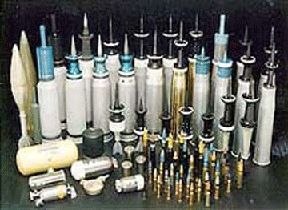 The health effects are disputed by the US and UK governments, who joined with France and Israel to vote against a resolution calling for “a precautionary approach” to the use of DU weapons at the United Nations general assembly in December; 155 countries voted in favour of the resolution.
Iraq’s depleted uranium clean-up to cost $30m as contamination spreads Rob Edwards guardian.co.uk, 6 March 2013 Report says toxic waste is being spread by scrap metal dealers, and describes its ‘alarming’ use in civilian areas during Iraq wars Cleaning up more than 300 sites in Iraq still contaminated by depleted uranium (DU) weapons will cost at least $30m, according to a report by a Dutch peace group to be published on Thursday.
The report, which was funded by the Norwegian Ministry of Foreign Affairs, warns that the contamination is being spread by poorly regulated scrap metal dealers, including children. It also documents evidence that DU munitions were fired at light vehicles, buildings and other civilian infrastructure including the Iraqi Ministry of Planning in Baghdad – casting doubt on official assurances that only armoured vehicles were targeted. “The use of DU in populated areas is alarming,” it says, adding that many more contaminated sites are likely to be discovered.
More than 400 tonnes of DU ammunition are estimated to have been fired by jets and tanks in the two Iraq wars in 1991 and 2003, the vast majority by US forces. The UK government says that British forces fired less than three tonnes.
DU is a chemically toxic and radioactive heavy metal produced as wasteby the nuclear power industry. It is used in weapons because it is an extremely hard material capable of piercing armour. Continue reading
Nuclear message in a plastic bottle
What do circuit boards at a nuclear power plant have to do with uric acid? First I thought those problems were caused by mice, but later an engineer secretly told me that it was because there was no restroom at the plants’ construction sites, so workers would go to the toilet wherever they could — often against the walls. Their urine then turned into uric acid which seeped into and corroded the circuit boards. The result was irregular signals or lost control of the signals.
By Jay Fang 方儉
Wed, Mar 06, 2013
Tapei Times

Imade source : http://www.gazette.uwo.ca/article.cfm?section=FrontPage&articleID=929&month=3&day=6&year=2007
If we want to learn about nuclear power safety here in Taiwan, we might find the answer in a simple plastic bottle.
President Ma Ying-jeou (馬英九) recently said that when it comes to the Fourth Nuclear Power Plant in Gongliao District (貢寮), New Taipei City (新北市), it is important to listen to people’s opinions, conduct thorough research, communicate, make careful decisions and carry out plans effectively. However, considering that the plant’s construction site does not even have a restroom, it is not likely that nuclear safety will ever become a reality in Taiwan.
More than two decades ago when I was interviewing people about the first three nuclear power plants, which had only been up and running for a few years, I discovered that the plants were plagued by the reactors randomly tripping.
Analysis of these incidents showed that, apart from the inevitable problems caused by natural events like earthquakes and typhoons, their biggest cause were things like malfunctioning circuit board control cards and overheating in the reactor units. Further analysis of these causes showed that many of the situations that were put down to “unknown causes” were actually due to “uric acid.”
1 This Month

Protect Sazan Island from the Trump family! https://secure.avaaz.org/campaign/en/protect_sazan_island_from_the_trump_family_loc/?bqFCVab&v=174511&cl=22707147157&_checksum=5e9dde668860e8231c33699735e16a1fbf22ab2cb01da50c999fe8732b9775ef&utm_source=email&utm_medium=blast_email&utm_campaign=174511


Cuba Is Not a Failed State – It Is a Besieged State
PETITION: “Global Appeal to Endorse Palestinian Right of Return of Refugees”
To see nuclear-related stories in greater depth and intensity – go to https://nuclearinformation.wordpress.com
-
Archives
- June 2026 (129)
- May 2026 (306)
- April 2026 (356)
- March 2026 (251)
- February 2026 (268)
- January 2026 (308)
- December 2025 (358)
- November 2025 (359)
- October 2025 (376)
- September 2025 (257)
- August 2025 (319)
- July 2025 (230)
-
Categories
- 1
- 1 NUCLEAR ISSUES
- business and costs
- climate change
- culture and arts
- ENERGY
- environment
- health
- history
- indigenous issues
- Legal
- marketing of nuclear
- media
- opposition to nuclear
- PERSONAL STORIES
- politics
- politics international
- Religion and ethics
- safety
- secrets,lies and civil liberties
- spinbuster
- technology
- Uranium
- wastes
- weapons and war
- Women
- 2 WORLD
- ACTION
- AFRICA
- Atrocities
- AUSTRALIA
- Christina's notes
- Christina's themes
- culture and arts
- Events
- Fuk 2022
- Fuk 2023
- Fukushima 2017
- Fukushima 2018
- fukushima 2019
- Fukushima 2020
- Fukushima 2021
- general
- global warming
- Humour (God we need it)
- Nuclear
- RARE EARTHS
- Reference
- resources – print
- Resources -audiovicual
- Weekly Newsletter
- World
- World Nuclear
- YouTube
-
RSS
Entries RSS
Comments RSS
 nuclear-news