WHO: Small cancer risk after Fukushima accident say British University Professors
“The additional risk is quite small and will probably be hidden by the noise of other (cancer) risks like people’s lifestyle choices and statistical fluctuations,” said Richard Wakeford of the University of Manchester, one of the authors of the report. “It’s more important not to start smoking than having been in Fukushima.”
“…Wakeford said the increase may be so small it will probably not be observable….”
“…For people beyond the most directly affected areas of Fukushima, Wakeford said the projected cancer risk from the radiation dropped dramatically. “The risks to everyone else were just infinitesimal.”…”
“….David Brenner of Columbia University in New York, an expert on radiation-induced cancers, said that although the risk to individuals is tiny outside the most contaminated areas, some cancers might still result, at least in theory. But they’d be too rare to be detectable in overall cancer rates, he said.
Brenner said the numerical risk estimates in the WHO report were not surprising. He also said they should be considered imprecise because of the difficulty in determining risk from low doses of radiation. He was not connected with the WHO report…..”
“… “On the basis of the radiation doses people have received, there is no reason to think there would be an increase in cancer in the next 50 years,” said Wade Allison, an emeritus professor of physics at Oxford University, who also had no role in developing the new report. “The very small increase in cancers means that it’s even less than the risk of crossing the road,” he said. … ”
“….. Gerry Thomas, a professor of molecular pathology at Imperial College London (UK Thyroid Assoc.), accused the United Nations health agency of hyping the cancer risk.
“It’s understandable that WHO wants to err on the side of caution, but telling the Japanese about a barely significant personal risk may not be helpful,” she said.
Thomas said the WHO report used inflated estimates of radiation doses and didn’t properly take into account Japan’s quick evacuation of people from Fukushima.
“This will fuel fears in Japan that could be more dangerous than the physical effects of radiation,” she said, noting that people living under stress have higher rates of heart problems, suicide and mental illness…. ”
“…..In Japan, Norio Kanno, the chief of Iitate village, in one of the regions hardest hit by the disaster, harshly criticized the WHO report on Japanese public television channel NHK, describing it as “totally hypothetical.”….”
By MARIA CHENG
Japan Today
LONDON —
Two years after Japan’s nuclear plant disaster, an international team of experts said Thursday that residents of areas hit by the highest doses of radiation face an increased cancer risk so small it probably won’t be detectable.
In fact, experts calculated that increase at about 1 extra percentage point added to a Japanese infant’s lifetime cancer risk.
[….]
Many people who remain in Fukushima still fear long-term health risks from the radiation, and some refuse to let their children play outside or eat locally grown food.
Some restrictions have been lifted on a 20-kilometer zone around the nuclear plant. But large sections of land in the area remain off-limits. Many residents aren’t expected to be able to return to their homes for years……__
Online:
WHO report: http://bit.ly/YDCXcb
See more at: http://www.japantoday.com/category/national/view/who-small-cancer-risk-after-fukushima-accident#sthash.HivRqR1a.dpuf
TEPCO Hires UK Propaganda Chief
“…To be sure, the nuclear issue still divides opinion sharply. Judge admits that a repeat of the Chernobyl disaster would close the industry down for 20 years…” 22 July 2009 –Barbara Judge
Published on Feb 11, 2013
https://nuclear-news.net/2013/02/18/tepco-hires-uk-propaganda-chief/
Fukushima: BBC Debunked – Chernobyl: BBC Debunked
“A range of other evidence assessed by the ESC included a report showing there have been 6,000 cases of thyroid cancer reported in children and adolescents as of 2005 – with many more expected over the coming decades.‘”
https://nuclear-news.net/2013/02/15/fukushima-bbc-debunked-chernobyl-bbc-debunked/
And a quick summary of the Q&A panel held after premier screening of ‘After the Apocalypse’. The panel included Baroness Helena Kennedy. Geraldine Thomas (oncology), Steve Wilkinson,
Prof Thomas says that genetic science is not accurate anyway?
Prof Thomas says the doctors in the film are trying to source funding by highlighting deformity etc
Prof Thomas doesn’t comment on the enforced genetic passports?? Everyone else on the panel does.
Prof Thomas says the incidence is of small incremental amounts but doesnt give a percentage..
Any percentage of millions/billions of people are huge numbers of personal distress and loss!!
The director looks harassed.. the film has been taken off You Tube.. Prof Thomas blames alcoholism for the gross defects of bibgul and her mother..
And here is the original list of speakers, no Prof Thomas?
[…]
May 5 ’11 After the Apocalypse Premiere
Good Pitch UK 2009 Alumnus After the Apocalypse,
A film about aftermath of soviet era nuclear experiments, is set to premiere in the UK on May 11th at Princes Charles Cinema.
Screening followed by a Q&A with key Genetic and Ethical specialists – Baroness Helena
Kennedy, the former Head of the Human Genetics Commission; Professor Yuri Dubrova –
Professor of Genetics at the University of Leicester and Steve Wilkinson – Professor of Medical
Ethics at Keele University.
Saturday, October 8, 2011
The Economist: Oxford Professor Says OK to Raise Annual Dose Limit by 1000 Times for the Japanese, But the Reporter Reluctant to Inhale
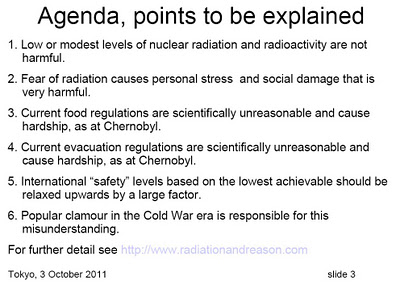
Dr. Wade Allison is professor emeritus of physics (particle physics) at Oxford University. The event that the Economist’s reporter refers to in the article must be the talk given at American Chamber of Commerce in Japan (ACCJ) on October 3, where the professor, along with another researcher, presented the strong case that the radiation exposure below 100 millisieverts per year was not a problem, if one only gets rid of the unreasonable fear of radiation. He also says the current food regulation, evacuation regulation are “unreasonable” and should be relaxed significantly.
Here’s the screen capture of a page from his presentation slides he used in the ACCJ talk:
1 Comment »
Leave a comment
1 This Month

of the week – Shut Down Drone Warfare!


Tell the Ukrainian Government to Drop Prosecution of Peace Activist Yurii Sheliazhenko

Petition to revoke the licensing of the Near Surface Nuclear Disposal Facility (NSDF) at Chalk River. https://www.ourcommons.ca/petitions/en/Petition/Details?Petition=e-7247
To see nuclear-related stories in greater depth and intensity – go to https://nuclearinformation.wordpress.com
-
Archives
- April 2026 (68)
- March 2026 (251)
- February 2026 (268)
- January 2026 (308)
- December 2025 (358)
- November 2025 (359)
- October 2025 (376)
- September 2025 (257)
- August 2025 (319)
- July 2025 (230)
- June 2025 (348)
- May 2025 (261)
-
Categories
- 1
- 1 NUCLEAR ISSUES
- business and costs
- climate change
- culture and arts
- ENERGY
- environment
- health
- history
- indigenous issues
- Legal
- marketing of nuclear
- media
- opposition to nuclear
- PERSONAL STORIES
- politics
- politics international
- Religion and ethics
- safety
- secrets,lies and civil liberties
- spinbuster
- technology
- Uranium
- wastes
- weapons and war
- Women
- 2 WORLD
- ACTION
- AFRICA
- Atrocities
- AUSTRALIA
- Christina's notes
- Christina's themes
- culture and arts
- Events
- Fuk 2022
- Fuk 2023
- Fukushima 2017
- Fukushima 2018
- fukushima 2019
- Fukushima 2020
- Fukushima 2021
- general
- global warming
- Humour (God we need it)
- Nuclear
- RARE EARTHS
- Reference
- resources – print
- Resources -audiovicual
- Weekly Newsletter
- World
- World Nuclear
- YouTube
-
RSS
Entries RSS
Comments RSS
 nuclear-news
[…] https://nuclear-news.net/2013/03/01/who-small-cancer-risk-after-fukushima-accident-says-british-unive… […]
Pingback by Strange Bedfellows: TEPCO & Lady Barbara Judge « nuclear-news | March 7, 2013 |