Part 2 -Information, Misinformation, Disinformation? -Japans radiation monitoring
Posted by azby on December 29, 2012
Safecast
GOVERNMENT MONITORING POSTS
In recent months there has been a fair amount of controversy concerning the accuracy of the radiation monitoring posts the government has installed all over Fukushima prefecture, and in some neighboring prefectures as well. We wrote about it back in July, 2012:
TEPCO cheating on radiation levels by using “improved” monitoring posts

A MEXT radiation monitoring post, aka “droid,” of a common type manufactured by NEC . This one is at the former Akasawa Elementary School in Aizu-Misato.
There are almost 700 of these monitoring posts (675 at latest count), which we refer to as “droids” because of how they look (see photo above). They are all powered by solar panels and use storage batteries.
Through the Ministry of Education, Culture, Sports, Science, and Technology (MEXT), the government spent a lot of money (we haven’t been able to find out precisely how much) to have them installed, and spent more money to have a web site made that displays the readings: MEXT realtime environmental radiation page
From this reasonably attractive-looking page, users are supposed to click on a prefecture, then on a region of the prefecture, and then choose from any one of a dozen or more municipalities. Then a scrolling list appears on the right hand side, and users can select a particular monitoring post to review (In the case of Koriyama City in Fukushima, there are 393 monitoring posts in the list). A zoomable, scrollable Google Fusion map appears, and the individual posts are marked by colored dots. Clicking a dot gives the current reading at that location, updated very 10 minutes it seems, and it is possible to download data for the entire month. So, thank you for doing that much, at least, MEXT.
This system sucks in many ways. While working with it in order to compare the MEXT readings with our own, we’ve found that it’s impossible to get an overview of more than a small part of Fukushima at any one time, that hunting down particular locations is incredibly time consuming and frustrating, that the cumulative time data does not go back far enough, and that the downloadable data comes with many restrictions and is difficult to pull down efficiently. Yes, MEXT made this system ADAP — As Difficult As Possible.

Screen capture from the MEXT online system of the area around Kawauchi Elementary school in Fukushima. The blue dots represent fixed monitoring posts, the blue diamond a reading taken with a handheld unit. One of the dots was selected, and the reading shown as 0.093 uSv/h (microsieverts per hour). The two fixed units at this location are actually much closer together than this map suggests (see photo further below).

The Safecast map of the same area. The most recent bGeigie readings for the road next to the school, from Nov 9, 2012, were in the 0.12 to 0.17μSv/h range. This is fairly consistent with what the droid shows. Readings taken on the same drive on the roads north and south of the school range as high as 0.18 μSv/h. Safecast readings from a year ago, however, are in the 0.14 to 0.25 μSv/h range alongside the school and up to 0.29 μSv/h on the road to the north. On the one hand this shows that the range of variation we often encounter within a short distance can easily be a factor of two, sometimes more. The most recent readings also support the idea that the schoolyard the monitoring posts are located in has been decontaminated since last year, as has the road (A blogger has reported recently that some areas just beyond the schoolyard remain fairly contaminated, however). MEXT has made their data fairly easy to access for people who know exactly what they are looking for and just want a quick look, but it is extremely difficult and time-consuming to make this kind of close comparison with other data sets. And we couldn’t help but notice that we have a lot more data available for this area than the government provides.
Part 1 -Information, Misinformation, Disinformation? -Japans radiation monitoring

Posted by azby on December 29, 2012
Safcast
Whose job is it to make this stuff easy to understand?
“YOU CAN’T ALWAYS FIND WHAT YOU’RE LOOKING FOR…..”
[Skip to Part 2] At Safecast we assumed from the start that our data should be accurate, easy to understand, informative, well-visualized, and easily accessible. In many respects this simply reflects “best practices” in information design, as well as a vision of social responsibility in which openness and transparency are paramount virtues. So when we make decisions about how to present our data, we adhere to principles of intuitiveness, depth, context, and dare we say it, beauty in design. We want to make it as easy as possible (AEAP) for people to find what they’re looking for, and to find out what it means. That’s why we’re continually miffed when official sources of information seem to be operating under an entirely different set of assumptions.
To be honest, the seriousness of government missteps and opacity during the early weeks of the disaster led us to accommodate ourselves to vastly lowered expectations in terms of the quality and accessibility of information we’d probably see from official sources. Even though it’s their job, and they are legally required to provide many kinds of information, many of us prepared ourselves for endless tooth-pulling and fact-checking about radiation information. So first, I’d like to give a sort of brief status update:
1) The government has made a lot of information available, more than we expected (because we expected nothing).
2) It still needs to be scrutinized, fact-checked, and independently confirmed.
3) There are still some areas where a lot of us have been pulling teeth for months and still haven’t been able to get the information we’re looking for.
So let’s just agree to live with #2 and #3 for the moment. It means constant effort on our part, but enough of us are constitutionally well-equipped for this kind of research-based tug-of-war that it’s not really that onerous at this point. We get good at it, we build trust, and people who were once opponents sometimes become allies, because frankly, they need our help.
But #1 is where we find ourselves really scratching our heads. There is all sorts of official information available, and a lot of it is proving reliable, but it’s rarely as easily accessible or informative as it should be. In fact, locating and using the data is usually as difficult as possible (ADAP) considering how easy it is now to find good information and web designers, and how inexpensive it has become. It should be easy to do a good job, if the people in charge really care about doing a good job.
REPORTING THE RESULTS OF WHOLE-BODY TESTS:
One brief example would be how results of internal contamination monitoring done with whole-body counters (WBC) are being reported. These tests are being done in municipalities all over Fukushima prefecture, sometimes under the direction of the prefecture itself, more often by individual hospitals on behalf of their municipalities. Fukushima Prefecture has put up a web page to communicate the results of testing done through Oct. 2012, as well as a more detailed breakdown. They’ve gathered quite a lot of numbers for us:

The WBC report page provided by Fukushima Prefecture summarizes the key data in this table. It shows how something can be entirely accurate and extremely uninformative at the same time.[
Petition: Evacuate Fukushima -Avaaz
Petition: Evacuate Fukushima

This very simple homemade video petitions is dedicated to all victims of 311 and the brave citizens of Tohoku. Already over 10,000 written signatures were collected on the Avaaz petition . Please sign this petition to support the children and become part of the solution.
HINKLEY UPDATE: PROTESTERS FINED IN COURT -SchnewsUK

Published on 29th December 2012 | Part of Issue 834
Four anti-nuclear protesters were fined £100 each and given 12 months conditional discharge on Wednesday (19th) in Taunton magistrates’ court. The four had chained themselves together and blocked the main access outside the Hinkley power plant in November. The blockade stopped entry and exit onto the site for over four hours until a removal team arrived from nearby Bristol. In court the four pleaded guilty to obstructing the highway. The action raised awareness and protested against the plans for reactors at the Hinkley C nuclear power station site in Somerset.
The defendants had no choice but to represent themselves in court as that was a better alternative to a duty solicitor according to one of the defendants SchNEWS spoke to, they went on to say “The outcome in court was expected and even though it could have been worse it is still not a good outcome. The conditional discharge restricts you from being active.”
In a statement taken from a press release on the stop hinkley website speaking after the verdict, tree surgeonZoe Smith from Bristol was in a defiant mood. “This is a national campaign and I expect there will be many more surprises for EDF over the coming months.
Barnaby Hodges, a catering worker from Glastonbury, said outside court: “I have never been arrested for protesting before, but like many people in Glastonbury I am ready to take whatever non-violent action is necessary to prevent the building of a potential Fukushima only 25 miles away. It’s not as if there aren’t any alternatives.”
There might be a small respite for the protesters as recent cutbacks at EDF’s parent company in France could mean long delays for the nuclear building programme. EDF has indicated for over a year now that it plans to spend billions on two reactors at the new plant at Hinkley. Confirmation is expected in March 2013 but with pressure from the French government to cut costs at the parent company the confirmation date might be pushed further away still.
http://www.schnews.org.uk/stories/HINKLEY-UPDATE-PROTESTERS-FINED-IN-COURT/
Stop Hinkley needs more supporters.
“…Stop Hinkley have a long and successful record campaigning against nuclear power at Hinkley Point and Oldbury. We campaigned vigorously on the dangers connected with running Hinkley ‘A’ and as a consequence BNFL reluctantly shut it down permanently in 2000. We have worked with regional BBC and ITV documentaries to highlight the risk from the crumbling old reactor at Oldbury. Now Hinkley Point is the proposed site for the first of a series of new nuclear power stations in the UK….”
Radiation spread from Fukushima in Northern hemisphere
Almost entire ground-level of Northern Hemisphere covered in radioactive fission product after 3/11 (GRAPHIC) — Study: “The impact of Fukushima radioxenon releases on the worldwide Xe-133 background must be investigated” http://enenews.com/almost-entire-ground-level-northern-hemisphere-covered-radioactive-fission-product-after-311-study-impact-fukushima-radioxenon-releases-worldwide-xe-133-background-be-investigated-graphic
December 31st, 2012
Title: Analysis of Radionuclide Releases from the Fukushima Dai-ichi Nuclear Power Plant Accident Part II
Source: Pure and Applied Geophysics
Authors: Pascal Achim, Marguerite Monfort, Gilbert Le Petit, Philippe Gross, Guilhem Douysset, Thomas Taffary, Xavier Blanchard, Christophe Moulin
Date: September 2012
[…] In this study, the emissions of the three fission products Cs-137, I-131 and Xe-133 are investigated.
[…] worldwide industrial Xe-133 background could be modified by Fukushima radioxenon release affecting the performances of the CTBT radionuclide monitoring network.
[…] during the couple of months after the Fukushima Dai-ichi accident, monitoring capabilities of the network could have been affected by the large amount of radioxenon released by the accident. The impact of Fukushima radioxenon releases on the worldwide Xe-133 background must also be investigated. […]..
Big nuclear powers not really motivated towards a diplomatic solution regarding Iran’s nuclear program
 ‘No real determination in P5+1 to resolve Iran nuclear issue’
http://presstv.com/detail/2013/01/02/281467/no-real-will-to-solve-ncase-in-p51/
An Iranian lawmaker says the P5+1 — Britain, China, France, Russia,
and the United States plus Germany — lacks the determination to
resolve Iran’s nuclear issue. Continue reading
An ugly story – Chrystal River nuclear plant – a national financial headache
 Utility companies pass those costs onto their customers, making
Crystal River’s failed do-it-yourself maintenance project a nationwide
responsibility…… And Crystal River isn’t the only concern. Most of
the 104 reactors in the United States were built in the 1970s and
early 1980s. They are starting to show their age, a fact that is
adding additional pressure to NEIL’s bottom line.
The insurance company is processing claims from American Electric
Power’s nuclear station in Bridgman, Mich., the South Texas Nuclear
Project and California’s San Onofre nuclear power station.
Adding in Crystal River, NEIL and its member utilities — and by
extension their customers — are potentially looking at a huge
financial hit. ” This,” said Cooper, the economist, “is an ugly story.”
Progress Energy Shares the Costly Pain of a Fix at Nuclear Power
Plant, News Chief.com By IVAN PENN TAMPA BAY TIMES, January 2, 2013
The crippled Crystal River nuclear plant, owned by Progress Energy, is
now America’s headache. The bill to fix it and pay for replacement
power may top $5 billion. The problem?
The company that insures all 104 U.S. nuclear power plants has just
$3.6 billion on hand to pay for claims.
Broken nuclear plants in California, Texas and Michigan will vie for
some of that money. But Crystal River alone represents such a
financial threat that the insurance company, Nuclear Electric
Insurance Ltd., may demand that its member utilities pony up more
money. And it could be a lot more — and quickly. Continue reading
Business before safety, in nuclear South Korea
 The country also hopes to
capitalize on its growing technological expertise, and it has already
exported four nuclear power plants to the United Arab Emirates.
Pursuing Economic Growth, South Korea Accepts The Risks Of Nuclear
Power Generation, International Business Tomes, 3 Jan 2013 It’s a new
year for nuclear energy in South Korea. The government has just
approved the reopening of a shuttered power plant in Yeonggwang
county, which will begin supplying electricity amid official
assurances that safety concerns have been addressed….. a sobering
caveat: Nuclear energy is inherently risky. …… especially
worrisome when South Korea shut down two of its own nuclear plants in
Yeonggwang — which is less than 200 miles from the capital city of
Seoul — in November, after it was revealed that some of the working
parts had quality certificates that had been forged. Continue reading
UK stuck with fairly useless nuclear submarines – mainly to save face
The Trident Debate: UK’s Strategic Nuclear Deterrent – Analysis By:
IPCS, January 2, 2013 By Debak Das Stuck in a world order where it
represents the lower rung of the club of ‘Nuclear Weapons States’, the
United Kingdom’s (UK) now delayed decision to upgrade its Trident
submarine nuclear missile system raises some important questions.
What does the deterrent mean for the UK and what is the need for it
now? And secondly, what are the implications of the upgradation of
this missile system along with the new £315 million pound deal to work
on the replacement of the Royal Navy’s Vanguard class of submarines.
Why Does The UK Need The Nuclear Deterrent? The Vanguard class of
submarines and the Trident submarine missile systems are a relic of
the Cold War…. Why then the deterrent? The answer to this question
lies in two propositions. First, the nuclear deterrent is a symbol of
the ‘great power’ that Britain once was. Continue reading
Inquest on gun murder aboard UK nuclear submarine
HMS Astute nuclear submarine officer shot tackling gunman BBC News 2
Jan 13, A navy officer was shot in the head as he tried to stop a
junior rating killing others on a nuclear-powered submarine, an
inquest heard.
Lt Cdr Ian Molyneux, 36, of Wigan, Greater Manchester, was shot at
close range on board HMS Astute while docked in Southampton in 2011.
The inquest into his death heard he would have fallen unconscious
immediately and died shortly after.
Able Seaman Ryan Donovan was jailed for at least 25 years for murder.
The navigator yeoman also pleaded guilty to attempting to murder Lt
Cdr Christopher Hodge, 45, who he shot in the stomach, Petty Officer
Christopher Brown, 36, and Chief Petty Officer David McCoy, 37.
Donovan’s attack, on 8 April 2011, was only stopped when the then
leader of Southampton City Council, Royston Smith, and its chief
executive, Alistair Neill, wrestled the weapon from
him…..http://www.bbc.co.uk/news/uk-england-hampshire-20893271
USA wind energy to get a boost with an extension of the Production Tax Credit
US tax move puts wind into renewable energy stocks, Sydney Morning
Herald, January 3, 2013 – Vestas Wind Systems, the biggest
wind-turbine maker, and Gamesa Corp. Tecnologica led gains among
European peers as the US Congress approved a law extending a tax
credit for the industry.
Shares of Aarhus, Denmark-based Vestas surged 6.7 per cent, the most
in five weeks, to close at 34 kroner in Copenhagen. Gamesa rose 9.5
per cent, the most since August, to 1.817 euros in Madrid, while
Nordex SE climbed 4 per cent in Frankfurt.
The US House late yesterday passed a bill averting spending cuts and
tax rises that had threatened an economic recovery. The law, already
approved by the Senate, includes an extension of the Production Tax
Credit, which pays wind-farm owners 2.2 cents for every kilowatt-hour
of power they produce.
“It’s really good news for Vestas, because the American market and how
it develops is extremely important,” Chief Marketing Officer Morten
Albaek said today in a phone interview. “It’s a good way of starting
the new year.”
The US Energy Information Administration said Dec. 19 that wind-farm
installations in the country would top 12 gigawatts in 2012 as
developers rushed to complete projects before the scheduled Dec. 31
expiry of the tax credit, known as the PTC. Th
http://www.smh.com.au/business/carbon-economy/us-tax-m
Russia’s latest killer nuclear submarine
Silent killer: Nuclear submarine is latest in new fleet of Russian
missile-carriers to have started sea trials nearly seven years after
building began Mail Online
Vladimir Monomakh, third submarine in Russia’s new fleet, began sea trials
The silent submarine is the third in Russia’s Borei project
Fleet’s first submarine, which cost $770m, was taken on by navy on same day
By JAMES RUSH 1 January 2013
Read more: http://www.dailymail.co.uk/news/article-2255683/Silent-killer-Nuclear-submarine-Vladimir-Monomakh-latest-new-fleet-Russian-missile-carriers-started-sea-trials-nearly-seven-years-building-began.html#ixzz2GyFrZfAm
More sharemarket interest in renewable energy
30 under 30 energy pictures.
http://www.forbes.com/sites/toddwoody/2012/12/31/renewable-energy-winning-mind-share-if-not-market-share/?ss=business%3Aenergy
Measuring gamma radiation levels in Virginia
NNSA Helicopters Conduct Radiation Assessment in Northern Virginia
Several residents report hearing helicopters in the skies over the
area.
Annandale Patch, 31 Dec 12, By Jamie M. Rogers “…. The helicopters
began flying over the area Thursday, measuring naturally occurring
radiation, according to the group’s website.
The flights will continue until Jan. 11 during daylight hours
only….. Scientists with NNSA’s Remote Sensing Laboratory (RSL) out
of Joint Base Andrews will use remote gamma radiation-sensing
instrumentals to carry out the assessments.
Naturally-occurring radiation is measured so that baseline levels can
be established and used in security and emergency preparedness,
scientists said. …
http://annandale.patch.com/articles/nnsa-helicopters-conduct-radiation-assessment-in-northern-virginia
Is Tanzania ready for the catastrophe of uranium mining?
Analyst gives caution on uranium mining safety The Citizen, Tanzania
31 December 2012 By Zephania Ubwani, The Citizen Bureau Chief
Arusha. Stringent measures must be taken to ensure that uranium
mining does not compromise the safety of people and the environment,
an academician has suggested.
Dr Priva M. Moshi of Tumaini University, Masoka Campus in Moshi, said
Tanzania must learn from other countries on the necessary safety
measures needed in uranium mining before commencement of extraction of
the radio-active mineral.
“Uranium mining has been problematic even in the developed countries
because of its life-threatening hazards. Are we ready for its
catastrophe?” he asked during a forum which ended here yesterday
(Sunday) on Post 2015 Global Development Agenda. Continue reading
1 This Month

22 June – Virtual Event –Climate Change: New Data, New Debate

Monday, June 22, 2026 2:30 p.m. – 3:15 p.m. CT
YouTube. Register here

Protect Sazan Island from the Trump family! https://secure.avaaz.org/campaign/en/protect_sazan_island_from_the_trump_family_loc/?bqFCVab&v=174511&cl=22707147157&_checksum=5e9dde668860e8231c33699735e16a1fbf22ab2cb01da50c999fe8732b9775ef&utm_source=email&utm_medium=blast_email&utm_campaign=174511
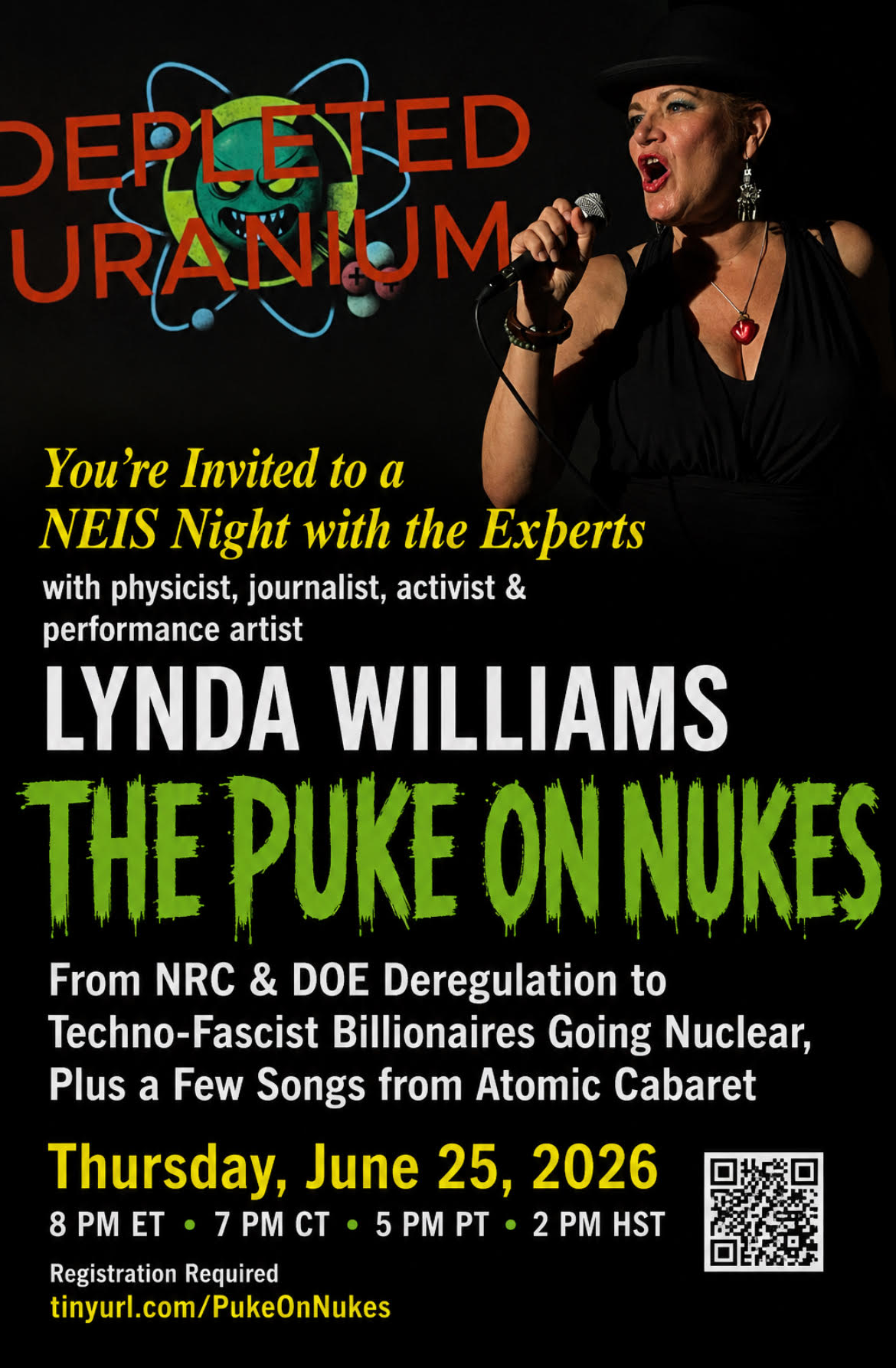
25 June- THE PUKE ON NUKES
Thursday, June 25, 2026
7pm Central Time (8pm ET, 6pm MT, 5pm PT) UTC – 5
From NRC & DOE Deregulation to Techno-Fascist Billionaires Going Nuclear, Plus a Few Songs from Atomic Cabaret REGISTER
26 June – Radiation Trainwreck at the NRC / Join the Protect Better Campaign – https://us02web.zoom.us/meeting/register/4ZlZ5_qLSHGiLSCg8FF6Bg#/registration


Cuba Is Not a Failed State – It Is a Besieged State
PETITION: “Global Appeal to Endorse Palestinian Right of Return of Refugees”
To see nuclear-related stories in greater depth and intensity – go to https://nuclearinformation.wordpress.com
-
Archives
- June 2026 (193)
- May 2026 (306)
- April 2026 (356)
- March 2026 (251)
- February 2026 (268)
- January 2026 (308)
- December 2025 (358)
- November 2025 (359)
- October 2025 (376)
- September 2025 (257)
- August 2025 (319)
- July 2025 (230)
-
Categories
- 1
- 1 NUCLEAR ISSUES
- business and costs
- climate change
- culture and arts
- ENERGY
- environment
- health
- history
- indigenous issues
- Legal
- marketing of nuclear
- media
- opposition to nuclear
- PERSONAL STORIES
- politics
- politics international
- Religion and ethics
- safety
- secrets,lies and civil liberties
- spinbuster
- technology
- Uranium
- wastes
- weapons and war
- Women
- 2 WORLD
- ACTION
- AFRICA
- Atrocities
- AUSTRALIA
- Christina's notes
- Christina's themes
- culture and arts
- Events
- Fuk 2022
- Fuk 2023
- Fukushima 2017
- Fukushima 2018
- fukushima 2019
- Fukushima 2020
- Fukushima 2021
- general
- global warming
- Humour (God we need it)
- Nuclear
- RARE EARTHS
- Reference
- resources – print
- Resources -audiovicual
- Weekly Newsletter
- World
- World Nuclear
- YouTube
-
RSS
Entries RSS
Comments RSS
 nuclear-news