War in Mali – to preserve France’s control of uranium resources?
 French mining company Areva, had lost its almost complete exclusive right to Niger’s uranium. This could easily explain why France could not afford to lose Mali as well.
On Monday, French foreign minister Laurent Fabius said… Key interests were at stake for us, for Africa, for Europe, so we had to act quickly,” said Fabius. Could one of the key interests mentioned by Mr. Fabius be uranium?
Uranium is indeed France’s key energy resource… , the country is heavily dependent on uranium..
Mali: France’s Neo-Colonial War for Uranium? News Junke Post, By Gilbert Mercier 15 Jan 13 In late December 2012, the United Nations Security Council approved the dispatch of an “African-led intervention force” to Mali’s to help the army reconquer the north of the country from Tuareg separatists and their allied Islamist militants. But in recent days, it is not the African-led troops who have been operating in Mali. Instead, troops from former colonial power France have been unilaterally deployed to fight the rebellion in the north….
Recipe for a failed state Continue reading
Nuclear reactors in operation – drop in numbers, as IAEA reclassifies 47 Japanese reactors as “Long-term Shutdown” (LTS)
IAEA Shifts 47 Japanese Reactors Into “Long-Term Shutdown” Category 16 January 2013 In an unprecedented move, the International Atomic Energy Agency (IAEA) has shifted 47 Japanese nuclear reactors from the category “In Operation” to the category “Long-term Shutdown” (LTS) in its web-based Power Reactor Information System (PRIS). The number of nuclear reactors listed as “In Operation” in the world thus drops from 437 yesterday to 390 today, a level last seen in Chernobyl-year 1986 and a dramatic step of the IAEA’s official statistics in recognizing industrial reality in Japan.
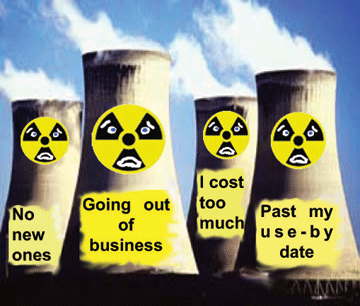
This is without doubt a unique revision of world operational nuclear data. However, numerous questions remain. The definitions of the IAEA’s reactor status categories remain unclear. Units can remain in the LTS category for many years, without any apparent limit. Japan has now 48 units listed as LTS, one of which is the fast breeder reactor Monju that has not been generating electricity since a sodium fire severely damaged the plant in 1995, while three further units at Kashiwazaki-kariwa have not been generating power since an earthquake hit the site in 2007.
New nuclear power- not a good investment
the nuclear renaissance may be largely over before it started.
New Centralized Nuclear Plants: Still an Investment Worth Making? Forbes, Peter Kelly-Detwiler,15 Jan 2013,
“…….Even without Fukushima, the verdict on large centralized US nukes is probably in, for the following reasons:
1) They take too long: In the ten years it can take to build a nuclear plant, the world can change considerably (look at what has happened with natural gas prices and the costs of solar since some of these investments were first proposed). The energy world is changing very quickly, which poses a significant risk for thirty to forty year investments.
2) They are among the most expensive and capital-intensive investments in the world; they cost many billions of dollars, and they are too frequently prone to crippling multi-billion dollar cost overruns and delays. In May 2008, the US Congressional Budget Office found that the actual cost of building 75 of America’s earlier nuclear plants involved an average 207% overrun, soaring from $938 to $2,959 per kilowatt.
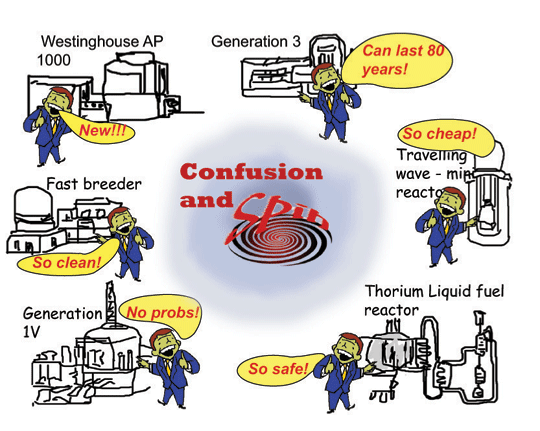
3) And once the investments commence, they are all-or-nothing. You can’t pull out without losing your entire investment. For those with longer memories, WPPS and Shoreham represent $2.25 bn (1983) and $6 bn (1989) wasted investments in which nothing was gained and ratepayers and bondholders lost a good deal. Continue reading
San Onofre leads the way for USA rust bucket nuclear reactors to go
The fiasco at San Onfre is being replayed at rust bucket reactors throughout the US.
Meanwhile, the conversion to green power in Germany is booming. When 8 reactors were shut and the conversion to wind, solar and biomass became official policy, “experts” predicated energy shortages and soaring prices. But the opposite has happened as supply has boomed and prices have dropped.
The same things will happen in California and elsewhere as these radioactive jalopies begin to shut. The effectiveness of citizen activism in California is now vastly multiplied as these two decrepit reactors become increasingly obsolete, inoperable and economically insupportable.
 Showdown at San Onofre: Why the Nuclear Industry May Be Dealt a Big Blowhttp://www.alternet.org/environment/showdown-san-onofre-why-nuclear-industry-may-be-dealt-big-blow?akid=9919.1085969.01RI09&rd=1&src=newsletter775567&t=19 Two stricken California reactors may soon redefine a global movement aimed at eradicating nuclear power.January 7, 2013
Two stricken California reactors may soon redefine a global movement aimed at eradicating nuclear power.
They sit in a seismic zone vulnerable to tsunamis. Faulty steam generators have forced them shut for nearly a year.
A powerful “No Nukes” movement wants them to stay that way. If they win, the shutdown of America’s 104 licensed reactors will seriously accelerate.
The story of San Onofre Units 2 & 3 is one of atomic idiocy. Continue reading
Radioactive groundwater leaking into Fukushima reactors
Tepco Official in US: “We are still seeing leakage” — Contaminated groundwater seeping into reactor areas http://enenews.com/tepco-official-leakage-contaminated-groundwater-seeping-reactor-areas
Title: Fukushima recovery aided by SRS cleanup technology
Source: The Augusta Chronicle
Author: Rob Pavey
Date: Jan. 15, 2013

[…] Even after almost two years of nonstop cleanup work, managing the flow of water contaminated with radiation continues to be one of site’s most significant challenges, [Masumi Ishikawa, TEPCO’s general manager for radioactive fuel management] said.
“We are still seeing leakage,” he said. “That is an important challenge we must meet.”
Maintaining the essential flow of cooling water to the melted reactors, he said, has been complicated by the need to remove and treat contaminated groundwater that has seeped into the reactor areas since the March 2011 earthquake and tsunami.
[…] Ishikawa said the plant site will almost certainly play some sort of role in the future.
“Our new prime minister explicitly has said, Japan’s revitalization will not happen without the revitalization of Fukushima Dai-ichi,” he said.
See also: ‘Impermeable wall’ between leaking Fukushima reactors and ocean yet to be built — Tepco still working on silt fence (PHOTO)
Virginia would be gambling its future, with uranium mining
Uranium mining: A fiscal conservative might say, ‘no’, http://www.wpcva.com/altavista/opinion/article_7de6346e-5ff6-11e2-9db4-001a4bcf887a.html ALTAVISTA Journal, Katie Whitehead/Special to the Journal. January 16, 2013
Traditional conservative values support continuing the moratorium on uranium mining in Virginia. Moving forward with legalization of uranium mining in Virginia would be expensive for taxpayers, with no guarantee the costs would ever be recovered.
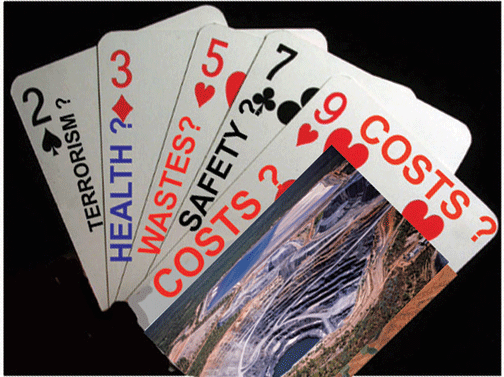
The governor’s Uranium Working Group (UWG) report lists the many protective actions Virginia would need to take to regulate and monitor uranium mining and milling. Following through on all the suggested safety measures would require establishing a comprehensive uranium mining and milling regulatory program. The only proposal worth considering — other than maintaining the moratorium — is a fully funded, fully staffed, comprehensive, state-level, statewide program that incorporates all the measures outlined by the UWG. Even then, it might be impossible to guarantee a degree of safety in operation that would be acceptable to a majority of citizens.
Dr. Paul Locke, chairman of the National Academy of Sciences (NAS) study committee, recently told reporters, “Putting protective regulations into place would be a very, very, very difficult task. Continue reading
Hear Arnie Gundersen on USA’s costly shutdown nuclear reactors
 AUDIO http://www.fairewinds.com/content/fairewinds-podcast REPAIRS AT FOUR NUCLEAR REACTORS ARE SO EXPENSIVE THAT THEY SHOULD NOT BE RESTARTED Jan 13, 2013 Fairewinds examines continuing problems at four US nuclear reactors, each of which have been shutdown for more than two years. Upstream dam failures continue to plague Ft. Calhoun, steam generator tube failures at San Onofre jeopardized Los Angeles. Crystal River’s containment repairs burden Floridians with excessive costs. Finally, Arnie examines a new proposal by the Department of Energy to melt radioactive scrap metal and reuse it in consumer goods like knives and forks.
Chrystal River, Vermont nuclear plants likely to follow Kewaunee into closure
Analyst: Florida nuclear plant will likely be closed — Gundersen: “The dominoes are starting to fall” (AUDIO)
Source: Fairewinds Energy Education
Date: January 13, 2013
Nuclear Expert Arnie Gundersen, Fairewinds Energy Education: Duke is seriously considering pulling the plug on the [Crystal River nuclear] plant […]
Last week we had a financial analyst at UBS suggest that Vermont Yankee didn’t make economic sense.
This week, we’ve got a financial analyst at another firm called Fitch and he says that the Crystal River plant will likely be closed because Duke can’t make economic sense out of it.
So the dominoes are starting to fall.
We’ve have Kewaunee, which is shutting down in the Midwest because of financial reasons. And now we’ve got UBS analysts and Fitch analysts also claiming it makes no economic sense to keep other nuclear plants running.
USA’s Dept of Energy announces goals for nuclear waste management
 DOE touts interim storage option for spent nuclear fuel, Augusta Chronicle, By Rob Pavey Jan. 16, 2013 “……….Read the complete report:
 http://energy.gov/downloads/strategy-management-and-disposal-used-nuclear-fuel-and-high-level-radioactive-waste
Legislative goals for next 10 years:
• Active engagement in a broad, national, consent-based process to site pilot and full-scale interim storage facilities, and site and characterize a geologic repository;
• Siting, design, licensing, and commencement of operations at a pilot-scale storage facility with an initial focus on accepting used nuclear fuel from shut-down reactor sites.;
• Significant progress on siting and licensing of a larger consolidated interim storage facility capable of providing system flexibility and an opportunity for more substantial progress in reducing government liabilities;
• Development of transportation capabilities (personnel, processes, equipment) to begin movement of fuel from shut-down reactors;
• Reformation of the funding approach in ways that preserve the necessary role for ongoing discretionary appropriations and also provide additional funds as necessary, whether from reclassified fees or from mandatory appropriation from the NWF or both; and
• Establishment of a new organization to run the program, the structure and positioning of which balance greater autonomy with the need for continued Executive and Legislative branch oversight.
Source: U.S. Energy Department http://chronicle.augusta.com/news/metro/2013-01-16/doe-touts-interim-storage-option-spent-nuclear-fuel?v=1358336852
Quantum Pendants radioactive – 2 independent tests from bloggers
https://www.youtube.com/watch?v=kZxX3ZWY4nw
The Quantum Pendant

Published on Jan 13, 2013
I bought a Quantum Pendant and MY pendant turned out to be radioactive. 🙂
Please note, my analysis was only for my personal quantum pendant and not others. I make no claim about any quantum pendant beyond my own.



Radioactive quantum scalar energy pendant review
A second analysis of another pendant

Published on Jan 13, 2013
the atomic age’s quack cures, today!
let’s have a closer look at this radioactive pendant…
https://www.youtube.com/watch?v=wfGKJK8Zgtc
i personally would not know why this should have any beneficial effects on my body. the stuff i have read about it sounds like absolute pseudoscience; scientific words are mixed up randomly in a context that makes zero sense to the literate person (but may sound amazing to an uninformed person).
maybe i’ll still wear it for a month or so, though, “just in case there’s something i don’t know”. i did the same with homeopathy once (with zero effects, but that’s probably because i believed it was quack from the first second – but i did take my sugar beads exactly as prescribed).


National governments are legislating to fight climate change
 Nations are taking action on climate change
http://www.newscientist.com/article/dn23079-nations-are-taking-action-on-climate-change.html
15 January 2013 by Fred Pearce
It may be climate change’s best-kept secret. While global talks
founder, national governments are passing legislation to curb
greenhouse gas emissions – a Plan B for fighting climate change that
was hatched at 2010 climate talks in Cancun.
This optimistic message is at the centre of a new London School of
Economics analysis, published by GLOBE International, a group of
environment-minded parliamentarians. Of 33 major economies, 32 have
now passed legislation to either combat climate change or improve
energy efficiency, the analysis suggests, with industrialising
countries like China, Mexico and South Korea at the forefront.
These national measures are not enough, of course – the World Bank
recently concluded that the world is still heading for 4 degrees of
warming by 2100 – but national measures may help enable a global
emissions-cutting deal in time for the 2015 UN target date.
“Only if national regulatory frameworks are in place will it be
possible to reach an agreement in 2015,” says GLOBE secretary Adam
Matthews. There is no Plan C.
David Bradbury: background to his documentary films on nuclear issues
A first wave of David Bradbury’s critically acclaimed filmography is now available for immediate streaming video on ScreenZone.tv:
http://www.screenzone.tv/products/jabiluka
http://www.screenzone.tv/products/hard-rain
http://www.screenzone.tv/products/public-enemy
http://www.screenzone.tv/products/blowin-in-the-wind
 ON THE FRONTLINE: A ScreenZone interview with David Bradbury, 15 Jan 13 ”……DB: My current film examines the three stages of the nuclear film cycle on a very personal level. It started when I met an aboriginal woman called Isabelle Dingamah (sic) about four years ago, and I started to film her story. She is one of the traditional custodians of the land at Roxby [Downs]. As a little girl she’d had the British atom bomb dropped on her and her family when she was 18-months-old. It’s kind of Shakespearian. Continue reading
France’s President Hollande calls for renewable energy spending
Hollande calls for more renewable energy spending http://www.middle-east-online.com/english/?id=56456 16 Jan 13, French President warns failure to invest in developing renewable energy will increase demand for fossil energy, risks of global warming. Middle East Online
ABU DHABI – French President Francois Hollande called on Tuesday for pumping more investments in renewable energy projects to prepare for the post-oil era and to avoid global warming.
“If we don’t spend … we will have a catastrophe,” Hollande told the opening session of the World Future Energy Summit (WEFS) in Abu Dhabi. Continue reading
USA’s fiasco of money wasted on nuclear energy
 Money spent on nuclear energy is wasted http://www.mlive.com/opinion/saginaw/index.ssf/2013/01/letter_terry_t_crevia.html TERRY T. CREVIA, The Jan. 14 Associated Press article “Training under way for new nuclear plant operators” shows the continued attempt to resurrect nuclear energy in the United States, despite its dismal track record of being too costly, too dangerous and inefficient.
Safety training is just one of the gaps in the nuclear energy fiasco. There are just too many problems with nuclear energy besides personnel training for it to continue to receive the tens of billions of dollars in government subsidies and additional financing for cost over-runs.
This is an example of wasteful spending we hear little about from Congress and the media, as too many get caught up in the excitement of cutting Social Security, Medicare, Medicaid and unemployment insurance.
Oyster Creek, N.J., is the oldest operating reactor in the United States. During Hurricane Sandy, flood waters rose by more than 6.5 feet, coming within 6 inches of wiping out the cooling system. Had this cooling system failed, the Northeast would have faced more radiation poisoning than Chernobyl or Fukushima.
From waste storage and transportation, accidental and planned radiation releases, locating fresh-water sites for cooling to uranium mining site contamination, nuclear energy has a host of unsolvable problems.
Since the Eisenhower administration’s Atoms for Peace program of the 1950s, the U.S. has spent half a trillion dollars without solving inherent nuclear energy problems, and still this industry is determined to put the square nuclear peg in the round energy hole. As Congress and the media beat the entitlements discussion to death, remember how your tax dollars are being wasted on the nuclear industry’s folly of hoping that with enough money and time, nuclear energy will become something, someday.
AUDIO USA Dept of Energy plans to put radioactive materials into products
 Gundersen: U.S. gov’t to allow highly radioactive material from nuclear plants into silverware, other items? (AUDIO)http://enenews.com/gundersen-u-s-govt-to-allow-highly-radioactive-material-from-nuclear-plants-into-silverware-other-items-audio 15 Jan 13
Source: Fairewinds Energy Education
Date: January 13, 2013 Arnie examines a new proposal by the Department of Energy to melt radioactive scrap metal and reuse it in consumer goods like knives and forks.
- 14:15 Radioactive material from inside a nuclear plant
- 14:20 Turn radioactive vessels from liability to asset
- 15:30 Pots, pans, forks, knives, spoons
- 16:30 Highly radioactive steam generators to be used?
- 17:15 Reused material can remain in radioactive lumps
- 19:45 It’s not helping the consumer here to get any radioactive material in their baby spoons
Full program here http://www.fairewinds.com/content/fairewinds-podcast
1 This Month

Protect Sazan Island from the Trump family! https://secure.avaaz.org/campaign/en/protect_sazan_island_from_the_trump_family_loc/?bqFCVab&v=174511&cl=22707147157&_checksum=5e9dde668860e8231c33699735e16a1fbf22ab2cb01da50c999fe8732b9775ef&utm_source=email&utm_medium=blast_email&utm_campaign=174511


Cuba Is Not a Failed State – It Is a Besieged State
PETITION: “Global Appeal to Endorse Palestinian Right of Return of Refugees”
To see nuclear-related stories in greater depth and intensity – go to https://nuclearinformation.wordpress.com
-
Archives
- June 2026 (129)
- May 2026 (306)
- April 2026 (356)
- March 2026 (251)
- February 2026 (268)
- January 2026 (308)
- December 2025 (358)
- November 2025 (359)
- October 2025 (376)
- September 2025 (257)
- August 2025 (319)
- July 2025 (230)
-
Categories
- 1
- 1 NUCLEAR ISSUES
- business and costs
- climate change
- culture and arts
- ENERGY
- environment
- health
- history
- indigenous issues
- Legal
- marketing of nuclear
- media
- opposition to nuclear
- PERSONAL STORIES
- politics
- politics international
- Religion and ethics
- safety
- secrets,lies and civil liberties
- spinbuster
- technology
- Uranium
- wastes
- weapons and war
- Women
- 2 WORLD
- ACTION
- AFRICA
- Atrocities
- AUSTRALIA
- Christina's notes
- Christina's themes
- culture and arts
- Events
- Fuk 2022
- Fuk 2023
- Fukushima 2017
- Fukushima 2018
- fukushima 2019
- Fukushima 2020
- Fukushima 2021
- general
- global warming
- Humour (God we need it)
- Nuclear
- RARE EARTHS
- Reference
- resources – print
- Resources -audiovicual
- Weekly Newsletter
- World
- World Nuclear
- YouTube
-
RSS
Entries RSS
Comments RSS
 nuclear-news