Medical radiation
 Recent evidence on the risks of very low-level radiation, Dr Ian Fairlie, January 17, 2013 “…...2. Medical Exposures
Most exposures from medical diagnostic procedures are relatively low, and although their collective doses are increasing in most developed countries, in almost all cases they are justified by their clinical benefits. Nevertheless there have been a score or so of articles in scientific journals in recent years expressing concern about the risks of increased doses from CT scans, especially to children. Even the WHO has issued a draft report expressing the need for more vigilance.
In order to investigate these concerns, Pearce et al (2012) conducted a massive UK retrospective cohort study of computed tomography (CT) scans among 178,000 patients. The team estimated absorbed brain and red bone marrow doses per CT scan and assessed the excess incidence of leukaemia and brain tumours cancer with Poisson relative risk models. They observed a positive association between radiation dose from CT scans and leukaemia (excess relative risk [ERR] per mGy = 0·036, 95% CI 0·005–0·120; p=0·0097); and a positive association with brain tumours (0·023, 0·010–0·049; p<0·0001). They found CT scans caused statistically significant increases in cancer risks in under three-year olds: three head scans tripled their risk of brain cancer and five to ten scans tripled their risk of leukemia. Although the authors did not comment on these risks, there is no doubt that these are large risk increases from relatively small doses.
I shall be writing more on this matter in due course.
In Canada, similar risk increases were observed by Eisenberg et al (2011) after low-dose exposures from cardiac imaging in adult patients with acute myocardial infarction. For every 10 mSv from cardiac imaging, a 3% increase in cancer risk (RR= 1.03 per 10 mSv, 95% CI = 1.02–1.04) was observed. The authors stated “These results call into question whether our current enthusiasm for imaging and therapeutic procedures after acute myocardial infarction should be tempered.”…….http://www.ianfairlie.org/news/recent-evidence-on-the-risks-of-very-low-level-radiation/
VIDEO: Dr Caldicott discusses symposium on nuclear radiation
 http://www.nuclearhotseat.com/nuclear-hotseat-83-dr-helen-caldicott/ BEST NUCLEAR HOTSEAT INTERVIEW EVER:
Dr. Helen Caldicott talks for the first time about her March 11-12 Symposium: The Medical and Environmental Consequences of Fukushima
Expert to discuss radioactive material being emptied into ocean from Fukushima Daiichi -Caldicott (AUDIO) http://enenews.com/expert-to-discuss-radioactive-material-being-emptied-into-ocean-from-fukushima-plant-caldicott-audio
January 16th, 2013
Title: #83: Dr. Helen Caldicott
Source: Nuclear Hotseat
Host and Producer: Libbe HaLevy
Release Date: Jan. 15, 2013
Description: Dr. Helen Caldicott talks for the first time about her March 11-12 Symposium: The Medical and Environmental Consequences of Fukushima – a watershed event for our movement, involving doctors, scientists and researchers from around the world. […]
**More information on the symposium here**
At 20:00 in
Dr. Helen Caldicott: Another doctor from the Woods Hole Oceanographic Institute is going to speak about the ocean contamination from massive amounts of radioactive material being spilled and still being emptied into the Pacific Ocean.
Full interview here
Unknown (but rocketing?) cost of Tennessee’s new nuclear weapons project
 We still don’t know how much Tennessee uranium building will cost https://mail.google.com/mail/ca/u/0/#inbox/13c4a4790af40902 By John Fleck / Journal Staff Writer , Jan 17, 2013 The latest from Frank Munger at Knoxnews is that we still don’t know how much the Uranium Processing Facility, the big Tennessee nuclear weapons project, will cost. UPF was the competitor to the Los Alamos plutonium laboratory. The multi-billion dollar uranium building got the nod for funding a year ago, while the multi-billion dollar plutonium building was deferred indefinitely.
But how many multi billions will UPF cost? As Frank reports, we’re still stuck with old numbers, with a redesign underway and no new numbers to take their place:
The overall cost of the Uranium Processing Facility is still estimated at between $4.2 billion and $6.5 billion, a cost range that’s been in effect for the past couple of years.
Wyatt, the public affairs manager in the NNSA’s Production Office, declined to give a date for providing a specific cost estimate on the high-profile project.
Climate change, renewable energy, top priorities for Obama’s second term
Obama to focus on renewable energy, climate change http://www.salon.com/2013/01/17/obama_to_focus_on_renewable_energy_climate_change/ BY BY MATTHEW DALY WASHINGTON (AP) — The White House says tackling climate change and enhancing energy security will be among President Barack Obama’s top priorities in his second term.
Obama will have to do that work with new heads of the agencies responsible for the environment. Interior Secretary Ken Salazar, Environmental Protection chief Lisa Jackson and Jane Lubchenco, head of the National Oceanic and Atmospheric Administration, all have announced they are leaving. Energy Secretary Steven Chu is expected to follow his colleagues out the door in coming weeks.
The White House says no decisions have been made on replacements for any of the energy or environment jobs, but says Obama’s priorities will remain unchanged, including a focus on renewable energy sources such as wind and solar and expanded production of oil and natural gas.
Nuclear weapons components “scattered” across America
Strategy Lacking for Disposal of Nuclear Weapons Components Secrecy News, January 17th, 2013 by Steven Aftergood There is a “large inventory” of classified nuclear weapons components “scattered across” the nation’s nuclear weapons complex and awaiting disposal, according to an internal Department of Energy contractor reportlast year.
But “there is no complex-wide cost-effective classified weapon disposition strategy.” And as a result, “Only a small portion of the inventory has been dispositioned and it has not always been in a cost-effective manner.”.. http://www.fas.org/blog/secrecy/2013/01/disposal_strategy.html
Japan- Allegations of General Election Fraud on Dec. 16, 2012 come to light!

THURSDAY, 17 JANUARY 2013
Source: Allegations of General Election Fraud on Dec. 16, 2012 in Japan
Liberal Democratic Party (LDP) won the majority of votes though they only had 14% of the vote. The new Government started on Dec. 26, 2012, and the media said one of the reasons why LDP won was that there were too many new parties that support a nuclear free society.
Therefore none of them got enough support from citizens who want a nuclear free society. However there have been so many reports from the general public through twitter and blogs on allegations of election rigging in the last one month.
Lots of voting places closed 1-4 hours earlier without any notice. Normally in Japan about 60% of the population goes to vote but this time so many people said there were very long queues outside the building. 85% of the nation doesn’t want nuclear energy, yet none of the political parties that support a nuclear free society did not do well. This does not sound right.
Image: http://www.corporateinformation.com/Company-Snapshot.aspx?cusip=C392J3410
Furthermore one company called MUSASHI CO., LTD dealt with the whole election: from counting votes to publicity; there is speculation that this company has something to do with nuclear power.
http://www.musashinet.co.jp/english/
Finally a written complaint of election fraud was submitted to the Tokyo High Court on Jan. 14th, 2013 and was accepted. I hope justice will be done before next general election this summer.
(Reference)
http://canadadenihongo.blogspot.ca/2012/12/blog-post_29.htm
h/t mia
UPDATE TO ARTICLE
23/1/13
I posted this correction in my blog.
Correction: 14% to 16.4% I would like to apologize that I didn’t explain well and got figure slightly wrong. Here is what I wanted to say: Even LDP won the election but it didn’t have majority support from the nation. You will find a good explanation in this Japanese blog:
http://uekusak.cocolog-nifty.com/blog/2012/12/9-04db.html
Japanese media says LDP won the election by gaining 43% of votes and got 79% of legislative seats. However it should say LDP won the election and got 73% of legislative seats by only getting 16.4% of all voters and 27.7% of proportional representation.
According to this blog:
LDP small electoral district 43%
voter turnout 59.3%
proportional representation 27.7% of the vote
No. of votes obtained 16350,000
2 microsievert per hour measured off a dogs paw in tokyo!
Published on Jan 14, 2013
2013年1月14日
雪降る東京で散歩から帰宅後、ワンコの足裏を測定した。
Jan/14/2013:
Measured dog’s paw for radiation contamination after a walk in snowy Tokyo.

h/t mike
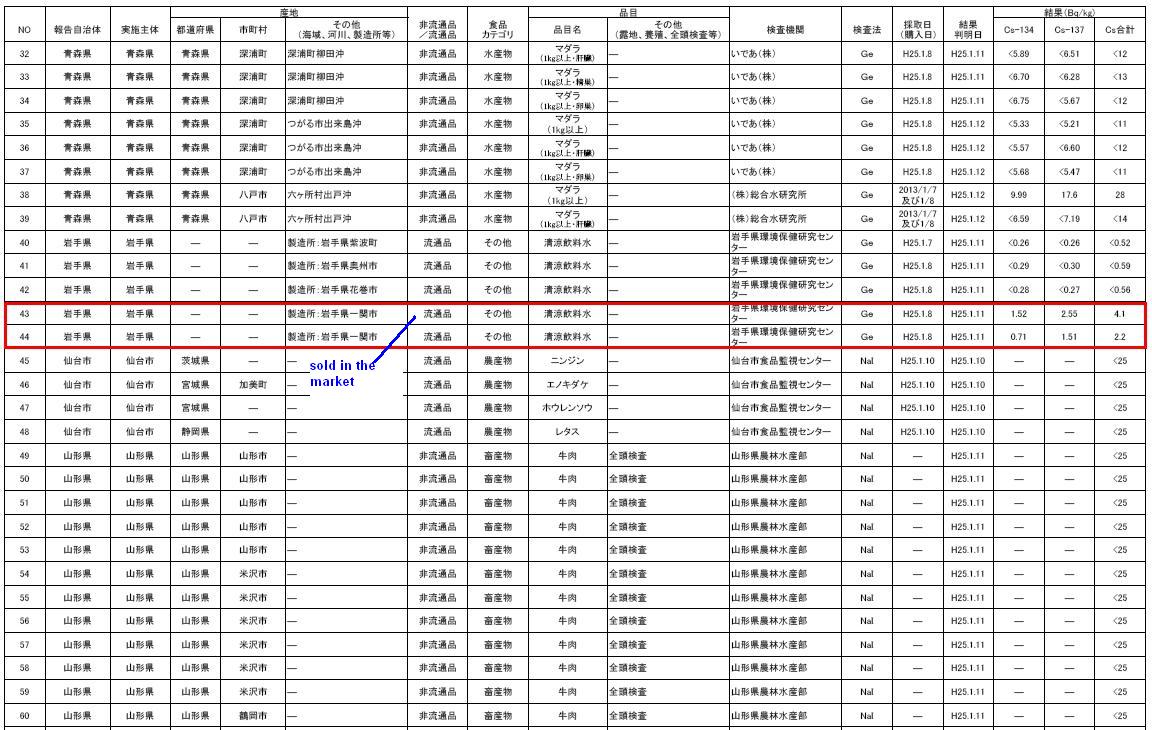
Radioactive Japan: “Soft Drink” from Iwate Prefecture Tested With 4.1 Bq/kg of Radioactive Cesium
17 Jan 2013
EXSKF
(UPDATE) It turned out to be apple juice. Someone called the agency in Iwate who did the testing and asked. Why didn’t they just say it upfront, that it was apple juice? That agency will probably be scolded by the Iwate prefectural government for sharing the information.
People have been freaking out on their own speculation that radioactive cesium must have been from the water itself.
===============================
No details other than it was “soft drink” bottled in Ichinoseki City in Iwate Prefecture, whose contamination had been initially denied by the city officials in the early days of the nuclear accident. It could be juice, it could be plain water. I can’t find information on the Iwaki Prefecture’s website.
One bottle tested had 4.1 Bq/kg of radioactive cesium, the other had 2.2 Bq/kg. The national safety standard for radioactive cesium is 10 Bq/kg.
In pre-Fukushima Japan, the level of radioactive cesium (Cs-137) in tap water in Iwate Prefecture was ND (not detected), according to the database by Japan Chemical Analysis Center.
Ministry of Health and Welfare’s data on January 15, 2013 says these bottles of soft drink were sampled from those sold in retail stores:
Video: “Going from bad to worse, day by day” at Fukushima plant — “The situation don’t improve at all”
http://enenews.com/video-going-bad-worse-day-day-fukushima-plant-situation-dont-improve-all
Published: January 17th, 2013 at 5:41 pm ET
By ENENews
Title: Statement von Izumi Yamaguchi zur Fukushima-Diskussion am 18.01.2013 in Düsseldorf-Bilk
Source: grueneddorf
Date Uploaded: Jan 17, 2013
At :45 in
Izumi Yamaguchi, from Tokyo, Japan: It will be 2 years since the accidentof Tepco Fukushima nuclear power plant No. 1 soon.
However, the situation don’t improve at all, rather are going from bad to worse, day by day.
This unprecedented serious circumstance, of course, has been bringing various serious results to Japan.
But most of Japanese people are indifferent to crisis of their lives.
They put themselves under one kind of self anesthesia. As if there were no nuclear power plant accident, no radio activities. […]
1 This Month

of the week – Shut Down Drone Warfare!


Tell the Ukrainian Government to Drop Prosecution of Peace Activist Yurii Sheliazhenko

Petition to revoke the licensing of the Near Surface Nuclear Disposal Facility (NSDF) at Chalk River. https://www.ourcommons.ca/petitions/en/Petition/Details?Petition=e-7247
To see nuclear-related stories in greater depth and intensity – go to https://nuclearinformation.wordpress.com
-
Archives
- April 2026 (103)
- March 2026 (251)
- February 2026 (268)
- January 2026 (308)
- December 2025 (358)
- November 2025 (359)
- October 2025 (376)
- September 2025 (257)
- August 2025 (319)
- July 2025 (230)
- June 2025 (348)
- May 2025 (261)
-
Categories
- 1
- 1 NUCLEAR ISSUES
- business and costs
- climate change
- culture and arts
- ENERGY
- environment
- health
- history
- indigenous issues
- Legal
- marketing of nuclear
- media
- opposition to nuclear
- PERSONAL STORIES
- politics
- politics international
- Religion and ethics
- safety
- secrets,lies and civil liberties
- spinbuster
- technology
- Uranium
- wastes
- weapons and war
- Women
- 2 WORLD
- ACTION
- AFRICA
- Atrocities
- AUSTRALIA
- Christina's notes
- Christina's themes
- culture and arts
- Events
- Fuk 2022
- Fuk 2023
- Fukushima 2017
- Fukushima 2018
- fukushima 2019
- Fukushima 2020
- Fukushima 2021
- general
- global warming
- Humour (God we need it)
- Nuclear
- RARE EARTHS
- Reference
- resources – print
- Resources -audiovicual
- Weekly Newsletter
- World
- World Nuclear
- YouTube
-
RSS
Entries RSS
Comments RSS
 nuclear-news