Sandy Hook’s real bond to Columbine, Big Pharma’s horrific studies laid bare for the first time and a peek into the village of eternity.
Seek truth from facts with psych med victims, the man who unearthed the industry’s deadly find, Irving Kirsch, US government whistleblower Allen Jones, the world’s top happiness Professor Andrew Oswald, and Tracey Lawson, author of A Year in the Village of Eternity. And Micheal Moore.
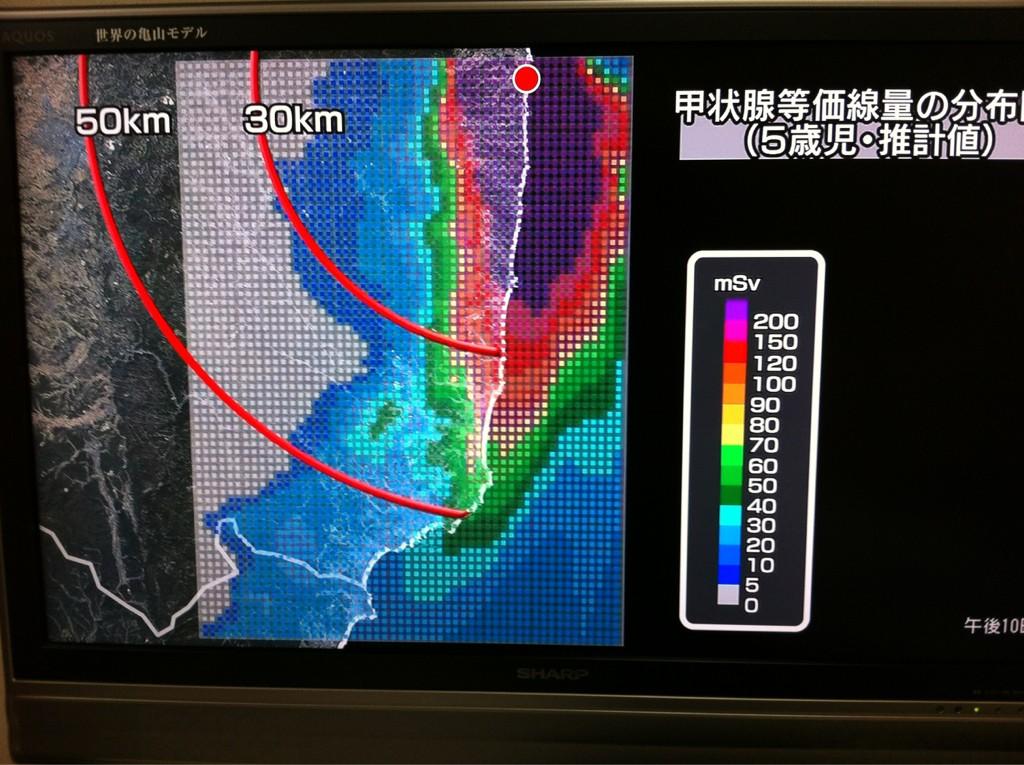
For some unknown reason, NHK decided to air a documentary on iodine-131 dispersion in the days right after the start of the Fukushima I Nuclear Power Plant accident in March 2011. In it, there was a simulation map created by researchers who carefully pieced together information without the government funding. It was a map of estimated thyroid dose equivalent exposure of I-131 for 5-year-olds.
The highest exposure is shown at above 200 millisieverts (thyroid dose equivalent for 5-year-olds).
This is the first map I’ve ever seen that has been made by the Japanese, plotting the thyroid dose.
What’s interesting is why the dispersion of iodine-131 is still an estimate and simulation. As NHK tells it, the government ministry in charge of measuring radiation, Ministry of Education, actively intervened and prohibited the officials or researchers from doing the actual measurement of radioactive iodine in the air from March 14 to March 17, 2011.
WHY? Because the explosion of the Reactor 3 building at Fukushima I Nuclear Power Plant would endanger the officials doing the measurement outdoors. The officials dutifully followed the order. They chose not to collect probably the most critical data of the accident, and they didn’t bother to tell the residents either, who were out and about with no information.
That’s if you can believe NHK.
I wonder why they created the above map as dose equivalent for 5-year-olds, instead of 1-year-olds, like France’s IRSN did. My guess is that the numbers would then be too high for viewers’ comfort.
NHK’s documentary (in Japanese) can be still seen here (part 1) and here (part 2), until NHK notices and takes them down.
[…] The recent situation in Soma city*..a child had acute leukemia, a man in 30s died, 5 people died of acute leukemia last year. This kind of information is concealed
*As of 2011, the city has an estimated population of 36,891 […] Sōma is about 45 kilometres (28 miles) north of Fukushima Daiichi Nuclear Power Plant –Wikipedia
[…] In his turn lawyer Toshio Yanagihara spoke about the “Fukushima Collective Evacuation Trial.” Through this class action suit on behalf of 14 children, the plaintiffs hope to force the authorities to recognize the legal right of hundreds of thousands of children to be evacuated from the contaminated areas. The fact that children are obliged to eat contaminated food and breathe radioactive air is a violation of the rights of the child. The press is gagged or gives false information provided by the government, which is a violation of the right to freedom of expression and information. […]
“…Aaron’s death is not simply a personal tragedy. It is the product of a criminal justice system rife with intimidation and prosecutorial overreach. Decisions made by officials in the Massachusetts U.S. Attorney’s office and at MIT contributed to his death. The US Attorney’s office pursued an exceptionally harsh array of charges, carrying potentially over 30 years in prison, to punish an alleged crime that had no victims. Meanwhile, unlike JSTOR, MIT refused to stand up for Aaron and its own community’s most cherished principles…”
Photo by Jacob Applebaum
Aaron Swartz /u/Aaronsw (1986 – 2013)
We at reddit were saddened by the news of Aaron’s passing. Here is a statement from his family. Our thoughts and deepest condolences are with his family and loved ones.
If you feel so moved, join us in donating to Demand Progress or GiveWell in Aaron’s memory so that his work for civil liberties, civil rights, and government reform can continue.
Official Statement from the family and partner of Aaron SwartzOur beloved brother, son, friend, and partner Aaron Swartz hanged himself on Friday in his Brooklyn apartment. We are in shock, and have not yet come to terms with his passing.Aaron’s insatiable curiosity, creativity, and brilliance; his reflexive empathy and capacity for selfless, boundless love; his refusal to accept injustice as inevitable—these gifts made the world, and our lives, far brighter. We’re grateful for our time with him, to those who loved him and stood with him, and to all of those who continue his work for a better world.
Aaron’s commitment to social justice was profound, and defined his life. He was instrumental to the defeat of an Internet censorship bill; he fought for a more democratic, open, and accountable political system; and he helped to create, build, and preserve a dizzying range of scholarly projects that extended the scope and accessibility of human knowledge. He used his prodigious skills as a programmer and technologist not to enrich himself but to make the Internet and the world a fairer, better place. His deeply humane writing touched minds and hearts across generations and continents. He earned the friendship of thousands and the respect and support of millions more.
Aaron’s death is not simply a personal tragedy. It is the product of a criminal justice system rife with intimidation and prosecutorial overreach. Decisions made by officials in the Massachusetts U.S. Attorney’s office and at MIT contributed to his death. The US Attorney’s office pursued an exceptionally harsh array of charges, carrying potentially over 30 years in prison, to punish an alleged crime that had no victims. Meanwhile, unlike JSTOR, MIT refused to stand up for Aaron and its own community’s most cherished principles.
Today, we grieve for the extraordinary and irreplaceable man that we have lost.
_____
Aaron is survived by his parents Robert and Susan Swartz, his younger brothers Noah and Ben, and his partner Taren Stinebrickner-Kauffman.
Aaron’s funeral will be held on Tuesday, January 15 at Central Avenue Synagogue, 874 Central Avenue, Highland Park, Illinois 60035. Further details, including the specific time, will be posted at http://rememberaaronsw.com, along with announcements aboutmemorial services to be held in other cities in coming weeks.
Remembrances of Aaron, as well as donations in his memory, can be submitted at http://rememberaaronsw.com
Donating through this page funds our general operations, not any specific candidate or campaign. You can donate by sending a check to:
Demand Progress
307 Allison St NW,
Washington DC 20011-7307
First they came for the Socialists, and I did not speak out–
Because I was not a Socialist.
Then they came for the Trade Unionists, and I did not speak out– Because I was not a Trade Unionist.
Then they came for the Jews, and I did not speak out– Because I was not a Jew.
Then they came for me–and there was no one left to speak for me.
Martin Niemöller (1892-1984)
Legal firm Ashurst threatening Australian nuclear/uranium critic
Among other things, the Ashurst letter accused the anti-nuclear campaigner of imputing that Mr Walker was ‘’insensitive’’.
In any case, these kinds of threats to muzzle free speech are on the rise. At a time when the mainstream media is under pressure from falling revenues, lawyers are threatening and shutting down websites around the country at an alarming clip.
“…Paladin chief executive John Borshoff said he was unaware of the
letter. “I’m not aware about a 75-year old lady,” said Borshoff, “All
I know is that these NGOs (Non-Government Organisations) and they are
absolutely maligning us, and we sent them legal letters”….”
Posted on January 11, 2013 at 7:07 pm by Associated Press
ALBANY, N.Y. — As Gov. Andrew Cuomo’s administration nears completion of regulations that could lift a 4 1/2-year-old ban on shale gas drilling in New York, opposition groups have ramped up efforts to persuade the governor to say no to fracking.
Environmental, health and community groups opposed to shale gas drilling and hydraulic fracturing, or “fracking,” say they collected more than 200,000 comments during an intense 30-day effort featuring online coaching and comment-writing workshops at churches, community centers, food co-ops, coffee shops and holiday house parties from New York City to Buffalo. They gave cases of comments to regulators on Friday, the last day to comment on proposed drilling rules.
Adding star power to the opposition were Yoko Ono and her son, Sean Lennon, who urged Cuomo to reject fracking.
Industry representatives were also delivering comments to the Department of Environmental Conservation, arguing that the proposed rules are so strict they’ll effectively prevent drilling in New York’s part of the Marcellus Shale formation.
DEC must read and respond to the comments. The agency received 66,000 comments during a four-month comment period on the earlier version of the regulations and the 1,500-page environmental impact study, and took most of 2012 to read, categorize and respond to them.
DEC has a deadline of the end of February to finalize the regulations. Otherwise it has to draft new regulations and hold additional hearings, potentially adding months onto the process.
“…These individual developments are troubling. But they cannot be understood in isolation from the larger multipolar system of major powers that is forming. To a great extent, this is a nuclear multipolar system: possessing nuclear weapons contributes to a country’s global status as a major power…”
January 13, 2013
The Nation – Pakistan
PAUL BRACKEN – North Korea’s launch of a long-range missile in mid-December was followed by a flurry of global condemnation that was almost comical in its predictability and impotence. But the launch underscored a larger reality that can no longer be ignored: the world has entered a second nuclear age. The atomic bomb has returned for a second act, a post-Cold War encore. This larger pattern needs to be understood if it is to be managed.
The contours of the second nuclear age are still taking shape. But the next few years will be especially perilous, because newness itself creates dangers as rules and red lines are redefined. This took at least ten years in the first nuclear age, and this time may be no different.
In the Middle East, South Asia, and East Asia, old rivalries now unfold in a nuclear context. This has already changed military postures across the Middle East. Part of the Israeli nuclear arsenal is being shifted to sea, with atomic warheads on diesel submarines, to prevent their being targeted in a surprise attack. Israel also is launching a new generation of satellites to provide early warning of other countries’ preparations for missile strikes. If Iran’s mobile missiles disperse, Israel wants to know about it immediately.
Thus, the old problem of Arab-Israeli peace is now seen in the new context of an Iranian nuclear threat. The two problems are linked. How would Israel respond to rocket attacks from Gaza, Lebanon, or Egypt if it simultaneously faced the threat of nuclear attack by Iran? What would the United States and Israel do if Iran carried its threat to the point of evacuating its cities, or placing missiles in its own cities to ensure that any attack on them would cause massive collateral damage?
Pakistan has doubled the size of its nuclear arsenal in the last five years. Its armed forces are set to field new tactical nuclear weapons – short-range battlefield weapons. India has deployed a nuclear triad – bombers, missiles, and submarines – and in 2012 tested an intercontinental ballistic missile, giving it the ability to hit Beijing and Shanghai. India almost certainly has a multiple warhead (known as a MIRV), in development, and has also launched satellites to aid its targeting of Pakistan’s forces. In East Asia, North Korea has gone nuclear and is set to add a whole new class of uranium bombs to its arsenal. It has rehearsed quick missile salvos, showing that it could launch attacks on South Korea and Japan before any counter-strike could be landed.
“…Group net profits shot up because there were no costs from generating power as all three of its reactors were idled….”
January 11, 2013
By SHIN MATSUURA / Staff Writer
The Asahi Shimbun
Japan Atomic Power Co. Posted record net profits for the first half of the current fiscal year, despite all of its reactors being taken offline following the 2011 Fukushima nuclear disaster.
The company, which supplies five regional electric utilities with power generated at its nuclear power plants, logged 20.9 billion yen ($ 238 million) in consolidated net profits in the April-September period in 2012, according to its half-year financial report submitted late last year to a regional office of the Finance Ministry.
It was able to post a profit despite generating no electricity because it was paid a combined 76 billion yen in “basic fees” by Tokyo Electric Power Co., Which owns the crippled Fukushima No. 1 nuclear plant, Kansai Electric Power Co. And three other utilities.
The unlisted Japan Atomic Power receives these basic fees based on its contracts with the utilities. The company says its contracts are renewed every year and that it receives the payments even if it supplies no electricity to them.
According to the report, the company logged 76.2 billion yen in group sales, a year-on-year drop of 10 percent. Most of those revenues came from basic fees paid by the utilities.
Group net profits shot up because there were no costs from generating power as all three of its reactors were idled.
The company is expected to set a record in the current fiscal year ending in March if it does not suffer any major losses, surpassing its highest full-year group net profits of about 3.2 billion yen in fiscal 2008.
But posting profits without supplying power could rouse public ire because utilities pass these fees on to their customers.
The utilities include basic fees, along with other expenses to generate and transmit electricity, such as fuel and payroll costs, when they calculate electricity rates for general households.
Japan Atomic Power defended its receipt of basic fees, however, saying it is based on its contracts.
SEOUL: A North Korean official has apparently told Chinese authorities that the communist state is planning to conduct a third nuclear test in the coming week, a news report said on Saturday.
“We’ve heard a North Korean official in Beijingtold the Chinese side that the North planned to carry out a nuclear test between January 13-20 ,” the Joongang Ilbo daily quoted an unidentified Seoul official as saying. South Korean officialshave a policy of not commenting on intelligence matters.
“We’re now stepping up surveillance over the Punggye-ri nuclear test site,” the official said in reference to the North’s only nuclear test site, where tests were carried out in 2006 and 2009.
With the UN Security Council still debating possible sanctions against the North following the launch of a long-range rocket last month, there has been widespread speculation that Pyongyang may carry out a third nuclear test.
However, Yang Moo-Jin of the University of North Korean Studies in Seoul said there were “no signs of a nuclear test being imminent” . “Chances are slim that the North might push ahead with a nuclear test in this winter season,” Yang said
“…”We have set a terrible precedent for the rest of the nation and for any town in the world where nuclear plants are located,” said Katsutaka Idokawa, the mayor of Futaba, one of two towns straddled by the devastated Fukushima facility. “I see this disaster as a meltdown of Japan itself.”…” (Quote from AP article below.)
Lives Slipped Away
The 50 Patients of Futaba Hospital
In the three days after the nuclear accident, more than 200 bed-ridden elderly people were stranded at the Futaba Hospital and attached old people’s home in the town of Okuma, Fukushima Prefecture, and 50 died during the exhausting evacuation operation. Those 50 deaths have shocked hospital and care home operators across the country and posed hard new questions for Japan as a land of frequent natural disasters.
Air date 1/11/2013
How much support can medical staff provide when they become victims of disaster?
“We medical workers can’t help more patients if we don’t survive. First and foremost, our own survival is critical”.
AP Enterprise: Nuke evacuation fatal for old, sick
Saturday – 3/10/2012, 6:58am ET
By ERIC TALMADGE and MARI YAMAGUCHI
Associated Press
MINAMI-SOMA, Japan (AP) – The doctors and nurses at Futaba Hospital pleaded for help as a radioactive plume wafted over their hospital. They had been ordered out but had no vehicles to evacuate the hundreds of patients in their care. After two days of waiting in the cold with no electricity, help finally came.
Nearly two dozen patients died in the chaotic, daylong odyssey that followed.
Japan’s government says only one person, an overworked employee at the Fukushima Dai-ichi nuclear power plant, died as a result of the worst nuclear disaster since Chernobyl. But one year later, details from a new report and interviews with local authorities show many more perished because of bad planning and miscommunication between government agencies.
In fact, if the calamities that unfolded on March 11, 2011, were to be repeated today, hundreds of thousands of lives would still be at risk, according to mayors, hospital administrators and disaster response officials interviewed by The Associated Press. They say little has been done to fix systemic planning shortfalls and communication problems between government agencies that compounded that day’s horrors.
“We have set a terrible precedent for the rest of the nation and for any town in the world where nuclear plants are located,” said Katsutaka Idokawa, the mayor of Futaba, one of two towns straddled by the devastated Fukushima facility. “I see this disaster as a meltdown of Japan itself.”
For readers in the US who were born before 1971, there is an online calculator available from the National Cancer Institute to assess your radioactive iodine (I-131) exposure (thyroid dose equivalent) from nuclear tests in Nevada:
State and county level exposures in an interactive map (which wasn’t working when I checked), here. The maximum exposure was 16 rad (thyroid dose equivalent), which is 160 milligray which is 160 millisieverts. That is rather high.
I got the links to the site from a tweet by a young nuclear researcher in Japan I follow on Twitter. He said in a later tweet, “It would have been very nice if Fukushima Prefecture’s system to estimate the radiation exposure had been available for the residents to run the calculation like this.” I can’t agree with him more.
Instead in Japan, the National Institute of Radiological Sciences (NIRS), a government agency, built a proprietary system based on the questionnaires from the Fukushima residents (low response rate), and came up with model cases. (For details, see this PDF, in Japanese.) I don’t think the residents who submitted the questionnaires have received any individualized estimate, but I could be wrong.
In nuclear testing in Nevada by the US government, soldiers were made to watch without any shielding.
The US Department of Defense has a website to assist ex-soldiers file a claim if they think they were exposed to ionizing radiation.
A video which explains the Ecology and Geology of Ennerdale, part of the Lake District National park (UK), and the impact of siting a Radioactive Nuclear Waste Facility on the Environment.
“…the First Nations community believes that the Canadian government has the duty to consult with the indigenous people of the country based on the treaties and agreements….”
Myka Burning in interview with Press TV
Sat Jan 12, 2013 7:20PM GMT
An activist says the government of the Canadian Prime Minister Stephen Harper has only created the illusion of collaborating with the First Nations community, Press TVreports.
“I think they are just sort of trying to appease people, you know, like giving the illusions of actually having that consultation going on but not actually committing to it,” Myka Burning said in an interview with Press TV on Saturday.
Referring to the protests staged by the Idle No More movement, Burning noted that the demonstrators will continue until they can achieve their demands.
“The protests when it comes to Idle No More itself…will continue until Harper brings back that collaboration with First Nations people which he has supposed to be doing, which he has been failing to do. That is one of the main objectives of Idle No More – it has to get that dialogue back on the table,” she further explained.
The Idle No More, a movement of the First Nations in Canada, has been holding protests since November 2012.
On January 3, National Chief of the Assembly of First Nations Shawn Atleo called on Harper to meet with the aboriginal leaders over their concerns.
Canadian aboriginals have also held demonstrations since the government approved Bill C-45, which seeks to change the rules about aboriginal land. The protests intensified after Chief of Attawapiskat First Nation in Northern Ontario Theresa Spence went on a hunger strike on December 11, 2012, demanding a meeting with Harper.



 “We’ve heard a North Korean official in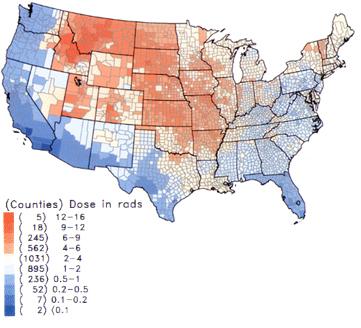





 nuclear-news