Farmer plows own antiradiation furrow .. No checks for Strontium 90? – What happens to the radioactive waste product?
“.. Only 0.6% of the total Sr was found in polished rice, while more than 99% was found in the non-edible components, of which 87% was present in the straw. These findings suggest that 90Sr in the non-edible parts could have been transferred to humans through the soil-plant system and/or feed-livestock pathway. The soil-to-plant transfer factor of 90Sr in polished rice was 0.0021 +/- 0.00007, which was two orders of magnitude lower than that in the straw…”
By TOMOKO OTAKE
Staff writer
October 14, 2012
At the end of March 2011, a few weeks after the Great East Japan Earthquake, 20 rice farmers affiliated to J-Rap, an agricultural distribution company in Sukagawa, central Fukushima Prefecture, got together to assess the situation.
 |
| Breaking new ground: Toshihiko Ito, head of the Sukagawa, Fukushima Prefecture-based agricultural company J-Rap, stands by one of its paddies where his innovative techniques appear to be succeeding in greatly reducing radiation in the rice. TOMOKO OTAKE |
With no one seeming to have much idea what was really happening or what to expect next, the atmosphere was overwhelmingly gloomy, and many farmers were in despair over the prospects for producing any rice that year.
Heading up their concerns was the then unknown amount of radioactive material that had been and was still being released following explosions and three reactor meltdowns at the Fukushima No. 1 nuclear power plant. Though winds had no doubt dispersed the contamination across massive swaths of eastern Japan, it seemed only logical to the farmers that their fields just 50 km southwest of the plant would have received a hefty dose — though back then, none of them had heard of iodine-131, cesium-134, cesium-137, microsieverts, becquerels or any of the radiation terminology they would soon grapple with.
But it wasn’t just radiation they had to worry about, because the magnitude 9 earthquake on March 11 had damaged the area’s irrigation systems, and many of them feared water supplies to their paddy fields would not be restored in time for the seedling planting season starting in May.
“Everyone was looking downcast,” Toshihiko Ito, head of J-Rap, said of that first meeting at the company’s Sukagawa base. In addition to 20 members present then, J-Rap also has 50 full-time farmers and 180 part-time farmers as members of the group, which specializes in no- or low-pesticide farming and whose members share agricultural equipment, a milling factory and a distribution network.
Rice planting to resume in Fukushima Prefecture
“Which governmental agency is doing the tests (..of the produce)?”
“It is not the government, it is unfortunate that the government is not wiling to test all the products in Japan. The testing started as a voluntry move by the farmers…”
So, if the farmer volunteers information that is incorrect the goverment will allow that product to be sold?
“yes, if it is declared under the government limits..”
Rice planting to resume in Fukushima Prefecture
The Yomiuri Shimbun

The town government of Hirono and the village government of Kawauchi in Fukushima Prefecture have decided to resume planting rice next year.
[…]
On Tuesday, the Hirono town government decided to resume rice planting in all areas, and the Kawauchi village government decided to plant rice in areas other than that formerly designated as a no-entry zone.
[….]
This month, the Hirono town government began decontaminating about 400 hectares of farmland by using such techniques as a process called sparging in conjunction with the mineral zeolite, which can absorb radioactive substances.
[…]
“If I can grow rice, the town will be revitalized even if only a little,” he said. “Some of the residents will return.”
[…]
This year, Ryohei Niitsuma, 53, planted rice despite the town government’s request to refrain from doing so.
But after he sent letters to about 100 individual customers, only five or six replied that they would buy the rice.
“It’s painful for me that the rice I produced through hard work doesn’t sell,” he said. “But unless I continue production, this town will decline.”
“Low Carbon” – UK government’s excuse for sneaking in nuclear subsidy
 EDF Nuclear Plan Gets Boost From U.K. Low Carbon Funds Bloomberg, By Sally Bakewell – Nov 23, 2012 The U.K.’s plan to collect 7.6 billion pounds ($12 billion) for low-carbon projects by 2020 would advance Electricite de France SA’s nuclear plants and add about a third to consumer electricity bills, analysts said.
The sum, announced today by the Department of Energy and Climate Change, will help pay for the 1.1 billion pounds of support a year needed to build two European Pressurized Reactors made by Areva SA (AREVA) for use at EDF sites in England, as well as renewable plants, according to Credit Suisse Group AG……..
Credit Suisse said Davey’s announcement was of particular importance for EDF Energy and Centrica Plc (CNA), which sought the arrangements.
A spokesman for SSE said, “We are pleased to see that the Levy Control Framework means that the U.K. will be building new power stations, including nuclear and renewables.”
hard questions to UK govt about its subsidies for nuclear power
 Questions over costs of nuclear http://www.scotsman.com/scotland-on-sunday/opinion/letters/questions-over-costs-of-nuclear-1-2658510 Richard Thomson, Ellon 25 November 2012 IF STUART Campbell is correct in his assertion that nuclear power stations in the UK have succeeded in paying their way without subsidy (Letters, 11 November), perhaps he could explain why it was necessary for the UK Government to nationalise a near-bankrupt British Energy, before selling it to EDF for just £12.5 billion without passing on any responsibility for future decommissioning of current sites to the new
owners?
That, however, is in the past. If it’s going to be different in the future, perhaps Mr Campbell could explain why EDF wants a guaranteed minimum electricity price for nuclear of £140 per MW/h – well in excess of what it costs to generate from fossil fuels and most renewables, whether in receipt of subsidy or not?
Kudankulam nuclear waste now a political issue in India
 “The people of Karnataka and the ruling BJP will not allow dumping of spent fuel from Kudankulam nuclear power plant in deep mines of KGF, as proposed by the Centre.”
 BJP opposes nuclear waste dump at KGF The Pioneer, 25 NOVEMBER 2012 KESTUR VASUKI | BANGALORE The submission by the Nuclear Power Corporation of India Limited (NPCIL) to the Supreme Court to bury the spent fuel from Kudankulam nuclear power plant in Tamil Nadu at the now defunct Kolar Gold Fields (KGF), has become a major political issue. Continue reading
Understandably, Japan doesn’t like India’s Nuclear Liability Law
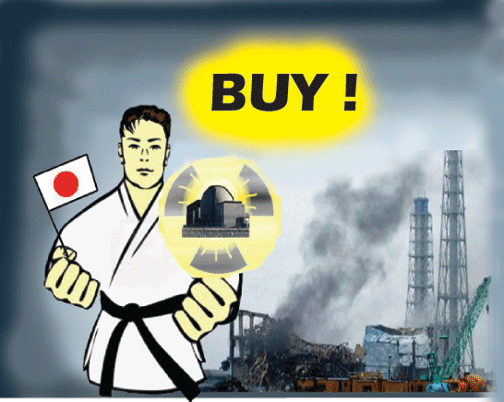 Japan also sought some clarifications about India’s nuclear liability law that prevents suppliers from making themselves immune to compensation claims in the event of an accident.
PM revives nuclear energy talks with Japan By Sachin Parashar, TNN | Nov 26, 2012 NEW DELHI: PM Manmohan Singh sought to revive with Japan negotiations for peaceful use of nuclear energy, which has remained stalled since the Fukushima nuclear accident in March, 2011, in a meeting with his counterpart Yoshihiko Noda in Phnom Penh last week.
Sources said Singh expressed hope before Noda that Japan would soon share its nuclear technology and expertise with India. Continue reading
England’s Prince Charles warns on the planet’s environmental crisis
Mankind must go green or die, says Prince Charles Environmental damage left unchecked would be ‘suicide on a grand scale’, Prince warns The independent, JONATHAN BROWN 23 NOVEMBER 2012 The Prince of Wales has warned that mankind is on the brink of “committing suicide on a grand scale” unless urgent progress is made in tackling green issues such as carbon dioxide (CO2) emissions, intensive farming and resource depletion.
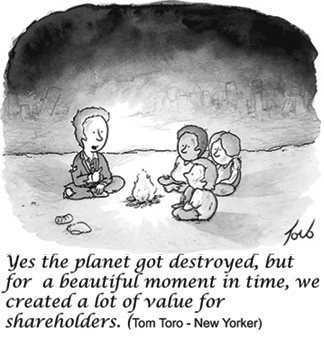
Adopting uncharacteristically apocalyptic language, the Prince said the world was heading towards a “terrifying point of no return” and that future generations faced an “unimaginable future” on a toxic planet. Continue reading
USA’s conservative think-tanks out to crush renewable energy
in the United States, the forces of greed, profit, and power are at work with no regard to the consequences of their actions.
Conservatives in U.S. trying to reverse renewable energy standards in the states, Examiner, NOVEMBER 25, 2012 BY: ROBERT BOWEN As world leaders begin discussions in Qatar Monday on an agreement to reduce carbon pollution, oil companies in the United States are out to repeal the renewable energy standards in the 29 states that have them. They are funding conservative groups to do their dirty work according to an article published Saturday in the Washington Post.
The Heartland Institute, a libertarian think tank that denies climate change science, has joined with the conservative American Legislative Exchange Council (ALEC) to write model legislation aimed at reversing state renewable energy mandates across the country. The Electricity Freedom Act, adopted by ALEC’s board of directors in October, would repeal state renewable energy standards (RES) which require utilities to get a portion of their electricity from renewable sources. ALEC and Heartland are using a tried and true tactic calling it “essentially a tax on consumers of electricity’ and bringing in “freedom.” Continue reading
USA taxpayers to pay up for Small Modular Nuclear Reactors
 “The Obama Administration continues to believe that low-carbon nuclear energy has an important role to play in America’s energy future,” DOE Secretary Steven Chu stated
Small nuclear reactors eyed for Oak Ridge site, Oakridger.com By Donna Smith/Staff Nov. 25, 2012 The former Clinch River Breeder Reactor site in Oak Ridge may become the home for four small modular nuclear reactors that could be operational by 2022. Continue reading
Amy Goodman of Democracy Now is Asked About Fukushima at Green Fest -Video

(EnviroNews California) – At a jammed packed Green Fest in San Francisco, California the likes of which we have never seen before, we were able to catch up with legendary news anchor and investigative reporter Amy Goodman of Democracy Now. Ms. Goodman was rushing to catch a flight after a signing where she was promoting her latest book “The Silenced Majority: Stories of Uprisings, Occupations, Resistance, and Hope”.
Desipte the extreme time crunch, EnviroNews California was able to ask her about one of the most critical stories of our lifetimes: The enormously disasterous and ongoing crisis at the Fukushima Daiichi power facility in Eastern Japan. Josh Cunnings Reporting.
Link to video here
The background to Germany’s leadership for a nuclear power free Europe
 As we know, in fact, nothing happened. Germany quickly adapted to the loss of the more-than-25% (but no much above that) of national power which nuclear electricity had provided
 Germany’s Energiewende And The End Of Nuclear Power, The Market Oracle Nov 25, 2012 By:Andrew_McKillop NUCLEAR SHOCK TREATMENT For Ukraine and Japan, learning to do without nuclear power needed shock treatment: the 1986 Chernobyl catastrophe, and the 2011 Fukushima disaster. The combined economic cost and losses due to these “unforeseen nuclear accidents” will probably exceed $500 billion over the years and the decades. Nuclear accidents are in a class apart, for long term damage capability.Above all, certainly since Fukushima they cannot be kept away from and out of public debate.
Like all revolutions, Germany’s Energiewende or energy transition – which took an intense new lease of life and renewed public interest following the Fukushima disaster – was set in motion by many factors. Continue reading
10,000 protest, in Kuala Lumpur, against Lynas rare earths processing plant
The rally is a culmination of a 13-day march against the plant’s opening
 Kuala Lumpur: 10,000 protest rare earth plant over health concerns Environmental activist group Himpunan Hijau organized the rally against the opening of rare earth company Lynas’ new plant. Global Post,Talia Ralph November 25, 2012 early 10,000 people took to the streets in Kuala Lumpur Sunday to protest the opening of Australia-based mining company Lynas’ new rare earth plant. Continue reading
World Health Organisation grudgingly admits that radiation raises cancer risk in children
 WHO forecasts no significant increase in cancer patients in Fukushima, Asahi Shimbun, By YURI OIWA, 25 Nov 12 “……..for children, who are deemed more susceptible to radiation exposure than adults, the increases varied sharply depending on the location.
The incidence rate for 1-year-old girls in Namie for developing thyroid cancer by the age of 16 grew 9.1 times from 0.004 percent before the accident to 0.037 percent, according to the WHO report. That means 3.7 1-year-old girls out of 10,000 living in the town will
develop thyroid cancer, compared with 0.4 girls before the accident.
For 1-year-old boys in Namie, the likelihood of developing leukemia was predicted to go up 1.8 times from 0.03 percent before the accident.
The thyroid cancer rate for 1-year-olds in Iitate, another town near the stricken nuclear plant, grew 5.9 times, while the rate in the prefectural capital of Fukushima increased 3.7 times.
The risks posed to fetuses were considered the same as those for 1-year-olds.
The report also said the chances of young people exposed to low-level radiation developing benign tumors or cysts will likely rise, and it urged continued monitoring of their health even though the tumors and cysts are unlikely to become cancerous…..
Some health experts hailed the WHO report for spelling out the health risks in numbers.
Residents in Fukushima Prefecture became skeptical of the repeated reassurances by the central government and the Fukushima prefectural government that their health would probably not be affected if their radiation exposure was 100 millisieverts or less.
Nuclear Fusion a clean alternative to Fission – not really!
Chernobyl Children Fukushima Children http://www.facebook.com/chernobylchildren.fukushimachildren 26 Nov 12 We were told the exact SAME LIES about Nuclear Fission. The exact same lies. Now it’s Fusion. A nuclear fusion power plant emits in normal operation 1000 times more radioactivity than a nuclear power plant and produces five times as much nuclear waste as a present-day nuclear fission power plant – Including the radioactive tritium beta emitter (heavy hydrogen). It mimics Hydrogen and becomes build in the DNA hydrogen bridges and causes childood leukemia. The nuclear fusion is not a “clean alternative” but a capital-intensive, centralized destructive force, based on the principle of the HYDROGEN BOMB, so the fusion is based on the fusion of radioactive Isotopes of hydrogen (deuterium and tritium) to helium, with large amounts of energy. http://www.greenpeace-aachen.de/archiv/energie/bilder/atom-kernfusion.jpg
Japanese government’s inaction on health of Fukushima’s children
 the response by Japanese politicians to the Fukushima disaster has been “ludicrously irresponsible,” not just because of their fundamental ignorance but because of their political ties with TEPCO and the nuclear industry, which tends to orchestrate a large part of the Japanese political agenda.
Unfortunately, politicians are focused on little but the mid-December national election
The Search for Action among Japan’s Ruling Classes November 14, 2012 By Akio Matsumura “,,,,, The debate right now in Japan centers not on the continuing issues with the Fukushima-Daiichi site, but whether to close down Japan’s nuclear power plants.
While politicians are focusing on national nuclear policy there are growing concerns that
the children of Fukushima require greater medical attention and assistance. After the Fukushima accident, concerns grew in the region as to whether higher rates of cancer, especially in the thyroid gland, would be found in children due to exposure to radioactive iodine. Continue reading
1 This Month

of the week – Shut Down Drone Warfare!


Tell the Ukrainian Government to Drop Prosecution of Peace Activist Yurii Sheliazhenko

Petition to revoke the licensing of the Near Surface Nuclear Disposal Facility (NSDF) at Chalk River. https://www.ourcommons.ca/petitions/en/Petition/Details?Petition=e-7247
To see nuclear-related stories in greater depth and intensity – go to https://nuclearinformation.wordpress.com
-
Archives
- March 2026 (237)
- February 2026 (268)
- January 2026 (308)
- December 2025 (358)
- November 2025 (359)
- October 2025 (376)
- September 2025 (257)
- August 2025 (319)
- July 2025 (230)
- June 2025 (348)
- May 2025 (261)
- April 2025 (305)
-
Categories
- 1
- 1 NUCLEAR ISSUES
- business and costs
- climate change
- culture and arts
- ENERGY
- environment
- health
- history
- indigenous issues
- Legal
- marketing of nuclear
- media
- opposition to nuclear
- PERSONAL STORIES
- politics
- politics international
- Religion and ethics
- safety
- secrets,lies and civil liberties
- spinbuster
- technology
- Uranium
- wastes
- weapons and war
- Women
- 2 WORLD
- ACTION
- AFRICA
- Atrocities
- AUSTRALIA
- Christina's notes
- Christina's themes
- culture and arts
- Events
- Fuk 2022
- Fuk 2023
- Fukushima 2017
- Fukushima 2018
- fukushima 2019
- Fukushima 2020
- Fukushima 2021
- general
- global warming
- Humour (God we need it)
- Nuclear
- RARE EARTHS
- Reference
- resources – print
- Resources -audiovicual
- Weekly Newsletter
- World
- World Nuclear
- YouTube
-
RSS
Entries RSS
Comments RSS
 nuclear-news