Hammerfest LNG set sails for Japan via Arctic route with 2 nuclear ice breakers

“This voyage is interesting because it shows how the shale gas has turned the gas market upside down,” says Senior Researcher Gunnar Sander. He coordinates a project aimed at studying how climate changes impact economic activity that may take place in the Arctic Ocean.
The tanker “Ob River” has loaded LNG from Statoil’s gas plant on the Barents Sea coast for the last few days. The plant, opened in 2007, was believed to ship major part of its LNG to the North American market. With commercial exploration of domestic shale gas, the US hunger for LNG disappeared. Hammerfest gas plant had to search for new markets.
Being the world’s northernmost LNG plant, its remote location could have been a disadvantage when searching for new customers. Not so for this week’s cargo. With rapid melting sea ice, Hammerfest LNG is located at the entrance gate for a possible new shipping route near the top of the globe to the energy hungry markets in Asia. The distance to Japan is nearly half via the north compared with sailing the more traditional Suez Canal route. The Northern Sea Route is estimated to save up to 20 days for the distance Hammerfest to Japan.
“Ob River” will first sail north-eastbound the Barents Sea towards Novaya Zemlya before her voyage enters the waters north of Siberia. Only a few years ago, the Arctic waters up here towards the Bering Streight were nearly impossible to sail in mid-November due to the freezing ice
“Ob River” has a capacity to carry 3.1 Bcf of gas equivalent, or 63,668 mt of LNG.
When the tanker makes port call in Japan in less than two weeks’ time, her LNG cargo is highly appreciated by energy companies. In the wake of the Fukushima disaster in March 2011, Japan is in nearly desperate need for energy sources to replace nuclear power. So far, only two reactors have been restarted after all of Japan’s plants were shut down for stress tests after Fukushima. Anti-nuclear movements have good times in Japan.
EDF’s Penly 1 nuclear reactor in unplanned outage- No cause or a restart date given?
Published: Wednesday, 7 Nov 2012 | 10:02 AM ET
PARIS, Nov 7 (Reuters) – EDF’s 1,300-MW Penly 1 nuclear reactor stopped in an unplanned outage at 1450 GMT on Wednesday, France’s power grid RTE said on its website.
RTE did not give a cause or a restart date.
(Reporting by Axelle du Crest)
http://www.cnbc.com/id/49726543
SOME HISTORY
Radioactive leak at France’s Penly plant after fires break out
A nuclear reactor at France’s Penly plant on the English Channel near Dieppe was shut down automatically after two small fires broke out causing a joint to leak radioactive water into collection tanks inside the reactor building.
Britain’s nuclear push may stall as risks mount -Reuters
“To put money into UK nuclear would be crazy,” said Dominic Nash, a utilities analysts at London-based investment bank Liberum Capital.
Energy Fair, a research group of energy economists opposed to nuclear, said in a report last month that the true cost of nuclear could even be over 200 pounds per MWh once “hidden subsidies” are taken into account.
By John McGarrity
LONDON | Wed Nov 7, 2012 3:23pm GMT
(Reuters) – Britain’s nuclear power generation future may be at risk as the list of potential operators shrinks due to concerns about the high costs of entry.
The British government wants to build around 10 nuclear power stations by 2025, which it says are necessary to keep the lights on in future decades, reduce dependence on foreign gas and meet tougher carbon targets.
But persuading potential operators to invest in nuclear generation could involve guaranteeing minimum power prices far above what cash-strapped government departments and households would be willing to pay, analysts said.
“The rewards from nuclear are likely to be far below what companies would require to justify this level of investment. The risks are enormous,” said Tom Burke, a consultant with environment and energy advisory E3G and former adviser to the British government on energy policy.
50 years of shocking neglect- the danger of UK’s Sellafield nuclear site
The plant is the UK’s largest and most hazardous nuclear site, storing enough high and intermediate level radioactive waste to fill 27 Olympic-sized swimming pools.

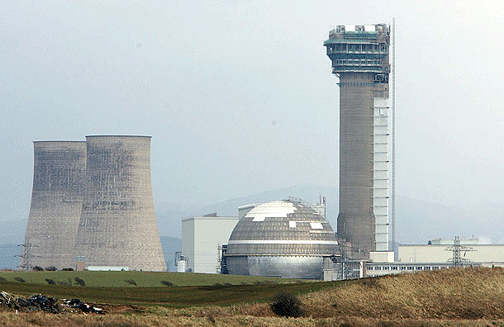 Sellafield nuclear waste storage poses ‘intolerable risk’ http://www.bbc.co.uk/news/uk-england-cumbria-20228176 7 November 2012 Sellafield is the UK’s largest and most hazardous nuclear site An “intolerable risk” is being posed by hazardous waste stored in run-down buildings at Sellafield nuclear plant, a watchdog has found.
The National Audit Office (NAO) also said that for 50 years, the operators of the Cumbria installation failed to develop a long-term plan for waste. Costs of plant-decommissioning has also spiralled out of control, it said. Operator Sellafield Ltd, said it welcomed the report’s findings and was “making improvements”. Continue reading
Britain’s ultimate phallic symbol – useless, expensive Trident nuclear missile
many defence experts now argue that a replacement deterrent is something that the UK neither needs nor can afford
the role of Britain’s nuclear deterrent is linked to the political and military establishment’s perception of the country’s place at the world’s top table “more a matter of national virility than national security”

 UK nuclear deterrent plan triggers divisions Announcement of an extra $565m for improved nuclear weapons capacity worries critics in an era of austerity. Aljazeera, Simon Hooper 06 Nov 2012 London, UK – At an unknown location somewhere deep beneath the world’s oceans, a British submarine sits primed to launch up to 40 nuclear warheads with a collective destructive power almost 300 times greater than the atomic bomb dropped on Hiroshima in 1945.
Since the late 1960s Britain’s nuclear deterrent strategy has required that at least one of the Royal Navy’s four-strong fleet of Vanguard submarines be operational and fully armed at all times, providing, according to the navy’s website, a “round-the-clock insurance policy”.
Only a British prime minister has the authority to order a nuclear attack. But, in the event that a submarine commander loses radio contact and suspects his homeland has been wiped off the map, orders contained in an onboard safe reputedly offer a choice to either “let them have it”or “sail to New Zealand if it’s still there”, according to documents unearthed by Peter Hennessy, a veteran historian of British state secrets. Continue reading
More doublespeak from UK Energy Minister about nuclear subsidies
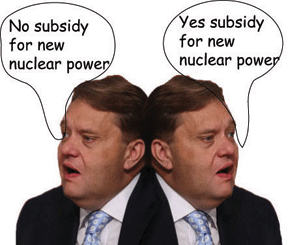 Hayes today reiterated that “there should be nothing available for nuclear that’s not available for other technologies”
(A subsidy is a subsidy is a subsidy – even if other forms of energy get one, too)
U.K. Will Reject EDF Nuclear Deal That Puts Burden on Consumers, Bloomberg By Sally Bakewell – Nov 6, 2012 The U.K. government is prepared to walk away from a deal with Electricite de France SA over plans to build the first nuclear plant in the country since the 1980s if the power price demanded by the utility is too high.
The government would “absolutely” refuse a deal that placed too great a burden on consumers, Energy Minister John Hayes said today in London . He held talks yesterday with Vincent de Rivaz, chief executive officer of EDF’s local unit.
Britain and EDF are negotiating the terms of a contract that would guarantee the price of power generated at Hinkley Point in Somerset. Continue reading
Sandy aftermath: New York City is rotting at the core
Beneath the destruction brought by superstorm Sandy lies a more insidious problem. Rising sea levels are corroding the very foundations of the Big Apple
http://www.newscientist.com/article/dn22471-sandy-aftermath-new-york-city-is-rotting-at-the-core.html subscription only
Solar truck helping to provide electricity in New York
 Rolling Sunlight Helping New York Storm Victims http://www.energymatters.com.au/index.php?main_page=news_article&article_id=3454 by Energy Matters, 7 Nov 12, Greenpeace’s solar truck is in New York, generating electricity for some of those affected by Sandy.
Hundreds of thousands of people in states hit by Sandy are still without power and it may be quite some time before electricity supply is back to normal. Adding to the misery is the cold weather and a lack of fuel.
Greenpeace has sent in Rolling Sunlight to lend a bit of a helping hand.
Built in 2001, Rolling Sunlight is a mobile power station fitted with 2.4kW of solar panels and a 50kWh deep cycle battery storage system. The truck itself is powered with biodiesel. After reaching a site, Rolling Sunlight can start cranking clean electricity within 15 minutes.
The truck has been generating power in a variety of locations, including acommunity store in Rockaway. Residents have also been able to drop by to get a much-needed charge for their mobile phones.
“We are happy to work with the community relief effort to bring solar power to New York. Today, solar power can help bring a small degree of comfort and a cell phone charge to the people left without electricity in Sandy’s wake,” said Greenpeace climate campaigner Robert Gardner.
“Tomorrow, the same solar power can help us slow down the global warming that is supercharging storms like Sandy, and prevent us from further loading the dice toward even worse extreme weather.”
In a nation where the term “climate change” is such a thorny issue that the topic was never raised during the recent series of presidential debates, attitudes are rapidly changing as a result of the storm.
While in a blackout scenario grid connected home solar power systems are also crippled as a safety measure, the Next Big Thing for solar is energy storage for residential applications; which will allow households to still generate power in such circumstances and enable people to further reduce their dependence on the mains grid.
Shortage of workers at Fukushima – TEPCO fudges the numbers
NHK – TEPCO over-reports number of Fukushima workers http://www.youtube.com/watch?feature=player_embedded&v=Voqq-DYQ48k
NHK: Concerns rising at Fukushima plant — 16,000 workers have quit, ‘severe working conditions’ blamed (VIDEO) http://enenews.com/nhk-concerns-rising-at-fukushima-plant-16000-workers-have-quit-severe-working-conditions-blamed-video
November 5th, 2012
Title: TEPCO over-reports number of Fukushima workers
Source: NHK
Date: Nov. 5, 2012
“Concerns are rising over whether Tepco has secured enough workers to decommission the Fukushima Daiichi nuclear power plant”
[…] NHK found through an interview with TEPCO officials that only 8,000 workers are registered for the job, as of last month.
Earlier, the utility said there would be no manpower shortage as it had secured about 24,000 workers.
But this figure represents the total number of people who have worked at the crippled plant since the accident on March 11 last year.
16,000 workers have already quit the job. Many of them left due to severe working conditions. […]
A new political momentum with IPCC’s fifth Climate Report
 Former UN official says climate report will shock nations into action SMH November 7, 2012 Peter Hannam “…..Yvo de Boer, the UN climate chief during the 2009 Copenhagen climate change talks, said his conversations with scientists working on the next report of the Intergovernmental Panel on Climate Change suggested the findings would be shocking….. Mr de Boer said in the only scheduled interview of his visit to Australia.
“I’m confident those scientific findings will create new political momentum.”
The IPCC’s fifth assessment report is due to be published in late 2013 and early 2014.
 Before then is the next end-of-year UN climate meeting in Doha, Qatar. Delegates will discuss a second commitment period for the Kyoto Protocol, the only legally binding accord to cut greenhouse gas emissions. Last December nations agreed in South Africa to work on a bindingagreement that would cover all countries. That work is expected to continue until 2015.
Mr de Boer, who is now special global advisor on climate change for KPMG, said the best prospect may be for nations to settle on targets that they write into their national laws, rather than a binding international deal. The latter would be “almost impossible to get through the US Senate”, he said.
http://www.smh.com.au/environment/climate-change/former-un-official-says-climate-report-will-shock-nations-into-action-20121106-28w5c.html#ixzz2BZ7D4XsR
Uranium mining – a sick industry and getting sicker
 Spot uranium price falls below $41/lb U308 on weak demand, good supply Washington (Platts)–6 Nov2012 The spot market price of uranium is now below $41/lb U3O8, according to price publishers TradeTech and Ux Consulting.
And given continued bearish sentiment in the market, some analysts are not ruling out the possibility that the spot price could fall $40/lb before the end of the year. UxC said that the price has not been $40/lb since March 2006.
TradeTech on Friday lowered its weekly spot price to $40.75/lb, down $2.25/lb from its October 26 price. Most of the decline occurred around October 31, TradeTech said, “driven by an increase in the supply” and weaker demand. “Sellers hoping to place material were faced with accepting lower prices well into the first and second quarters of 2013 to conclude transactions,” it said.
TradeTech’s daily price Monday also was $40.75/lb.
UxC on Monday cut its weekly spot price to $40.75/lb, down $1.75 from October 29. UxC said the questions now facing the market are whether the $40/lb support level will be broken and if it holds, what type of rebound in price might the market expect to see.
UxC’s broker average price on Monday was $40.69/lb, down 30 cents from Friday. The BAP bid-offer spread Monday was $40-$41.38/lb. The BAP is based on the price information from Evolution Markets and Armajaro Securities.
The Platts NuclearFuel price range for week was $39.50-$43/lb U3O8….. http://www.platts.com/RSSFeedDetailedNews/RSSFeed/ElectricPower/8889209
Westmill Solar Co-operative – the whopper community owned energy project
World’s Largest Community Owned Solar Project http://www.energymatters.com.au/index.php main_page=news_article&article_id=3455 by Energy Matters, 7 Nov 12 Last week, Westmill Solar Co-operative in the UK completed the acquisition of Westmill Solar Park, making the project the largest community-owned solar power station in the world.
The £16.5million facility is a 5MW solar farm covering 30 acres and consisting of over 20,000 solar panels. The power station is located near Watchfield, on the Wiltshire/Oxfordshire border.
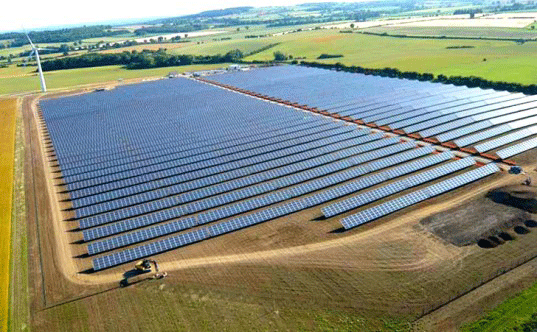
Westmill Wind Farm is adjacent to the site, which was also started as a 100% community owned renewable energy project.
In the last year, the solar farm has generated 4,900 MWh of clean electricity, enough to power 1,500 households and avoiding over 2,000 tonnes of carbon dioxide emissions.
“Westmill represents the best of what low carbon investment and renewable energy can offer and hopefully will inspire others to realise that when we get together we can make change happen and can engage positively with the threat of climate change,” said founder director Adam Twine.
The Westmill Solar Co-operative share offer attracted around 1650 investors in just 6 weeks- 50% more than was required. More than half of the Westmill members live within 40km of the project. Members will be entitled to a share in the profits generated by the electricity sold. Predicted internal rate of return to members is 9 – 11% over the 24 years of the project.
Aside from the environmental benefits and in addition to offering local residents a substantial return on their investment, the solar farm will boost the local economy by making sure the profits stay in the area, encourage tourism and raise the local area’s profile.
“Solar power will become the world’s greatest energy source in our lifetime; heralding a new era of sustainable and ‘democratic’ energy supply,” said Cooperative chairman Philip Wolfe.
“As the success of Westmill shows, solar energy enables ordinary people to produce clean power, not only on their roof tops, but also at utility scale.”
Community owned windfarms could be good for UK
 Windfarms: is community ownership the way ahead? http://www.guardian.co.uk/environment/2012/nov/05/windfarms-community-ownership
On the Danish island of Samsø many of the wind turbines are owned by the residents. Is that the way around nimbyism? Patrick Kingsley guardian.co.uk, 5 November 2012 “I can’t single-handedly build a new Jerusalem,” said John Hayes, the Tory energy minister, last week, “but I can protect our green and pleasant land.” What was he on about? Windfarms. He wants them stopped because he says locals don’t like them.
But that isn’t always the case. Take Samsø, a pretty island off the coast of Denmark. In the late 90s, Samsø’s 4,000 elderly farmers were famous for their early crop of new potatoes. Smothering their isolated Eden with windmills was far from a priority.
Yet 15 years later, that is exactly what’s happened. These conservative islanders have installed 11 onshore windmills, while another 10 lie just off the coast. Astonishingly, Samsø is now one of the world’s largest carbon-neutral settlements. To find how it happened, I visited the island this spring while researching my new book, How to be Danish. The answer? Community ownership. Sixteen of the 21 new turbines are owned either by local co-operatives, or by individual farmers. This means that the turbines haven’t been sprung on the locals. Instead, the latter are invested in the former, both emotionally and financially. The excess energy created by the turbines is sold back to the national grid – and the profit creates a handy annual dividend for each local. “There’s money in it,” smiles 66-year-old Erik Andersen, who owns a herd of rare Red Danish cows. “It’s a good investment.”
So wind power doesn’t always alienate locals. Denmark has over 6,000 turbines – 2,000 more than Britain, despite being a sixth of the size. This is partly down to its topography: it’s flat, so there’s a lot of wind. But it’s also to do with how the Danes involve local communities. Around 70-80% of those turbines are co-owned by local groups – little wonder there’s more of them.
Could it happen in Britain? An ICM poll suggests so: while only one in two Britons would back a windmill within two miles of their home, 68% would support one that was community-owned. John Hayes, take note.
The insidious climate change danger – acidification of sea, land and air
Earth on Acid: The Present & Future of Global Acidification http://www.geosociety.org/news/pr/12-89.htm GSA Annual Meeting & Exposition, Charlotte, North Carolina, USA, 4–7 November 2012 Boulder, CO, USA – Climate change and extreme weather events grab the headlines, but there is another, lesser known, global change underway on land, in the seas, and in the air: acidification.
It turns out that combustion of fossil fuels, smelting of ores, mining of coal and metal ores, and application of nitrogen fertilizer to soils are all driving down the pH of the air, water, and the soil at rates far faster than Earth’s natural systems can buffer, posing threats to both land and sea life. Continue reading
Nine Mile Point nuclear reactor remains shut
TV: Problem during reactor restart process at New York nuclear plant damaged by Sandy http://enenews.com/tv-problem-during-reactor-restart-process-at-ny-nuclear-plant-damaged-by-sandy
November 6th, 2012
Title: Nuclear industry studies Sandy’s impact on several reactors
Source: YNN (Syracuse)
Author: Candace Hopkins
Date: 11/05/2012
As Sandy barreled towards the northeast last week, staff at several nuclear plants were on high alert.
[…]
At Nine Mile, workers prepared the plants for high winds or power outages and extra manpower was called in. Monday night, high winds took down a pole, damaging the plant’s electrical grid. Unit two was forced to switch to its backup generator. Unit one was pushed offline altogether. Because of the planning, the staff was ready for the damage.
[…]
Nine Mile Point operators say the plants will be taking extra precautions to prepare equipment for high winds. Meanwhile, three other plants were also impacted by the storm. The NRC says the good news is no major damage was done.
Nine Mile Point One remains shut down after a secondary problem during the reactor restart process. Constellation Energy says it’s likely not related to Sandy. There was no threat to the public.
1 This Month

of the week – Shut Down Drone Warfare!


Tell the Ukrainian Government to Drop Prosecution of Peace Activist Yurii Sheliazhenko

Petition to revoke the licensing of the Near Surface Nuclear Disposal Facility (NSDF) at Chalk River. https://www.ourcommons.ca/petitions/en/Petition/Details?Petition=e-7247
To see nuclear-related stories in greater depth and intensity – go to https://nuclearinformation.wordpress.com
-
Archives
- April 2026 (91)
- March 2026 (251)
- February 2026 (268)
- January 2026 (308)
- December 2025 (358)
- November 2025 (359)
- October 2025 (376)
- September 2025 (257)
- August 2025 (319)
- July 2025 (230)
- June 2025 (348)
- May 2025 (261)
-
Categories
- 1
- 1 NUCLEAR ISSUES
- business and costs
- climate change
- culture and arts
- ENERGY
- environment
- health
- history
- indigenous issues
- Legal
- marketing of nuclear
- media
- opposition to nuclear
- PERSONAL STORIES
- politics
- politics international
- Religion and ethics
- safety
- secrets,lies and civil liberties
- spinbuster
- technology
- Uranium
- wastes
- weapons and war
- Women
- 2 WORLD
- ACTION
- AFRICA
- Atrocities
- AUSTRALIA
- Christina's notes
- Christina's themes
- culture and arts
- Events
- Fuk 2022
- Fuk 2023
- Fukushima 2017
- Fukushima 2018
- fukushima 2019
- Fukushima 2020
- Fukushima 2021
- general
- global warming
- Humour (God we need it)
- Nuclear
- RARE EARTHS
- Reference
- resources – print
- Resources -audiovicual
- Weekly Newsletter
- World
- World Nuclear
- YouTube
-
RSS
Entries RSS
Comments RSS
 nuclear-news