East Kazakhstan’s 812 million tonnes of highly radioactive uranium tailings
 Josef Stalin’s nuclear legacy remains in East Kazakhstan Scotsman.com, 9 October 2012 “…..It was over 20 years after the end of atomic testing in the Polygon that the world began to take notice, but Stalin’s legacy may yet have an impact that could threaten future generations across the globe. The mining of uranium to manufacture the atomic weapons tested in the Polygon has left a staggering 812 million tonnes of highly radioactive uranium tailings (waste byproduct). They lie in dilapidated dumps in four of the five Central Asian republics, posing not just an imminent threat to the environment but a potential flashpoint for violence and conflict. Continue reading
$660 billion for USA’s nuclear arsenal

“Our estimate includes costs to maintain and modernize our existing nuclear arsenal, pay for missile defense programs, support the environmental and health costs associated with past and current nuclear weapons programs, and continue nuclear threat reduction programs.”
America’s nuclear tab nearing $660 billion, new report says http://e-ring.foreignpolicy.com/posts/2012/10/08/america s_nuclear_tab_nearing_660_billion_new_report_says By Kevin Baron –The cost of American’s nuclear arsenal is projected to reach as much as $661 billion over the next decade, a new report claims.
The report, released Oct. 7 by Ploughshares Fund, a group that advocates nuclear disarmament, says its estimate ranges from $620 billion, if defense spending stays below inflation, to as high as $661 billion if defense spending keeps pace with inflation.
A closer look at those numbers, though, shows that nuclear costing is more art than science, given factors like the secretive nature of the field, unknowable future costs in fuel or aircraft, and the budgetary whims of Congress. Continue reading
UK’s Cumbrian nuclear waste site dilemma

About 1,000 construction workers would take an estimated 15 years to complete it at a projected cost of between £12bn and £20bn.
Nuclear waste disposal: Where in Cumbria to bury it? BBC News 8 Oct 12 The need for deep underground nuclear waste storage is becoming crucial Arguments over nuclear waste disposal have been raging for decades, especially in Cumbria where the search continues for a site suitable for storing waste for tens of thousands of years.

Nuclear and scientific experts disagree about geological issues and, combined with Cumbrian public concerns at having an underground repository for nuclear waste, the dilemma continues. Continue reading
Extreme heat, police repression, nothing stops The People’s Movement Against Nuclear Energy (PMANE)
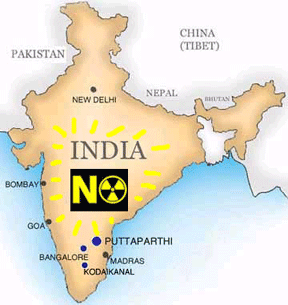 Anti-nuclear protesters lay seige to Kudankulam plant http://www.khaleejtimes.com/displayarticle.asp?xfile=data/international/2012/October/international_October252.xml§ion=international&col= 9 October 2012 The People’s Movement Against Nuclear Energy (PMANE) on Monday strengthened their 420-day agitation against Kudankulam atomic power plant in Tamil Nadu by laying siege of the plant.
Hundreds of fishermen and farmers from over 80 villages in Tirunelveli, Kanyakumari and Thoothukudi districts surrounded the sea 500 metres off the plant by placing their fibre boats and floating buoys. The protests passed off peacefully.
Defying the scorching heat, the protesters remained in the sea till evening demanding closure of the plant, 100kms from the Kerala capital of Trivandrum. The villagers also demanded withdrawal of police from the villages, release of those arrested and cancellation of false cases registered against them. Continue reading
VIDEO shows how and why Fukushima catastrophe happened
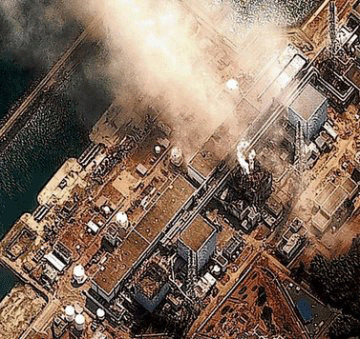
 http://www.sbs.com.au/ondemand/video/2286222852/Nuclear-Meltdown?utm_source=Search&utm_term=nuclear Nuclear Meltdown Aired – 7 October 2012 Expires in 13 Days On 11 March 2011, a magnitude 9.0 earthquake hit Japan’s northeast coast followed by a massive tsunami. The country suffered widespread devastation and in the aftermath of the disaster, four nuclear reactors in Fukushima began to disintegrate. This program details the unfolding disaster at Fukushima and reveals exactly how it happened and why.
Powerful opposition growing against nuclear waste in Saskatchewan
The Saskatchewan Aboriginal Women’s Circle Corporation of Saskatchewan also passed a resolution last year, opposing the transportation and storage of nuclear waste in Saskatchewan. The resolution was then adopted by the Native Women’s Association of Canada at its annual general assembly held in Saskatoon in August 2012.
 Stopping Nuclear Waste in its Tracks Communities, Indigenous organizations pass resolutions against transportation and storage of nuclear waste in Saskatchewan The Dominion, by SANDRA CUFFE, 8 Oct 12, Growing numbers of communities in Saskatchewan are vowing to block nuclear waste from being transported through their territory BEAUVAL, SK—Three places in northern Saskatchewan may be on the map in Canada’s search for a high-level radioactive waste dump site, but the spent nuclear fuel bundles may be stopped in their tracks.

Communities and Indigenous organizations along potential transport routes and
beyond have been passing resolutions against nuclear waste. Continue reading
The UNsafety of South Korea’s nuclear power plants

 Nuclear safety concerns growing Korea Times. Experts stress system overhaul necessary to avoid disaster By Park Si-soo, 8 Oct 12, With nuclear reactors shutting down repeatedly month after month, there is growing concern over whether the nation’s atomic power plant management system has a structural problem that could lead to disaster. Continue reading
South Korea – civil liberties disappearing, in the interests of nuclear industry
 South Korea can’t deny the risks of nuclear power forever http://www.greenpeace.org/international/en/news/Blogs/nuclear-reaction/nuclear-south-korea-risks/blog/42486/
by Jan Beranek – October 8, 2012 I am at a detention centre at South Korea’s airport, quickly writing these few words as best I can on a mobile phone. Together with my colleague, Dr. Rianne Teule, I have been denied entry to South Korea.
We have done nothing wrong. That is, unless you agree with the government in Seoul that exposing the risks of nuclear power and calling for better protection of people from radiation is wrong. Continue reading
Thorium bred Uranium-233 can be used to make atomic bombs
 Thorium Nuclear Bombs (Shorter version) Kevin Meyerson, kevinmeyerson.wordpress.com 9 Oct 12, Thorium bred Uranium-233 can be used to make atomic bombs, despite what proponents may claim.
You don’t have to trust me on this, see what the experts at various institutions have to say below:
MIT Energy Initiative, The Future of the Nuclear Fuel Cycle Continue reading
VIDEO:the full story of the Fukushima nuclear disaster
http://www.thegreatplanet.com/nuclear-nightmare-japan-in-crisis-discovery-channel-documentary/ Nuclear Nightmare: Japan in Crisis – Discovery Channel Documentary (2011) By Sandeep Sep 09, 2012 Nuclear Nightmare: Japan in Crisis – Released on April 28th 2011, this Discovery Channel documentary film is about the earthquake tsunami and subsequent nuclear disaster that struck Japan in early 2011. It is produced by David Elisko and Nanette Harrison. Paula Zahn is the narrator of this Discovery Channel documentary film. This Discovery Channel documentary film does a detailed investigation into the reasons that made the Fukushima disaster one of the worst in world history.
It was the morning of March 11, 2011 when an earthquake of a massive scale occurred on the outskirts of Fukushima beach. This earthquake had not been predicted and the resulting waves it caused were also dangerously big. The quake’s massive jolts triggered a tsunami within minutes, and before the authorities could do anything to control the situation the first of the tsunami’s waves hit shore.
The Fukushima Nuclear Plant was also built near the seashore because it is much more convenient to have water from the sea cooling the reactor’s sensitive components. In this instance, this convenience turned awry and the waves caused serious damage to the reactor. These waves topped the nuclear plant’s designed seawalls and caused flooding in the reactor basement.
Contaminations from the environment combined with loss of electricity (onboard diesel generators stopped working as a result of flooding) meant the nuclear reactor could not get adequate cooling either. This caused the nuclear reactor to overheat and danger of a meltdown was also imminent. TEPCO declared first level emergency at this time and failed attempts at stabilizing the situation led to mass evacuations.
Nuclear Nightmare: Japan in Crisis – The Discovery Channel documentary film contains never before seen footage of the situation as it was unfolding, among other things we see a news helicopter flying over the nuclear site and hundreds of workers evacuating the nuclear power plant moments before the water hit. This incident has widely been quoted as the worst nuclear disaster in history after the infamous Chernobyl disaster in 1986. Estimates show that this disaster released almost two hundred times more radiation in the environment than the nuclear bombings on Hiroshima and Nagasaki.
UK’s nuclear waste burial problems – geology and public acceptance
Criteria for site selection include relatively flat rock where groundwater moves slowly in simple formations which avoids complex, potentially leaky faultlines.

UK limits nuclear waste disposal options MENAFN – Arab News – 08/10/2012 Britain risks eroding support for nuclear power if it buries long-term waste near an existing processing facility without considering wider, potentially safer options. Continue reading
Fukushima Unit 4 crisis downplayed, to save USA embarrassment
 AUDIO with translation Former Japan Ambassador: US gov’t is main reason why crisis at Fukushima Unit 4 has been “toned down” (VIDEO) http://enenews.com/watch-govt-main-reason-crisis-fukushima-unit-4-toned-down-video
October 7th, 2012 Interview with Mitsuhei Murata, Former Japanese Ambassador to Switzerland
English-Chinese translation by Asianjijo
Published on Aug 3, 2012
h/t onesizjk
Mitsuhei Murata, Former Japanese Ambassador to Switzerland: In the US there are 31 [sic] units the same type of that of Fukushima nuclear plant. So, if the accident be spread too far that really embarrasses the US. So that is why the crisis of Unit 4 has been toned down recently. The USA is actually the main reason.
The “Fukushima Syndrome” – sick and dying cattle
Inside Evacuation Zone: Cattle sick, dying — “We call it Fukushima syndrome” — Severe diarrhea, skin problems, weakened immune systems http://enenews.com/farm-evacuation-zone-cattle-sick-dying-call-fukushima-syndrome-diarrhea-like-water-snivel-spreading-dermatitis-immune-system-being-weaken October 8th, 2012
Oct 5, 2012Recent tweets by Fukushima Farm Sanctuary (@kibounobokujyou), a farm inside the 20 kilometer evacuation zone, translated by Fukushima Diary:
4 cattle have died since yesterday. One more calf is about to die. They must be fed enough though nutrition might not be perfect. Is bad disease going around ? I’m worried about radiation too. We call it Fukushima syndrome. […]
3 died yesterday. […]
Masami Yoshizawa, RancherDiarrhea like water, snivel, spreading dermatitis, their immune system is being weaken, which is obvious even for amateur. It might be because of simply the lack of nutrition, epidemic disease, or radiation exposure. Probably it’s only in this hazard area, where series of cattle die one after one. We call it Fukushima syndrome, which was born from Tepco and the government.
A lot of calves are dying but adult cattle are dying too. Calves die regardless of the age. If it becomes winter in this situation, the number might become half or less than that.
East Kazakhstan’s horror nuclear legacy from Soviet times till now

 Josef Stalin’s nuclear legacy remains in East Kazakhstan Scotsman.com, 9 October 2012 Stalin used the area as a nuclear test site and the local population have been paying a terrible price ever since. The plight of these people in East Kazakhstan has touched the heart of Scottish MEP Struan Stevenson, who has campaigned to bring their situation to wider
recognition for 13 years. Now, in an exclusive article for
The Scotsman, he argues Stalin’s actions could have devastating consequences in the future, too Continue reading
Josef Stalin’s nuclear legacy remains in East Kazakhstan Scotsman.com, 9 October 2012 Stalin used the area as a nuclear test site and the local population have been paying a terrible price ever since. The plight of these people in East Kazakhstan has touched the heart of Scottish MEP Struan Stevenson, who has campaigned to bring their situation to wider
recognition for 13 years. Now, in an exclusive article for
The Scotsman, he argues Stalin’s actions could have devastating consequences in the future, too Continue reading
Rising danger of a nuclear disaster in UK
UK nuclear plant disaster is ‘inevitable This is Somerset, 8 Oct 12 A specialist engineer who worked at Hinkley Point nuclear power station for almost 30 years has attacked the nuclear industry’s approach to safety and predicted that a Fukushima-type disaster in the UK was
“almost inevitable”.Peter Smith’s comments were made at and after a weekend rally in Bridgwater against the proposed new Hinkley C nuclear power station……
Mr Smith, who was head of the ‘electrical instrumentation section’ at Hinkley, said: “Over the years, I became more and more aware of the dangers and dark side of nuclear power. The industry denies that it ever puts profit before safety but this is a lie. I have seen
corner-cutting from the design stage onwards.
“The nuclear industry suffers from the delusion that nuclear power is safe. They said that after Three Mile Island, they said it after Chernobyl and they said it after Fukushima. Do we really want Hinkley Point to be the next major disaster?”
He said that the likelihood of a major accident in the UK is increasing…..
1 This Month

Protect Sazan Island from the Trump family! https://secure.avaaz.org/campaign/en/protect_sazan_island_from_the_trump_family_loc/?bqFCVab&v=174511&cl=22707147157&_checksum=5e9dde668860e8231c33699735e16a1fbf22ab2cb01da50c999fe8732b9775ef&utm_source=email&utm_medium=blast_email&utm_campaign=174511
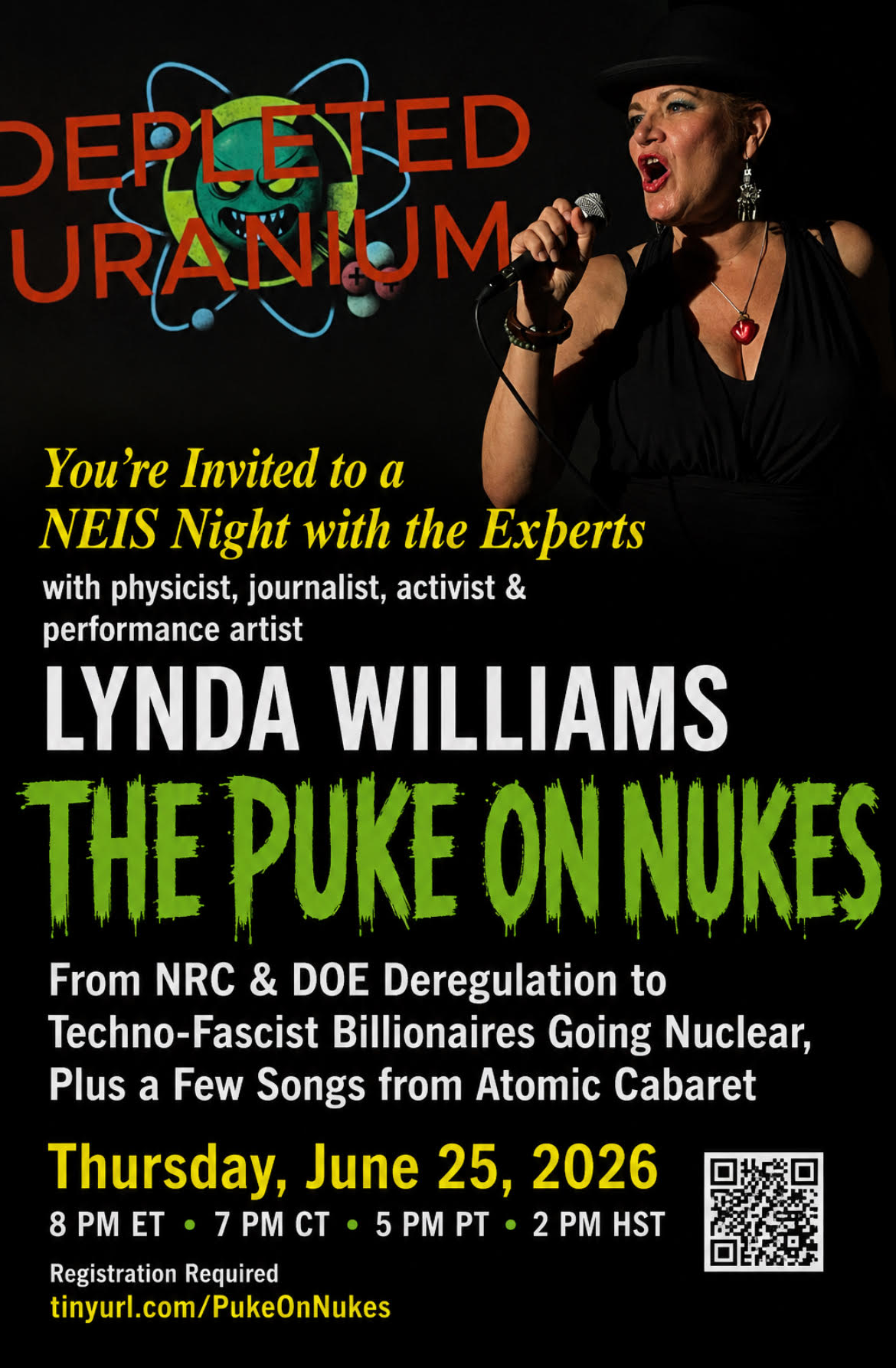
25 June- THE PUKE ON NUKES
Thursday, June 25, 2026
7pm Central Time (8pm ET, 6pm MT, 5pm PT) UTC – 5
From NRC & DOE Deregulation to Techno-Fascist Billionaires Going Nuclear, Plus a Few Songs from Atomic Cabaret REGISTER
26 June – Radiation Trainwreck at the NRC / Join the Protect Better Campaign – https://us02web.zoom.us/meeting/register/4ZlZ5_qLSHGiLSCg8FF6Bg#/registration


Cuba Is Not a Failed State – It Is a Besieged State
PETITION: “Global Appeal to Endorse Palestinian Right of Return of Refugees”
To see nuclear-related stories in greater depth and intensity – go to https://nuclearinformation.wordpress.com
-
Archives
- June 2026 (138)
- May 2026 (306)
- April 2026 (356)
- March 2026 (251)
- February 2026 (268)
- January 2026 (308)
- December 2025 (358)
- November 2025 (359)
- October 2025 (376)
- September 2025 (257)
- August 2025 (319)
- July 2025 (230)
-
Categories
- 1
- 1 NUCLEAR ISSUES
- business and costs
- climate change
- culture and arts
- ENERGY
- environment
- health
- history
- indigenous issues
- Legal
- marketing of nuclear
- media
- opposition to nuclear
- PERSONAL STORIES
- politics
- politics international
- Religion and ethics
- safety
- secrets,lies and civil liberties
- spinbuster
- technology
- Uranium
- wastes
- weapons and war
- Women
- 2 WORLD
- ACTION
- AFRICA
- Atrocities
- AUSTRALIA
- Christina's notes
- Christina's themes
- culture and arts
- Events
- Fuk 2022
- Fuk 2023
- Fukushima 2017
- Fukushima 2018
- fukushima 2019
- Fukushima 2020
- Fukushima 2021
- general
- global warming
- Humour (God we need it)
- Nuclear
- RARE EARTHS
- Reference
- resources – print
- Resources -audiovicual
- Weekly Newsletter
- World
- World Nuclear
- YouTube
-
RSS
Entries RSS
Comments RSS
 nuclear-news