USA cuts the budget for The Domestic Nuclear Detection Office (DNDO)
 Occupy the NRC (Nuclear Regulatory Commission) WTF??? WHY ARE WE CUTTING THE DNDO BUDGET BY 40%??? Shouldn’t we be INCREASING the detection of radiation in our country b/c there’s an ongoing nuclear disaster in Japan and the prevailing winds are in OUR direction?? It rains down in OUR crops, contaminates OUR food supply, and gets in OUR air and water!! Would someone please explain that to the people in charge!!! Never mind the fact that many of our own 104 aging nuclear power plants also leak and when they do the leaking is invisible. Shouldn’t we be spending MORE on monitoring all of this instead of cutting the budget by 40%?? In the middle of an ongoing nuclear disaster it seems really stupid to be slashing the radiation monitoring budget.
The Domestic Nuclear Detection Office (DNDO) is a jointly staffed agency within the Department of Homeland Security. DNDO is the primary entity in the U.S. government for implementing domestic nuclear detection efforts for a managed and coordin
WE NEED BETTER MONITORING OF OUR FOOD SUPPLYhttp://www.change.org/petitions/urgent-fukushima-radioactive-fallout-food-safety-petition
AND WE CERTAINLY DON’T WANT INGREDIENTS FROM FUKUSHIMA TO BE MIXED INTO OUR FOOD SUPPLY
http://www.change.org/petitions/urgent-fukushima-radioactive-fallout-food-safety-petition
Budget Information Here http://www.whitehouse.gov/sites/default/files/microsites/ostp/FY12-slides.pdf
How Many Potential Fukushimas in US?
Nuclear Perceptions Fight Reality OpEd News, By William Boardman, 22 Oct 12, FUKUSHIMA FREAKOUT OBSCURES REAL ACCIDENT THAT GOES ON AND ON “……How Many Potential Fukushimas in US? After discussing the Fort Calhoun nuclear plant surrounded by flood waters in 2011, with five
full-to-capacity dams upstream, Gunderson commented: “Yet the NRC was basically telling everybody, don’t worry be happy. You know, the probability of a dam failing is pretty low, but so is the probability of a 60 foot high tsunami hitting Fukushima. We know that low-probability events happen. And the NRC and Tokyo Electric both basically don’t want to admit that these events can happen. And we’ve got 34 different Fukushimas in the United States — one third of the nuclear fleet is in danger of an upstream dam failing.”
Currently four U.S. nuclear power plants have been shut down for extended periods of one to four years, while ratepayers continue to pay the operating costs of plants that aren’t operating. The two shut down reactors at San Onofre in California are costing ratepayers $50 million a month just to maintain the opportunity to re-start the reactors on short notice.
Worldwide, about 60 of the world’s 434 so-called safe, clean, reliable, inexpensive nuclear power plants are shut down, some forever.
“It just shows that the people we’re counting on to protect us, the regulators and the people that own these power plants, can’t be trusted,” Gunderson concluded. http://www.opednews.com/articles/Nuclear-Perceptions-Fight-by-William-Boardman-121022-931.html
Emails against nuclear plants – deleted by NRC
March 16th, 2011 – NRC Deleted Over 100 E-mails From Members of the Public Demanding Immediate Closure of US Nuclear Plants
Ikea uses sun, wind to become energy independent Wendy Koch, USA TODAY 22 Oct 12 As more U.S. businesses embrace renewable energy, IKEA plans to announce Tuesday that it will rely on the sun and the wind to produce all the power it uses at its stores and buildings by 2020. – Continue reading
Climate change – now at the irreversible stage?
Is climate change out of our hands? Redding.com October 21, 2012
“Human history becomes more and more a race between education and catastrophe.”
H.G. Wells “……
In March in Reuters we read,, “The world is close to reaching tipping points that will make it irreversibly hotter, making this decade critical in efforts to contain global warming, scientists warned on Monday.”
And now in the current Scientific American we learn it may not matter anymore. It may be too late. We may have already crossed the line. The crash may be underway. Our denial protects us from knowing. But for how much longer? Continue reading
Duke replied with a laugh: “If this is radioactivity, I love it!” -BBC
22 October 2012
Palomares bombs: Spain waits for US to finish nuclear clean-up
By Gerry HaddenPRI’s The World
Actually, just how much plutonium is still out there is hard to determine, because the US has never said how much the bombs were carrying to begin with. But Spanish investigator Carlos Sancho estimates that between 15 and 25 pounds (7 and 11kg) of the material ended up in the soil. Sancho, who runs the Palomares section of the Spanish Department of Energy, insists it does not pose health risks.
“The earth there can’t be moved because the plutonium is latent in the soil,” he says. “If we disturb the soil the plutonium could be dispersed.”
Egyptian delegation to visit South Korea to discuss nuclear cooperation
22 Oct 2012 10:23 AM
Cairo – The Egyptian government has announced that it would send an economic delegation to South Korea in the near future to examine ways to bolster cooperation in several fields, including nuclear energy, Al-Hayat reported Sunday.
According to the London-based newspaper, Egypt is seeking to increase its trade with South Korea.
South Korean officials have said that Samsung has decided to establish its first center for development and research in Egypt, an investment worth more than US$300 million.
The Egyptian Tourism Ministry will also work to attract South Korean tourists back to Egypt. Around 76,000 South Korean tourists visited Egypt every year before the 25 January revolution. The Egyptian government also plans to resume direct flights between the two countries.
Total trade between Egypt and South Korea exceeds $3 billion a year, but Egyptian exports to South Korea remain low, with oil constituting 95 percent of them. South Korean investments in Egypt amount to $1 billion while Egyptian investments in South Korea are almost negligible, as investment in South Korea requires large amounts of capital and advanced technology.
Source: Al-Masry Al-Youm
150 years before people can return to radiation contaminated land
 It takes over 150 yrs for people to come back to Futaba machi, “Decontamination is useless.” http://fukushima-diary.com/2012/10/it-takes-over-150-yrs-for-people-to-come-back-to-futaba-machi-decontamination-is-useless/ by Mochizuki October 20th, 2012 · On 10/16/2012, Assistant Prof. Kimura from Dokkyo medical university had a lecture in the
restration committee of Futaba machi.
In this lecture, he introduced his personal view over the situation that it takes over 150 years for all the citizens to come back to the town even though they consider the half-life and the shielding effect of the ground.
He adds this is on the assumption that they don’t decontaminate the town, but he also added it’s useless to decontaminate this highly contaminated land. In Futaba machi, the lowest atmospheric dose is 0.3μSv/h but the highest reading is over20μSv/h.
Fukushima Diary reveals – Japan to restart another nuclear plant
[Express] Another nuclear plant will be restarted http://fukushima-diary.com/2012/10/express-another-nuclear-plant-will-be-restarted/ by Mochizuki October 22, 2012
民主党の細野豪志政調会長は21日、薩摩川内(さつませんだい)市内の街頭演説で、九州電力川内原発の再稼働を明言しました。詳しくは明日の「しんぶん赤旗」で。
― 赤旗政治記者さん (@akahataseiji) 10月 21, 2012
<Translate>
On 10/21/2012, Hosono, the policy chief of Democratic Party of Japan had a soapbox oratory, then stated they are going to restart Sendai nuclear plant of Kyushu electric power. (Sendai nuclear plant is in Kagoshima prefecture, Kyushu)
Independent Scotland would demand removal of Trident nuclear base
 Nuclear weapons ‘outlawed’ in an independent Scotland, says Salmond, BBC News 21 Oct 12, The leader of the SNP has said that if his party won power in an independent government it would make nuclear weapons illegal.
Alex Salmond told the BBC’s Andrew Marr Show that Trident, which currently resides at Faslane Naval base on the Clyde, would have to go.
He also said a go-alone Scotland would remain a member of the European Union….. He said: “The UK government has two choices – they either relocate Trident to another part of the rest of the UK or alternatively they could use nuclear facilities in America or France.”
Mr Salmond made a further point that it was possible for a UK government to decide a “much better policy” and decommission its weapons system….. http://www.bbc.co.uk/news/uk-scotland-scotland-politics-20020839
Authorities keeping quiet about Fukushima reactor 4’s dire situation
Fukushima Daiichi’s Reactor 3 and 4 are waterlogged, cracked and just one major earthquake jolt away from a catastrophe that one expert said could be “of biblical proportions.”
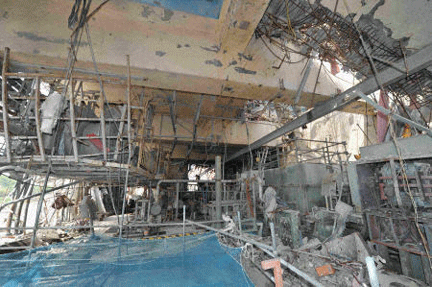 Fukushima’s Hot Water: Now Fallout in Our Kitchens? On The Issue, by Kimberly Robertson, 21 Oct 12, Information about radioactive fallout from Japan has been in very short supply since the unprecedented triple nuclear meltdowns at Fukushima Daiichi on March 11, 2011.
“Nuclear meltdown” is a term for a catastrophic reaction in a nuclear reactor that has overheated. The uncontrolled heat damages the reactor itself, causing an uncontrolled release of life threatening radioactive material, also known as “radioactive fallout” into the environment.
At Fukushima this happened three times, an unprecedented catastrophe.With the 67th anniversary of the atomic bombing of Hiroshima in August 2012, it was strange to realize that Japan unwittingly dropped an even deadlier bomb on itself. Fukushima contained over 100 times more cesium-137 alone than Hiroshima, and there are literally hundreds of dangerous radionuclides in the “mix.” Continue reading
Taxpayers still paying up for dirty energy
When It Comes to Government Subsidies, Dirty Energy Still Cleans Up http://www.businessweek.com/articles/2012-10-21/when-it-comes-to-government-subsidies-dirty-energy-still-cleans-up
 by: Charles Kennyn October 21, 2012 The Oct. 16 presidential town hall debate featured Mr. Romney and Mr. Obama facing off on who was really Mr. Oil or Mr. Gas or Mr. Coal. Neither candidate even mentioned climate change. And while President Obama did refer to renewable production, solar got short shrift—doubtless because of the fracas over now-bankrupt thin-film solar manufacturer Solyndra, which had received loan guarantees as part of the stimulus bill.
That’s a shame, because the reason panel production has moved from such countries as America and Germany to China is because prices have dropped and production has become a commoditized, high-volume enterprise. That may be bad news for Western manufacturing jobs, but it’s great news for the global environment, consumers, and even American energy security.
In fact, if we had a level playing field, where neither fossil fuels nor renewable energy received favorable regulatory or subsidy treatment, solar would be increasingly competitive. Mr. Coal would be going home, and Mr. Sun would be coming out to play.
Global subsidies for oil, gas, and coal amounted to $409 billion in 2010 —compared with $60 billion for renewable energy that year. Cutting those subsidies would be economically efficient, reduce overall energy consumption, and level the playing field with renewable power. The International Energy Agency suggests that removing fossil fuel subsidies would reduce carbon dioxide emissions by as much as 2.6 gigatonnes a year by 2035. That’s half of what’s required to prevent the planet’s average temperature from increasing by two degrees centigrade or more per year. Continue reading
UK government to betray its promise on subsidising nuclear power

 The Independent : Who pays the nuclear power bill?
http://www.independent.co.uk/voices/letters/letters-who-pays-the-nuclear-power-bill-8219862.html by Dr Paul Dorfman and 8 other UK University dignitaries 21 October 2012 The Government have promised that they would never, under any circumstances, subsidise nuclear power. Ed Davey, the Coalition Secretary of State for the Department of Energy and Climate Change, has stated that “There will be no blank cheque for nuclear – unless
they are price competitive, nuclear projects will not go ahead.”
However, the Coalition Energy Minister John Hayes, is now considering a major U-turn in energy policy by giving a blank cheque to nuclear by “underwriting” construction cost over-runs. This is despite the fact that the key to nuclear is its spiralling cost over-runs. Continue reading
Sinking ground under Fukushima nuclear reactor 4 brings catastrophic risk
 Fukushima threatens Global Human Survival The Canadian, 21 OCTOBER 2012 : BY SUBRATA “…..is Fukushima still a threat? It seems that it is, and on a potentially devastating level. Mitsuhei Murata, who served his country as Ambassador to both Senegal and
Switzerland, explained in a recent interview that far from the situation at the Fukushima Daiitsu plant improving, it is actually worsening in an alarming way: the ground beneath the plant’s number 4 reactor is sinking.
Mr Murata implied that the whole structure is on the verge of collapse. He wrote to the Secretary General of the United Nations stating unequivocally that the fate, not only of Japan, but of the rest of the world depends on the No. 4 reactor.
The cooling pool still contains more than fifteen hundred spent fuelrods. The collective power of these “spent” rods is 37 million curies. By comparison, the release of nuclear material at Three Mile Island, Pennsylvania (an INES level 5 event) amounted to approximately
2.5 million curies. In other words, there are nearly 15 Three Mile Islands sitting in the severely compromised Unit 4.
The ground beneath Unit 4 has sunk by about 31.5 inches already. Further sinking, or a minor earthquake could cause the entire structure to collapse, draining the pool and causing a meltdown of potentially catastrophic proportions. Some scientists predict that
his would mean the ruin of Japan and a serious threat to the rest of the world. http://www.agoracosmopolitan.com/news/nature/2012/10/19/4621.html
Nuclear Regulatory Commission now discussing 80 year nuclear reactor licensing!
 AUDIO “You won’t believe this”: US nuclear regulator meets to discuss 80-year licenses for old reactors -Expert ) http://enenews.com/you-wont-believe-this-us-nuclear-regulator-meets-to-discuss-80-year-licenses-for-old-reactors-not-just-rolling-the-dice-youre-practically-committing-suicide-expert-video
October 18th, 2012 Title: Interview with David Freeman
 Source: IF YOU LOVE THIS PLANET with Dr. Helen Caldicott
Date: Oct. 12, 2012
h/t MsMilkytheclown
David Freeman, a senior advisor with Friends of the Earth’s nuclear campaign […] was appointed chairman of the Tennessee Valley Authority by President Jimmy Carter in 1977, where he stopped the construction of eight large nuclear power plants and pioneered a massive energy conservation program. Subsequently, Freeman served for two decades as general manager of several large public power agencies including the Los Angeles Department of Water and Power, the New York Power Authority and the Sacramento Municipal Utility District. He is a renowned expert on clean energy, efficiency and the risks of nuclear power.
At 27:30 in
David Freeman, former chairman of the Tennessee Valley Authority: And now guess what? The Nuclear Regulatory Commission last Thursday, guess what they met on? You won’t believe this… The subject of the meeting was 80-year licenses for old nuclear power plants […] If you have a plant operating for 80 years [next to an earthquake fault] you’re not just rolling the dice, you’re practically committing suicide […] everyone living within a 50 mile radius is a guinea pig.
1 This Month

Protect Sazan Island from the Trump family! https://secure.avaaz.org/campaign/en/protect_sazan_island_from_the_trump_family_loc/?bqFCVab&v=174511&cl=22707147157&_checksum=5e9dde668860e8231c33699735e16a1fbf22ab2cb01da50c999fe8732b9775ef&utm_source=email&utm_medium=blast_email&utm_campaign=174511

Cuba Is Not a Failed State – It Is a Besieged State
PETITION: “Global Appeal to Endorse Palestinian Right of Return of Refugees”
To see nuclear-related stories in greater depth and intensity – go to https://nuclearinformation.wordpress.com
-
Archives
- June 2026 (129)
- May 2026 (306)
- April 2026 (356)
- March 2026 (251)
- February 2026 (268)
- January 2026 (308)
- December 2025 (358)
- November 2025 (359)
- October 2025 (376)
- September 2025 (257)
- August 2025 (319)
- July 2025 (230)
-
Categories
- 1
- 1 NUCLEAR ISSUES
- business and costs
- climate change
- culture and arts
- ENERGY
- environment
- health
- history
- indigenous issues
- Legal
- marketing of nuclear
- media
- opposition to nuclear
- PERSONAL STORIES
- politics
- politics international
- Religion and ethics
- safety
- secrets,lies and civil liberties
- spinbuster
- technology
- Uranium
- wastes
- weapons and war
- Women
- 2 WORLD
- ACTION
- AFRICA
- Atrocities
- AUSTRALIA
- Christina's notes
- Christina's themes
- culture and arts
- Events
- Fuk 2022
- Fuk 2023
- Fukushima 2017
- Fukushima 2018
- fukushima 2019
- Fukushima 2020
- Fukushima 2021
- general
- global warming
- Humour (God we need it)
- Nuclear
- RARE EARTHS
- Reference
- resources – print
- Resources -audiovicual
- Weekly Newsletter
- World
- World Nuclear
- YouTube
-
RSS
Entries RSS
Comments RSS
 nuclear-news