Scandal involving military’s top brass exposed in Britain -UK/military academic Funding details
The scandal, revealed in a Sunday Times investigation, involves retired high-ranking military officers, who are filmed claiming they can influence lucrative arms deals worth millions of pounds as lobbyists, despite Ministry of Defence (MoD) regulations banning the practice.
The three-month investigation by the paper has been carried out by reporters posed as representatives of arms manufacturing companies.
Retired military figures including General Lord Dannatt, the former head of the army, and Lord Stirrup, former chief of the defence staff, from among others have been filmed claiming they could give weapons manufacturers influence in
Whitehall and Westminster in return for six-figure sums.
According to the paper, Lieutenant General Sir John Kiszely, former head of the Defence Academy, claimed he could use his role as president of the Royal British Legion to influence his clients’ agenda with the Prime Minister.
Meanwhile, Lieutenant General Richard Applegate, a former Ministry of Defence procurement chief, reportedly described a secret lobbying campaign in parliament for a £500million military programme on behalf of an Israeli arms company.
It was also reported that Admiral Sir Trevor Soar, Commander of the naval fleet until March 2011, told undercover reporters he would “ignore” the two-year ban imposed on lobbying ministers.
Lord Dannatt, the former head of the army, also talked about ignoring a ban on discussion of a £400m contract by “targeting” the MoD’s top civil servant, with whom he went to school.
This comes as Prime Minister David Cameron vowed to tackle acts of lobbying before he came to power in May 2010 general elections.
“Just before the election, Cam [Prime Minister David Cameron] was passionate to stop next great scandal of lobbying. Action so far? Nothing. Scandal breaks up in Sunday Times”, said Paul Flynn MP in a tweet.
http://www.presstv.com/detail/266549.html
Arms Trade Firms Fund Elite Universities With £83m Over Three Years
Posted: 23/08/2012 09:01 BST
Britain’s top universities have received at least £83m worth of funds from firms involved in the arms trade over the last three years, The Huffington Post UK can disclose.
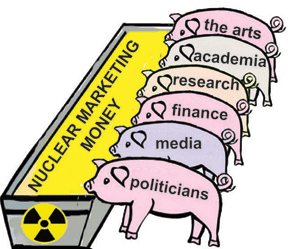
Data released by the Campaign Against The Arms Trade (CAAT) has revealed the elite Russell Group universities, including Oxford and Cambridge, gain millions in research and sponsorship money from companies which manufacture weapons.
The figures come amid concerns among activists that cash-starved institutions are helping to promote the manufacture of weapons by accepting such funding.
But the Russell Group said universities took pains to make sure all partnerships were “appropriate”.
CAAT analysed data obtained under Freedom of Information requests, which asked for the amount of funding for research and from sponsorship the 24 Russell Group universities derived from private arms companies and the ministry of defence’s research arms from 2008-11.
Private companies provided £62.8m of the money to the Russell Group universities with the rest coming from the Ministry of Defence.
Of the 18 out of 24 universities that responded, only one, the London School of Economics – said it received no such funds.
Of the others it found Imperial College London received the most funds from government and private military sources at £15.2m, followed by Sheffield and Cambridge, both with £13.7m and Oxford with just over £9m.
Oxford University received research grants worth £319k in 2008 to 2009, £196k from 09-10 and £199k in 10-11 from BAE systems, one of the world’s largest military contractors.
Cambridge University took £75,000 of sponsorship money from GKN, which makes both commercial and defence related aircraft, to fund their GKN Chair of Manufacturing Engineering in 2009.
CAAT told The Huffington Post UK it was a problem for universities to be associated with arms companies because “any link that a university has with an arms company provides that company with a veneer of respectability and sends a message that the arms trade is a legitimate one”.
The group is urging military funding for universities to be at the very least debated, raising concerns that institutions are advocating the arms trade by accepting money from companies involved with the military.
Their concerns are shared by ethical group Scientists for Global Responsibility.
Executive Director Dr Stuart Parkinson told The Huffington Post UK: “Arms companies fund university research for three key reasons: to gain a competitive advantage on commercial rivals; to create a sympathetic audience among scientists and engineers; and to recruit the next generation of professionals to develop new weapons systems.”
CAAT media coordinator Kaye Stearman told The Huffington Post UK the figures were likely to be an “underestimate” because some universities refused to answer, and others withheld information due to “confidentiality clauses”.
“For some universities the funding is a major element in determining research priorities in areas of engineering and science,” she added.
Imperial University told The Huffington Post UK their yearly research income was “almost £300m” and the amount it received from companies and organisations in the defence sector represented around one and a half percent of that.
At Cardiff University, BAE, Rolls Royce, the world’s second largest provider of defence aero-engine products, and GKN have each sponsored students on an MsC in Lean Operations, for manufacturing managers, in the last three years.
Professor Martin Kitchener, Associate Dean at Cardiff Business School said companies had supplied students from the course. “Those students may or may not have come from the military divisions of those conglomerates. Researchers in the school have conducted research in those companies.
“We have ongoing discussions about ethics within the school and last year we were approached by British American Tobacco looking to put students on our courses and we said no to them.”
CAAT’s Starman said military funding is “more than just another form of commercial sponsorship” and should at least be debated.
“The ethos of education, which is to support learning and thereby create a better educated and more productive society, is undermined by the war, destruction and waste engendered by the manufacture and trade in deadly weaponry.”
York University, which has received £3,961,357 since 2008 from arms companieswas forced to pass an ethical investment policy in 2009 after controversy about its dealings with the arms trade.
York University graduate Chris, 24, told The Huffington Post UK he thought such companies evaded “moral scrutiny”.
“The research conducted at universities helps arms companies to develop weapons which are then sold indiscriminately to governments and armed groups across the world.
“Universities must start to take seriously their duty as institutions of education to promote peace and understanding, not to advance the commercial interests of those who thrive on war and corruption.”
A spokesperson for Oxford told The Huffington Post UK the university: “Only enters into funding contracts with companies that abide by relevant UK and international obligations in the area of arms manufacturing, and the University does not accept funding from organisations whose activities would be illegal under UK and international laws”.
A Russell Group spokesperson said: “Like all world-class universities Russell Group institutions collaborate with a number of public and private sector companies on a wide range of leading research projects, including in the defence sector. All our universities have robust systems in place to ensure any partnerships are appropriate.”
A spokesperson for Cambridge University said they had nothing to add to the Russell Group’s comments.
| Table 1 – Military funding at Russell Group Universities 2008-2011 | ||||
| Name | Funding for military projects | Direct government funding (UK) | Private company funding (UK) | |
| Bristol | 6500000 | 1900000 | 4600000 | |
| Cambridge | 13743200 | 4197000 | 9548200 | |
| Cardiff | 423605 | 66490 | 357115 | |
| Durham | 67535 | 67535 | ||
| Edinburgh | 472979 | 369164 | 103815 | |
| Exeter | 1531242 | 1376491 | 154751 | |
| Imperial | 15241277 | 7844062 | 7397215 | |
| Kings College | 5346498 | 5343998 | 2500 | |
| Leeds | *875418 | 0 | *875418 | |
| Newcastle | 2017247 | 26127 | 1991120 | |
| Nottingham | 5980540 | 955234 | 5025306 | |
| Oxford | 9006444 | 299032 | 8707412 | |
| Queen’s University, Belfast | 553083 | 279579 | 273504 | |
| Queen Mary, London | 155745 | 60000 | 95745 | |
| Sheffield | 13777909 | 465607 | 13312302 | |
| Southampton | 3813000 | 0 | 3813000 | |
| York | 3961357 | 518007 | 3443350 | |
| * Has other funding from Rolls Royce but withheld because of confidentiality clauses (sections 41 and 43 of FOI) [Also, Rolls Royce recieved a large nuclear related funding from the uk government recently -arclight2011] | ||||
| ** Includes Foreign Govt funds in total but not in UK Government funding |
1 Comment »
Leave a Reply
1 This Month
23-25 October – on Zoom – World BEYOND War’s annual global conferenc

To see nuclear-related stories in greater depth and intensity – go to https://nuclearinformation.wordpress.com

Say No to NASA’s Reckless Nuclear Reactor on the Moon
Say No to NASA’s Reckless Nuclear Reactor on the Moon
-
Archives
- October 2026 (160)
- September 2026 (339)
- August 2026 (330)
- July 2026 (355)
- June 2026 (287)
- May 2026 (306)
- April 2026 (356)
- March 2026 (251)
- February 2026 (267)
- January 2026 (308)
- December 2025 (358)
- November 2025 (359)
-
Categories
- 1
- 1 NUCLEAR ISSUES
- business and costs
- climate change
- culture and arts
- ENERGY
- environment
- health
- history
- indigenous issues
- Legal
- marketing of nuclear
- media
- opposition to nuclear
- PERSONAL STORIES
- politics
- politics international
- Religion and ethics
- safety
- secrets,lies and civil liberties
- spinbuster
- technology
- Uranium
- wastes
- weapons and war
- Women
- 2 WORLD
- ACTION
- AFRICA
- Atrocities
- AUSTRALIA
- Christina's notes
- Christina's themes
- culture and arts
- Events
- Fuk 2022
- Fuk 2023
- Fukushima 2017
- Fukushima 2018
- fukushima 2019
- Fukushima 2020
- Fukushima 2021
- general
- global warming
- Humour (God we need it)
- Nuclear
- RARE EARTHS
- Reference
- resources – print
- Resources -audiovicual
- Weekly Newsletter
- World
- World Nuclear
- YouTube
-
RSS
Entries RSS
Comments RSS


[…] Source: https://nuclear-news.net/2012/10/14/scandal-involving-militarys-top-brass-exposed-in-britain-ukmilita… […]
Pingback by Scandal involving military's top brass exposed in … – Nuclear News | ibulokigevi | October 16, 2012 |