The Real US Motivation For Japan To Keep Nuclear Power
“At a meeting with the DPJ’s policy chief Tuesday, Poneman said that if Japan takes such steps it might have unexpected effects on the United States and other concerned parties, Maehara said”
“The new policy allows Japan to continue its fuel recycling program, despite the nuclear phase-out. The contradiction prompted U.S. Deputy Secretary of Energy Daniel Poneman to raise concerns about Japan’s ability to reduce plutonium stockpiles,”
The US has also sent a former NRC official to assist TEPCO in their effort to rehabilitate their image in order to restart some of their nuclear reactors.
October 4th, 2012
Last week the odd political dance between the US and Japan ended with Japan backing off of their plan to phase out nuclear power. The US claimed heavily that is was over proliferation issues but mentioned as an aside it would hurt the US nuclear energy sector. This seemed quite odd, why the US would be so worried about Japan’s civilian nuclear power program. The proliferation excuse was very flawed and made no sense.
Ending nuclear power generation would stop the fuel cycle in Japan meaning no new plutonium would be created. This then would only leave the issue of what to do with all the spent fuel and plutonium already created in Japan. A wide array of options exist to deal with the proliferation issue yet the US pretended to be oblivious to the multiple ways to solve this problem declaring the only solution would be for Japan to instead keep making even more spent fuel….
So why does the US really need Japan to not phase out nuclear power?
There are three companies capable of currently building nuclear reactors in the US.
Areva/EDF from France, they have the EPR reactor. Two are attempting to be built currently. One in France and the other in Finland. Both are massively over budget and have had a long history of technical failures in the building process. Currently there are no plans to build an EPR in the US.
Toshiba/Westinghouse has the AP1000 reactor design. This design seems to be the reactor of choice for all the possible new reactor builds in the US. Westinghouse was bought by Toshiba. Toshiba owns 87% of the company this leaves the company under the ownership of the Japanese company.
The third is GE-Hitachi Nuclear. Hitachi owns 60% of this company leaving is slightly in controlling ownership by the Japanese company. Looking at the activity of both sides of the partnership, the Hitachi side appears to be the active partner building or upgrading nuclear facilities. GE-Hitachi has a couple of newer reactor designs, theABWR and ESBWR. Both GE-Hitachi and Toshiba sell the ABWR. All have been built in Japan or Asia. Two were planned for the US at the South Texas Project. That nuclear plant project has been officially scrappedleaving no ABWR units built or planned in the US. The ESBWR is still in the approval process, none are planned in the US.
Mitsubishi also does some business in the US but does not currently have an approved reactor design for the US. They have recently come under fire for the design flaws in the steam generators for PWR reactors at San Onofre that may cause the plant to be scrapped. Mitsubishi is a Japanese company with no US partnership.
Areva has no planned reactors in the US. Toshiba/Westinghouse is owned by a Japanese company. GE-Hitachi is 60% owned by the Japanese company and Hitachi has played the active role.
Other nuclear industry companies in the US include Bechtel, Babcock & Wilcox, Fluor and Shaw. These companies do construction and engineering of nuclear plant builds based on the designs of the big companies listed above. Only Babcock & Wilcox has a reactor design, the SMR that is not ready for commercial deployment and has not been given any approvals by the NRC yet.
The US nuclear industry is apparently very dependent on Japan. The two major players in reactor design, fuel production and reactor maintenance are not really US companies. When Germany declared their nuclear phase out, Siemens announced they were closing their nuclear division to focus on other energy sectors. The US nuclear industry has openly admitted their domestic business is waning. If Japan ends their nuclear power program, Toshiba/Westinghouse, Mitsubishi and GE-Hitachi may either end their nuclear divisions or drastically cut them to meet actual demand. Both options would leave the US without a functional nuclear industry. With closer inspection it shows how dependent the US is on Japan’s nuclear power program to keep their dying industry on life support. The US carefully hints at this in an Asahi Shimbun article from early September.
More here.. (recommend)
1 Comment »
Leave a reply to Nick Nadhob Cancel reply
1 This Month
26 April – Chernobyl: Inside the Meltdown airs on National Geographic on Sunday 26th April from 4pm
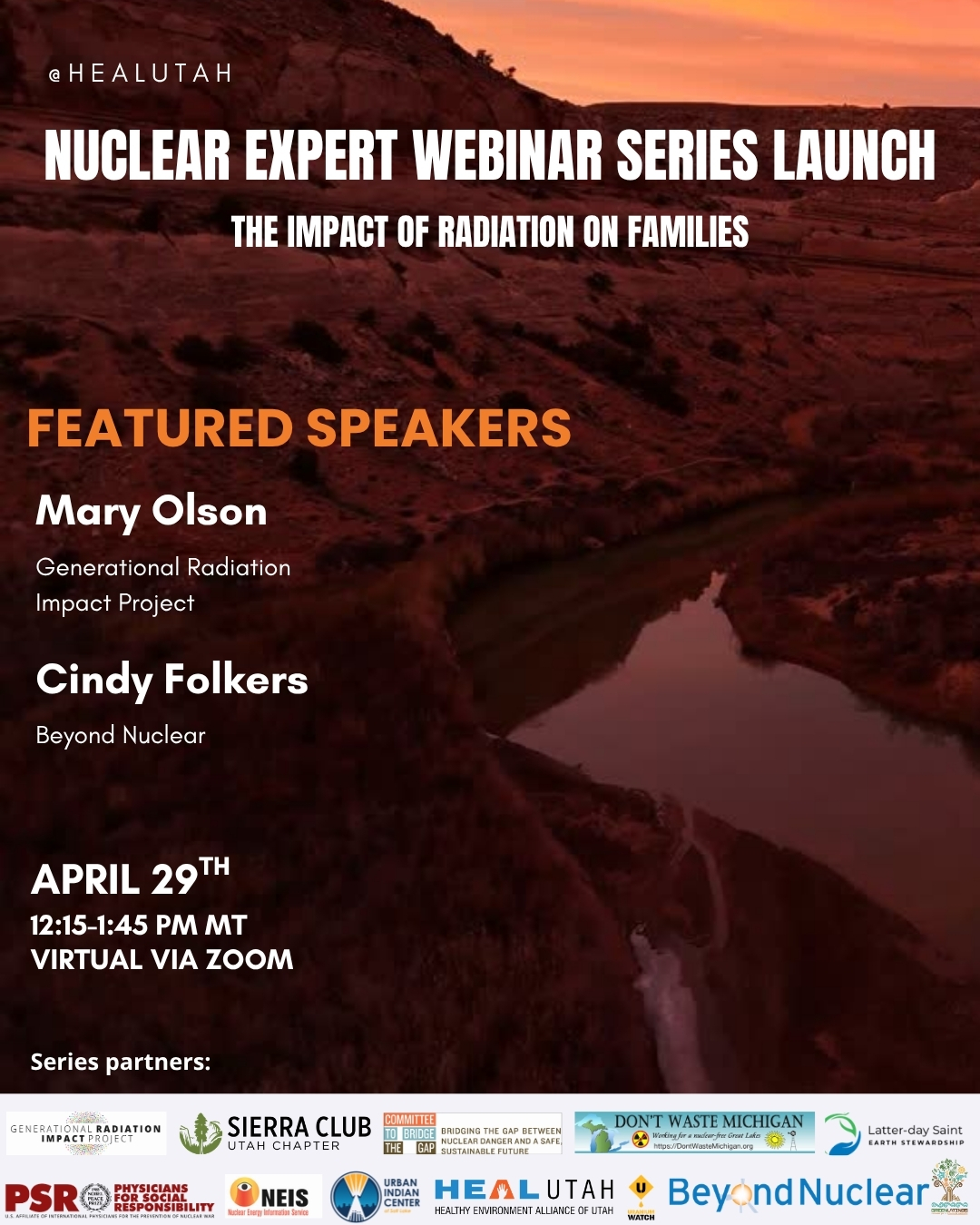
29 April – Nuclear Expert Webinar #1 – Radiation Impacts on Families with Mary Olson and Cindy Folkers
- 12:15 PM MT – 1:45 PM MT
- Location: Virtual – REGISTER TODAY

4 May -West Suburban Peace Coalition to discuss Iran war at May Educational Forum
Monday, May 4, 7:00 – 8:00 PM Central Standard Time
Title: : How Trump’s Narrative Tries to Shape the Reality of the War on Iran.
Contact Walt Zlotow, zlotow@hotmail.com 630 442 3045 for further information
14 May – online event From Bombs to Data Centres: the Face of Nuclear Colonialism

Pine Ridge Uranium is the real threat, not Tehran- Tell Burgum: Stop the Extraction.
Chernobyl: The Lost Tapes – A good documentary on Chernobyl on SBS available On Demand for the next 3 weeks– https://www.sbs.com.au/ondemand/tv-program/chernobyl-the-lost-tapes/2352741955560
To see nuclear-related stories in greater depth and intensity – go to https://nuclearinformation.wordpress.com
-
Archives
- April 2026 (356)
- March 2026 (251)
- February 2026 (268)
- January 2026 (308)
- December 2025 (358)
- November 2025 (359)
- October 2025 (376)
- September 2025 (257)
- August 2025 (319)
- July 2025 (230)
- June 2025 (348)
- May 2025 (261)
-
Categories
- 1
- 1 NUCLEAR ISSUES
- business and costs
- climate change
- culture and arts
- ENERGY
- environment
- health
- history
- indigenous issues
- Legal
- marketing of nuclear
- media
- opposition to nuclear
- PERSONAL STORIES
- politics
- politics international
- Religion and ethics
- safety
- secrets,lies and civil liberties
- spinbuster
- technology
- Uranium
- wastes
- weapons and war
- Women
- 2 WORLD
- ACTION
- AFRICA
- Atrocities
- AUSTRALIA
- Christina's notes
- Christina's themes
- culture and arts
- Events
- Fuk 2022
- Fuk 2023
- Fukushima 2017
- Fukushima 2018
- fukushima 2019
- Fukushima 2020
- Fukushima 2021
- general
- global warming
- Humour (God we need it)
- Nuclear
- RARE EARTHS
- Reference
- resources – print
- Resources -audiovicual
- Weekly Newsletter
- World
- World Nuclear
- YouTube
-
RSS
Entries RSS
Comments RSS
 nuclear-news
mossad not muslims did 9/11/01