The true scale of Chernobyl’s radioactive disaster

 Chernobyl, Insight from the Inside by Vladimir M.
  Chernousenko, Scientific Director of the Ukrainian Academy of Sciences Institute of Physics in Kiev’s Task Force for the Rectification of the Consequences of the Chernobyl Accident
Foreward, pp. XVI-XVII, From the Publisher:
The author’s chief motivation for writing this book is that he considers it vitally important that the world should be told the unvarnished truth about the scale and consequences of the disaster, the legacy of which will remain with us for many generations. He presents realistic estimates and new unpublished hard data from various reliable sources about the radiation pollution caused by the accident. The figures prove to be much higher than anyone dared assume up to now. We are confronted with horrendous numbers regarding the radiation pollution of the soil and aquifers in the Soviet Union. On the basis of these data, it is estimated that a territory of a least 100,000 km^2 is so polluted as to be uninhabitable. There are even estimates of an amount three times as high.
The author’s greatest concern is the well-being of the people still living in this huge territory. Many of those who are still living in the polluted areas want to leave, but the problems posed by local administration and bureaucracy do not allow them to do so. For lack of precedence, the effects on their health in the long-term can only be guessed at, at the present time. But those effects are already beginning to become evident. The health statistics included in this book are a matter of serious concern and urgently call for further investigations.
Chapter 1, pp. 9-10:
A more official view on `The Nuclear Accident in Block 4 of the Chernobyl Nuclear Power Station and the Safety of the RBMK Reactor’ give the following excerpts from an unpublished report by A.A. Yadrikhinskii, Nuclear Safety Inspection Engineer of the USSR State Atomic Energy Survey Commission (Kurchatov town, RSFSR February, 1988):
. . . Radiation emission was no less that 80% of the core (with a total of 192 tons), which amounted to 6.4 x 10^9 Ci.[16] If we divide the figure by the population of the whole earth (4.6 x 10^9 people) then we get 1 Ci per person.[17]
The radiation levels of the emissions from the Chernobyl disaster exceed 16 to 27 times the maximum figure estimated as resulting from a hypothetical accident, in which the fuel rods melt down and the safety mechanisms are destroyed — this maximum figure was calculated as 3-5% of the core content.
It is practically impossible to eliminate all radioactive substances from the subsoil and soil in the contaminated area. It is also not reasonable to hope for natural decay of the radiation. The radiation levels given off by the substances emitted from the reactor will in the first 100 years decrease 5 times from 5 x 10^12 to 1 x 10^12 and, in 1000 years, 1000 times to 1 x 10^9.
One way of illustrating the danger is to calculate the volume of water required to dilute the radioactive material to the maximum permissible concentration. The 15 m^3 of radioactive substances emitted from Block 4 at this time could be diluted in 15 x 5 x 10^12 = 75,000 km^3 of water. In 100 years, 15,000 km^3 would be needed. In 1000 years 15 km^3 would be the required amount. For comparison: the total outflow of the world’s rivers is 36,380 km^3 — i.e., its use to dilute the radiation would take 50 years before the radioactive emission from Chernobyl will be brought down to the permissible level.
Disasters on the scale of the Chernobyl accident lead to harmful effects on the population, territorial lossess without any military action, and to thousands of billions of roubles’[18] worth of damage, and are, therefore, hard to justify by the need for electric power.
It was the secrecy and lack of accountability of our nuclear science, and its refusal to open itself up to discussion and criticism which made it possible for dangerous design faults to lead finally to a nuclear accident of this scale. No technical design plan of any one of the existing nuclear power stations in the USSR is available. The Soviet nuclear industry presents its projects as works of near-genius so that they apparently feel that reactor design deficiencies and infringemnets of safety regulations have to be hushed up to go unnoticed and — what is significantly worse — uncorrected for years and even decades. Economical reactor operation is pursued at a definite cost in terms of nuclear safety.
__________________
- The old unit for the activity was the Curie [Ci] which has been replaced by the Becquerel [Bq]; 1 Bq = 1/s implying one decay per second. 1 Ci = 3.7 x 10^10 Bq and 1 Bq ~= 2.7 x 10^-11 Ci ~= 27 pCi. See also the Appendix.
- Naturally, the implications are not that everybody received such a dose, but such crude numbers certainly help to illustrate the scale of the accident.
- At that time 1 rouble was roughly $1.5.
Foreward, pp. XVII-XVIII, From the Publisher:
For several years after the accident a true disclosure was withheld from the residents of the affected region (and from the world). Unavoidable consequences are that even correct information on radioactive contamination, on radiation doses, and on the resultant health risks is now met with disbelief, and that conflicting information is abundant. Even in regions with less radioactive contamination the people are uncertain and frightened, and even in these regions they accept grave constraints — especially with regard to food — that make normal living conditions impossible, and in many cases they want to leave their villages, even when this does not seem to be necessary from the radiological point of view. This includes many settlements and cities that could well be saved.
The misguided information policy of the past has made it almost impossible for the Soviet administration to now arrive at acceptable terms with the residents of the afflicted areas of the Soviet Union……. http://www.ratical.org/radiation/Chernobyl/ChernobylIftI.html
No comments yet.
1 This Month
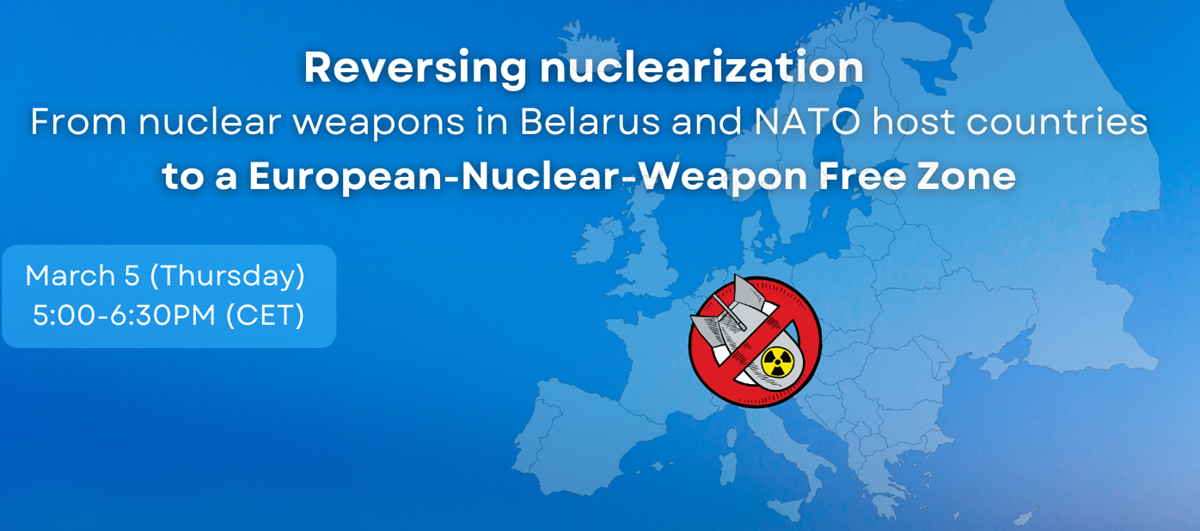
5 March -Online – Reversing nuclearization:
From nuclear weapons in Belarus and NATO host countries to a European-Nuclear-Weapon Free Zone
11am-12:30pm Eastern Time USA / 5pm-6:30pm CET

of the week – Advocating for a
nuclear free beach – https://www.samuellawrencefoundation.org/
The Samuel Lawrence Foundation advocates for a Nuclear Waste Free Beach at San Onofre, join us and take action!

10 March A LIVE WEBINAR THE REAL EFFECTS OF NUCLEAR POWER
What the Industry Isn’t Telling Us
1:00 PM Mountain, 2 pm Central, 3 pm Eastern. Live on the Keepers of the Water Facebook page

18 March Webinar @ 1 PM EST: An Assessment of SMR Projects: The Case of Canada
register for the zoom:
https://us02web.zoom.us/webinar/register/WN_o8BIIOUvQ2ONJR1nta65DQ#/registration

of the week – STOP SMALL MODULAR REACTORS IN CANADA
To see nuclear-related stories in greater depth and intensity – go to https://nuclearinformation.wordpress.com
-
Archives
- March 2026 (51)
- February 2026 (268)
- January 2026 (308)
- December 2025 (358)
- November 2025 (359)
- October 2025 (376)
- September 2025 (258)
- August 2025 (319)
- July 2025 (230)
- June 2025 (348)
- May 2025 (261)
- April 2025 (305)
-
Categories
- 1
- 1 NUCLEAR ISSUES
- business and costs
- climate change
- culture and arts
- ENERGY
- environment
- health
- history
- indigenous issues
- Legal
- marketing of nuclear
- media
- opposition to nuclear
- PERSONAL STORIES
- politics
- politics international
- Religion and ethics
- safety
- secrets,lies and civil liberties
- spinbuster
- technology
- Uranium
- wastes
- weapons and war
- Women
- 2 WORLD
- ACTION
- AFRICA
- Atrocities
- AUSTRALIA
- Christina's notes
- Christina's themes
- culture and arts
- Events
- Fuk 2022
- Fuk 2023
- Fukushima 2017
- Fukushima 2018
- fukushima 2019
- Fukushima 2020
- Fukushima 2021
- general
- global warming
- Humour (God we need it)
- Nuclear
- RARE EARTHS
- Reference
- resources – print
- Resources -audiovicual
- Weekly Newsletter
- World
- World Nuclear
- YouTube
-
RSS
Entries RSS
Comments RSS
 nuclear-news
Leave a comment