Continuing danger and ever escalating costs at the Chernobyl and Fukushima cleanups
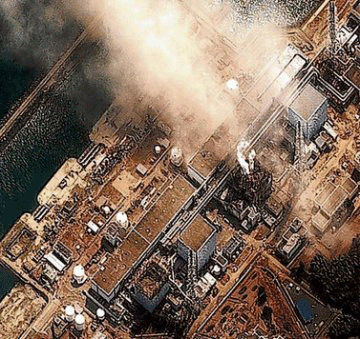 It will be especially dangerous to remove the remaining nuclear fuel because of the high levels of radiation that such substances emit.
conditions [at the Chernobyl plant] are still dangerous for the 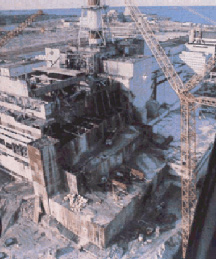 3,500 workers now cleaning up the site. And some 200 tons of nuclear fuel still remain at the bottom of the reactor.
When reactors die, costs keep climbing. Fukushima Diiachi costs to go through the roof.http://nuclearhistory.wordpress.com/2012/09/03/when-reactors-die-costs-keep-climbing-fukushima-diiachi-costs-to-go-through-the-roof/ 4 Sept 12
http://e.nikkei.com/e/fr/tnks/Nni20120815D15HH187.htm Decommissioning Of Fukushima To Be Long, Costly Process FUKUSHIMA (Nikkei)–-The government and Tokyo Electric Power Co. (9501) have made the first revisions to a plan to decommission the crippled Fukushima Daiichi nuclear power plant, but the details remain uncertain.
At the Chernobyl plant, efforts are now in full swing to build a massive shelter to stop the site from releasing radiation into the environment.
Among other matters, the revisions involve adding measures to prevent radioactive water from leaking into the environment. But it is still unclear how much time and money this will actually entail.
The decommissioning of a nuclear power plant involves removing nuclear
fuel and dismantling the reactors before turning the site into a
vacant lot. But this process can be dangerous and complicated. It will be especially dangerous to remove the remaining nuclear fuel because of the high levels of radiation that such substances emit.
Past Precedent
However, the situation at the Chernobyl nuclear power plant, the site
of a catastrophic accident 26 years ago, offers a number of ideas
about what lies ahead for efforts to dismantle the Fukushima facility.
At the Chernobyl plant, about a three-hour drive from the Ukrainian
capital of Kiev, efforts are now in full swing to build a massive
shelter to stop the site from releasing radiation into the
environment.
The semi-cylindrical steel shelter, which is being built on a site
about 500m from the plant, is 108m high and 150m wide. It is being
designed to entirely cover Unit 4, which exploded in April 1986 and
released radiation into the atmosphere.
Construction of the shelter is scheduled for completion in October
2015. Once the reactor is covered by the shelter, two small cranes
will be used to recover nuclear fuel from the reactor, which is now
encased in a concrete shelter, or “stone coffin.”
In the wake of the accident, the fuel melted and reacted with soil and
rock to form highly radioactive black lumps. The radiation level of
the solidified nuclear fuel has fallen to 5 millisieverts per hour,
from 80 sieverts immediately after the accident occurred.
But conditions are still dangerous for the 3,500 workers now cleaning up the site. And some 200 tons of nuclear fuel still remain at the bottom of the reactor.
Yet the situation at the Fukushima plant is different in a number of
important ways, experts claim. “At Chernobyl, the nuclear fuel melted
and flowed out to reach all corners of the lower parts of the
reactor,” said an executive officer at the Nuclear Safety Research
Association. “The work may be less difficult at the Fukushima plant,
where the fuel remains within the containment vessels.”
But the conditions within the crippled Fukushima reactors remain
unclear. The revisions to the plan to decommission them includes steps
to effectively assess the situation inside the reactors in advance.
But it will be a long time before such crucial details become clear.
Cost Concerns
The cost of the entire decommissioning project will likely be high. At
Chernobyl, construction costs for the shelter alone will reach
approximately 1.54 billion euros (about 149 billion yen). The amount
of money that has already been spent on the cleanup has not been
revealed. However, it is clear that the project will place a huge,
long-term fiscal burden on the government of the Ukraine.
Tokyo Electric Power has estimated the cost of decommissioning the
Fukushima plant at approximately 900 billion yen. But the utility,
known as Tepco, has admitted that this might not be an accurate
estimate.
The costs will almost certainly continue to rise over time. Some
experts have even estimated the eventual total at several trillion
yen.
Surging costs will probably force Tepco to raise electricity rates and
push the government to provide additional financial aid to the
embattled utility. This will almost certainly affect taxpayers.
A Ukrainian government official in charge of dealing with the
situation at the Chernobyl plant recently said that the only viable
approach is to move forward slowly and steadily, one step at a time.
The current plan involving Tepco and the government, which could
extend for 30 to 40 years, is fraught with problems. The only certain
thing is that it will be a long, extremely costly process.
–Translated from an article by Nikkei staff writer Atsunobu Takeshita
No comments yet.
1 This Month

of the week – Shut Down Drone Warfare!


Tell the Ukrainian Government to Drop Prosecution of Peace Activist Yurii Sheliazhenko

Petition to revoke the licensing of the Near Surface Nuclear Disposal Facility (NSDF) at Chalk River. https://www.ourcommons.ca/petitions/en/Petition/Details?Petition=e-7247
To see nuclear-related stories in greater depth and intensity – go to https://nuclearinformation.wordpress.com
-
Archives
- March 2026 (237)
- February 2026 (268)
- January 2026 (308)
- December 2025 (358)
- November 2025 (359)
- October 2025 (376)
- September 2025 (257)
- August 2025 (319)
- July 2025 (230)
- June 2025 (348)
- May 2025 (261)
- April 2025 (305)
-
Categories
- 1
- 1 NUCLEAR ISSUES
- business and costs
- climate change
- culture and arts
- ENERGY
- environment
- health
- history
- indigenous issues
- Legal
- marketing of nuclear
- media
- opposition to nuclear
- PERSONAL STORIES
- politics
- politics international
- Religion and ethics
- safety
- secrets,lies and civil liberties
- spinbuster
- technology
- Uranium
- wastes
- weapons and war
- Women
- 2 WORLD
- ACTION
- AFRICA
- Atrocities
- AUSTRALIA
- Christina's notes
- Christina's themes
- culture and arts
- Events
- Fuk 2022
- Fuk 2023
- Fukushima 2017
- Fukushima 2018
- fukushima 2019
- Fukushima 2020
- Fukushima 2021
- general
- global warming
- Humour (God we need it)
- Nuclear
- RARE EARTHS
- Reference
- resources – print
- Resources -audiovicual
- Weekly Newsletter
- World
- World Nuclear
- YouTube
-
RSS
Entries RSS
Comments RSS
 nuclear-news
Leave a comment