Seoul restarts aged nuclear reactor despite safety concerns
Korea Times, 7 Aug 12 The government decided Monday to restart an aged nuclear reactor that recently underwent months-long scrutiny over its safety, amid looming signs of a power shortage due to a record heat wave.
Operation of the Reactor-1 at Gori Nuclear Power Plant in Busan was
resumed earlier in the day with the reactor expected to reach its full
generation capacity on Friday, according to the Ministry of Knowledge
Economy….. The 578-megawatt reactor, located some 450 kilometers
southeast of Seoul, was manually shut down on March 12 after the Hydro
& Nuclear Power Co. belatedly reported a major safety breach during a
regular maintenance check the previous month, when the reactor, along
with its backup generator, temporarily lost power….. the reactor had
remained shut down amid widespread public concerns over safety of the
reactor whose initial 30-year lifespan ran out but was extended by 10
years in 2008….
http://www.koreatimes.co.kr/www/news/biz/2012/08/123_116740.html
India- Russian deal on nuclear power plant seriously delayed
India’s nuclear fix Deccan Chronicle August 8, 2012 By Inder Malhotra How things change! In 2008 when the Indo-US nuclear deal was signed and sealed — and was followed by the “clean waiver” to this country by the 45-nation Vienna-based Nuclear Suppliers Group (NSG) from all its restrictive guidelines — there were great expectations here of a speedy spurt in the installation of nuclear reactors with foreign collaboration and
investment.
Four years later the picture is far less rosy. Indeed, it is no exaggeration to say that the much-needed expansion of India’s nuclear power industry could be gravely delayed, if not
disrupted……….
…There is little time, therefore, for the Manmohan Singh government to decide on a thorny issue. The Russians insist that KK-3 and KK-4 are also spawned by the 1988 deal, like the
first two plants, and are, therefore, exempt from the liability law….
Uranium price not getting any better
 Uranium Spot Prices Slip Below $50 Uranium Investing News, August 8, 2012, By Melissa Pistilli – The uranium spot price slipped further last week, dropping below the $50 mark for the first time in nearly a year as sellers gave in to lower bids.
This week, TradeTech is reporting a spot price of $49.50 per pound, down 25 cents from the previous week. …. The consulting firm said transaction activity in the spot market remains “exceptionally weak,” with transaction volume at less than 500,000 pounds of U308 over the past two months. Even with ConverDyn’s Metropolis Works conversion facility looking at a possible 15-month shutdown for safety upgrades, “the market is at a standstill.”…
Kudankulam nuclear power plant – Russians want to avoid liability
India’s Kudankulam Nuclear Power Plant – Caveat Emptor Oil Price.com, By John Daly, 07 August 2012 As India’s nationwide power outage last week showed, the country needs new energy resources – fast.
And New Delhi sees nuclear power as a shortcut to alleviating its energy shortages, adding to its six current nuclear power plants (NPPs) containing 20 reactors which generate 4,780 megawatts, an additional seven reactors are expected to generate an additional 5,300 megawatts.
The poster child for this expansion is the $2.5 billion, Kudankulam NPP in Tamil Nadu state, containing six 1,200 megawatt and two 1,000 megawatt reactors.
Despite sustained civil protests during its construction, Nuclear Power Corporation of India Limited (NPCIL) Chairman and Managing Director K.C. Purohit told the media, “Our inspection (of the reactor pressure vessel) is almost complete,” he said from Mumbai. “We will submit our observations and reports to a committee of the Atomic Energy Regulatory Board (AERB) and load the fuel based on its decision,” adding that “the day is not far off” for the nuclear fuel rod assemblies to be loaded into the reactor pressure vessel beginning in mid-August. But this sunny picture has recently been somewhat clouded by the increasing skepticism of Indian Prime Minister Manmohan Singh, who is now querying the Department of Atomic Energy about liability and who will pay if there is a mishap at the Kudankulam NPP. It doesn’t help nuclear proponents that Prime Minister Singh is also India’s Minister for Atomic Energy.
Needless to say, everyone involved with the Kudankulam NPP has been furiously backpedaling from the issue of liability….. All of this loose talk about liability has officials at Atomstroieksport, the Russian Federation’s nuclear power equipment and service export monopoly, increasingly worried. Its not like business is booming – in 2011 the company’s net losses doubled from their 2010 rate to $469 million. So, hardly surprisingly, Russian Atomstroieksport officials, who also built Iran’s controversial Bushehr NPP, have their fingers crossed that the Indian government will not saddle them with liability for the Kudankulam NPP, which could cause yet more oceans of red ink to wash across their books…… http://oilprice.com/Alternative-Energy/Nuclear-Power/Indias-Kudankulam-Nuclear-Power-Plant-Caveat-Emptor.html
UNR program helps those exposed to radiation testing in 1950s and 1960s,
UNR program helps those exposed to radiation testing in 1950s and
1960s, Foxreno.com RENO — Personnel from the Nevada Radiation Exposure Screening and Education Program (RESEP) will offer free medical screenings on Saturday, August 25, 2012 at University of Nevada, Reno in the Brigham Building.
Nevadans who lived near or worked at the Nevada Test Site during the
period of atmospheric nuclear testing (1951 – 1963) may be eligible to
participate. Screenings are by appointment only.
The Nevada RESEP Program offers Nevadans exposed to radiation no cost
medical screenings. This screening program also provides education on
cancer and illnesses related to exposure to nuclear radiation.
In addition, the Nevada RESEP program assists individuals in applying
for compensation through the federal Radiation Exposure Compensation
Act. Under this act, eligible Nevadans who have had cancer or other
radiogenic illnesses may receive up to $75,000 in compensation.
The University of Nevada School of Medicine is the only institution to
offer free cancer screening clinics to Nevada residents exposed to
radiation from above ground nuclear testing and is able to do so
because of a Health Resources and Services Administration (HRSA)
grant, now in its seventh year. Under the direction of Thomas J. Hunt,
M.D., associate professor at the School of Medicine, screening and
diagnostic services facilitating early detection of cancers and other
health hazards associated with radiation are offered at the Family
Medicine Center in Las Vegas and at clinics periodically held in
various locations throughout Nevada….
http://www.foxreno.com/news/news/local/unr-program-helps-those-exposed-radiation-testing-/nQB6f/
Highest Yet: 300 times over cesium limit in wild mushroom
Highest Yet: 300 times over cesium limit in wild mushroom — Found far
from Fukushima plant, 140 km away in Tochigi Prefecture
http://enenews.com/highest-yet-310-times-safety-limit-in-wild-mushroom-found-outside-fukushima-in-tochigi-prefecture August 7th, 2012
August 6, 2012 report in the Nikkei Shinbun translated by EXSKF:
Highest level of cesium detected in wild mushroom
Tochigi Prefecture announced on August 6 that 31,000 Bq/kg of
radioactive cesium was detected in wild “Lactarius volemus” (tawny
milkcap mushroom) harvested in Nikko City, far exceeding the national
safety standard (100 Bq/kg).
[…]
According to the Ministry of Health and Welfare, it is the highest
level exceeding the amount detected in “Lactarius volemus” harvested
in Tanakura-machi in Fukushima Prefecture in September last year,
which measured 28,000 Bq/kg. The Tochigi prefectural government says,
“We believe the cesium absorption was largely from the soil, but
radioactive materials from the surrounding trees may also have
affected it.”
Bloomberg: Tepco considered shooting firearms at No. 3 reactor building
Bloomberg: Tepco considered shooting firearms at No. 3 reactor building
August 7th, 2012 By ENENews Title: Tepco Weighed Using Firearms to Avoid Fukushima Explosion
Source: Bloomberg
Author: By Tsuyoshi Inajima and Yuji Okada
Date: Aug 7, 2012
As the first hydrogen explosion rocked the Fukushima Dai-Ichi nuclear plant, Tokyo Electric Power Co. (9501) officials scrambled to prevent a second blast, at one point weighing the use of firearms to shoot a hole in the reactor building to release the pressure.
[…]
Officials were discussing methods to release hydrogen gas building up inside the facility housing the No. 3 reactor after the first explosion rocked the No. 1 unit on March 12, 2011. Videos show officials considering the use of firearms and a helicopter to drop an object into the reactor housing to make a hole, with those who proposed the actions at one point suggesting they may sound “wild” or “absurd.”
[…]
Some in the U.S. government were coming up with similar plans:
MATCHING SUPPLIES OF ELECTRICITY TO VARIABLE DEMANDS FOR ELECTRICITY
MATCHING SUPPLIES OF ELECTRICITY TO VARIABLE DEMANDS FOR ELECTRICITY, DESERTEC UK, August 12,
It is sometimes suggested that renewable sources of electricity cannot provide more than about 20% of our electricity supplies because they are intermittent or variable. But all sources of electricity are intermittent because they need to be taken out of service for scheduled maintenance and because, like any kind of equipment, they are liable to unscheduled breakdowns. With all sources of power, load factors are normally well short of 100%.
The variability of sources such as wind power is much less of an issue than is sometimes suggested, as described in Managing Variability (PDF, 402 KB, a report by independent consultant David Milborrow commissioned by Greenpeace, WWF, RSPB, Friends of the Earth, July 2009).
Not only are all sources of electricity intermittent, and many of them are variable, but the demand for electricity is variable too—and there can be quite large changes from one minute to the next. The often-quoted example is how there can be a sharp peak in demand for electricity when there is a commercial break in a popular TV programme and many people go and put the kettle on to make a cup of tea.
There is a range of techniques available for matching supplies with constantly varying demands. When electricity supply systems are properly engineered, they should be able to accommodate sources of electricity that are 100% renewable.
Any or all of the following techniques may be used:
Large-scale ‘HVDC’ transmission grids. In an area like Europe, there are several potential benefits from building a ‘supergrid’ of highly-efficient HVDC transmission lines to link existing HVAC transmission grids (see electricity transmission grids). One of the most important benefits is that this kind of large-scale grid can make it much easier to match variable supplies with variable demands. For example, the wind may stop blowing in any one spot but it almost never stops blowing everywhere across a wide area like Europe. If there is a peak in demand in any one area, it can almost always be met from spare capacity in one or more other areas. Large-scale storage facilities, such as pumped-storage systems in Norway and the Alps, may be widely shared. Submarine HVDC transmission lines that have been laid between Norway and Denmark and between Norway and the Netherlands enable both pairs of countries to benefit in this way.- Complementary sources of power. In load-balancing via the grid, it is helpful if different kinds of generators have complementary characteristics. For example, there is a good fit between solar power—which is strongest in the summer—and wind power—which is strongest in the winter (see, for example, Seasonal optimal mix of wind and solar power in a future, highly renewable Europe, Dominik Heide and others, Renewable Energy 35, 2483-2489, 2010).
- Power on demand. One of the most useful attributes in any source of electricity is the ability to respond quickly to peaks in demand. Sources of electricity such as coal-fired power stations or nuclear power cannot respond quickly in that way and are really only suitable for ‘base load’. Non-renewable sources that provide power on demand are gas-fired power stations and stand-by generators (See Emergency power systems to be worth £1.5bn by 2020, The Telegraph, 2011-11-09). Renewable sources of power that can provide power on demand include:…… http://www.desertec-uk.org.uk/elec_eng/supply_demand.html
Ratepayers stuck with nuclear plant charges
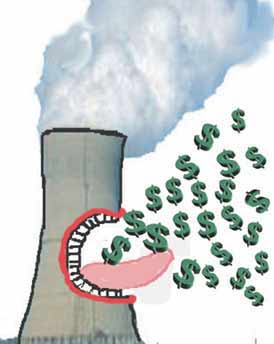 Ratepayers stuck with nuclear plant charges, Tampa Bay Times, August 7, 2012 Imagine adding a garage to a house that is about to collapse. Or installing a new radio in a rusted Chevy that’s up on blocks. Or buying bigger stoves for a closed restaurant that may never reopen. That is how ludicrous it is for Progress Energy Florida to proceed with plans to spend more than $200 million to upgrade the broken Crystal River nuclear plant that may never generate electricity again. Who is going to stop this waste of ratepayers’
money? Continue reading
Top Radiation Expert: 50 Bq/kg in humans leads to irreversible lesions in vital organs — Then top UN official refutes effects of internal radiation (VIDEO)
http://enenews.com/must-see-top-radiation-expert-50-bqkg-in-humans-leads-to-irreversible-lesions-in-vital-organs-then-top-un-official-refutes-effects-of-internal-radiation-video
December 10th, 2011
By ENENews Nuclear Controversies by Vladimir Tchertkoff; Released in 2003, 51 minutes
Key Points
Intro – Children’s perspective
2:30 – Agreement between IAEA and WHO – WHO cannot research health
effects of radiation or effects of nuclear accidents if IAEA does not
agree
7:00 – Former head of WHO admits they answer to IAEA
14:00 – Chernobyl had no effect -UN
15:45 – Scientist refutes UN
27:30 – 200km from Chernobyl, 10,000 becquerels measured inside child
30:20 – According to Professor Yury Bandazhevsky (former director of
the Medical Institute in Gomel), Over 50 Bq/kg of body weight lead to
irreversible lesions in vital organs
30:50 – *MUST SEE* Refutes internal radiation! -Norman Gentner,
Secretary of UN UNSCEAR (United Nations Scientific Committee on the
Effects of Atomic Radiation), ~2001 (See Gentner speak at 13:55 — No
increase in leukemia, even among liquidators)
34:15 – *MUST SEE* Internal or external it makes no difference!
45:20 – Internal lesions
49:25 – Now only 20 out of 100 considered healthy, before it was 80 out of 100
« WSJ: Tepco managing director says “evacuate the workers from the site” after Reactor No. 3 exploded — “Bulk of footage is available for viewing only by select journalist” Radioactive cesium reported in Kellogg’s cereal from Japan — Almost 20 becquerels per kilogram »
Tepco Tapes: Fukushima chief calls out ‘mayday, mayday’ when Reactor No. 3 exploded http://enenews.com/tepco-tapes-fukushima-chief-calls-out-mayday-mayday-when-reactor-no-3-exploded-hq-started-to-respond-as-if-he-said-he-was-going-out-to-lunch-video — HQ started to respond as if he said he was going out to lunch (VIDEO)
Published: August 6th, 2012 at 10:53 am ET
By ENENews Video of when Reactor 3 exploded posted on Nikkei.com with summary translation by EXSKF:
It was more like Plant Manager Yoshida was calling “mayday, mayday” when Reactor 3 blew up. The people at TEPCO HQ didn’t seem to comprehend what Yoshida was saying for several seconds, and started to respond as if Yoshida had just said he was going out to lunch.
They started to say “hai”, “hai” – OK, yes -, then “Uh… so it’s the same as Reactor 1? OK it’s an emergency. I will issue emergency communication then…”
[…]
Wikipedia: Mayday is an emergency procedure word used internationally as a distress signal in voice procedure radio communications. […] It is used to signal a life-threatening emergency primarily by mariners and aviators, but in some countries local organisations such as police forces, firefighters, and transportation organizations also use the term.
Nikkei has 9 videos (Japanese only) posted here
Guards replaced after Tennessee nuclear security breach By Mark Hosenball
WASHINGTON Aug 6, 2012 (Reuters) – The Energy Department said on Monday it was replacing guards and supervisors on duty 10 days ago when three peace activists, including an 82 year-old nun, breached perimeter fences at the principal U.S. facility for storing weapons-grade enriched uranium….. The U.S. government both processes and stores enriched uranium at the Y-12 complex, which a senior official had previously touted as “the Fort Knox of uranium.”….
The building was designed
and built after the September 11, 2001 Al Qaeda attacks with special
features to withstand possible attacks by militants.
In a video which the NNSA posted on YouTube in 2010, Jason Hatfield,
billed as the “operations manager”, said: “This facility has been
called the Fort Knox of uranium. Our mission is to provide safe,
secure and efficient storage for highly-enriched uranium.”….
http://www.reuters.com/article/2012/08/06/us-usa-nuclear-security-idUSBRE8751AM20120806
Fukushima – deception in the workplace
 Asahi: Disturbing picture emerging as nuclear employees come out of the woodwork — Fukushima workers report groups clocking in with no dosimeters http://enenews.com/asahi-disturbing-picture-emerging-nuclear-employees-woodwork-fukushima-workers-report-groups-clocking-dosimeters August 6th, 2012
By ENENews (Subscription Only) Title: Nuclear power plants: A hidden world of untruths, unethical behavior
Source: Asahi AJW
Author: Compiled from reports by Miki Aoki, Toshio Tada and Tamiyuki Kihara
The long and the short of it is this: Nuclear power plants probably would not operate properly in Japan if workers were not willing to sacrifice their health, and possibly their lives.
It emerges that workers at nuclear plants routinely resorted to ingenious ways to conceal the true levels of radiation to which they were exposed–simply to go on earning a living. Continue reading
Japan’s govt delaying decision on energy plans – video
NHK: With support growing for the 0% nuclear power option, gov’t to delay deadline for deciding on an energy policy (VIDEO) http://enenews.com/nhk-support-growing-0-nuclear-power-option-govt-considering-missing-deadline-decide-energy-policy-video
August 6th, 2012 By ENENews Title: Noda to examine issues to end nuclear dependence
Source: NHK World
Date: Aug. 6, 2012
Japan’s Prime Minister Yoshihiko Noda says he’ll ask his ministers to clarify what issues lay ahead if the country should end its dependence on nuclear energy.
Noda told reporters in Hiroshima on Monday that he wants to see a thorough discussion on the matter, rather than rushing to reach a conclusion.
He indicated that he won’t insist on sticking to the government’s initial target of the end of this month in deciding the country’s new energy policy.
[…]
Mitsuko Nishikawa, NHK Reporter: The Japanese gov’t plans to decide on the energy policy by the end of this month, but with support growing for the 0% nuclear power option it is considering postponing that deadline.
http://www.youtube.com/watch?feature=player_detailpage&v=WCA8MYRuXR0#t=430s
Continuing safety concerns about USA’s X ray airport scanners
X-Ray Scans at Airports Leave Lingering Worries NYT, By RONI CARYN RABIN , 6 Aug 12, Even before she was pregnant, Yolanda Marin-Czachor tried to avoid the full-body X-ray scanners that security officers use to screen airport passengers. Now she’s adamant about it: She’ll take a radiation-free pat-down instead any day. THE CONSUMERAdvice on money and health.
“I had two miscarriages before thispregnancy ,” Ms. Marin-Czachor, a 34-year-old mother and teacher from Green Bay, Wis., recalled, “and one of the first things my doctor said was: ‘Do not go through one of those machines. There have not been any long-term studies. I would prefer you stay away from it.’ ”
There are 244 full-body “backscatter” X-ray scanners in use at 36 airports in the United States. They operate almost nonstop, according to the Transportation Security Administration. Other airports use millimeter wave scanners, which look like glass telephone booths and do not use radiation, or metal detectors…..
some experts are less sanguine, and questions persist about the safety of using X-ray machines on such a large scale. A recent study reported thatradiation from the machines can reach organs through the skin . In another report, researchers estimated that one billion X-ray backscatter scans per year would lead to perhaps 100 radiation-induced cancers in the future. The European Union has banned body scanners that use radiation ; it is against the law in several European countries to X-ray people without a medical reason.
The machines move a narrowly focused beam of high-intensity radiation very quickly across the body, and David Brenner, director of the Center for Radiological Research at Columbia University Medical Center, says he worries about mechanical malfunctions that could cause the beam to stop in one place for even a few seconds, resulting in greater radiation exposure.
For security reasons, much about how the machines work has been kept secret…… John Sedat, emeritus professor of biochemistry and biophysics at the University of California, San Francisco, believes that the effective dose could be 45 times as high as the T.S.A. has estimated, equivalent to about 10 percent of a single chest X-ray……. The machines, though, have had mechanical problems. A recent T.S.A. report said that between May 2010 and May 2011, there were 3,778 service calls concerning mechanical problems in backscatter X-ray machines . Radiation safety surveys were conducted after only 2 percent of the calls.
Those at greatest risk, however, may be T.S.A. employees and others who work in the terminals and go through security daily. A 2004 National Institute for Occupational Safety and Health study of T.S.A. baggage screeners urged the agency to have employees wear film badges to monitor ongoing exposure systemically , as many hospital and lab employees do, and to label machines more prominently. The agency has not done so. http://well.blogs.nytimes.com/2012/08/06/x-ray-scans-at-airports-leave-lingering-worries/
1 This Month

of the week – Shut Down Drone Warfare!


Tell the Ukrainian Government to Drop Prosecution of Peace Activist Yurii Sheliazhenko

Petition to revoke the licensing of the Near Surface Nuclear Disposal Facility (NSDF) at Chalk River. https://www.ourcommons.ca/petitions/en/Petition/Details?Petition=e-7247
To see nuclear-related stories in greater depth and intensity – go to https://nuclearinformation.wordpress.com
-
Archives
- April 2026 (7)
- March 2026 (251)
- February 2026 (268)
- January 2026 (308)
- December 2025 (358)
- November 2025 (359)
- October 2025 (376)
- September 2025 (257)
- August 2025 (319)
- July 2025 (230)
- June 2025 (348)
- May 2025 (261)
-
Categories
- 1
- 1 NUCLEAR ISSUES
- business and costs
- climate change
- culture and arts
- ENERGY
- environment
- health
- history
- indigenous issues
- Legal
- marketing of nuclear
- media
- opposition to nuclear
- PERSONAL STORIES
- politics
- politics international
- Religion and ethics
- safety
- secrets,lies and civil liberties
- spinbuster
- technology
- Uranium
- wastes
- weapons and war
- Women
- 2 WORLD
- ACTION
- AFRICA
- Atrocities
- AUSTRALIA
- Christina's notes
- Christina's themes
- culture and arts
- Events
- Fuk 2022
- Fuk 2023
- Fukushima 2017
- Fukushima 2018
- fukushima 2019
- Fukushima 2020
- Fukushima 2021
- general
- global warming
- Humour (God we need it)
- Nuclear
- RARE EARTHS
- Reference
- resources – print
- Resources -audiovicual
- Weekly Newsletter
- World
- World Nuclear
- YouTube
-
RSS
Entries RSS
Comments RSS
 nuclear-news