Japan moving towards renewable energy
the Japanese Wind Power Association has put the longer-term wind potential at over 200 GW, on and offshore, even taking account of locational constraints. That is similar to Japans total present energy generating capacity.
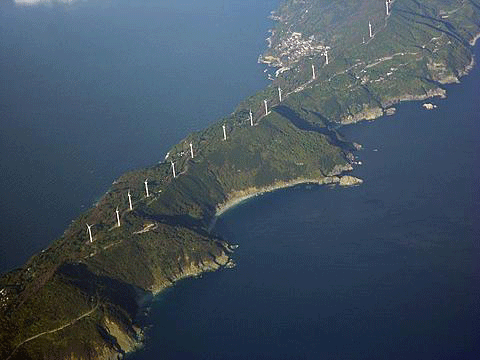
the aim would be to create a 50 trillion yen ($628 billion) green energy market by 2020 through deregulation and subsidies to promote development of renewable energy and low-emission cars.
Greening Japan’s energy http://environmentalresearchweb.org/blog/2012/07/greening-japans-energy.html 15 July 12 As part of its policy of moving away from nuclear power, the Japanese government is pushing ahead with renewables and improved energy efficiency. Given the urgent need to cut energy demand, following the shut down of all its nuclear plants in May, it encouraged voluntary energy saving initiatives, with some success.
Although, despite major protest, two nuclear plants have now been started up again, the summer air conditioning load may still present problems, and the energy savings programme is being expanded. The government has called for 15% cuts. It has also requested retailers and home appliance makers to voluntarily halt production and sale of inefficient incandescent lightbulbs. Under Japans existing basic energy plan, all lighting products were already meant to be replaced by LED or other low energy lights by 2020. Japan’s Institute of Energy Economics says that, if all incandescent bulbs/fluorescent lamps currently used were replaced by LED lights, the total annual power saved would be 9%, the equivalent output of 13 nuclear reactors.
Understandably, given that Japan is a series of relatively crowded Island with constraints on land use, the renewables programme is focused heavily on offshore resources. The government is supporting the development of a range of marine power technologies with plans for a series of trials next year. The Ministry of Economy, Trade and Industry, the Ministry of Environment and others have earmarked a total of 10 billion yen for promoting marine renewable energies in the fiscal 2012 budget. Most of the funds are for projects related to floating wind turbines.
Four different designs for offshore wind floating platforms will be installed off the coast of Fukushima in 2013 and 2014, as part of a demonstration project funded by $300m the Japanese government Ministry of Trade, Economic and Industry. Eleven companies and organisations will collaborate on ‘FORWARD’, the Fukushima floating Offshore Wind farm Demonstration project, with Japanese conglomerate Marubeni leading. Companies contributing innovative floating platform designs include IHI Marine United, Mitsubishi and Mitsui. The port of Onahama, near the city of Iwaki, will serve the Forward project. The government hopes that the Forward project will result in the emergence of one or more commercially-viable designs for offshore wind floating platforms.
Windpower Monthly reported that the first stage, in 2013, will involve installation of a floating 2MW downwind turbine, on a compact semi-submersible base. In 2014, two further turbines, 7MW designs by Mitsubishi, will be installed, one to be carried by a v-shape semi-sub and the other by an advanced spar-float, possibly like the Norwegian Sway /Hywind designs. A second demonstration project, funded by Japan’s environment ministry. in the Goto islands, is already underway with a small 110kW turbine on a floating platform. It’s planned to replace it with a 2MW turbine next year.
Given that the area, about 20km off the Fukushima coast, has suffered radioactive contamination, the future of fishing there is uncertain so there may be no conflict; indeed offshore wind could provide alternative employment for former fishermen, if this proves necessary. Certainly this industry could expand. According to early reports, Japan could have up to 1GW of offshore wind capacity in place by 2020,
In addition, Japan is following up other offshore options. The marine energy programme will be expanded in 2013 to include tidal and wave energy, along with OTEC ocean thermal gradient technologies. Tests are likely to be carried out off the Tohoku & Kyushu regions, in co-operation with the private sector and universities. In parallel, the Ocean Energy Association of Japan (OEAJ), is to set up a Japanese Marine Energy Centre (JMEC), with help from EMEC in Scotland. It’s a two-way exercise: Kawasaki Heavy Industries is to test a newly developed tidal energy system at EMEC on the Orkneys.
Some of the more developed renewables are also being pushed hard. PV solar is already in quite widespread use, and being mostly on rooftops, is not land-using, To accelerate consumer uptake, in June the government approved Feed-In Tariff (FiT) subsidies under which utilities will pay 42yen (53 U.S. cents) per kWh for solar-generated electricity, double the tariff offered in Germany and more than three times that paid in China. Despite the land use constraints, there is also some potential for on-land wind and wind power will get at least 23.1 yen/ kWh in the new FiT system, compared with as low as 4.87 euro cents (6 U.S. cents) in Germany. The new wind tariff converts to about 18p/kWh, which compares to 5p/kWh (10p/kWh offshore) available for wind projects under the Renewables Obligation in the UK. So they are really pushing it. Geothermal energy is also being backed. It is already widely used for heating. So is solar thermal- there is over 3.7GW(th) installed on rooftops . We can expect to see much more.
1 Comment »
Leave a reply to 김민우 Cancel reply
1 This Month

4 May -West Suburban Peace Coalition to discuss Iran war at May Educational Forum
Monday, May 4, 7:00 – 8:00 PM Central Standard Time
Title: : How Trump’s Narrative Tries to Shape the Reality of the War on Iran.
Contact Walt Zlotow, zlotow@hotmail.com 630 442 3045 for further information
14 May – online event From Bombs to Data Centres: the Face of Nuclear Colonialism
To see nuclear-related stories in greater depth and intensity – go to https://nuclearinformation.wordpress.com
-
Archives
- May 2026 (37)
- April 2026 (356)
- March 2026 (251)
- February 2026 (268)
- January 2026 (308)
- December 2025 (358)
- November 2025 (359)
- October 2025 (376)
- September 2025 (257)
- August 2025 (319)
- July 2025 (230)
- June 2025 (348)
-
Categories
- 1
- 1 NUCLEAR ISSUES
- business and costs
- climate change
- culture and arts
- ENERGY
- environment
- health
- history
- indigenous issues
- Legal
- marketing of nuclear
- media
- opposition to nuclear
- PERSONAL STORIES
- politics
- politics international
- Religion and ethics
- safety
- secrets,lies and civil liberties
- spinbuster
- technology
- Uranium
- wastes
- weapons and war
- Women
- 2 WORLD
- ACTION
- AFRICA
- Atrocities
- AUSTRALIA
- Christina's notes
- Christina's themes
- culture and arts
- Events
- Fuk 2022
- Fuk 2023
- Fukushima 2017
- Fukushima 2018
- fukushima 2019
- Fukushima 2020
- Fukushima 2021
- general
- global warming
- Humour (God we need it)
- Nuclear
- RARE EARTHS
- Reference
- resources – print
- Resources -audiovicual
- Weekly Newsletter
- World
- World Nuclear
- YouTube
-
RSS
Entries RSS
Comments RSS
 nuclear-news
Japan’s FiT in July is among the highest in the world. It’s clear that Japan’s FiT will shake the renewable energy market. New solutions will be showed in Japan. This is it!
Floating Wind Turbine is one of the best solutions for Japan. Japan has more install places around its shores than any other in the world. But they have to reduce vibration to install Floating Wind Turbines on the sea. Because, it makes many kinds of problems! Vibration’s caused by wind, waves and external forces. New Floating Body Stabilizer for Floating Wind Turbines has been created in South Korea. The Floating Body Stabilizers generate drag force immediately when Floating Wind Turbines are being rolled and pitched on the water. Recently, this Floating Body Stabilizers have been used to reduce vibration of Floating Solar Panels in South Korea. You can see New Floating Body Stabilizer videos in YouTube. http://youtu.be/O2oys_YHhCc, http://www.youtube.com/watch?v=nA_xFp5ktbU&feature=youtu.be.