“Regulatory Capture” by the global nuclear industry, not just Japan
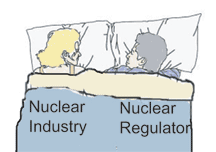 in the Japanese original of Thursday’s report…it explains the disaster in terms of “regulatory capture” – that is, that the relationship between the regulators and the regulated was much too close, enabling the regulated to subject the regulators to undue pressure and influence.
he supposedly Japanese qualities that the report outlines, such as obedience, reluctance to question authority, “sticking with the programme” and insularity, are not at all unique to Japan, but are universal qualities in all societies.
The Fukushima report hides behind the cultural curtain By claiming the disaster was ‘made in Japan’, an official report reinforces, yet does not explain, unhelpful stereotypes Naoko Shimazu guardian.co.uk, 6 July 2012 More than a year after a catastrophic earthquake and tsunami struck Japan on 11 March 2011, the Fukushima nuclear accident independent investigation commission released an 88-page report this week delivering the indictment that Fukushima could not be considered a natural disaster but a “profoundly man-made disaster”.
It went on to state that “this was a disaster ‘made in Japan’. Its fundamental causes are to be found in the ingrained conventions of Japanese culture: our reflexive obedience; our reluctance to question authority; our devotion to ‘sticking with the programme’; and our ‘insularity’.”….
.. in the Japanese original of Thursday’s report. Instead, it explains the disaster in terms of “regulatory capture” – that is, that the relationship between the regulators and the regulated was much too close, enabling the regulated to subject the regulators to undue pressure and influence. By referring to regulatory capture, the Japanese report points the finger of blame at the complex entanglement of political, bureaucratic, and financial interests dating back to the heyday of high economic growth, a thinly veiled criticism of the one-party Liberal Democratic party rule that has dominated Japan’s politico-industrial world for much of the post-1945 era. In the English edition, regulatory capture appears in the main report but not in the chairman’s message.
Bringing out the “made in Japan” argument is not helpful. It panders to the uniqueness idea and does not explain, but rather reinforces, existing stereotypes. Moreover, the supposedly Japanese qualities that the report outlines, such as obedience, reluctance to question authority, “sticking with the programme” and insularity, are not at all unique to Japan, but are universal qualities in all societies.
Putting a cultural gloss on the critical investigative report sends a confusing message to the global community – particularly when it comes from a country that is a world leader in technological sophistication. http://www.guardian.co.uk/commentisfree/2012/jul/06/fukushima-report-disaster-japan
No comments yet.
1 This Month
Chernobyl: The Lost Tapes – A good documentary on Chernobyl on SBS available On Demand for the next 3 weeks– https://www.sbs.com.au/ondemand/tv-program/chernobyl-the-lost-tapes/2352741955560

of the week–London Campaign for Nuclear Disarmament

Tell the Ukrainian Government to Drop Prosecution of Peace Activist Yurii Sheliazhenko
To see nuclear-related stories in greater depth and intensity – go to https://nuclearinformation.wordpress.com
-
Archives
- April 2026 (139)
- March 2026 (251)
- February 2026 (268)
- January 2026 (308)
- December 2025 (358)
- November 2025 (359)
- October 2025 (376)
- September 2025 (257)
- August 2025 (319)
- July 2025 (230)
- June 2025 (348)
- May 2025 (261)
-
Categories
- 1
- 1 NUCLEAR ISSUES
- business and costs
- climate change
- culture and arts
- ENERGY
- environment
- health
- history
- indigenous issues
- Legal
- marketing of nuclear
- media
- opposition to nuclear
- PERSONAL STORIES
- politics
- politics international
- Religion and ethics
- safety
- secrets,lies and civil liberties
- spinbuster
- technology
- Uranium
- wastes
- weapons and war
- Women
- 2 WORLD
- ACTION
- AFRICA
- Atrocities
- AUSTRALIA
- Christina's notes
- Christina's themes
- culture and arts
- Events
- Fuk 2022
- Fuk 2023
- Fukushima 2017
- Fukushima 2018
- fukushima 2019
- Fukushima 2020
- Fukushima 2021
- general
- global warming
- Humour (God we need it)
- Nuclear
- RARE EARTHS
- Reference
- resources – print
- Resources -audiovicual
- Weekly Newsletter
- World
- World Nuclear
- YouTube
-
RSS
Entries RSS
Comments RSS
 nuclear-news
Leave a comment