Indian Point still USA’s most dangerous nuclear plant
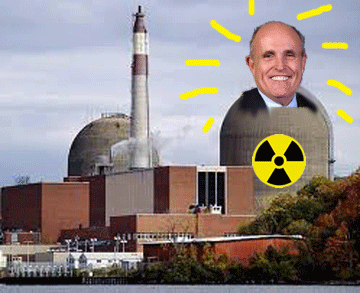 There is no protection for those fuel pools…You couldn’t see the fuel rods in fuel pool 2 because the water was so murky… it is so densely crowded with fuel rods, you can’t even get equipment in to fully inspect it …”
“There’s enough surplus power in this region to turn off Indian Point tomorrow and we won’t have any kind of shortage if we don’t do another thing until 2020,” “In the meantime, you can build two Indian Point’s worth of replacement power. You can save 30 percent of our power needs just by energy efficiency… We do not need the power —
they want to fool you into believing we do.”
Why the “Shut It Down” Crowd Won’t be Silenced Indian Point: Still America’s Most Dangerous Nuclear Plant? Counter Punch, by JOHN RAYMOND, 31 May 12 “Shut it down! Shut it down! Shut it down!” rang through the cavernous grand ballroom of the Doubletree Hotel in Tarrytown, NY, last week when the Nuclear Regulatory Commission staged an Orwellian charade promoted as an “open house” held to reassure the public that the Indian Point nuclear power plant was, as the New York Post headlined the following day, “Still Safe!”
The NRC’s annual “safety assessment” of the plant, which sits on the Hudson River 30 miles north of New York City, was based on 11,000 hours of ”inspection activities.” It found that Indian Point performed “within expected regulatory bounds” and the 25 matters that do require attention but “no additional NRC oversight,” are ‘low risk’, or have “very low safety significance.”
“So,” the Post mused, “will this finally silence the ‘shut it down’
crowd? …Don’t hold your breath.”
But do keep your fingers crossed…if you’re one of the 17.5 million
people living within 50 miles of the plant…
“The NRC’s annual assessment completely fails to address the public’s
primary concerns about Indian Point — evacuation planning, earthquake
risk and nuclear waste storage post-Fukushima,” said Phillip Musegaas,
a lawyer with Riverkeeper, an environmental group based in Ossining,
NY.
Those concerns were addressed in Riverkeeper’s briefing held in the
rear of the ballroom prior to the NRC’s hearing that night. Some
highlights:
Manna Jo Green, a member of the town council of Rosendale and
Environmental Director of Clearwater, who recently toured the plant
with the Atomic Safety and Licensing Board: “We are calling for expansion of the evacuation plan from 10 miles to 50 miles and hardening of the fuel pools. There is no protection for those fuel pools…You couldn’t see the fuel rods in fuel pool 2 because the water was so murky… it is so densely crowded with fuel rods, you can’t even get equipment in to fully inspect it …”
Like Riverkeeper, Clearwater in Beacon, NY has filed multiple
contentions with the NRC in the legal fight to deny Entergy
Corporation a 20-year license extension for Indian Point. Current
licenses for the two operating reactors expire in 2013 and 2015.
Relicensing hearings are expected to begin in October.
John Armbruster, a seismologist with Lamont Doherty Earth Observatory
of Columbia University, cited the study, published in 2008, that
revealed there was a second fault line passing near Indian Point in
addition to the Ramapo fault line.
“We believe this is a significant new development in what might happen
to Indian point. We have been asking since 2008 for our new results to
be incorporated into the hearings for the relicensing of Indian Point
– and that has been rejected as ‘outside of scope’. What was done when
Indian Point was designed 40 years ago is obsolete and Fukushima tells
us we have to prepare for the things that are very unlikely.”……
Paul Gallay, Executive Director of Riverkeeper, countered claims that
shutting down Indian Point would cause an energy shortage and lead to
blackouts. Results of a study commissioned by Riverkeeper and the
National Resources Defense Council published earlier this year
concluded otherwise.
“There’s enough surplus power in this region to turn off Indian Point tomorrow and we won’t have any kind of shortage if we don’t do another thing until 2020,” Gallay said. “In the meantime, you can build two Indian Point’s worth of replacement power. You can save 30 percent of our power needs just by energy efficiency… We do not need the power —
they want to fool you into believing we do.”…..
Stepping up to the mike, Mark Jacobson, a co-founder of the Indian
Point Safe Energy Coalition (IPSEC), asked, “Where is Entergy? Why
isn’t Entergy in the room? We want to ask them questions.”
Getting no reply, Jacobson told the panel that he had questioned
inspectors about the status of the radioactive leak under Unit 2’s
transformer yard. “They said they didn’t know. It’s a leak that’s been
likened to the size of the Central Park reservoir… and we can’t find
out about it at this annual meeting. Who are we supposed to ask?”
Indian Point’s leaks are contaminating groundwater and the nearby
Hudson River with radioactive carcinogens including strontium-90,
cesium 137, and iodine 131.
The impossibility of evacuation in the event of an accident at Indian
Point stirred the loudest protest of the night…..
http://www.counterpunch.org/2012/06/01/indian-point-still-americas-most-dangerous-nuclear-plant/
1 Comment »
Leave a reply to angelomichaelweitz Cancel reply
1 This Month

of the week– Nuclear Reactor Information Task Force

14 May – online event From Bombs to Data Centres: the Face of Nuclear Colonialism
To see nuclear-related stories in greater depth and intensity – go to https://nuclearinformation.wordpress.com
-
Archives
- May 2026 (92)
- April 2026 (356)
- March 2026 (251)
- February 2026 (268)
- January 2026 (308)
- December 2025 (358)
- November 2025 (359)
- October 2025 (376)
- September 2025 (257)
- August 2025 (319)
- July 2025 (230)
- June 2025 (348)
-
Categories
- 1
- 1 NUCLEAR ISSUES
- business and costs
- climate change
- culture and arts
- ENERGY
- environment
- health
- history
- indigenous issues
- Legal
- marketing of nuclear
- media
- opposition to nuclear
- PERSONAL STORIES
- politics
- politics international
- Religion and ethics
- safety
- secrets,lies and civil liberties
- spinbuster
- technology
- Uranium
- wastes
- weapons and war
- Women
- 2 WORLD
- ACTION
- AFRICA
- Atrocities
- AUSTRALIA
- Christina's notes
- Christina's themes
- culture and arts
- Events
- Fuk 2022
- Fuk 2023
- Fukushima 2017
- Fukushima 2018
- fukushima 2019
- Fukushima 2020
- Fukushima 2021
- general
- global warming
- Humour (God we need it)
- Nuclear
- RARE EARTHS
- Reference
- resources – print
- Resources -audiovicual
- Weekly Newsletter
- World
- World Nuclear
- YouTube
-
RSS
Entries RSS
Comments RSS
 nuclear-news
I have expressed concerns for the impact of tsunamis on nuclear power plants since around October 2004. At that time I had become aware of the approximate time, location and death toll of the Indian Ocean tsunami. I had also related parameters of other events, including the hurricanes of 2005. After Katrina, I endured some rather debilitating trauma, and struggled to make a recovery. I remained active in relaying information, and, around November 2010, I was able to [definitively] conclude that a tsunami would occur in Japan and that it would damage a nuclear facility. As I had not given a precise time for the event, I continued to deliver updates with some of my last reports stating that the tsunami was imminent occurring within 1-2 weeks of the earthquake. At this time, my main concern is for a tsunami on the west coast of America, where there are also several nuclear reactors. I have not been able to conclude any specific details at the moment, but the notion that the concern is valid and that the quake is drawing nearer to its occurrence is becoming more solidified. At this point, and previously, my estimate for the quake has been mid to late 2012. I continue to strive to garner and relay more information.