Germany leads, and Europe follows, away from nuclear energy


And today there’s even another new constituency: the green-collar workers of the renewable energy industry. They’re conspicuous at demonstrations in their work clothes and badges, yet not out of place. The almost 400,000 clean energy jobs in Germany, many in the down-trodden eastern states, and the promise of more is another sound argument in the quiver of Energiewende proponents
From Advocates to Enemies: Nuclear Decline in Germany World Policy Blog May 10, 2012 -By Paul Hockenos The fact that Germany, in the aftermath of the 2011 Fukushima disaster, redoubled its efforts to phase out nuclear energy has nothing to do with hysteria or postwar angst. On the contrary, a majority of Germans, including much of the political class, has been unconvinced of its merits since the early 1980s; the source of this anti-atom consensus lies not in emotional populism but rather in the persuasive, fact-based arguments of a powerful, grassroots social movement that has long included nuclear physicists and other bona fide experts.
During this four decade long campaign, start-up think tanks, academic scholars, and professionals with nuclear industry experience, among others, were instrumental in convincing most Germans of three main points: nuclear energy is a high-risk technology; renewable energies are viable; and there is no fail-safe way to dispose of radioactive waste.
Of the many misconceptions that cloud the perception of Germany’s energy stands, one is that Germany is somehow on its own in Europe, on the fringe of the continent’s mainstream. Continue reading
Finland’s plan for eternal storage of nuclear waste
there is the problem of time. HLW will remain dangerous for longer than civilization itself has existed. Future civilizations may not even have the ability to address the dangers—even if we could somehow warn them what they’re dealing with.

Meanwhile, the construction of new nuclear facilities continues apace, even in the U.S. Earlier this year, federal regulators granted licenses to construct two new plants in Georgia, the first such licenses in the U.S. since 1978. So our waste problem, and the world’s, will only get worse.
 Finland’s Crazy Plan to Make Nuclear Waste Disappear, Popular Mechanics, By Tim Heffernan 11 May 12, The U.S. plan to bury nuclear waste in Yucca Mountain may be dead, but in Finland, engineers are going ahead with a plan to build an enormous bunker to house the dangerous stuff. And they have a radical solution to keep future civilizations away—hide the nuclear waste somewhere so unremarkable and unpleasant that nobody would ever think to go there. Barring a disaster—or a miracle, depending on your viewpoint—the Finnish government later this year will begin the final licensing of the world’s first permanent storage facility for high-level nuclear waste. Continue reading
Allegations of data suppression at Nuclear Regulatory Commission

 Probe to Look Into Allegations at NRC, WSJ, By KEITH JOHNSON, May 10, 2012, The Nuclear Regulatory Commission’s inspector general will open an investigation into allegations that a regional supervisor sought to squelch some nuclear inspectors’ safety findings, according to an internal memo issued Thursday that defended the agency’s safety
record.
The investigation was prompted by an April 24 letter from anonymous staff in the NRC’s Western region to Rep. Ed Markey (D., Mass.), ranking member of the House energy committee. The letter said one of the region’s deputy directors had created a “corrosive environment which inhibits the ability of inspectors to identify safety-significant issues.”…. Continue reading
Germany to be nuclear free within 10 years
 includes VIDEO http://www.todaysthv.com/news/article/210528/288/Germany-plans-to-go-nuclear-free-within-a-decade Germany plans to go nuclear free within a decade, May 10, 2012 “…. Protest against nuclear energy in Germany began shortly after the Fukushima disaster in 2011 and Berlin reacted. After a safety review Angela Merkel’s government decided to shut down eight of Germany’s 17 reactors immediately and abandon nuclear energy altogether by 2022. She says, “We want to make sure that our power supply is safe,” Merkel said. “But at the same time it must be reliable.”
Germany’s answer is renewables! Aside from solar power, the country embarked on an ambitious quest to build dozens of off shore wind parks with thousands of turbines in the North and Baltic Seas. Most of the assembly happens in the northern town of Bremerhaven and local officials say the rush into renewables has led to an economic boom here. Nils Schnorrenberger says, “We had an unemployment rate of 25 per cent six years ago. Now it is 14 per cent and the companies gave 2000 people jobs just here in Bremerhaven.”..
. Ever since the Chernobyl disaster, Germans have had a troubled relationship with
nuclear energy with regular protests against new plants and nuclear waste transports. Since Fukushima, however, the country’s decision to quit atomic power seems irreversible, even in the face of challenges and uncertainties ahead. http://www.todaysthv.com/news/article/210528/288/Germany-plans-to-go-nuclear-free-within-a-decade
Archival test results of low level radiation do NOT show health benefits
 Reactor casualties 4 – The phony lost archive versus the real one. Paul Langley’s Nuclear History Blog, 11 May 12, In a recent issue of “Nature” claims are made of a “lost archive” of Cold War era animal tissue. The animals had been injected with radioactive isotopes in the USSR and the USA. 1,000s of animals were involved. Both nations’ governments wanted to know the effect of internalised substances which were radioactive. The claim in “Nature” involves the supposed recent “discovery” of these lost archives of tissue in both countries. Lo and behold, the quoted scientist claims that the tissue “proves” the health benefits of low dose radiation. Sound familiar?
Nuclear capable missile tested by Pakistan

 Pakistan tests nuclear-capable ballistic missile, Daily Times, 11 May 12, ISLAMABAD: Pakistan carried out a successful test firing of a short-range nuclear-capable ballistic missile on Thursday, the military said. The launch of the Hatf III, which has a range of up to 290 kilometres and can also carry conventional warheads, came at the end of a field training exercise, a military statement said. Two weeks ago Pakistan test-fired an intermediate range ballistic missile, seen as a response to India’s launch of its new long-range Agni V, capable of hitting targets anywhere in China……http://www.dailytimes.com.pk/default.asp?page=2012%5C05%5C11%5Cstory_11-5-2012_pg7_7
Unnecessary, expensive and dangerous new NATO nuclear weapons
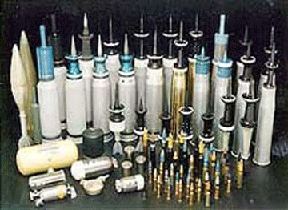 “The planned upgrade of Nato’s tactical nuclear forces in Europe will be expensive and is unnecessary. Nato states are fully secure without this additional capability and should be focused on removing all tactical nuclear weapons from Europe, not on modernising them”.
Nato plans to upgrade nuclear weapons ‘expensive and unnecessary’ http://www.guardian.co.uk/world/2012/may/11/nato-nuclear-weapons-upgrade Proposals to modernise nuclear arsenal will heighten tensions with Russia, warns thinktank backed by ex-ministers, Richard Norton-Taylor guardian.co.uk, Friday 11 May 2012 Nato’s plans to upgrade the US’s estimated 180 tactical nuclear weapons in western Europe are unnecessary, expensive and likely to exacerbate already difficult relations with Russia, according to a report. Continue reading
The history of Germany’s anti nuclear movement
The Germans also had an anti-nuke party as of 1980, namely the Greens, who carried the concerns of the mass movement into the national parliament, the Bundestag. No other country in the world has had a force so determined and influential in taking on the powerful atomic energy lobby.
From Advocates to Enemies: Nuclear Decline in Germany World Policy Blog May 10, 2012 -By Paul Hockenos “……….it wasn’t until the early 1970s when protests broke out in Germany’s southwestern-most corner that Germans began looking twice at the nuclear power facilities and waste repositories in their backyards. The anti-nuclear energy movement was born in the wine-growing region of the Black Forest abutting the borders of Switzerland and France’s Alsace-Loraine. There, in the tiny hamlet of Wyhl, the area’s staunchly conservative farmers, joined by left-wing activists from the nearby university city of Freiburg, as well as concerned French and Swiss citizens, organized to stop the construction of a planned reactor.
The Wyhl coalition bore many of the characteristics that would define the movement for years to follow: It was locally led, politically diverse, and committed to non-violent civil disobedience. Initially, the farmers’ objection was that the steam clouds from the reactor’s cooling towers would block the sun light in their vineyards, not that radioactivity as such was a hazard. This changed as the community learned more about the health effects of low-level radiation, such as that produced by nuclear power plants on pregnant women in their vicinity.
Against all odds, the Wyhl coalition forced the utility giant to back down and scrap its plans. Continue reading
Saudi Arabia’s $109 billion solar energy plan

 Saudi Arabia Plans $109 Billion Boost for Solar Power Bloomberg, By Wael Mahdi and Marc Roca – May 10, 2012 Saudi Arabia is seeking investors for a $109 billion plan to create a solar industry that generates a third of the nation’s electricity by 2032, according to officials at the agency developing the plan….
“We are not only looking for building solar plants,” al- Odan said in an interview in Riyadh yesterday. “We want to run a sustainable solar energy sector that will become a driver for the domestic energy for years to come.”…
Nuclear free Mid East meeting now doubtful
Mideast Nuclear Meeting in Doubt , WSJ, 10 May 12, By JAY SOLOMON, WASHINGTON—Plans for a United Nations-backed conference aimed at ridding the Middle East of nuclear weapons are unraveling because of political upheaval in the region and diplomatic sparring over suspected nuclear-weapons programs in Iran and Israel, said officials involved in the event’s preparations. Continue reading
A new book on a crime against humanity – nuclear warfare
 Taking a stand against nuclear war The Star, Malaysia, By LIM WEY WEN KUALA LUMPUR: Nuclear war is a crime against humanity and it has to be prevented, said Canadian academic Prof Michel Chossudovsky .
That was the reason he wrote a book in an effort to prevent nuclear war.
“Death by radiation is gradual, and the effects could spread,” said the author of Towards a World War III Scenario: The Dangers of Nuclear War. “I am a writer and a researcher, and this book is there to sensitise public opinion (on nuclear warfare).
“(The book) is to present the facts and to point to the fact that in the wake of Sept 11, 2001, there has been a very significant redefinition of nuclear doctrine in terms of the US military.”
He said this after the launch at the Perdana Global Peace Foundation (PGPF) here….. Prof Chossudovsky asserts the world is at a very critical crossroad as the line between nuclear and conventional weapons becomes increasingly blurred.
He warns of the development of “new-generation nuclear weapons” that are touted to be “safe” for the surrounding civilian population.
“The distinction between conventional and nuclear weapons has been totally blurred and the wars of the 21st century are going to be waged with a combination of both,” he said….. http://thestar.com.my/news/story.asp?file=/2012/5/11/nation/11264133&sec=nation
Renewable energy chosen by island nations
 Climate Conversations – Island nations commit to renewable energy Alert Net By Veerle Vandeweerd, 11 May 12, Jamaica is a nation on a mission for sustainable energy for all. The government spent $2.2 billion – or 40 percent – of its foreign exchange earnings on
importing fossil fuels in 2011. So they decided to make a change.
They turned to the nature around them – the sunshine, waterfalls and rivers – investing in renewable energy. By 2030, 30 percent of Jamaica’s energy will come from renewables. Continue reading
More airport radiation scanners for USA
 TSA may buy more controversial scanners, Sun Sentinel, May 08, 2012|By Ken Kaye, Despite the controversy over whether they pose a health risk, the Transportation Security Administration says it may purchase even more airport scanners that emit radiation to check passengers.
TSA spokesman Jonathan Allen said in coming months the agency plans to test software that would allow radiation-emitting scanners, known as backscatter units, to generate generic body images. Currently, these units generate naked images that resemble chalk etchings of passengers.
“When that software meets TSA’s standards and is successfully tested in an airport environment, TSA could purchase and deploy additional backscatter units,” he said…..
http://articles.sun-sentinel.com/2012-05-08/news/fl-tsa-radiation-scanners-20120508_1_airport-scanners-backscatter-tsa-administrator-john-pistole
1 This Month



Tell the Ukrainian Government to Drop Prosecution of Peace Activist Yurii Sheliazhenko

Petition to revoke the licensing of the Near Surface Nuclear Disposal Facility (NSDF) at Chalk River. https://www.ourcommons.ca/petitions/en/Petition/Details?Petition=e-7247


of the week – STOP SMALL MODULAR REACTORS IN CANADA
To see nuclear-related stories in greater depth and intensity – go to https://nuclearinformation.wordpress.com
-
Archives
- March 2026 (222)
- February 2026 (268)
- January 2026 (308)
- December 2025 (358)
- November 2025 (359)
- October 2025 (376)
- September 2025 (258)
- August 2025 (319)
- July 2025 (230)
- June 2025 (348)
- May 2025 (261)
- April 2025 (305)
-
Categories
- 1
- 1 NUCLEAR ISSUES
- business and costs
- climate change
- culture and arts
- ENERGY
- environment
- health
- history
- indigenous issues
- Legal
- marketing of nuclear
- media
- opposition to nuclear
- PERSONAL STORIES
- politics
- politics international
- Religion and ethics
- safety
- secrets,lies and civil liberties
- spinbuster
- technology
- Uranium
- wastes
- weapons and war
- Women
- 2 WORLD
- ACTION
- AFRICA
- Atrocities
- AUSTRALIA
- Christina's notes
- Christina's themes
- culture and arts
- Events
- Fuk 2022
- Fuk 2023
- Fukushima 2017
- Fukushima 2018
- fukushima 2019
- Fukushima 2020
- Fukushima 2021
- general
- global warming
- Humour (God we need it)
- Nuclear
- RARE EARTHS
- Reference
- resources – print
- Resources -audiovicual
- Weekly Newsletter
- World
- World Nuclear
- YouTube
-
RSS
Entries RSS
Comments RSS
 nuclear-news