USA’s laughable “Nuclear Waste Confidence Rule”
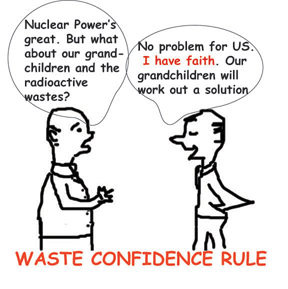 Public comments needed against NRC’s Nuclear Waste Confidence Game , Beyond Nuclear 25 Feb 12, The U.S. Nuclear Regulatory Commission (NRC) has requested public comments on its latest revision to its “Nuclear Waste Confidence Decision.” Please email your comments before March 19th to WCOutreach@nrc.gov in order to head off this latest round of a very dangerous “game being played” by NRC, which is doing the bidding of the nuclear power industry…..
The NRC’s “confidence” that on-site storage for 120 years (60 during reactors operations, 60 after reactor shutdown) is safe and secure would be laughable, if it weren’t so seriously wrong. 120 years is half as long as the United States has been an independent country (1776 to 2012, 236 years). A lot can go wrong in 120 years. NRC’s consideration of 200 to 300 years of on-site storage is even more preposterous. This is not “interim” or “temporary” on-site storage. This is de facto permanent on-site storage, in any common understanding of the term…..
BACKGROUND
First promulgated in 1984, NRC’s “Nuclear Waste Confidence Decision” claimed that by 2007, the U.S. would open one or more repositories for the permanent disposal of irradiated nuclear fuel. In the meantime, NRC expressed its “confidence” that irradiated fuel stored in pools or dry casks on-site would be done so safely and securely. This served as legal cover, carte blanche, for nuclear utilities to generate an unlimited amount of high-level radioactive waste, while blocking concerned citizens and environmental groups intervening in NRC proceedings from challenging new reactor license applications or old reactor license extensions on such grounds as the fact that there is no safe solution to the problem of radioactive waste management.
By 1990, NRC already had to “postpone” its “confidence.” It revised its “Confidence Decision” to now say that by 2025, at least one repository would be opened.
In December 2010, NRC revised its “Nuclear Waste Confidence Decision” yet again, to reflect the reality of the Obama administration’s wise decision to cancel the Yucca Mountain dump. NRC now declared no date certain for the opening of the first repository, but rather stated that on-site storage in pools and/or dry casks was safe for 120 years — 60 years during reactor operations, and 60 years after reactor shutdown. In addition, the five NRC Commissioners ordered their staff to study the potential for on-site storage lasting 200 to 300 years into the future. That explains NRC current request for public comments….
Please submit comments to WCOutreach@nrc.gov. You may also send comments through the U.S mail to: Christine Pineda, Project Manager; Mailstop EBB-2B2; Office of Nuclear Material Safety and Safeguards; U.S. Nuclear Regulatory Commission; Washington, DC 20555-0001 http://www.beyondnuclear.org/radioactive-waste-whatsnew/2012/2/23/public-comments-needed-against-nrcs-nuclear-waste-confidence.html
Japan banking on non-viable reprocessing, because it has nowhere to put nuclear wastes
the government has delegated the task of dealing with waste to the private sector, so there is no central decision-maker
 “Why does the government stick to the very costly recycle policy? That is because if they give it up, they should explain where a final repository will be located,”
 Beyond Fukushima Japan faces deeper nuclear concerns, Vancouver Sun, By RISA MAEDA, Reuters February 24, 2012 TOKYO“…..A DECENT BURIAL With Japan’s recycling efforts running so far behind the required pace
to deal with the waste problem, Japan needs to find another resting place for its waste, away from nuclear power plants, which are typically located on the coast.

But unlike France and the United States, the world’s biggest atomic power generators, Japan does not have much in the way of geologically stable and empty landscapes in which to bury nuclear waste for centuries. Given its population density is 10 times higher than the United States and almost three times higher than France, Japan faces a “not in my backyard” problem like no other big nuclear-power nation. Continue reading
Europe’s costly mess about burying the dead nuclear reactors
Auditors criticise decommissioning of nuclear reactors in Eastern Europe European Energy Review, By Hughes Belin, 24 Feb 12 The European Court of Auditors (ECA), which checks the management of EU money, has published a highly critical report on the management of the EU’s financial assistance for the decommissioning of eight nuclear reactors in Bulgaria (Kozloduy), Lithuania (Ignalina) and Slovakia (Bohunice).
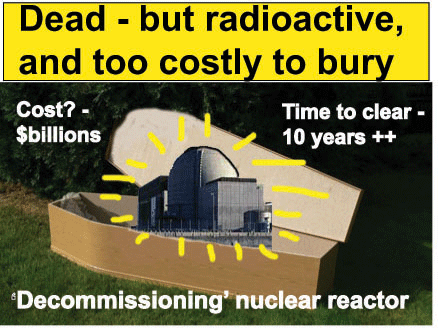
As one “Green” member of the European Parliament puts it, the ECA’s report shows ‘the enormous hidden costs of nuclear energy’. Continue reading
Kuwait scraps nuclear power project
 Kuwait abandons nuclear power option Feb. 23, 2012, KUWAIT CITY, Feb. 23 (UPI) –– Kuwait has decided to abandon civilian nuclear power production…. Kuwait is scrapping plans formulated last July to build four nuclear reactors by 2022.
Officials at the Kuwaiti government at the Kuwait Institute for Scientific Research made the announcement, Kyodo news agency reported Wednesday. Kuwait Institute for Scientific Research scientist Osama al-Sayegh and two colleagues said the Fukushima incident resulted in the public questioning the necessity of building nuclear power plants in oil-rich Kuwait.
There was also the question of where Kuwait would store the radioactive waste generated by the NPPs…… Read more: http://www.upi.com/Business_News/Energy-Resources/2012/02/23/Kuwait-abandons-nuclear-power-option/UPI-63001330021334/#ixzz1nQxkSo5S
Naomi Wolf on the future of nuclear power
Q&A with Naomi Wolf: America’s nuclear future, Guardian UK, 24 Feb 12, After the Fukushima disaster, Germany ditched nuclear power. So why has the US stopped worrying and learned to love nukes?
This week, Naomi wrote about nuclear power, nuclear weapons and nuclear safety, as the Obama administration prepares to go ahead with a new expansion of both a civilian nuclear power program and nuclear weapons-producing facilities.
Is America’s nuclear industry unsafe at any size? How will the US meet emissions targets and move beyond a fossil-fuel energy economy without nuclear power, as some environmental activists have accepted is necessary?
Naomi will be joining commenters for her weekly live webchat here in the discussion thread from 1pm till 2pm EST (6-7pm UK time). Commenting will be switched on then, and the thread will remain open afterwards. http://www.guardian.co.uk/commentisfree/cifamerica/2012/feb/24/qanda-naomi-wolf-americas-nuclear-future?newsfeed=true
At Nuclear Security Summit, japan will raise problem of terrorist attacks on nuclear plants
 Japan to propose backup power sources in event of nuclear terrorism, Mainichi Daily News 25 Feb 12, TOKYO (Kyodo) –– The government intends to propose at a global nuclear security summit next month the creation of backup systems to secure power supplies in the event that electricity sources are lost due to terrorist attacks against nuclear plants, government sources said Thursday.
Japan intends to make the proposal at the Nuclear Security Summit to be held March 26 to 27 in Seoul, and incorporate it in a document to be adopted at the meeting, the sources said.
The government, drawing lessons from the nuclear crisis at the Fukushima Daiichi power plant, will also emphasize the need to map out detailed procedures on how to deal with potential terrorist attacks on nuclear plants, they said…… http://mdn.mainichi.jp/mdnnews/news/20120224p2g00m0dm022000c.html
Is a Saudi Arabian nuclear bomb a bigger danger than Iran’s?
Unsurprisingly, many US politicians are extremely worried about a Saudi bomb. As in the case of Pakistan, Saudi Arabia had what one might call ‘fluid’ ties to Islamist terrorists.

 Never mind Iran, is Saudi Arabia about to acquire a nuclear bomb? Mail Online, By MICHAEL BURLEIGH, 24th February 2012 Both Saudi Arabia and the Gulf Cooperation Council maintain that they want a WMD-free Middle East. However, key members of the Saudi royal elite have recently signalled that if Iran develops a nuclear weapon, then Saudi Arabia will get one too.
Speaking of signalling, they have also long indicated that if Israel were to overfly the desert kingdom to bomb Iranian nuclear sites, they would temporarily turn their radars off.
Saudi Arabia has signed nuclear technology agreements with several
states: China, France, Argentina and South Korea, Continue reading
Rocky Flats nuclear weapons site still contaminated with plutonium
 The Rocky Mountain Peace and Justice Center hired independent contractors to test the soil and find out what the level of present plutonium contamination really looks like – but they were barred from actually entering the refuge. Instead, they tested the soil along the outside of the fence, and found that the level of contamination hasn’t changed since the 1970s.
 Plutonium particles in the soil at Rocky Flats will one way or another, sooner or later, come into people’s lungs and lives, since, with a half-life of 24,000 years, it poses a radiation hazard essentially forever
the Rocky Mountain Peace and Justice Center has filed a lawsuit to attempt to block any construction.
Former Colorado Nuclear Weapons Plant Just As Contaminated 40 Years Later http://www.care2.com/causes/former-colorado-nuclear-weapons-plant-just-as-contaminated-40-years-later.html, Care 2, by Julie Rodriguez February 24, 2012 16 miles northwest of Denver, CO sits the Rocky Flats site, formerly home to a plant that produced nuclear weapons from 1952-1989. These operations were shut down for repeated safety violations, which whistleblowers started bringing to the attention of the EPA and FBI in 1987. The extent of the contamination of the site was never revealed publically. Continue reading
Nuclear reprocessing not a viable option for Japan
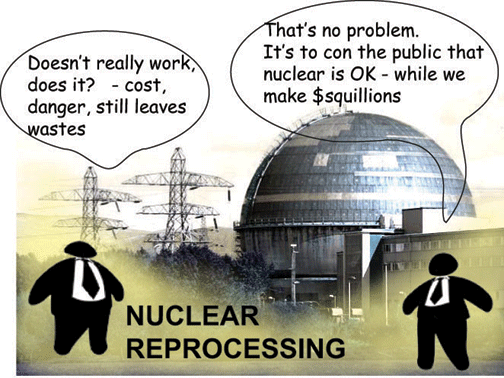 Fast-breeder said realistic no more, Japan Times, 25 Feb 12, Kyodo A panel of experts reviewing the nuclear fuel cycle policy in light of the Fukushima crisis has agreed that while a fast-breeder reactor has advantages, from a technology viewpoint it can’t be considered a realistic option for the next 20 to 30 years. The nuclear fuel policy involves reprocessing spent fuel to produce plutonium that can be reused to produce electricity.
The subcommittee of the Japan Atomic Energy Commission said in a draft document summarizing its discussions that two viable options during the next few decades would be to not reprocess spent nuclear fuel, and to recycle plutonium-uranium mixed oxide fuel, or MOX fuel.
The former option is called the “once-through” cycle, in which uranium fuel is used in nuclear reactors just one time and disposed of by burying it in the ground. In the latter option, MOX fuel is manufactured from plutonium recovered from spent nuclear fuel and used
in ordinary reactors. Continue reading
Chernobyl, Fukushima teach us that nuclear power is not worth the risk
Nuclear plant risks are not worth it, Green Bay Press Gazette, Mary Tordeur,24 Feb 12, “………Fukushima cannot be considered a small incident that can easily be corrected. It caused a great area to be uninhabitable, as well as a risk to the health of the entire nation’s population for generations to come.
The 1986 Chernobyl disaster caused 6,000-8,000 deaths due to cancer and other radiation-related illnesses, another 15,000 suffering related diseases since 1992, along with 32 deaths from the explosion itself, according to a story in the Press-Gazette story in 1992.
Cleanup costs were estimated to hit $400 billion. It caused a lethal cloud that drifted over Europe, risking the health of millions and contaminating water, livestock, milk, hay and food crops. It left 1,000 square miles highly contaminated and nearly 3 million acres of
agricultural land considered lost for a century. It was estimated there could be 1 million extra cancers worldwide within 70 years of Chernobyl. Continue reading
Tonga aiming for 50% renewable energy by 2015
Tonga has set its renewable energy target at 50% by 2015, and already has a plan
(the Tonga Energy Roadmap) for how it will achieve this lofty figure.
Tonga is receiving financial support from New Zealand and technical support from the Renewable Energy & Efficiency Program (REEP) in the development of its renewable energy projects
Tonga Starts on its Plan to Achieve 50% Renewable Energy by 2015, Oil Price, By Charles Kennedy , 24 February 2012 As oil prices increase, steady oil supplies become more uncertain, and CO2 emissions continue to increase, many countries around the world are trying to invest in renewable energy sources. Continue reading
Some progress in USA – North Korea nuclear talks
U.S. nuclear talks with N. Korea produce progress but no breakthrough, Washington Post, By Chico Harlan, February 24, TOKYO — The United States’ nuclear negotiations with North Korea ended Friday with “a little bit of progress” but no breakthrough, said chief U.S. negotiator Glyn Davies, who hinted that a long and slow process will determine Pyongyang’s willingness to swap its weapons program for aid. Continue reading
Forceful opposition to renewing license for Pilgrim nuclear power plant
Pilgrim is one of the 23 reactors in the United States that is of the exact same design of the Fukushima reactors
Ms. Lampert also accused the federal government of bowing to corporate interests by disregarding the NRC’s own cautionary findings that these types of reactors should not be allowed to operate.
a 1990 Massachusetts Department of Health study pointed out elevated levels of leukemia among residents living in the region around Pilgrim Power
Opponents To Pilgrim Nuclear Power Plant Turn Out In Force For Panel Discussion, Cape News.net, 24 Feb 12 “……The panel they came to hear from included Carolyn O’Connor, director of external affairs for ISO New England, the entity that oversees the power grid in the region, state Senator Daniel A. Wolf, and Mary E. Lampert, founder and director of Pilgrim Watch and a longtime health and safety advocate.
Entergy Nuclear, the owner of the Pilgrim plant, declined an invitation to have a representative speak at the forum. Continue reading
Our generation should not pass the nuclear problem on to our grandchildren, says US Senator
Senator Wolf calls for Pilgrim nuclear plant shutdown By Rich Eldred, Herald news, Cape Codder, Feb 24, 2012 CAPE COD — State Sen. Dan Wolf, who represents most all of Barnstable County, called for the shutdown of the Pilgrim Nuclear Power Plant at a forum
sponsored by the Cape and Islands Renewable Energy Collaborative Wednesday night at Cape Cod Community College..
… Wolf said if this was a brand new proposed plant it would never be built in Plymouth, close to so many people. Pointing to two 13-year olds in the audience he said, “When you’re 32 you’re going to have to figure out what you’re going to do with a 60-year old piece of technology. Our generation is kicking the can down the road.”..
Taiwanese will march for a nuclear power free homeland
Anti-nuclear rallies set for March 11 Taipei Times, Staff Writer, with CNA 25 Feb 12, Nearly 20 local non-governmental organizations (NGO) yesterday urged the public to take to the streets on March 11, the first anniversary of Japan’s devastating earthquake and tsunami, to demand that the government scrap plans for further construction of nuclear power plants.
The organizers said they hope to draw more than 10,000 demonstrators in rallies to be held in Taipei, Greater Taichung and Greater Kaohsiung. The march would mark continuing efforts to build local momentum amid global concerns over nuclear safety, the organizers said.
The action is also aimed at pushing the government to commit to a nuclear-free homeland, said Tsui Su-hsin (崔傃欣), secretary-general of the Green Citizens’ Action Alliance, one of the participating NGOs. Continue reading
1 This Month

of the week – Shut Down Drone Warfare!


Tell the Ukrainian Government to Drop Prosecution of Peace Activist Yurii Sheliazhenko

Petition to revoke the licensing of the Near Surface Nuclear Disposal Facility (NSDF) at Chalk River. https://www.ourcommons.ca/petitions/en/Petition/Details?Petition=e-7247
To see nuclear-related stories in greater depth and intensity – go to https://nuclearinformation.wordpress.com
-
Archives
- March 2026 (230)
- February 2026 (268)
- January 2026 (308)
- December 2025 (358)
- November 2025 (359)
- October 2025 (376)
- September 2025 (257)
- August 2025 (319)
- July 2025 (230)
- June 2025 (348)
- May 2025 (261)
- April 2025 (305)
-
Categories
- 1
- 1 NUCLEAR ISSUES
- business and costs
- climate change
- culture and arts
- ENERGY
- environment
- health
- history
- indigenous issues
- Legal
- marketing of nuclear
- media
- opposition to nuclear
- PERSONAL STORIES
- politics
- politics international
- Religion and ethics
- safety
- secrets,lies and civil liberties
- spinbuster
- technology
- Uranium
- wastes
- weapons and war
- Women
- 2 WORLD
- ACTION
- AFRICA
- Atrocities
- AUSTRALIA
- Christina's notes
- Christina's themes
- culture and arts
- Events
- Fuk 2022
- Fuk 2023
- Fukushima 2017
- Fukushima 2018
- fukushima 2019
- Fukushima 2020
- Fukushima 2021
- general
- global warming
- Humour (God we need it)
- Nuclear
- RARE EARTHS
- Reference
- resources – print
- Resources -audiovicual
- Weekly Newsletter
- World
- World Nuclear
- YouTube
-
RSS
Entries RSS
Comments RSS
 nuclear-news