Direct current (DC) the way of the future, with renewable energy
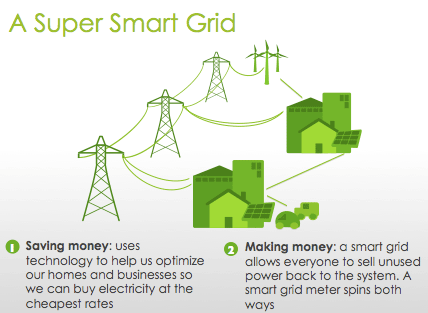 The main factor driving demand is the need to conserve energy and produce more of it from renewable sources. Alternating current is generated by rotating engines, but renewable sources such as wind and solar produce DC power.
DC can now be transmitted at high voltage over very long distances, longer than AC. It can be easily used in cables, over ground or under the sea.
“I’d put my money on the sun and solar energy,” – [Edison said]
 Insight: How renewable energy may be Edison’s revenge, Reuters, By Sara Ledwith LONDON | Tue Dec 20, 2011 “……The American inventor, who made the incandescent light bulb viable for the mass market, also built the world’s first electrical distribution system, in New York, using “direct current” electricity. DC’s disadvantage was that it couldn’t carry power beyond a few blocks. His Serbian-born rival Tesla, who at one stage worked with Edison, figured out how to send “alternating current” through transformers to enable it to step up the voltage for transmission over longer distances……
from the late 1800s, AC became the accepted form to carry electricity in mains systems. For most of the last century, the power that has reached the sockets in our homes and businesses is alternating current.
Now DC is making a comeback, becoming a promising money-spinner in renewable or high-security energy projects. From data centers to long-distance power lines and backup power supplies, direct current is proving useful in thousands of projects worldwide…
FROM CLOUD TO MICROGRID
The main factor driving demand is the need to conserve energy and produce more of it from renewable sources. Alternating current is generated by rotating engines, but renewable sources such as wind and solar produce DC power. To use it, because of the way our buildings are wired, we first convert it to AC.
Another thing that’s happened since Edison’s time is the advent of the semiconductor. Semiconductors need DC power, and are increasingly found in household appliances. These have to convert the AC supply back to DC, which is a waste of energy and generates heat. In the early years of industrialization this wasn’t an issue, but today it’s important, especially in the huge and fast-growing business of cloud computing……..Direct current may be one way to increase efficiency and reduce emissions……
Swiss-Swedish engineering firm ABB, a big DC advocate, says about 35 percent of demand for green data centers will come from the United States, 30 percent from Europe, and the rest spread globally.
Every day, says ABB, we all send more than 300 billion emails and 250 million tweets globally. The centers to handle all this data are growing by 10 percent each year and already consume 80 million megawatt-hours of energy annually — almost 1.5 times the amount of electricity used by the whole of New York City. They’re also responsible for about 2 percent of global carbon emissions.
DC power could help. At low voltages it has long been used in data centers but will be “game-changing” at higher voltages, ABB says.
Beyond its potential in data centers, DC power’s ability to run on renewable energy sources makes it interesting for important plants that need to operate in “island mode” — independent of the grid — in case of a supply failure. Building systems with small, self-contained electricity distribution networks known as microgrids is of particular interest to governments and militaries who worry about terrorist attacks.
“In our view the market (for microgrids) is about to take off,” said Pike Research’s Asmus, who also sees demand for microgrids in countries that aren’t densely covered by AC grids, such as Australia and India, and in developing countries looking to replace costly and wasteful diesel generators.
SMART GRIDS
And it’s not just “island mode.” Thanks to power electronics – semiconductor switching devices – DC can now be transmitted at high voltage over very long distances, longer than AC. It can be easily used in cables, over ground or under the sea.
High voltage direct current (HVDC) systems are the backbone of plans for smart grids, or supergrids, which aim to channel energy from places where power sources such as sunlight and hydropower are abundant to countries where it is scarce.
Siemens, which vies with ABB for market leadership in HVDC transmission, says demand is increasing fast……
How would Edison see all this? He might even have foreseen it. “I’d put my money on the sun and solar energy,” he reportedly told his associates Henry Ford and Harvey Firestone in the 1930s. “What a source of power! I hope we don’t have to wait until oil and coal run out before we tackle that.” http://www.reuters.com/article/2011/12/20/us-power-acdc-idUSTRE7BJ0PW20111220.
1 Comment »
Leave a reply to Isabella Kauffman Cancel reply
1 This Month
Chernobyl: The Lost Tapes – A good documentary on Chernobyl on SBS available On Demand for the next 3 weeks– https://www.sbs.com.au/ondemand/tv-program/chernobyl-the-lost-tapes/2352741955560

of the week–London Campaign for Nuclear Disarmament

Tell the Ukrainian Government to Drop Prosecution of Peace Activist Yurii Sheliazhenko
To see nuclear-related stories in greater depth and intensity – go to https://nuclearinformation.wordpress.com
-
Archives
- April 2026 (173)
- March 2026 (251)
- February 2026 (268)
- January 2026 (308)
- December 2025 (358)
- November 2025 (359)
- October 2025 (376)
- September 2025 (257)
- August 2025 (319)
- July 2025 (230)
- June 2025 (348)
- May 2025 (261)
-
Categories
- 1
- 1 NUCLEAR ISSUES
- business and costs
- climate change
- culture and arts
- ENERGY
- environment
- health
- history
- indigenous issues
- Legal
- marketing of nuclear
- media
- opposition to nuclear
- PERSONAL STORIES
- politics
- politics international
- Religion and ethics
- safety
- secrets,lies and civil liberties
- spinbuster
- technology
- Uranium
- wastes
- weapons and war
- Women
- 2 WORLD
- ACTION
- AFRICA
- Atrocities
- AUSTRALIA
- Christina's notes
- Christina's themes
- culture and arts
- Events
- Fuk 2022
- Fuk 2023
- Fukushima 2017
- Fukushima 2018
- fukushima 2019
- Fukushima 2020
- Fukushima 2021
- general
- global warming
- Humour (God we need it)
- Nuclear
- RARE EARTHS
- Reference
- resources – print
- Resources -audiovicual
- Weekly Newsletter
- World
- World Nuclear
- YouTube
-
RSS
Entries RSS
Comments RSS
 nuclear-news
I have realized that of all different types of insurance, health insurance coverage is the most controversial because of the turmoil between the insurance plan company’s duty to remain adrift and the customer’s need to have insurance policy. Insurance companies’ commissions on health plans are very low, as a result some companies struggle to gain profits. Thanks for the tips you write about through this website. Visit my webpage . thx..!