Japan’s anti nuclear Occupy movement determined to make Japan nuclear free
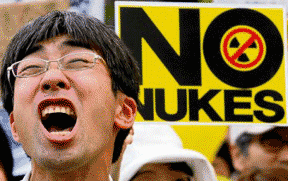 Anti-nuclear protestors sit tight at Japanese ministry, BUSINESS RECORDER NOVEMBER 18, 2011 TAKEHIKO KAMBAYASHA Anti-nuclear activist Tadao Eda says he and other citizens will continue their sit-in at the Industry Ministry for as long as Japan is running nuclear power stations despite the ongoing crisis at a damaged plant in the north-east.
“Japan needs drastic changes in energy policy by scrapping all the nuclear reactors,” Eda says from his tent erected in a corner of the ministry’s grounds two months ago. “We won’t allow the government to restart idled reactors” after they are shut down for maintenance, he says.
All of Japan’s 11 reactors still in operation, are scheduled to be shut down for servicing by April, he says. If the government withholds permission for them to restart, Japan would be free of nuclear power. “That’s an immediate goal,” Eda says outside the ministry, which has promoted the country’s nuclear-dependent energy policy for decades.
The country’s other 43 reactors are either currently being inspected, or have been shut down in the wake of the March 11 earthquake and tsunami…..round 1,300 people turned out last week to form a human chain around the ministry, despite the rain.
In other parts of the country, people have also been taking to the streets. On Sunday, on the southern island of Kyushu, the site of another nuclear power plant, 15,000 people demonstrated to call on the government to scrap all of the nation’s 54 reactors.
In Tokyo, many women involved in the protest at the industry ministry have also called for the immediate evacuation of all children in Fukushima prefecture, to protect them from the leaked radiation. Members of the Fukushima Network for Saving Children from Radiation met industry ministry officials in early November with the same request.
High levels of radiation have been detected 60 kilometres from the damaged Fukushima plant, well beyond the 20-kilometre official exclusion zone in place since April.
Chieko Shiina, a leader of the Fukushima-based group who joined the sit-in protest at the ministry, says, “The government has been trying to hide truths on the disaster.
Many children and babies have been left behind in the disaster zone.” The protest “is a way to take direct action to convey our voices to the government,” Shiina says.
Some see a link with the high-profile “occupy” protests in Western countries, which call for action against the capitalist economy and the growing gap between rich and poor. Tanaka, who covered the anti-Wall Street protests in New York, has dubbed the tent protest in Tokyo “Occupy Industry Ministry.” The nuclear situation in Japan does have a wealth dimension, Shiina says.
Many of the nuclear plants are in the country’s poorest regions, so the risk they pose to locals is underestimated.
The relative poverty of the region is one reason the government “abandoned Fukushima” after the disaster, she says.HTTP://WWW.BRECORDER.COM/ARTICLES-A-LETTERS/SINGLE/626/187/1252284/
1 Comment »
Leave a reply to nuclearwindsatomiclies Cancel reply
1 This Month
Chernobyl: The Lost Tapes – A good documentary on Chernobyl on SBS available On Demand for the next 3 weeks– https://www.sbs.com.au/ondemand/tv-program/chernobyl-the-lost-tapes/2352741955560

of the week–London Campaign for Nuclear Disarmament

Tell the Ukrainian Government to Drop Prosecution of Peace Activist Yurii Sheliazhenko
To see nuclear-related stories in greater depth and intensity – go to https://nuclearinformation.wordpress.com
-
Archives
- April 2026 (189)
- March 2026 (251)
- February 2026 (268)
- January 2026 (308)
- December 2025 (358)
- November 2025 (359)
- October 2025 (376)
- September 2025 (257)
- August 2025 (319)
- July 2025 (230)
- June 2025 (348)
- May 2025 (261)
-
Categories
- 1
- 1 NUCLEAR ISSUES
- business and costs
- climate change
- culture and arts
- ENERGY
- environment
- health
- history
- indigenous issues
- Legal
- marketing of nuclear
- media
- opposition to nuclear
- PERSONAL STORIES
- politics
- politics international
- Religion and ethics
- safety
- secrets,lies and civil liberties
- spinbuster
- technology
- Uranium
- wastes
- weapons and war
- Women
- 2 WORLD
- ACTION
- AFRICA
- Atrocities
- AUSTRALIA
- Christina's notes
- Christina's themes
- culture and arts
- Events
- Fuk 2022
- Fuk 2023
- Fukushima 2017
- Fukushima 2018
- fukushima 2019
- Fukushima 2020
- Fukushima 2021
- general
- global warming
- Humour (God we need it)
- Nuclear
- RARE EARTHS
- Reference
- resources – print
- Resources -audiovicual
- Weekly Newsletter
- World
- World Nuclear
- YouTube
-
RSS
Entries RSS
Comments RSS
 nuclear-news
Solidarity!!!
We must all stand together, the entire 99%, against the nuclear lies being propogated on planet earth-stop the madness, the cancer, the heart disease, the mental and physical deformities-no more nuclear!