Endless radioactive cleanup problems – Chernobyl, Hanford, Fukushima

Government guidelines provide scant detail about the $14-billion-plus effort. A new cleanup law doesn’t take effect until January. Cities across Fukushima prefecture are scraping contaminated topsoil off school grounds and parks, but Tokyo hasn’t yet decided where to store the tainted material. Frustrated residents of some towns have planted sunflowers in a fruitless effort to suck radioactive cesium out of the farmland.
Here in this city of 332,500 nearly 40 miles from the crippled reactors, local volunteers regularly hose down sidewalks where radiation readings are high, even though that could spread contamination into sewage systems. “Everybody is groping in the dark,” says Hiroto Nishimaki, a 48-year-old executive of a gardening company near here.
After a client asked to have contaminated grass removed, Mr. Nishimaki called the local labor-inspection office to check if he needed a license to handle radioactive material. The labor office referred him to the education ministry, which passed him on to the environment ministry, which passed him back to the education ministry, he says. Frustrated, Mr. Nishimaki went to a local assemblyman and was told no license was required.
Japan’s struggle to come up with a cleanup plan has exposed a critical shortcoming: weak central decision making. Since the March 11 earthquake and tsunami, a lack of clear leadership on the issue, combined with bureaucratic divisions, has slowed the government’s response and diluted accountability.
In the crucial early days after the tsunami knocked out power to cooling systems at the Fukushima Daiichi nuclear plant, the government and plant operator Tokyo Electric Power Co. argued over who was in charge of containing the escalating disaster. Officials delayed the evacuation of residents in hot spots, despite information that radiation levels were high. They didn’t distribute iodine pills to protect against thyroid cancer, despite calls from some experts to do so. They insisted that meat and vegetables produced around the nuclear facilities were safe, although they didn’t adequately test for radiation.
How Japan fares in cleaning up the radioactive contamination will determine, in part, the extent of any long-term damage. The longer Japan waits to take action, the greater the chances that radioactive materials will spread through wind or rain and get into water and food supplies. Radioactive cesium, which experts say can stick around for as long as 300 years, has a tendency to bind to earth and be carried by silt in water. Earlier in October, Japan detected the highest radiation levels yet outside of Fukushima prefecture in a community 125 miles from the plant, raising new fears about the extent of contamination.
Other nuclear cleanup efforts have taken years. In Chernobyl, 25 years after the nuclear accident, radiation is still detected in the surrounding forests, experts say. The U.S. government has spent more than $34 billion over two decades at a nuclear-cleanup site in Hanford, Wash., a 586-square-mile site contaminated over four decades. Underground waste-storage containers there, thought to be impermeable, leaked. The cleanup is expected to take another 50 years and cost an additional $115 billion, according to the Department of Energy.
Human exposure to radiation is measured in units called sieverts. World-wide, the average person is exposed to about 2.4 millisieverts a year from the environment, cosmic rays and food, not including X-rays and some other man-made sources. In Japan, prior to the disaster, the average exposure was 1.5 millisieverts, according to the Japanese government.
Japan’s ceiling for what it calls safe—20 millisieverts per year—is one-fifth the level at which many scientists say clear evidence of health risks emerges. But 20 millisieverts per year is at the top of a range that the International Commission on Radiological Protection, an independent international body, says shouldn’t be exceeded over the long-term after an accident. In the long run, Japan is aiming to reduce radiation levels to one millisievert per year or less—a goal that may be hard to achieve in some places, experts say.
In September, Japan’s environment ministry suggested the government would fund a thorough decontamination of areas with radiation exposure of five millisieverts per year or more. After local officials complained, the government expanded the cleanup area to a zone with exposure of one millisievert or more—an estimated 4,500 square miles of land……
Local officials In Koriyama say that, in April, one school detected radiation that would amount to more than 20 millisieverts over the course of a year. At that time, the government’s guidance was to restrict outdoor activity for schools with high radiation levels, but there were no guidelines on how to reduce the contamination levels….
http://online.wsj.com/article/SB10001424052970204394804577008192502423920.html
Cleaning up Fukushima’s sprawling farmlands could create an even bigger storage problem. Farms haven’t planted rice in soil where emitted radiation has been measured in excess of 5,000 becquerels per kilogram. The agriculture ministry now says removing that contaminated topsoil may be effective. If just four centimeters of topsoil is scraped off the contaminated farmland, the ministry says, it would create 3.3 million tons of waste.
1 Comment »
Leave a reply to Fukushima Update | Fukushima Update – Day 236 Cancel reply
1 This Month
To see nuclear-related stories in greater depth and intensity – go to https://nuclearinformation.wordpress.com/
12 February – Webinar The Big Push: New Nuclear Projects in Canada
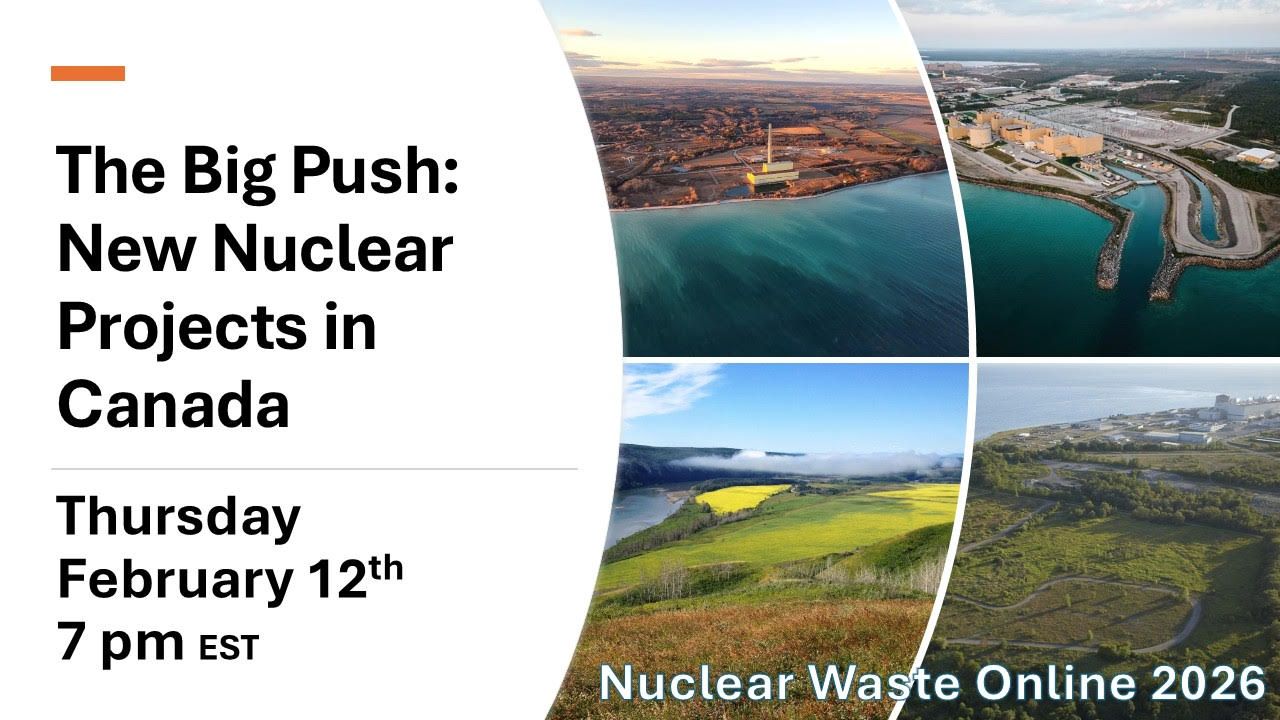
Thursday, February 12, 7 pm Eastern | 2nd of 4 sessions in the 2026 Nuclear Waste Online webinar series
Join a webinar on the push for new nuclear generation in Canada. Go to Northwatch.org to register or use the registration link https://us02web.zoom.us/webinar/register/WN_ZfWOf1GITqSRIZX8CB-A9w
-
Archives
- February 2026 (127)
- January 2026 (308)
- December 2025 (358)
- November 2025 (359)
- October 2025 (376)
- September 2025 (258)
- August 2025 (319)
- July 2025 (230)
- June 2025 (348)
- May 2025 (261)
- April 2025 (305)
- March 2025 (319)
-
Categories
- 1
- 1 NUCLEAR ISSUES
- business and costs
- climate change
- culture and arts
- ENERGY
- environment
- health
- history
- indigenous issues
- Legal
- marketing of nuclear
- media
- opposition to nuclear
- PERSONAL STORIES
- politics
- politics international
- Religion and ethics
- safety
- secrets,lies and civil liberties
- spinbuster
- technology
- Uranium
- wastes
- weapons and war
- Women
- 2 WORLD
- ACTION
- AFRICA
- Atrocities
- AUSTRALIA
- Christina's notes
- Christina's themes
- culture and arts
- Events
- Fuk 2022
- Fuk 2023
- Fukushima 2017
- Fukushima 2018
- fukushima 2019
- Fukushima 2020
- Fukushima 2021
- general
- global warming
- Humour (God we need it)
- Nuclear
- RARE EARTHS
- Reference
- resources – print
- Resources -audiovicual
- Weekly Newsletter
- World
- World Nuclear
- YouTube
-
RSS
Entries RSS
Comments RSS
 nuclear-news
[…] promises a nuclear free Taiwan Downward plunge of prices and shares for uranium mining company Endless radioactive cleanup problems – Chernobyl, Hanford, Fukushima Twice as much radiation released from Fukushima as previously estimated 70 organisations and […]
Pingback by Fukushima Update | Fukushima Update – Day 236 | November 1, 2011 |