Rio Tinto, uranium miners, and nuclear colonialism
situation isn’t all rosy for the multinational, which has long faced allegations of widespread environmental destruction and labor and human rights abuses in Africa, Asia and even the U.S.
Foreign control of metals and other natural resources in African and other developing countries is increasingly seen as a new form of colonialism, wherein locals work for relatively low wages and often in grueling, repressive conditions for companies that take most of the profit from the resources and labor out of the country.
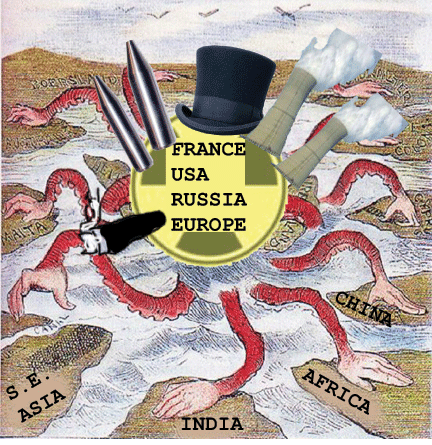
Namibian Uranium Miners vs. Rio Tinto, IN THESE TIMES, BY KARI LYDERSEN, OCT 3, 2011 Namibian union uranium miners on strike against international mining giant Rio Tinto alleged in late September that a week into the strike, the company was violating mutually agreed upon conditions of the strike by hiring nonunion workers at its Rossing uranium mine.
Rio Tinto says it is not hiring nonunion workers and is demanding written proof from the Namibian Miners Union.
Miners have demanded payments of $2,557 (USD) each to end the strike over union allegations of unfair bonus payments and other grievances. Rio Tinto has asked the country’s labor court to rule that the union’s complaints are not grounds for a strike.
The newspaper Informante reported:
Electricians, diesel mechanics, operators, general workers, and cleaners were shoulder-to-shoulder at the mine’s entrance, demanding their issues surrounding alleged unfair bonus practices be met. In the wake of last Friday [Sept. 23]’s rejection of the mediated agreement for an additional bonus pay-out, workers indicated to Informanté on Monday that they were willing to accept an immediate after-tax payout across the board to all striking workers of N$20,000 [Namibian dollars]. “Many of us work at the mine since the seventies. We want to work, but we strike as a result of the unfair treatment we received with the production bonus pay-outs,” the newspaper was told.
It wouldn’t seem like a significant imposition for a company with $14 billion in profits last year. And Rio Tinto is expecting booming profits worldwide as demand for copper and other commodities are expected to increase greatly in coming years – global copper demand alone is expected to grow 40 percent by 2020, according to the company…..
But the situation isn’t all rosy for the multinational, which has long faced allegations of widespread environmental destruction and labor and human rights abuses in Africa, Asia and even the U.S. While mining companies say Chinese demand for building and manufacturing products will continue to drive a mining boom, skeptics say a “double-dip recession” in Europe and the U.S. will suppress demand including in China just as the new mining projects are ramping up.
Meanwhile in Mongolia, Mozambique, Guinea and possibly other countries, Rio Tinto profits are threatened by government moves to nationalize a larger share of natural resources. ……
1 Comment »
Leave a reply to Guest Cancel reply
1 This Month

18 March Webinar @ 1 PM EST: An Assessment of SMR Projects: The Case of Canada
register for the zoom:
https://us02web.zoom.us/webinar/register/WN_o8BIIOUvQ2ONJR1nta65DQ#/registration

of the week – STOP SMALL MODULAR REACTORS IN CANADA
To see nuclear-related stories in greater depth and intensity – go to https://nuclearinformation.wordpress.com
-
Archives
- February 2026 (256)
- January 2026 (308)
- December 2025 (358)
- November 2025 (359)
- October 2025 (376)
- September 2025 (258)
- August 2025 (319)
- July 2025 (230)
- June 2025 (348)
- May 2025 (261)
- April 2025 (305)
- March 2025 (319)
-
Categories
- 1
- 1 NUCLEAR ISSUES
- business and costs
- climate change
- culture and arts
- ENERGY
- environment
- health
- history
- indigenous issues
- Legal
- marketing of nuclear
- media
- opposition to nuclear
- PERSONAL STORIES
- politics
- politics international
- Religion and ethics
- safety
- secrets,lies and civil liberties
- spinbuster
- technology
- Uranium
- wastes
- weapons and war
- Women
- 2 WORLD
- ACTION
- AFRICA
- Atrocities
- AUSTRALIA
- Christina's notes
- Christina's themes
- culture and arts
- Events
- Fuk 2022
- Fuk 2023
- Fukushima 2017
- Fukushima 2018
- fukushima 2019
- Fukushima 2020
- Fukushima 2021
- general
- global warming
- Humour (God we need it)
- Nuclear
- RARE EARTHS
- Reference
- resources – print
- Resources -audiovicual
- Weekly Newsletter
- World
- World Nuclear
- YouTube
-
RSS
Entries RSS
Comments RSS
 nuclear-news
Well, hello!
I was searching for the source of cancers in Namibia and this article of yours came up.
The reason I was searching was because of a PR piece by the IAEA on 11/25/11 saying that India donated a radiotherapy machine to Namibia “to support the country in fighting the cancer epidemic affecting its population.”
Then I read this wonderful blog of yours and learned that Namibia mines uranium.
Add 2+2 and it’s obvious that the cancers are coming from uranium mining!!!
Those of us who have compassion for others are often so busy that sometimes we don’t connect the dots immediately…
But you would think that the IAEA must know why there is an epidemic in cancers in Namibia!
Yet lives and health will be sacrificed again for the nuclear industry.
http://www.iaea.org/newscenter/news/2011/indiacommitment.html