Even an undamaged nuclear reactor takes decades to decommission
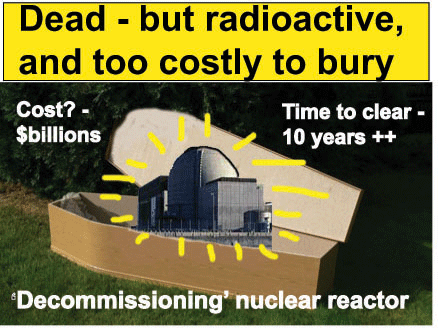 Experts: Scrapping Fukushima plant could take decades, asahi.com(朝日新聞社)2 April 11, “…..Even an undamaged nuclear reactor takes decades to decommission. After the fuel rods are removed, all of the pipes to the core have to be sealed. The inactive reactor then has to be kept airtight for five to 10 years, allowing radiation levels within the core to fall. The core is then dismantled and removed. Finally, the building that houses the core is taken down. In order to stop radiation from leaking into the atmosphere, more contaminated parts of the building have to be removed before parts with low levels of radiation….”asahi.com(朝日新聞社):Experts: Scrapping Fukushima plant could take decades – English
Global monitoring of Fukushima radiation fallout
Radioactive iodine-131 and cesium-137 are key to this process. They don’t exist in nature, so their appearance signals a nuclear event — either a bomb or a reactor in trouble…..Nuclear detectives can dive deeper still, sorting out whether radioactive emissions emanate from a dangerously active and still-fissioning reactor core, from burning fuel rods, or from used fuel sitting in pools.
 As Fukushima fallout circles the globe, nuclear sleuths sift it for clues, The Washington Post, by Brian Vastag 1 April 11, Fallout from the Fukushima Daiichi nuclear plant has landed on 30 exquisitely sensitive detectors on desolate Arctic islands, on the tops of tall buildings and in other windy locales across the Northern Hemisphere, according to the Comprehensive Test Ban Treaty Organization, which maintains those sensors. Sniffing the air like silent sentinels, the 63 shack-like stations (with 17 more planned) are capturing tiny radioactive particles in filters much like those on a home furnace. Continue reading
Whom to believe about Fukushima – nuclear industry or doctors?
 Nuclear’s green cheerleaders forget Chernobyl at our peril Pundits who downplay the risks of radiation are ignoring the casualities of the past. Fukushima’s meltdown may be worse John Vidal guardian.co.uk, Friday 1 April 2011
“……So who can we trust when the estimates swing so wildly? Should we believe the empirical evidence of the doctors; or governments and industrialists backed by their PR companies? So politicised has nuclear energy become, that you can now pick and choose your data, rubbish your opponents, and ignore anything you do not like. The fact is we may never know the truth about Chernobyl because the records are lost, thousands of people from 24 countries who cleaned up the site have dispersed across the vast former Soviet Union, and many people have died.Fukushima is not Chernobyl, but it is potentially worse. It is a multiple reactor catastrophe happening within 150 miles of a metropolis of 30 million people. If it happened at Sellafield, there would be panic in every major city in Britain. We still don’t know the final outcome but to hear experts claiming that nuclear radiation is not that serious, or that this accident proves the need for nuclear power, is nothing short of disgraceful…..
Nuclear’s green cheerleaders forget Chernobyl at our peril | John Vidal | Comment is free | The Guardian
Money, not Fukushima, is nuclear industry’s biggest hurdle
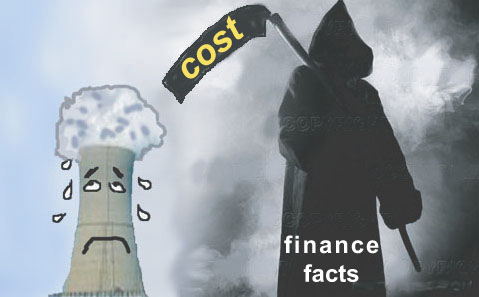 Nuclear industry’s other big hurdle: finance NRG put brakes on new plant; industry aims at loan guarantees By Steve Gelsi, MarketWatch, 1 April 11,
NEW YORK — While public outrage over radiation seeping from Japan’s damaged Fukushima Daiichi power plant is a huge setback for proponents of nuclear power, securing financing for new reactors poses perhaps an even bigger challenge in the United States….. Continue reading
Canada’s former nuclear watchdog supports Greens
Former nuclear watchdog supports May, slams Tory minister. Ottawa Citizen, By Cindy Harnett, Postmedia News April 1, 2011 VICTORIA — Canada’s former nuclear watchdog threw her support behind Green party leader Elizabeth May on Friday, three years after she was fired by the Harper government……Keen was fired from her post as CEO of the Canadian Nuclear Safety Commission after she forced a shutdown in late 2007 at a Chalk River reactor that provides vital isotopes for medical uses, and refused to restart it until safety systems were in place, despite intense political pressure……She also used the opportunity to link the nuclear issue to the crisis in Japan, where the Fukushima nuclear plant was badly damaged in an earthquake last month, and has leaked radiation to surrounding areas. “I think all Canadians can agree that there can be no short cuts or compromises on nuclear safety,” said May, who became friends with Keen after she was fired…….Former nuclear watchdog supports May, slams Tory minister.
Fukushima nuclear disaster like a slow motion collision
Q&A: Japan nuclear crisis ‘getting worse’ : World News Australia on SBS, 1 April 11, “…….Where to now for the people around Fukushima? What we’re seeing now, it’s rather like a slow motion collision, taking part over weeks. In a way we’re being reassured all the time it’s not going to get worse. But it is getting apparently worse. Continue reading
Don’t be the nuclear industry’s April fool

Christina Macpherson's websites & blogs
When you check out the nuclear news, you find plenty of cosy little items saying how Chernobyl wasn’t so bad – very few deaths etc. How low level radiation is not harmful to you, might even be good. How ‘progress’ is being made on the Fukushima cleanup. How it was all the fault of TEPCO anyway – the industry as a whole is safe, really. The new model nuclear reactors are really really really safe.
Don’t believe it. In 2011 – 25 years after the Chernobyl explosion, it’s just the right time for cancers to emerge in those who were subjected to “low level” radiation in the Ukraine. While it is true that one individual’s risk of cancer is small from exposure to low levels of radiation, exposure of many to this radiation will produce cancers in some of them. The world’s scientific authorities are united in pronouncing that there is no safe level for ionising radiation.
As to the safety of nuclear reactors, and the effects of radiation from even the normal operations of the nuclear fuel cycle – ask yourself who is supplying this information – “What’s in it for whom?
There may be some legitimate grounds for minimising the effects of the Fukushima radiation – a reasonable aim by authorities to prevent panic, and perhaps to save the businesses of farmers whose produce is not radioactive. To avoid unnecessary anxiety in countries distant from Japan. Just ask “What’s in it for whom? – Christina Macpherson
100 years before Fukushima’s nuclear fuel rods are safe
 Crews ‘facing 100-year battle’ at Fukushima, ABC News (Australian Broadcasting Corporation)By David Mark, Mark Willacy, 1 April 11, A nuclear expert has warned that it might be 100 years before melting fuel rods can be safely removed from Japan’s Fukushima nuclear plant. Continue reading
The ‘Fukushima 50’ heroic workers expect to die from radiation
 Japan nuclear crisis: Fukushima 50 ‘expect to die’ Workers who have been fighting to bring the reactors under control at Japan’s strick nuclear plant expect to die from radiation sickness, according to the mother of one of the men. – Telegraph, By Danielle Demetriou in Tokyo 31 Mar 2011
The so-called Fukushima 50, the group of around 300 technicians, soldiers and firemen who work in shifts of 50, have been exposed repeatedly to dangerously high radioactive levels as they attempt to avert a nuclear disaster.The mother of one of the men has admitted that the group have discussed their situation and have accepted that death is a strong possibility.
“My son and his colleagues have discussed it at length and they have committed themselves to die if necessary in the long-term.” Japan nuclear crisis: Fukushima 50 ‘expect to die’ – Telegraph
1000 Japanese bodies irradiated near Fukushima Dai-ichi nuclear plant
 Radiation leaves 1,000 tsunami bodies near nuke plant off-limits, USA Today, Mar 31, 2011 Radiation within 12 miles of the leaking Fukushima Dai-ichi nuclear plant has prevented the recovery of about 1,000 victims of the March 11 earthquake and tsunami, Kyodo News reports.
Even after the bodies are recovered and returned to families, how relatives choose to say goodbye to loved ones will pose health and safety dielmmas, sources said: Cremation could spread radioactive material, while conventional burial would contaminate soil.
Police sources said today that bodies had been exposed to high levels of radiation after death and that officials are reconsidering their plan to inspect the bodies after removing them from the evacuation zone……Radiation leaves 1,000 tsunami bodies near nuke plant off-limits –
Unsafe for rescuers to retrieve irradiated bodies around Fukushima No 1 plant
 The rescuers are now in a bind. Even if they retrieve the bodies, anyone who comes into contact with them risks being irradiated, too, whether they’re in the evacuation zone or not.
In Japan, a grisly consequence of radiation ajc.com March 31, 2011, by JayBoy, hadn’t thought about this aspect of the tragedy in Japan … from the Japan Times: Radiation is preventing the retrieval of hundreds of bodies from inside the 20-km evacuation zone around the Fukushima No. 1 nuclear power plant, police sources said Thursday……. Continue reading
Aerial views of Fukushima Dai-ichi nuclear power complex
 PHOTOS Bird’s-Eye View Of Japan’s Stricken Nuclear Plant Shows Vast Damage : The Picture Show : NPR, by Andrew Prince, 31 March, Our reporters and photographers on the ground in Japan have helped us hear and see the destruction wrought by the massive quake and tsunami that struck the island nation March 11. In contrast, the crisis unfolding at the Fukushima Dai-ichi nuclear power complex remains largely opaque.
Mostly, that’s because damage to the nuclear reactors and the buildings that house them makes for hazardous and radioactive conditions. Forget about access for journalists: Workers can’t even get too close for too long. Four of the facility’s six reactor units have been badly damaged by explosions and fires triggered by failures in emergency cooling systems in the wake of the quake and tsunami. These aerial photographs of the facility, taken by a drone on March 20 and 24, put a new face on the ongoing nuclear crisis….. Bird’s-Eye View Of Japan’s Stricken Nuclear Plant Shows Vast Damage : The Picture Show : NPR
Nuclear power now losing its glow in France
 France has quietly begun reassessing the risks of nuclear power…… “Climate change is changing the situation,” he said, “Extreme events that so far happened every thousand years along the coast now happen every hundred years.”…..
 France Gives Its Nuclear Power Industry a 2nd Look NYTimes.com By KATRIN BENNHOLD and DAVID JOLLY March 31, 2011 PARIS — The Fukushima nuclear crisis has prompted anti-nuclear marches across the world, persuaded the Chinese authorities to delay the construction of new reactors and helped the German government lose an important state election. Continue reading
The uranium boom- over before it’s begun
 virtually impossible to get new financing to develop projects for which there will be no economic justification. This will all be reflected in a slow, inexorable decline in share prices
The bull market in uranium is over, – MoneyWeek. By Dominic Frisby Mar 31, 2011 “The worldwide backlash against the nuclear power industry is only beginning to be felt and promises to deal a devastating blow long-term to the uranium stock sector. The catastrophic events in Japan were followed by a precipitous drop in uranium share prices, which have just had their obligatory dead cat bounce. Continue reading
Why a doctor chose not to have airport radiation scanning
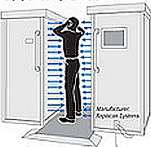
Radiation exposure, however small, is a known risk to our health. My bottom line: Must I receive radiation for lack of an alternative? In this scenario, thankfully, no. The alternative in this case is that full body pat-down, completely devoid of any radiation exposure. So, for now, I choose the latter
Dr. Cindy Haines: Why I Said ‘No’ to Backscatter Scanning, THE HUFFINGTON POST 1 April 11, There are two types of these advanced imaging technologies: the backscatter scanners [at left] (which use ionizing radiation) and millimeter-wave scanners[at right]  (which emit low-energy waves).
This terminal happened to have the backscatter scanners and — lo and behold — I was chosen for it. My only alternative? The controversial physical screen. And surely nothing says “Good Morning” like a full body pat-down, with lots of on-lookers to enjoy the show.
I was certainly not happy about this invasive maneuver but I found it to be preferable over the quicker and more efficient scan. This, despite the fact that I have researched and written on the very low risk that is associated with these backscatter scanners. So why my refusal of the scan? Continue reading
1 This Month

Protect Sazan Island from the Trump family! https://secure.avaaz.org/campaign/en/protect_sazan_island_from_the_trump_family_loc/?bqFCVab&v=174511&cl=22707147157&_checksum=5e9dde668860e8231c33699735e16a1fbf22ab2cb01da50c999fe8732b9775ef&utm_source=email&utm_medium=blast_email&utm_campaign=174511


Cuba Is Not a Failed State – It Is a Besieged State
PETITION: “Global Appeal to Endorse Palestinian Right of Return of Refugees”
To see nuclear-related stories in greater depth and intensity – go to https://nuclearinformation.wordpress.com
-
Archives
- June 2026 (129)
- May 2026 (306)
- April 2026 (356)
- March 2026 (251)
- February 2026 (268)
- January 2026 (308)
- December 2025 (358)
- November 2025 (359)
- October 2025 (376)
- September 2025 (257)
- August 2025 (319)
- July 2025 (230)
-
Categories
- 1
- 1 NUCLEAR ISSUES
- business and costs
- climate change
- culture and arts
- ENERGY
- environment
- health
- history
- indigenous issues
- Legal
- marketing of nuclear
- media
- opposition to nuclear
- PERSONAL STORIES
- politics
- politics international
- Religion and ethics
- safety
- secrets,lies and civil liberties
- spinbuster
- technology
- Uranium
- wastes
- weapons and war
- Women
- 2 WORLD
- ACTION
- AFRICA
- Atrocities
- AUSTRALIA
- Christina's notes
- Christina's themes
- culture and arts
- Events
- Fuk 2022
- Fuk 2023
- Fukushima 2017
- Fukushima 2018
- fukushima 2019
- Fukushima 2020
- Fukushima 2021
- general
- global warming
- Humour (God we need it)
- Nuclear
- RARE EARTHS
- Reference
- resources – print
- Resources -audiovicual
- Weekly Newsletter
- World
- World Nuclear
- YouTube
-
RSS
Entries RSS
Comments RSS
 nuclear-news