In Washington, huge and costly lobbying by nuclear company Entergy
 glimpses into Entergy’s extensive lobbying efforts in Washington.
It’s impossible to tell how much Entergy spent on its efforts to try to get the NRC and Justice Department to intervene in the Vermont Yankee case
Entergy Services reported spending $670,000 on lobbying in the second quarter of this year, when the question of government intervention in the Vermont Yankee case was most in play, and that Entergy Nuclear Northeast, another company unit, spent $90,000…..
The reports do not include money the company spent on lawyers involved in the Vermont Yankee matter; the documents indicate that involvement was extensive…..
Documents show heavy Entergy lobbying on Vt. nuke, Boston.com By Dave Gram, Associated Press / November 6, 2011 MONTPELIER, Vt.—Entergy Corp. heavily lobbied multiple federal agencies last spring as it unsuccessfully pleaded with them to join its lawsuit against the state of Vermont’s efforts to close the Vermont Yankee nuclear plant, internal Nuclear Regulatory Commission documents show. Continue reading
A British warning against an attack on Iran
Iran is a far more sophisticated and divided society than the picture generally painted in the west.
An attack on Iran would halt and reverse moves to reform. The Arab spring would become an Arab winter with disastrous consequences for US and European interests as well as Arab societies, including Saudi Arabia. The alternatives are many – to continue to apply economic sanctions, a policy of carrot and stick, but with much more emphasis on the carrot. Embraces are far more difficult to withstand than attacks…

 An attack on Iran would be disastrous Britain must resist US pressure for military action. Even if Iran had nuclear weapons, engagement is the only course to take, Guardian UK 6 Nov 11
“Would a British prime minister ever refuse a plea from a US president to join America in a controversial military operation?” This was the response, rhetorical and unanswerable as far as they were concerned, by Whitehall mandarins whenever they were asked why Tony Blair agreed to invade Iraq. It was not a matter of whether the invasion was wrong or right; it was that the occupier of 10 Downing Street would simply not turn down such a request from the White House.
For the US, Britain could offer not only political and “moral” support but a juicy physical asset – Diego Garcia, the base conveniently placed for American bombers, on the British Indian Ocean Territory.
This is what so worries Whitehall, and Britain’s top brass in particular – a growing fear that Barack Obama will find it difficult to oppose increasing pressure for military action against Iran’s nuclear facilities within the next 12 months. Continue reading
Brakes put on Colorado uranium mining
 in the rush to develop this infamous resource (again), there was a rare moment of rationality two weeks ago when a federal judge ordered DOE officials to halt permits for exploring and mining in Colorado. U.S. District Judge William Martinez said the agency “acted arbitrarily and capriciously in failing to analyze site-specific impacts” on the people and places in the path of the mining boom. He said the DOE violated environmental laws, including the Endangered Species Act, by failing to consult U.S. Fish and Wildlife Service scientists about the potential impacts of the extractions.
In the rush for uranium, cooler heads prevail — for now High Country News, By Heather Hansen, Red Lodge Clearing House, 4 Nov 11 Greens got what seemed like a rare bit of good news when the Bureau of Land Management (BLM) last week released their Final Environmental Impact Statement (EIS) for the Northern Arizona Proposed Withdrawal. The report looks at the potential impacts of removing federal lands near the Grand Canyon from mining consideration for the next two decades. Continue reading
8 months after Fukushima nuclear disaster, dangerous radiation level
 Tepco Finds Dangerous Level of Radiation at Fukushima Station, , Bloomberg, By Chris Cooper, Nov. 6 — Tokyo Electric Power Co. found a dangerous level of radiation at its wrecked Fukushima nuclear plant, eight months after the March 11 earthquake and tsunami that caused the worst atomic crisis in 25 years.
Workers at the company usually called Tepco detected 620 millisieverts of radiation an hour on the first floor of Reactor 3 on Nov. 3, the highest level found in that unit, it said.
The level of radiation is more than the 500-millisievert short-term dose recommended as the maximum for emergency workers in live-saving situations, according to the World Nuclear Association. The company and government officials are trying to contain the worst nuclear crisis since Chernobyl in 1986 after the March 11 earthquake and tsunami caused a loss of cooling and the meltdowns of three reactors.
Tepco will today start taking radiation out of water used to cool spent fuel rods, spokesman Hiroki Kawamata said today by phone…..http://www.businessweek.com/news/2011-11-06/tepco-finds-dangerous-level-of-radiation-at-fukushima-station.html
Republican presidential candidate warns against use of military “drones”
“For every one you kill, you create 10 new ones who hate our guts and want to do us harm,” Mr. Paul said…..
 Paul Says Drone Strikes ‘Make More Enemies’, WSJ, 6 Nov 11 By Julian E. Barnes, Presidential candidate Ron Paul said Sunday that the CIA’s drone campaign in Pakistan was making the U.S. less safe. Continue reading
Favourable report for Scotland’s renewable energy

 Report backs Scottish renewables under independence, BBC News 6 Nov 11
A new bank report has backed Scotland’s renewable energy policies, just days after a major finance company warned businesses against investing in the renewables sector in Scotland. Citigroup had said the independence referendum process would create huge uncertainty when major decisions on green projects were needed.
But investment bank Altium Securities dismissed the warning. Energy Minister Fergus Ewing welcomed the Altium report….. In its report, Altium Securities said it “did not share recent competitor analysis that utilities developing renewable energy assets were exposed to stranded asset risk from an independent Scotland”.
It also argued Scotland had the potential to be the lowest-cost generator of wind energy in Europe due its “unique wind characteristics”….. http://www.bbc.co.uk/news/uk-scotland-scotland-politics-15608107
TEPCO nuclear company makes $8 billion loss, gets $11.5 billion in public funds

 Japan Approves Billions in Aid to TEPCO, Voice of America, 5 Nov 11 Government agreed Friday to a deal giving $11.5 billion in public funds to the Tokyo Electric Power Company (TEPCO) to cover costs in the aftermath of the March 11 earthquake and tsunami that crippled its Fukushima nuclear power plant.
The government said the funds would help TEPCO with cleanup and dismantling of the plant and compensation payments to residents of the area. The money comes from a fund made up of all Japanese nuclear plant operators and the government. In return, the utility must reduce its operating costs by more than $32 billion over the next 10 years and lay off more than 7,000 workers.
Engineers at Fukushima are still trying to bring the reactors to a stable cold shutdown by the end of this year. News of the bailout came on the same day TEPCO forecast a nearly $8 billion loss for the current fiscal year, ending in March. http://blogs.voanews.com/breaking-news/2011/11/04/japan-approves-billions-in-aid-to-tepco-2/
The International Energy Agency puts the case for falling use of nuclear energy!
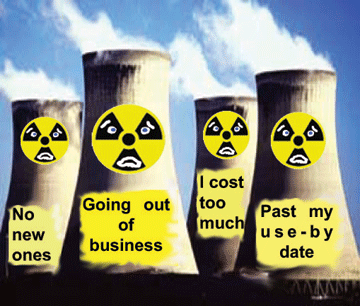 The Low Nuclear Case is not a forecast but “is intended to illustrate what a pessimistic view of the prospects for the nuclear power industry might entail,” the report said.
IEA draft: Nuclear to fall as power demand Reuters 5 Nov 11 – The Fukushima disaster could lead to a 15 percent fall in world nuclear power generation by 2035, while power demand at the same time could rise by 3.1 percent a year, according to a draft copy of the International Energy Agency’s 2011 World Energy Outlook.
Following the Japanese crisis, many countries put their nuclear power plans on hold or under review, and some, including Germany and Switzerland, opted out of the technology entirely.
The draft, obtained by Reuters ahead of its release next week, sai the IEA had developed a “Low Nuclear Case” that assesses possible implications for global energy balances of a much smaller role for nuclear power. Continue reading
7 billion people can benefit from renewable energy
 The 2011 Human Development Report will serve as a blueprint for action ahead of next year’s Earth Summit, the United Nations Conference on Regional Development, to be held in Rio de Janeiro in June 2012. ….
Renewable Energy Vital To Provide Power For 7 Billion+ by Energy Matters, 5 Nov 11 This week saw the world’s population hit the seven billion mark and with it came increased anxiety over shortages of food and natural resources in developing nations. It’s fitting that in the same week the United Nations Development Programme has called on the international community in its 2011 Human Development Report to use renewable energy sources as a way to promote environmental sustainability and equity. Continue reading
The danger of Pakistan’s nuclear weapons situation

 Which sinks the U.S. into the nadir of absurdity. It funds a terrorist-sponsoring state while conducting a massive undeclared war on part of that state’s territory. It wants that state’s assistance to end the Afghanistan war while that state’s soldiers help insurgents wage it. And seeking a world without nuclear weapons while its “Major Non-NATO Ally” drastically increases the probability that terrorists will acquire a the most dangerous weapon of all.
Pakistan Carts Its Nukes Around In Delivery Vans, Wired.com By Spencer Ackerman November 4, 2011 Pakistan is taking nuclear paranoia to a horrifying new low. And it’s making the world a vastly more dangerous place in the process. Continue reading
The international nuclear war machine rolls on, costing $billions
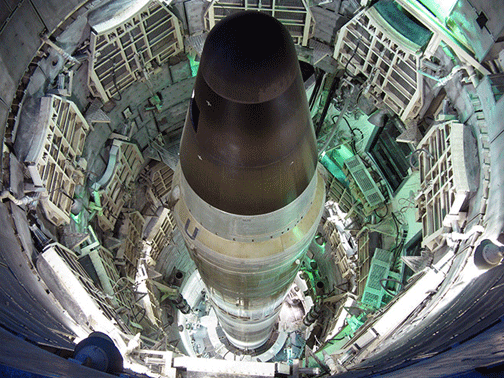 still the warheads are engineered. Billions of dollars are found, are always found, for weapons. Is this a higher duty to a citizenry than the health, education and wellbeing of that citizenry?
There are far more people in the world now than in 1945 – 7 billion from this week – and you can’t do anything with a warhead but die from it.
World takes a step back under the clouds of nuclear gloom, SMH, Warwick McFadyen November 5, 2011 THERE comes a time when memory fails, when remembrance of things past fades into the ether. A decade into the 21st century we have arrived at that denuded place. How else to explain the recent disclosures that the world is embarking on a new era of spending on nuclear weapons? Continue reading
Low security of Pakistan’s nukes
Pakistan’s nuclear weapons vulnerable to theft: report, Google News, 5 Nov 11 WASHINGTON — Pakistan has begun moving its nuclear weapons in low-security vans on congested roads to hide them from US spy agencies, making the weapons more vulnerable to theft by Islamist militants, two US magazines reported Friday.
The Atlantic and the National Journal, in a joint report citing unnamed sources, wrote that the US raid that killed Al-Qaeda chief Osama bin Laden in May at his Pakistani compound reinforced Islamabad’s longstanding fears that Washington could try to dismantle the country’s nuclear arsenal.
As a result, the head of the Strategic Plans Divisions (SPD), which is charged with safeguarding Pakistan’s atomic weapons, was ordered to take action to keep the location of nuclear weapons and components hidden from the United States, the report said. Khalid Kidwai, the retired general who leads the SPD, expanded his agency’s efforts to disperse components and sensitive materials to different facilities, it said.
But instead of transporting the nuclear parts in armored, well-defended convoys, the atomic bombs “capable of destroying entire cities are transported in delivery vans on congested and dangerous roads,” according to the report. The pace of the dispersal movements has increased, raising concerns at the Pentagon, it said…..http://www.google.com/hostednews/afp/article/ALeqM5hl_vZqjJHYTQL-3LlinxBrEl8oJQ?docId=CNG.d8a458444a1f0fb688322c8410b26047.431
Researchers show that Syria’s supposed nuclear site is a textile factory
That secret nuclear facility in Syria? It’s a textile factory, researchers say in new report, Washington Post By Joby Warrick 4 Nov After a four-year search for hidden atomic facilities in Syria, U.N. officials appeared this week to have finally struck gold: News reports linked a large factory in eastern Syria to a suspected clandestine effort to spin uranium gas into fuel for nuclear bombs.
But after further probing by private researchers, Syria’s mystery plant is looking far less mysterious. A new reportconcludes that the facility and its thousands of fast-spinning machines were intended to make not uranium, but cloth — a very ordinary cotton-polyester.
“It is, and always has been, a textile factory,” said one of the researchers, Jeffrey Lewis, a nuclear policy expert at the Center for Nonproliferation Studies and publisher of the blog Arms Control Wonk…..
Japanese mothers demand radiation protection, and closure of nuclear power
The women are calling for two things. First, they want to protect children living in highly contaminated areas by giving them the officially sanctioned ‘right to evacuate.’ This would include government compensation and support that would enable children and their families to relocate on a voluntary basis.
Secondly, they want to close down all nuclear power plants in Japan. “Fukushima women feel very strongly that there is no safe nuclear power,” “This is the lesson to be learned from Fukushima.”
The women have asked for a response from the state by Nov. 11—exactly eight months after the deadly quake.
 Fukushima Women Demand Better Protection for Children Exposed to Radiation, TIME.com , November 3, 2011 Lucy Birmingham. About 100 women from Fukushima, Japan, have started a week-long sit-in at a government office in Tokyo to demand greater protection for children affected by radiation. “Many children and their families are trapped in Fukushima because they can’t afford to move,” explains Ayako Oga, 38, a housewife living in the prefecture and one of the sit-in organizers. “The government has set the accepted radiation exposure rate too high.” Japan’s standard rate for exposure to radiation is 1 millisievert per year. For Fukushima residents alone the accepted exposure rate is up to 20 millisieverts per year. The International Commission on Radiological Protection considers this rate the top level and says it should not be exceeded over the long term.
National and prefectural governments have determined that until the 20 millisieverts level they are not obligated to offer financial support to residents, certain businesses or schools wanting to relocate outside the irradiated areas. At the heart of the debate is the question of who has a ‘right to evacuate.’ “At Chernobyl, the right to evacuate, which means government support, was given from 1 to 5 millisieverts. In Japan it’s 20,” Continue reading
What it’s really like to be a cleanup worker at Fukushima
Those on the lower rungs, say labour advocates, are particularly
vulnerable. They often have no corporate health, pension or redundancy
benefits. ….
the hardest work was done by the low-level labourers. They had so much rubble to clear, he says, that they often keeled over in the heat under the weight of their protective gear.
Taken out in ambulances, they would usually be back the following day.
Cleaning up Japan’s nuclear mess, The twilight zone, Its owner fears not just radiation leaking out of the Fukushima plant, but also bad news, The Economist Nov 5th 2011 | IWAKI | IT IS another world beyond the roadblocks stopping unauthorised traffic from entering the 20km (12.5-mile) exclusion zone around the
Fukushima Dai-ichi nuclear power plant. ….
The air of secrecy is compounded when you try to approach workers involved in the nightmarish task of stabilising the nuclear plant. Many are not salaried Tepco staff but low-paid contract workers lodging in Iwaki, just south of the exclusion zone. Continue reading
1 This Month

of the week – Shut Down Drone Warfare!


Tell the Ukrainian Government to Drop Prosecution of Peace Activist Yurii Sheliazhenko

Petition to revoke the licensing of the Near Surface Nuclear Disposal Facility (NSDF) at Chalk River. https://www.ourcommons.ca/petitions/en/Petition/Details?Petition=e-7247
To see nuclear-related stories in greater depth and intensity – go to https://nuclearinformation.wordpress.com
-
Archives
- March 2026 (244)
- February 2026 (268)
- January 2026 (308)
- December 2025 (358)
- November 2025 (359)
- October 2025 (376)
- September 2025 (257)
- August 2025 (319)
- July 2025 (230)
- June 2025 (348)
- May 2025 (261)
- April 2025 (305)
-
Categories
- 1
- 1 NUCLEAR ISSUES
- business and costs
- climate change
- culture and arts
- ENERGY
- environment
- health
- history
- indigenous issues
- Legal
- marketing of nuclear
- media
- opposition to nuclear
- PERSONAL STORIES
- politics
- politics international
- Religion and ethics
- safety
- secrets,lies and civil liberties
- spinbuster
- technology
- Uranium
- wastes
- weapons and war
- Women
- 2 WORLD
- ACTION
- AFRICA
- Atrocities
- AUSTRALIA
- Christina's notes
- Christina's themes
- culture and arts
- Events
- Fuk 2022
- Fuk 2023
- Fukushima 2017
- Fukushima 2018
- fukushima 2019
- Fukushima 2020
- Fukushima 2021
- general
- global warming
- Humour (God we need it)
- Nuclear
- RARE EARTHS
- Reference
- resources – print
- Resources -audiovicual
- Weekly Newsletter
- World
- World Nuclear
- YouTube
-
RSS
Entries RSS
Comments RSS
 nuclear-news