Why do America’s Republicans love a socialised industry – nuclear energy?
The nuclear industry and the Republican Party have nothing ideologically obvious in common other than a soft spot for things that go boom…..Nuclear power is the king of subsidized energy industries, with its very origin in government—
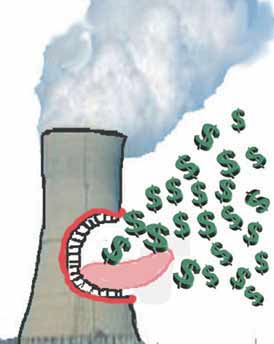
Nuclear Reactionaries, Washinton Monthly, December 2010, It’s a big-government-dependent tool to fight climate change that was championed by Jimmy Carter, is now dominated by the French, and has never managed to compete in the marketplace. So why, exactly, do Republicans love nuclear power so much? By T. A. Frank
When the White House released a budget proposal in February calling for $54 billion worth of federal loan guarantees for the construction of nuclear power plants, part of the idea was to woo the other side of the aisle. Congressional Republicans had spent the better part of a year blocking a piece of climate legislation known as the Waxman-Markey Bill, and it was hoped that some nuclear seduction might soften their opposition. Even if the White House had no luck with the GOP, what would be the harm—really—of firing up some new reactors?……..
Well, Republicans can love nuclear if they want. And Democrats can indulge them in some conciliatory fission if they want. But the rest of us shouldn’t have to smile politely. Nor should we pretend that the bedfellows are anything but bizarre. The GOP and nuclear power are such old friends, like Tarzan and Cheeta, that we forget to reflect on the oddity of the relationship. At least Tarzan and Cheeta had compatible policy priorities, such as defense against crocodiles.
But the nuclear industry and the Republican Party have nothing ideologically obvious in common other than a soft spot for things that go boom. That they’ve teamed up all the same says something—all too much, really—about our politics today.
Anyone with even a passing interest in politics knows that Republicans stand for a few bedrock ideas. One is that the market knows better than politicians
(Republicans don’t favor “using the government in Washington to pick winners and losers,” Senator Lamar Alexander once told Wolf Blitzer.)
Another is that bailouts and subsidies are a waste of money. (“[T]here is no guarantee that financial assistance from taxpayer dollars will prevent these companies from collapsing,” said Lisa Murkowski, explaining her vote against loans to the auto industry.) So how does a push for expanded nuclear energy match up with such convictions? At the risk of oversimplifying, the short answer is “Not at all.” And the long answer is “Um, not at all.”….
Nuclear power is the king of subsidized energy industries, with its very origin in government—from Truman-era research into nuclear fission, to the launch of Atoms for Peace under Eisenhower. The original idea, sixty years ago, was to give the whole business a push, with some generous government start-up capital, so that before long “cheap atomic power could be used to irrigate deserts” and to “air-condition the tropics and the frozen wastes of the Arctic,”……….
…..—the part about cheap atomic power never really came to pass. Not only did nuclear energy remain stubbornly pricey; the nuclear industry proved spectacularly incompetent. The parade of nuclear power plants built in the United States in the 1970s and ’80s resulted in dozens, even scores, of botched projects and billions of dollars in cost overruns. One particularly flagrant example: the Shoreham Nuclear Power Plant on Long Island. It took two decades to plan, build, and test, and wound up costing about eighty times its original estimate, which would have been bad enough even if it had been put into service; it wasn’t. So bad was the track record of nuclear power in the United States that in 1985 Forbes called it the “largest managerial disaster in business history…………….
The shaky financials of nuclear power aren’t limited to the United States. England’s nuclear power company British Energy was spared from bankruptcy in 2002 only by a generous state bailout. France’s mostly state-owned power company Electricité de France (EDF), which oversees a vast archipelago of reactors, has been in such a financial mess that, according to a 2004 report in the Economist, factoring in the liabilities on its balance sheet would leave the company “technically insolvent.”…..
No comments yet.
1 This Month

of the week – Shut Down Drone Warfare!


Tell the Ukrainian Government to Drop Prosecution of Peace Activist Yurii Sheliazhenko

Petition to revoke the licensing of the Near Surface Nuclear Disposal Facility (NSDF) at Chalk River. https://www.ourcommons.ca/petitions/en/Petition/Details?Petition=e-7247
To see nuclear-related stories in greater depth and intensity – go to https://nuclearinformation.wordpress.com
-
Archives
- April 2026 (91)
- March 2026 (251)
- February 2026 (268)
- January 2026 (308)
- December 2025 (358)
- November 2025 (359)
- October 2025 (376)
- September 2025 (257)
- August 2025 (319)
- July 2025 (230)
- June 2025 (348)
- May 2025 (261)
-
Categories
- 1
- 1 NUCLEAR ISSUES
- business and costs
- climate change
- culture and arts
- ENERGY
- environment
- health
- history
- indigenous issues
- Legal
- marketing of nuclear
- media
- opposition to nuclear
- PERSONAL STORIES
- politics
- politics international
- Religion and ethics
- safety
- secrets,lies and civil liberties
- spinbuster
- technology
- Uranium
- wastes
- weapons and war
- Women
- 2 WORLD
- ACTION
- AFRICA
- Atrocities
- AUSTRALIA
- Christina's notes
- Christina's themes
- culture and arts
- Events
- Fuk 2022
- Fuk 2023
- Fukushima 2017
- Fukushima 2018
- fukushima 2019
- Fukushima 2020
- Fukushima 2021
- general
- global warming
- Humour (God we need it)
- Nuclear
- RARE EARTHS
- Reference
- resources – print
- Resources -audiovicual
- Weekly Newsletter
- World
- World Nuclear
- YouTube
-
RSS
Entries RSS
Comments RSS
 nuclear-news
Leave a comment