Costs are looking like the killer for the nuclear industry
Critics such as Mark Cooper at the University of Vermont say the real costs tend to range toward $7,000 to $10,000 per kilowatt. State support of these projects turns into “nuclear socialism,” Cooper says. Amory Lovins of the Rocky Mountain Institute says costs have escalated beyond what proponents claim.
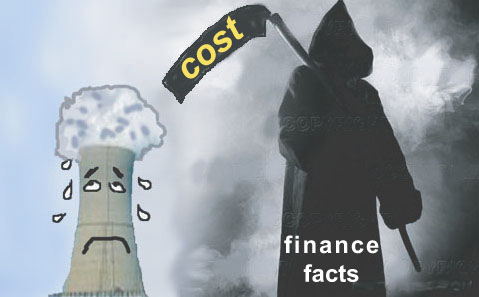
Cost remains a huge problem for the nuclear industry. : Greentech Media, Michael Kanellos, 29 Sept, 10 The MIT report estimates that overnight cost — i.e., the cost of a plant minus financing during construction — is around $4,000 a kilowatt, compared to $2,300 per kilowatt for natural gas and $850 for coal. A nuclear facility at this level could produce power for 8.4 cents per kilowatt hour compared to 6.2 cents per kilowatt hour for coal and 4.2 cents to 8.7 cents for natural gas……..
If the risk premium built into those nuclear figures were eliminated, the price of nuclear could be dropped to 6.6 cents, according to the report.
But eliminating that risk isn’t easy.
“The track record for the construction costs of nuclear plants completed in the U.S. during the 1980s and early 1990s was poor. Actual costs were far higher than had been projected. Construction schedules experienced long delays, which, together with increases in interest rates at the time, resulted in high financing charges. Whether the lessons learned from the past can be factored into the construction of future plants has yet to be seen,” the report states.
Critics such as Mark Cooper at the University of Vermont say the real costs tend to range toward $7,000 to $10,000 per kilowatt. State support of these projects turns into “nuclear socialism,” Cooper says. Amory Lovins of the Rocky Mountain Institute says costs have escalated beyond what proponents claim.
Solar and wind advocates, meanwhile, claim that their power can cost even less. Wind turbines can produce power for 4 to 6 cents per kilowatt hour. Additionally, the interest incurred during construction that overnight costs exclude is lower due to fewer delays.
To ameliorate the risk, MIT proposes that the U.S. government provides helper incentives to the next seven to ten nuclear projects that are proposed. The White House has already begun to issue loan guarantees to some nuclear projects……
Another issue: the U.S. has not made adequate plans for storing and disposing of nuclear waste. Spent nuclear fuel takes 40 to 60 years to cool before it can be permanently sequestered, according to Charles Forsberg, executive director of the MIT fuel cycle study.The time horizon of a century should be contemplated when drawing up fuel cycle strategies.
No comments yet.
1 This Month

of the week – Shut Down Drone Warfare!


Tell the Ukrainian Government to Drop Prosecution of Peace Activist Yurii Sheliazhenko

Petition to revoke the licensing of the Near Surface Nuclear Disposal Facility (NSDF) at Chalk River. https://www.ourcommons.ca/petitions/en/Petition/Details?Petition=e-7247
To see nuclear-related stories in greater depth and intensity – go to https://nuclearinformation.wordpress.com
-
Archives
- March 2026 (251)
- February 2026 (268)
- January 2026 (308)
- December 2025 (358)
- November 2025 (359)
- October 2025 (376)
- September 2025 (257)
- August 2025 (319)
- July 2025 (230)
- June 2025 (348)
- May 2025 (261)
- April 2025 (305)
-
Categories
- 1
- 1 NUCLEAR ISSUES
- business and costs
- climate change
- culture and arts
- ENERGY
- environment
- health
- history
- indigenous issues
- Legal
- marketing of nuclear
- media
- opposition to nuclear
- PERSONAL STORIES
- politics
- politics international
- Religion and ethics
- safety
- secrets,lies and civil liberties
- spinbuster
- technology
- Uranium
- wastes
- weapons and war
- Women
- 2 WORLD
- ACTION
- AFRICA
- Atrocities
- AUSTRALIA
- Christina's notes
- Christina's themes
- culture and arts
- Events
- Fuk 2022
- Fuk 2023
- Fukushima 2017
- Fukushima 2018
- fukushima 2019
- Fukushima 2020
- Fukushima 2021
- general
- global warming
- Humour (God we need it)
- Nuclear
- RARE EARTHS
- Reference
- resources – print
- Resources -audiovicual
- Weekly Newsletter
- World
- World Nuclear
- YouTube
-
RSS
Entries RSS
Comments RSS
 nuclear-news
Leave a comment