Desert solar energy in Ontario could provide immense electrical power
“Nuclear power for all of the United States is about 100 gigawatts. We can produce 90 on barren land with just solar in this tiny region
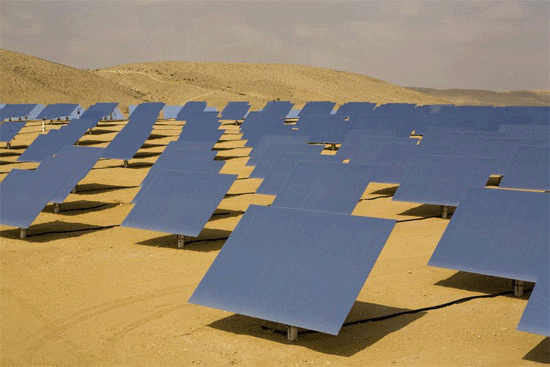
Solar Power in Ontario Could Produce Almost as Much Power as All U.S. Nuclear Reactors, Studies Find ScienceDaily (Apr. 14, 2010) — Solar power in southeastern Ontario has the potential to produce almost the same amount of power as all the nuclear reactors in the United States, according to two studies conducted by the Queen’s University Applied Sustainability Research Group located in Kingston, Canada.
These studies, led by Queen’s mechanical engineering professor Joshua Pearce, are the first to explore the region’s solar energy potential. Professor Pearce was surprised by how many gigawatts could be produced.
“We came up with enormous numbers and we were being conservative. There about 95 gigawatts of potential power just in southeastern Ontario — that shows there is massive potential,” says Professor Pearce, who specializes in solar photovoltaic materials and applied sustainability…….
A second study, published in May issue of the journal Solar Energy, looked at land in southeastern Ontario that could be used for solar farms. The study considered land with little economic value — barren, rocky, non-farmable areas near electrical grids — and concluded it has the potential to produce 90 gigawatts.
“Nuclear power for all of the United States is about 100 gigawatts. We can produce 90 on barren land with just solar in this tiny region, so we are not talking about small potatoes,” Professor Pearce says.
The professor conducted the studies to provide policy makers solid numbers on solar energy potential, as well as find possible solar farm locations for developers. Solar power in Ontario could produce almost as much power as all U.S. nuclear reactors, studies find
2 Comments »
Leave a reply to Scottosaurus Cancel reply
1 This Month

of the week – Shut Down Drone Warfare!


Tell the Ukrainian Government to Drop Prosecution of Peace Activist Yurii Sheliazhenko

Petition to revoke the licensing of the Near Surface Nuclear Disposal Facility (NSDF) at Chalk River. https://www.ourcommons.ca/petitions/en/Petition/Details?Petition=e-7247
To see nuclear-related stories in greater depth and intensity – go to https://nuclearinformation.wordpress.com
-
Archives
- April 2026 (103)
- March 2026 (251)
- February 2026 (268)
- January 2026 (308)
- December 2025 (358)
- November 2025 (359)
- October 2025 (376)
- September 2025 (257)
- August 2025 (319)
- July 2025 (230)
- June 2025 (348)
- May 2025 (261)
-
Categories
- 1
- 1 NUCLEAR ISSUES
- business and costs
- climate change
- culture and arts
- ENERGY
- environment
- health
- history
- indigenous issues
- Legal
- marketing of nuclear
- media
- opposition to nuclear
- PERSONAL STORIES
- politics
- politics international
- Religion and ethics
- safety
- secrets,lies and civil liberties
- spinbuster
- technology
- Uranium
- wastes
- weapons and war
- Women
- 2 WORLD
- ACTION
- AFRICA
- Atrocities
- AUSTRALIA
- Christina's notes
- Christina's themes
- culture and arts
- Events
- Fuk 2022
- Fuk 2023
- Fukushima 2017
- Fukushima 2018
- fukushima 2019
- Fukushima 2020
- Fukushima 2021
- general
- global warming
- Humour (God we need it)
- Nuclear
- RARE EARTHS
- Reference
- resources – print
- Resources -audiovicual
- Weekly Newsletter
- World
- World Nuclear
- YouTube
-
RSS
Entries RSS
Comments RSS
 nuclear-news
I’m passing this on to my brother-in-law who is working with solar in France. Good post! Thanks.
What backs up solar power on the grid when it is nighttime or conditions are not suitable for the solar panels to generate electricity – you know, like 70% of the time? Once solar and wind advocates move past nameplate capacity to actually figuring out how to supply sustained baseload power, then perhaps we will be onto something. Until then, I’d like to see some power source that can reliably and cleanly supply electricity when it is neither sunny nor windy. Hydro’s good, but there are limits to how much we can get from it, and it also has environmental impacts.