Uranium mining continues to damage indigenous communities
Déline is known as the “village of widows’ because most of the men who worked as labourers in the mines have died of some form of cancer.

The impacts of uranium mining on indigenous communities.-Peace, Earth and Justice News Heather Tufts February 13, 2010 – “….. Uranium mining speculation lacks comprehensive health and safety regulations while the ethics of Canadian exported uranium, which can lead to depleted uranium used in zones of war, needs greater scrutiny.
Abandoned uranium mines and the subsequent hazards experienced in forgotten communities have also been virtually ignored in Canada leading to tragic, unmitigated circumstances.
The long-term negative impacts of uranium mining can be witnessed in the small, rural community of Déline (North West Territories) which has a Dené population of 800 people. They are located right on the shore of Sahtu (Great Bear Lake) about 300 miles north of Yellowknife. Great Bear Lake is considered to be one of the last great fresh water lakes in the world. This area on the north shore of Sahtu was the site of radium mining from 1934 to 1939, and then a uranium mine from 1943 to 1962…………
Déline is known as the “village of widows’ because most of the men who worked as labourers in the mines have died of some form of cancer. The widows, who are traditional women, were left to raise their families without husbands and breadwinners. As a result they became dependent on welfare and relied on the young men who remained in the community to help supply them with their traditional foods. The women are struggling and the village is seeing the first generation of young men in the history of the Dené to grow up without the guidance and teachings of their grandfathers, fathers and uncles. This unfulfilled tradition threatens the cultural and spiritual survival of the only community on the Great Bear Lake.
In 1998 the Dené First Nation lobbied the federal government for compensation and mitigation. On September 6, 2005, Déline community members were given the disappointing findings of a five-year study to examine the health and environmental impacts of the government-owned radium and uranium mine which had operated for almost thirty years in Déline. Although the community had lost 15 former ore transport workers to cancer the report stated that the numbers of deaths were insufficient to prove unequivocally the link to the mine.
By not acknowledging the full health consequences of uranium mining the government offloads the responsibility to compensate or provide justice to the Dené First Nation……………….
The land is rich in uranium deposits but this hazardous mining industry poses a considerable threat to the natural ecology and the values of people who live on the land. At the heart of this issue is a system of indigenous beliefs and culture which regards them as inseparable from the land, the waters and the animals. Environmental assessment panels have often listened to the submissions of aboriginal people in the area who have expressed deep concerns for the toxicity of uranium mines. The impact of mining on their ancestral lands where they are the traditional custodianscontravenes their spiritual and cultural beliefs.
No comments yet.
1 This Month
To see nuclear-related stories in greater depth and intensity – go to https://nuclearinformation.wordpress.com/
12 February – Webinar The Big Push: New Nuclear Projects in Canada
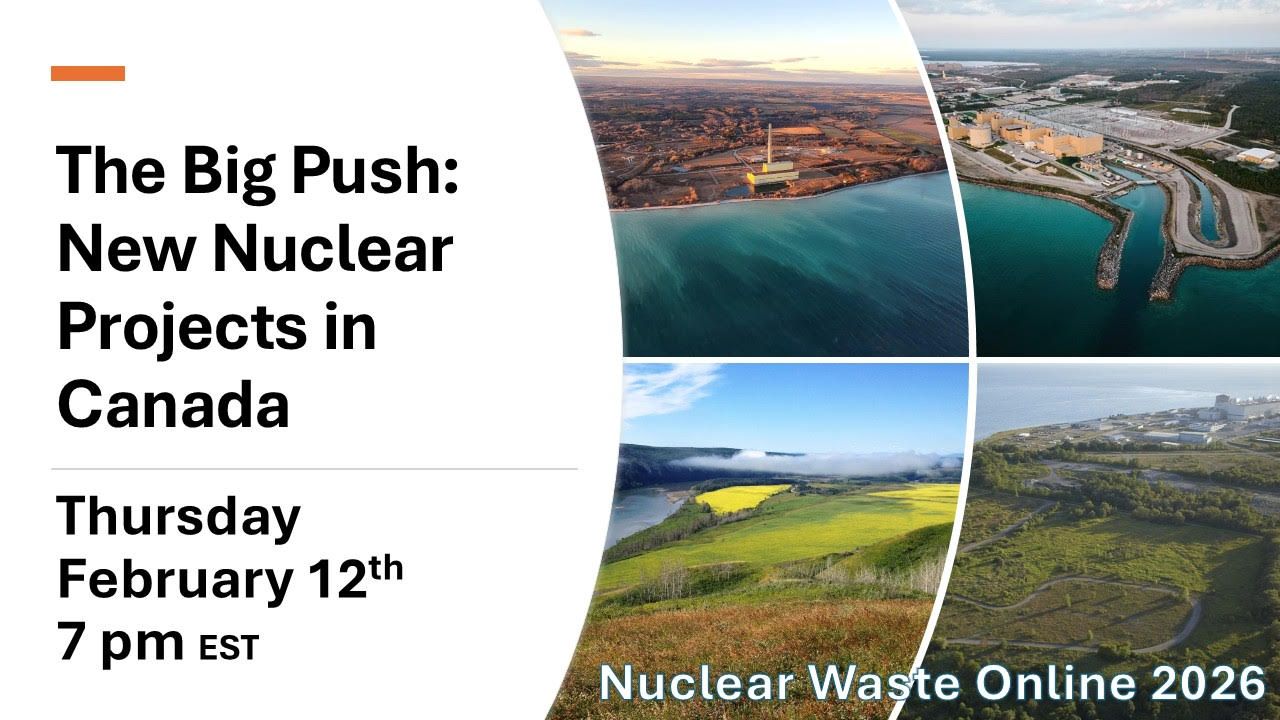
Thursday, February 12, 7 pm Eastern | 2nd of 4 sessions in the 2026 Nuclear Waste Online webinar series
Join a webinar on the push for new nuclear generation in Canada. Go to Northwatch.org to register or use the registration link https://us02web.zoom.us/webinar/register/WN_ZfWOf1GITqSRIZX8CB-A9w
-
Archives
- February 2026 (127)
- January 2026 (308)
- December 2025 (358)
- November 2025 (359)
- October 2025 (376)
- September 2025 (258)
- August 2025 (319)
- July 2025 (230)
- June 2025 (348)
- May 2025 (261)
- April 2025 (305)
- March 2025 (319)
-
Categories
- 1
- 1 NUCLEAR ISSUES
- business and costs
- climate change
- culture and arts
- ENERGY
- environment
- health
- history
- indigenous issues
- Legal
- marketing of nuclear
- media
- opposition to nuclear
- PERSONAL STORIES
- politics
- politics international
- Religion and ethics
- safety
- secrets,lies and civil liberties
- spinbuster
- technology
- Uranium
- wastes
- weapons and war
- Women
- 2 WORLD
- ACTION
- AFRICA
- Atrocities
- AUSTRALIA
- Christina's notes
- Christina's themes
- culture and arts
- Events
- Fuk 2022
- Fuk 2023
- Fukushima 2017
- Fukushima 2018
- fukushima 2019
- Fukushima 2020
- Fukushima 2021
- general
- global warming
- Humour (God we need it)
- Nuclear
- RARE EARTHS
- Reference
- resources – print
- Resources -audiovicual
- Weekly Newsletter
- World
- World Nuclear
- YouTube
-
RSS
Entries RSS
Comments RSS
 nuclear-news
Leave a comment